FW
Levi Strauss half yearly revenue up six per cent
Levi Strauss revenue grew six per cent in the first half of the year. Net revenue rose five per cent. Sales at its China unit rose three per cent. Selling, general and administrative expenses rose about seven per cent mainly due to higher advertising and marketing costs. Net income attributable to the company fell, hit primarily by costs related to its initial public offering earlier this year.
An ongoing weakness in the retail sector weighed on its US wholesale business, which reported a two per cent drop in sales. Globally, the business accounts for a third of Levi’s revenue. The company expects its wholesale business in the US to be challenged in the second half of the year with bankruptcies and door closures and tightening of customers open-to-buy budgets. To counter the weakness in its wholesale unit, the company has been investing in its online business and retail outlets, while expanding its presence in markets such as China, India and Brazil. The efforts helped raise sales across segments in the second quarter, with its women’s business growing 16 per cent and tops segment rising 14 per cent.
The company has forecast full-year net revenue growth at the high end of the mid-single-digit range.
Iran aims to boost apparel at trade with border countries
Iran wants to boost garment output and exports. Domestic units supply 70 to 80 per cent of the requirement for clothing inside the country. After the ban imposed on imports of clothing, domestic units are making all endeavors to boost the quality and quantity of their products. Garments exports are planned especially to Afghanistan, Iraq, Russia and Yemen.
Iran shares a border with the United Arab Emirates, Iraq, Turkey, Afghanistan, Pakistan, Russia, Oman, Azerbaijan, Turkmenistan, Kuwait, Qatar, Kazakhstan, Armenia, Bahrain, and Saudi Arabia. The value of Iran’s trade with neighboring countries in the past Iranian calendar year was about 41 per cent of the country’s total non-oil trade in the mentioned time span. Increasing non-oil exports to neighboring countries is another plan. Some of the areas worked on include home appliances, petrochemicals, and marine industries, basic metals such as steel, aluminum and copper as well as agriculture.
Fifteen mega export projects will be launched to identify target markets. A comprehensive system will be launched for registration of domestically-made products in the near future. This transparent mechanism will lay the ground for introducing different industries and industrial capabilities aiming to strengthen domestic production. Iran has named this year as the year of pickup in production.
DTG printing systems gain traction
With the rise of textile printing, direct-to-garment (DTG) printing systems are gaining traction in the market. One of the stand-out names not only in DTG but in the global printing market is Ricoh. Ricoh regularly invests in innovative solutions for print service providers. The Ri 1000 is the latest DTG printer from Ricoh. It prints full-color graphics on garments of a diverse array of sizes, colors and materials. Quick-change magnetic platens, available in multiple styles and sizes, provide a variety of print options. All Ricoh Ri 1000 platens are pre-prepared to provide users with hassle free loading and garment protection. Additional benefits include durable steel construction. The printer’s special carriage and table design helps keep garments flat and in place, even while printing at speeds of up to 28 seconds.
Another leading brand in DTG technology is Epson. The SC-F2100 from Epson is capable of producing high-quality full color prints on a range of items. It offers new features such as improved speed and reliability and the ability to create customised print designs. The SC-F2100 is aimed at anyone who wants to add DTG printing to their services, namely production T-shirt printers, online T-shirt retailers, high and low-volume print companies, as well as corporates who want to produce their own branded work wear or promotional items.
India frets over garment imports from Bangladesh
Garments from Bangladesh are flooding India. Bangladesh sources fabrics duty-free from China and exports garments to India. This huge jump in garment imports from Bangladesh under the free trade agreement has put India’s domestic industry in a fix. This comes amid slowing domestic demand and banks curtailing credit to 80 per cent of micro, small and medium enterprises in the sector. Import of garments from Bangladesh was up 82 per cent in the last fiscal. It has been growing steadily at a compounded annual growth rate of 52 per cent. This is feared to render about ten lakh people jobless with most small garment units shutting shop. India’s garment exports fell four per cent in the last fiscal. However, they have revived partially in the last two months with the export incentive schemes.
The Indian textile industry feels Bangladesh has to be compelled to source a part of its fabrics requirement from India as putting a cap on exports from Bangladesh looks difficult. Bangladesh, which is the world’s second-largest garment exporter, has seen the value of its overseas sales rise. It aims at doubling its exports by 2024. Its economy is expected to expand by a record eight per cent for the next two years.
Bangladesh exports to the US up 14 per cent
This fiscal year, Bangladesh’s exports to the US rose by 14.92 per cent. Earnings from apparel exports to the US grew 14.60 per cent over the previous year’s earnings.
Exports to Germany were up 4.79 per cent. Germany imports 15.23 per cent of Bangladesh’s total exports. Export earnings from the UK rose by 4.51 per cent, which is 10.29 per cent of the total exports of Bangladesh. The lion’s share of Bangladesh’s exports is limited to 10 countries viz: US, Germany, the United Kingdom, Spain, France, Italy, Canada, Japan, the Netherlands and Poland. The 10 countries import over 71 per cent of Bangladesh’s total exports.
Bangladesh is trying to reduce dependency on a few markets and diversify export destinations. The efforts are succeeding. Once, 65 per cent of Bangladesh’s total exports were limited to the US. That is now 17 per cent. Bilateral trade agreements are seen as a way to avail of duty-free market access to new countries such as the Russian federation and South Africa. Bangladesh provides a four per cent cash incentive against exports of apparel goods to non-traditional export markets. This is in addition to the one per cent incentive for all traditional export destinations.
Surat upset over petrol cess
The road and infrastructure cess on petrol and diesel has not gone down well with those associated with Surat’s Rs 80,000 crore textile industry. Textile traders say transport costs at every stage, right from bringing the raw material, sending the grey fabric to process houses and sending the finished goods to the market, would become more expensive as petrol and diesel prices have already gone up.
The textile industry in Surat is also disappointed the reverse charge mechanism (RCM) is still in force. The industry blames RCM for the prolonged money circulation cycle and the shortage of finance. In the textile value chain businessmen are required to do cash transactions at various stages, but subject to a limit of Rs 10,000 a day. They have demanded an increase in the limit up to at least Rs 25,000 a day. The textile industry was also pitching for scrapping GST for those units whose turnover is below Rs 5 crores. At present, the limit is Rs 50 lakhs.
Surat is the hub of manmade fabric in the country. There are seven lakh power looms in Surat. The annual turnover of the textile industry in Surat is pegged at around Rs 80,000 crores.
Reliance partners Turkey’s Kivanc Tekstil to manufacture RElan and Recron Green
Reliance has partnered Turkis company Kivanc Tekstil to manufacture Reliance’s fabric brand R Elan. Kıvanc will also be the exclusive distributor of Recron Green Gold fibers to spinners, yarn manufacturers and knitters across Turkey. The arrangement will enable Reliance and Kıvanc to offer the best quality eco-friendly textile solutions to brands and retailers which source their requirements from Turkey to meet the ever-growing demand of environment-friendly apparels.
Kıvanc Tekstil caters to major European and American fashion brands and retailers. Vertically integrated across spinning, weaving, dyeing, printing and finishing, Kıvanc produces 18 million meters of blended fabrics a year. Products comprise a wide range of blends straddling polyester, cotton, viscose, linen, tencel, modal and wool.
Reliance, the owner of R Elan, is one of the largest recyclers of PET bottles in India, recycling 2.2 billion PET bottles a year. R Elan Green Gold, made from recycled PET, substantially reduces the emission of greenhouse gases. The fabric is made from pre-dyed fibers. Its manufacture doesn’t need much water. Whatever little water is used, 90 per cent of it is recycled. It uses bio-fuels and is one of the few recycled brands that provides end-to-end traceability throughout the supply chain, right from PET bottles to fibers.
Primark founder Arthur Ryan is dead
Ryan is described as a true real retail pioneer, who innovated and was never complacent, despite many successes. After 40 years leading the retail chain, Ryan stepped down from his role as CEO in 2009 but remained deeply involved in the company in his new position as chairman.
Primark is a low-cost global apparel retail giant. Founded in 1969, Primark has since developed into a retail empire consisting of more than 350 stores employing over 75,000 people in 12 countries, spread over both Europe and North America. Primark is owned by Associated British Foods. Primark is driving sales growth by expanding new stores at a breakneck pace. AB Foods expects better purchasing and fewer discounts to help offset a recent recovery in the dollar in the second half. The company has forecast a higher operating margin this year and has been reducing markdowns and benefiting from a weaker dollar that makes it cheaper to source garments from Asia. A stronger July is expected due to the improving weather. Last year had the feel-good factor, with the hot weather, the royal wedding and soccer World Cup, which boosted sales for Primark. A huge new Primark outlet in England is designed to be a concept store for the future.
New Delhi textile show next week
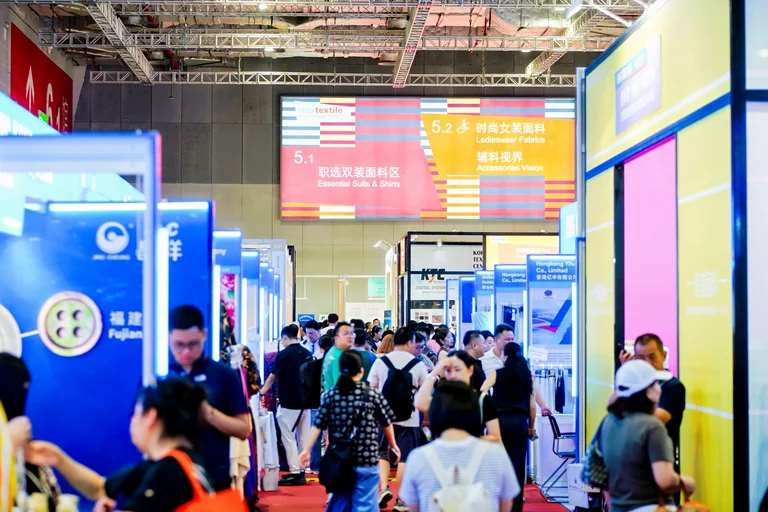
Textile Fairs India will be held in New Delhi from July 21 to 23, 2022. It will include three trade fairs, Yarnex, F&A Show, and Fashion Connect. Yarnex brings together manufacturers and suppliers of fibers, yarns and related services to showcase their merchandise to buyers from across the world. F&A is a fashion and accessories show. Fashion Connect connects clothing brands and contract manufacturers with the entire retail fraternity. Besides being a platform for sourcing, the event also disseminates information on fashion trends.
Textile Fairs India will bring together over 240 domestic and international fashion manufacturers to showcase upcoming trends and provide opportunities for them to network to expand their distribution networks. Countries including India, Austria, China, Hong Kong, and Japan will take part in the event and showcase textiles such as yarns and fibers, trims and embellishments, and readymade garments. The trade fair will feature products intended for both spring/summer 2020 and autumn/winter 2020-21. A special focus will be on sustainable fashion. Industry professionals will discuss how to make production more environmentally friendly and a dedicated sustainable fashion showcase will shine the spotlight on recycled and upcycled clothing. A number of design and product awards will also feature during the event.
Lenzing enters digital traceability
Lenzing is embracing blockchain technology to ensure transparency and traceability from wood to finished garment. The hope is to ensure end-to-end traceability for apparel brands and buyers. The improved supply chain transparency is expected to help Lenzing customers and suppliers identify Tencel fibers and the source of the wood in every part of the production and distribution process. A QR code on each garment’s tag will allow consumers to look up the origin before they buy the clothing. The key advantage of this technology is it takes a decentral approach to authentication based on blockchain based digital-tokens, unlike the centralized approach based on a file or pdf-based authentication system. Consumers in many industries are interested in the suppliers and ingredients of the products they buy. Up to 30 per cent of branded organic or sustainable fibers are thought to be fake.
Lenzing, based in Austria, is the world market leader in fibers made from renewable wood. With Lenzing Ecovero-branded fibers Lenzing was the frontrunner in physical traceability and is now entering the age of digital traceability. Lenzing plans to conduct several pilot tests over the next few months with partners across its entire value chain. The platform is expected to be fully operational in the first quarter of 2020.