FW
Leigh Fibers, Tidal Vision team up to reduce toxicity in traditional textile treatments
Leigh Fibers and Tidal Vision have partnered to reduce toxicity in traditional textile treatments. According to this partnership, Tidal Vision will apply its Tidal-Tex water-based textile treatments, which incorporate chitosan, to products from Leigh Fibers, which is known for its textile-waste conversion.
To create Tidal-Tex, Tidal Vision processes its chitosan through crab and shrimp shells, sourced as by-products from seafood-industry waste. A nontoxic, biodegradable polymer, chitosan is a product that can be added to a textile manufacturer’s existing system.
Tidal-Tex is used by manufacturers of fiber at the top of the supply chain, such as Leigh Fibers Those fibers are turned into textiles by textile manufacturers further down the supply chain, and the treated products end up in all sorts of products from furniture, mattresses, carpet and more.“
The South Carolina location of the facility where the Bellingham, Wash.–headquartered Tidal Vision will produce its Tidal-Tex within Leigh Fibers’ 1 million-square-foot headquarters is centrally located in a hub of the United States textile industry. Tidal-Tex is applied via a simple act of dipping, spraying or coating. As a versatile product, Tidal-Tex can be applied to fibers, yarn, and woven and nonwoven fabrics. Through this partnership, the use of the facility will allow Tidal-Tex to be available at a lower cost than more-traditional treatments.
Fashion Shenzhen hosts over 1,000 brands and companies
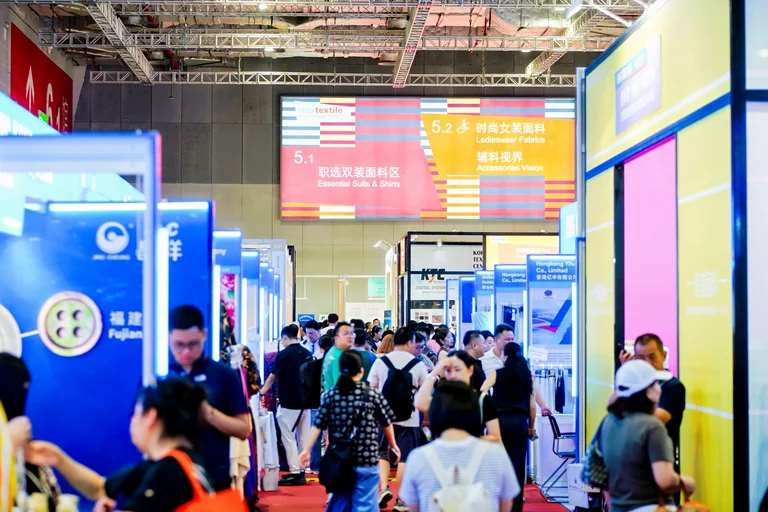
Held from July 07-09, 2021, Chinese international fashion brand fair, Fashion Shenzhen hosted over 1,000 Chinese fashion brands and companies. The fair included over 20 forum activities held in nine halls spanning 110,000 sq m.
The Fashion Shenzhen show featured three theme-based pavilions; Premium Label, Industry Value Chain, and Apparel Fabrics and Accessories. It had nine areas focusing on specific topics like vogue force, modern manufacture, design attitude, fashion accessories, fashion solution, modern home, premium apparel fabrics and accessories, and fashionable apparel fabrics and accessories to make more efficient business matchmaking between fashion enterprises and professional buyers.
In 2020, the Fashion Shenzhen show was upgraded to two shows per year spanning 80,000 square meter of exhibition space. The event hosted 827 exhibitors and 116,752 visitors despite COVID-19 restrictions across the world. The show attracted professional buyers from all over the world, making it one of the most popular fashion trade shows in Asia after COVID-19 outbreak.
Kering Eyewear to acquire 100% shares of Lindberg
Kering Eyewear has signed an agreement to acquire 100 per cent of the share capital of Lindberg, a high-end manufacturer of design-oriented, lightweight, and customizable optical frames with a specialization in titanium.
This acquisition is an important milestone in the successful expansion of Kering Eyewear and perfectly fits with its development strategy. Since its start in 2014, Kering Eyewear has built an innovative business model that enabled the company to reach a critical size in the market with close to €600 million wholesale external revenues pre-COVID (FY2019).
This acquisition will further reinforce Kering Eyewear as the most relevant player in the luxury eyewear market segment, adding to its portfolio a complementary and proprietary brand with strong legitimacy, undisputed know-how and best-in-class customer service in optical frames. Thanks to their business complementarities, both companies will be able to leverage on their respective strengths across the value chain, with synergies in distribution and geographical reach notably. This will contribute to accelerate the growth and enhance the profitability of Kering Eyewear.
IIFD partners with FDCI to offer students wider connections in the industry
The Indian Institute of Fashion and Design (IIFD) has partnered with the Fashion Design Council of India (FDCI) as an institutional member which will give its students wider connections in the Indian fashion industry.
Through its new partnership with the FDCI, the IIFD aims to offer both its students and the fashion industry at large, new opportunities for innovation. The institute organizes an array of fashion-based courses including fashion design, fashion styling, textile design, fashion journalism, and interior design and offers diplomas, undergraduate courses, and postgraduate courses. The IIFD’s main campus is located in Chandigarh and it also has another campus in Mohali.
The FDCI is a non-profit organisation which hold a range of fashion events throughout the year including India Couture Week and works to promote the Indian fashion industry at home and abroad. This year, the FDCI teamed up with Lakme Fashion Week to hold a joint edition which featured hybrid in-person and online events.
GHCL creditors approve Inorganic Chemicals and Textile business demerger
The creditors of India’s leading chemical & textile company GHCL have approved the demerger of its Inorganic Chemicals and Textile businesses. The company had announced restructuring in March 2020. It will now seek approval from the National Company Law Tribunal (NCLT).
The company expects this demerger to help it achieve a focused growth, concentrated approach, business synergies and increased operational and customer focus. In addition, the demerger is expected to address independent business opportunities with efficient capital allocation and attract different set of investors, strategic partners, lenders and other stakeholders. It will also help the company cater to the different needs of the diverse businesses in a better way and aid value creation for our stakeholders.
Apparel exports from Peru rise by 75.1 % during January-May’21
Peru’s apparel exports from January-May this year increased by 75.1 per cent to $421 million over the same period in 2020, reports the National Society of Industries.
In May, the country’s apparel export value increased by 70 per cent to $96 million and was the highest in the last 22 months. On the other hand garment shipments from January-May 2021 reached $240 million over $409 million shipments in 2019.
According to data from the institution, exports to the United States accounted for 69 per cent of the total shipments supported by sales worth $289 million between January and May 2021.
Apparel exports to the US by expanded 77.3 per cent between January and May 2021 over the same period in 2020 and rose by 2.1 per cent if compared to the first five months of 2019.
The main items exported to this destination country were: T-shirts and knitted shirts, which totaled about $130 million; knitted shirts for men and boys ($47 million); sweaters, pullovers, and similar items ($26 million); and other knitwear ($19 million). Other important destinations for Peruvian apparel shipments were Canada, Chile, Brazil, Germany and Ecuador.
US’ garment imports rise by 22.19 per cent during January-May 2021
From January-May 2021, US’ imports of garments increased rapidly and are expected to soon reach pre-COVID levels.
As per Textile Value Chain, the United States imported $ 29.22 billion in clothes from January to May of this year, representing a 22.19 percent year-on-year increase and an 11.75 percent drop from January to May of last year. Its imports declined by $11.93 million to $6.14 billion in May ’21.
US’ garment imports in May this year rose by 8.28 percent rise compared to April, when the country imported only $5.67 billion in clothing. In terms of volume, the United States experienced an increase in import numbers in May, with 2,280.22 million SMEs of apparel arriving in the nation, up from 2,066 million SMEs in April of this year.
US Cotton Trust Protocol adds Levi Strauss and legacy brands as new members
The US Cotton Trust Protocol has added one of world’s reputed denim companies, Levi Strauss & Co, and its legacy brands Levi’s®, Dockers®, Denizen® by Levi’s®, and Signature by Levi Strauss & Co™ as new members
Levi Strauss & Co has committed to sourcing 100 percent more sustainably grown cotton focusing on decreasing water use, cutting carbon emissions, and reducing fertilizer and pesticide use. This corporate commitment to more sustainable and resilient cotton sourcing is part of a broader internal initiative designed to move the company toward a more sustainable and circular product strategy.
The Trust Protocol will aid Levi Strauss & Co.’s efforts by providing verified data on sustainability practices from U.S. cotton growers and access to aggregate year-over-year data on critical metrics including water use, greenhouse gas emissions, energy use, soil carbon, soil loss and land use efficiency. Levi Strauss & Co will also participate in the pilot phase of the Protocol Credit Management System which provides its members with complete supply chain transparency through use of TextileGenesis’ blockchain technology.
The Trust Protocol has welcomed more than 450 brand, retailer, mill and manufacturer members since its launch in 2020. This includes Gap Inc. and its collection of purpose-led lifestyle brands Old Navy, Gap, Banana Republic and Athleta as well as global apparel manufacturer Gildan. The Trust Protocol has also welcomed UK retailers Tesco, Byford and Next Plc. Other Trust Protocol member announcements include the first 10 U.S. mills to join and the first members in Latin America.
The 21st Zhejiang Trade Fair attracts over 11,000 visitors
Held last month at the Yiwu International Expo Centre, the 21st ZheJiang trade fair for textile and garment industry attracted over 11,728 visitors and 300 exhibitors. The theme of the three-day exhibition was “trans-boundary innovation, intelligent textiles and healthy future”.
The exhibition was divided into four theme zones: knitting industry, sewing automation, digital and printing application, and knitting products and accessories, gathering many well-known exhibitors including Chemtax, Yingyun, Dahaomingde, Jiazhili, Kemei, Chu Yun, Kaiqiang, Jieke, Toka Benma, Bopai, and Dairen.
It showcased a wide range of automatic machineries, promoting industrial automation and providing valuable business opportunities. Professional visitors, delegation groups and enterprise groups from various countries were attracted to the show.
A series of concurrent events were held together with ZhejiangTex 2021 to let the professional visitors stay tuned to the latest market trends under the era changes. On June 9, 2021, National Antibacterial and Antiviral Functional Textile Supply Chain Conference was held. Initiated by textile innovations, more than 200 enterprises are connected, with their resources including raw materials, technology, knitting products OEM, and branding, forming the Yingyun Knitting Union. From June 9 to 12, China Yiwu Fashion Week was successfully held, leading an innovative fashion trend and opening a new fashion future.
Medical supplies rise by 16% in 2020: WTO Report
The 25th WTO Trade Monitoring Report on G20 Trade Measures indicates, medical supplies rose by 16 per cent in 2020 while PPE exports grew by 50 per cent. This was despite an 8 per cent decline in the value of global merchandize trade during the year, as per a report by China Textiles.
The 25th WTO Trade Monitoring Report on G20 Trade Measures spans the mid-October 2020 to mid-May 2021 period. It provides an important insight into a number of areas as countries begin addressing the challenges of a post-pandemic economic recovery. In particular, the past several months saw international cooperation and coordination among nations and intergovernmental organizations increase and intensify.
The report also notes that the multilateral trading system has kept trade flowing, with the WTO playing a central role in ensuring that supply chains are kept open and restrictive trade policies are avoided.
The G20 economies implemented 140 trade and trade-related measures in the area of goods since the outbreak of the pandemic - 101 (72 percent) of a trade-facilitating nature and 39 (28 percent) of a trade-restrictive nature. The reduction or elimination of import tariffs and import taxes made up 60 percent of trade-facilitating measures taken, and certain G20 economies reduced their tariffs on a variety of goods such as PPE, sanitizers, disinfectants, medical equipment and medicine/drugs.