FW
India: Textile and garment units cease operations in Tamil Nadu
Some 300 textile and weaving units in Tamil Nadu, India plan to shut down for some time. The units mainly in Tirupur and Coimbatore have decided to do this due to unstable yarn prices and highpower tariffs. Prices of grey fibers and textiles have risen due to the volatility of yarn prices and high tariffs.
Apart from this Tirupur’s apparel exports have fallen 21 per cent in October 2022 from October 2021. Of this, knitwear exports, which Tirupur is known for, fell almost 40 per cent. And this was the third straight month knitwear exports contracted. Average capacity utilisation at garment exporting units in Tirupuris 30 per cent now.
The US, EU and the UK account for 85 per cent of shipments from Tirupur. With high inflation in these economies, clothing is not a priority for consumers now. Further, with buyers saddled with huge stocks, they are postponing delivery. This has resulted in stocks piling up at the producers’ end. So Tirupur has a huge inventory of finished goods as brands are asking for deferred shipments. With buyers in the EU and the US holding high inventory, and expectations of better sales during the Thanksgiving holidays and Christmas, exporters are expecting orders to revive only by January.
Shima Seiki to exhibit at ITME
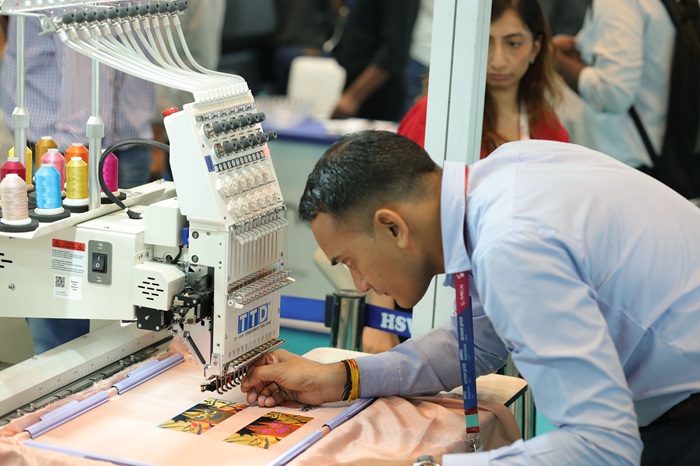
Shima Seiki will exhibit at India ITME, Noida, December8 to 13, 2022. The Japanese flat knitting solutions provider will exhibit the latest in knitting technology for both whole garment and shaping as well as the latest in DX solutions utilizing virtual sampling.
Seam-free wholegarment knitting technology offers an alternative to labor-intensive manufacturing in India and other international markets. Featured will be the Mach2 XS wholegarment knitting machine with original Slide Needle on four needle beds and a spring-loaded moveable sinker system supporting a wide range of high-quality wholegarment knitting in all needles.
The N.SVR 123SP computerized knitting machine features a special loop presser bed, capable of producing hybrid inlay fabrics with both knit and weave characteristics, and the special i-Plating option, capable of alternating yarn colours in any pattern, producing jacquard-like designs using plain jersey stitch for even greater diversity in knit design.Demonstrations will be performed on Shima’s SDS-ONE APEX4 design system.
At the core of the company’s Total Fashion System concept, SDS-ONE APEX4 provides comprehensive support throughout the production supply chain, integrating production into one smooth and efficient workflow from yarn development, product planning and design, to machine programming, production and even sales promotion.India's textile industry is seeing rapid growth in both the domestic market and demand for exports and ShimaSeiki will show the latest sustainable solutions that can keep up with this growth.
India: PLI replaces ATUFS
India will promote the development of textile machinery through a production linked incentive (PLI) than the Amended Technology Upgradation Fund Scheme.
The threshold for textile manufacturing units to be eligible for sops under the proposed scheme would be investment in plant and machinery of Rs1 crore to Rs50 crores for micro, small and medium enterprises and above Rs50 crores for non-MSMEs.
Incentives would be provided based on the turnover achieved after making the threshold investment in modernisation through installation of benchmarked technology.Incentives of up to 60 per cent based on the investment and turnover criteria could be provided across weaving, knitting and spinning, among other textile segments. Turnover achieved from job work in select segments would be accounted for while calculating incentives and only the products manufactured by the registered company would be eligible.
Incentives are likely for manufacturing of garments and home textiles such as blankets and bed spreads, and textile accessories like lace, button, and zippers. The Amended Technology Upgradation Fund Scheme (ATUFS) was intended as a flagship incentive scheme for capital investments in textiles and garments.
ATUFS was notified in January 2016 with an outlay of Rs17,822 crores to mobilise new investments of about Rs 95,000 crores. It helped create employment for about 3.5 million till 2022. The scheme expired on March 31, 2022.
Pure London to feature eminent speakers
At the UK’s leading trade fashion buying event, Pure London, February 12 to 14, 2023, retail industry legend Ed Burstell and winner of All That Glitters jewellery designer Piers Carpenter will be among the keynote speakers.
There will be an in-depth discussion on fashion expansion and growth and how this can be navigated in a sustainable and ethical manner. Burstell’s adept leadership of Liberty during his stint at the department store saw double-digit year on year growth driven by a renewed focus on young British designers as well as spearheading a host of collaborations with brands to highlight Liberty’s renowned floral prints. Piers Carpenter loved jewellery from a young age and in 2011 joined the industry as a sales assistant in an antique jeweller. As a goldsmith apprentice Piers channeled his passion and honed his craft, becoming recognized for his technical and creative abilities as a designer.
At Pure London, Piers will discuss his journey to become a jewellery star, charting his experiences and advice along the way.
In today’s challenging retail environment, Pure London wants to encourage conversations about building businesses and utilising modern technology. Since launching the Power of One initiative in 2018 the event has committed to supporting the journey of brands and retailers towards sustainability.
Lenzing hosts conclaves in India
Lenzing hosted conclaves in Surat and Mumbai. India is one of the key markets for Lenzing.
The aim was to connect supply chain partners with the new generation of fibers and products for the textile industry, engage with the local weaving community, domestic brands, and their supply chains and explore a new line of products.The conclaves offered a platform for discussion and ideas exchange.The conclave in Mumbai focused on the creation of new product lines with Tencel lyocell and modal fibers along with homegrown brands and their supply chains.
The discussions focused extensively on the current developments within the global market for fiber and how the Indian textile makers can benefit from it. The discussion during the conclave in Surat concentrated on collaborating with the local weaving community and creating innovative new products, especially with traditional clothing like saris. The conclave hosted a discussion with Gujarat’s weaving community on global fiber market updates and trends.
Lenzing is a pioneer in wood-based specialty fibers. Lenzing’s viscose fibers help maintain environmental balance by being integrated into nature’s cycle. These are efficient and environmental-friendly products. As more brands and manufacturers show interest in embracing sustainable textiles, Lenzing expects the market for these products to grow further.
Chinese Oct exports to EU down nine per cent
China’s exports to the EU dropped by nine per cent in October 2022. China’s exports of many upstream and midstream products, such as base metals, ceramics and glass, textiles, and plastics and rubber, to the EU have plunged amid the latter’s muted downstream production this winter.
One exception is the export of gas-intensive chemicals, in particular, fertilisers, which continues to surge. The EU’s demand for mineral fuels, food and beverage and some winter necessities stayed resilient, with its imports of mineral fuels from China soaring by 218 per cent in October.
Softening global demand for computer, communication and consumer electronics products has dimmed the export outlook for China’s machinery and electrical and electronic products, which account for 57 per cent of its overall exports. Growth in exports of renewable energy equipment has also slowed from earlier months. Near-term exports of digital products may be hampered by the latest Omicron outbreaks in China that have resulted in operational disruptions in some production hubs, including Foxconn’s Zhengzhou plant, since late October. In contrast, electric vehicles and batteries remain the bright spots in China’s export outlook.
The US and the EU are China’s largest export destinations, accounting for 16 per cent and 15 per cent of its overall export value.
Bangladesh retains much of garment receipts
Bangladesh has managed to retain nearly 67 per cent garment export receipts, thanks to increasing use of local raw materials.
The retention value of the exported apparel surged 36 per cent in financial year 2021-2022 from what it was a year earlier. That means Bangladesh was able to retain 66 per cent of the total garment export receipts in the financial year.
Bangladesh's apparel export earnings fell 12 per cent in the first 18 days of September 2022.This fall in export receipts has been putdown to record inflation in the sector's major destinations fuelled by the ongoing Russia-Ukraine war.In the face of reduced consumer demand, a number of retailers, including Walmart, have already cancelled some orders. Besides, some buyers are requesting exporters to delay shipments or suspend orders ready for delivery. The slowdown of apparel shipments was expected from August 2022 as most factories have been facing a fall in work orders, which is being reflected in export earnings.The fear is that it might continue till May 2023. The industry is experiencing a slowdown as retailers are stuck with too much inventory at their stores.The war-driven economic recession has badly affected clothing demand.
Some knitting factories in Bangadesh have shut down because of order shortages that have continued over two months.
FTA will boost Indian exports to UAE
The free trade agreement between India and the UAE will give duty free access to garments made in India and help increase India’s garment exports.
India is already the second largest supplier of readymade garments to the UAE after China. The UAE has traditionally been the topmost trading partner for Indian garment exports. With signing of the UAE-India CEPA (Comprehensive Economic Partnership Agreement) giving duty-free access to Indian garment exports, this share is expected to increase further.
India has a huge export potential especially in categories such as women’s wear, kids’ wear, knitwear, home furnishings and technical textiles used in the construction industry, agriculture, medicine etc.UAE clothing brands have a great opportunity to source from India considering the strengths of the Indian garment industry in terms of raw material availability and variety right from cotton, jute, silk, viscose, nylon, acrylic with abundant in house production. India’s apparel designs and styles are in line with the latest fashion trends in a wide range of traditional cotton and manmade fiber garments.
After having established itself in traditional garments, the Indian apparel industry has now moved on to diversifying itself into newer areas of manmade fiber garments. Indian companies and businesses have benefited from leveraging Dubai’s position as a supply market to the Gulf and other regions.
India: Exports of children’s wear up 16 per cent
From January 2022 to September 2022 India’s exports of children’s wear increased by 16 per cent.
The US has a 36 per cent share in India’s export values in the category, followed by UK (15 per cent), UAE (six per cent), Germany (four per cent) and France (four per cent).
Clothing worn by children up 14 years is referred to as children’s wear. These garments are often composed of high-quality materials that provide comfort and breathability, and come in a wide range of colours and textures.
The children’s apparel market in India is growing at five percent a year.The market is primarily driven by the rising number of nuclear and double-income households in India. Strong economic growth in recent years and increasing purchasing power, along with the changing spending patterns of parents with an increasing inclination toward providing their children with enhanced comfort and convenience, is boosting the sales of branded and high-quality children’s apparel.
Additionally, children in the urban and semi-urban settings of the country are now being exposed to mass media, which has accelerated their active participation in purchase decisions. Along with this, several players are focusing on effective promotional strategies and modes of advertisements to gain prominence among their target consumers.
India’s cotton yarn exports down 70 per cent
India’s cotton yarn exports fell 70 per cent during September 2022.
Cotton yarn shipments to Bangladesh dropped by 71 per cent in September 2022, while shipments to Egypt and Portugal tumbled by 57 per cent and 79 per cent. However shipments to Italy and Sri Lanka increased by ten per cent and 37 per cent in September 2022.
The projection of India’s cotton crop was lowered from around 3.55 crore candy to 3.15 crore candy and it resulted in an unprecedented rise in cotton prices, reaching Rs. 1.10 lakh per candy from its traditional price of about Rs 45,000 per candy. The price of Indian cotton remained at least 20 per cent higher than that of other varieties and therefore Indian competitiveness against Turkey, Vietnam and China went down.
In fact, India imported about 10,000 tons of cotton yarn from Vietnam. The far-eastern country was earlier one of the major markets for Indian cotton yarn. The scarcity of cotton along with a comparatively higher price in India has resulted in a shift in its trade dynamics with Vietnam.Cotton prices in India are still ruling higher than those in the international market.But fiscal year 2022 had proved to be a great one for Indian cotton yarn exporters as they managed to tap 92 per cent growth on a yearly basis.