FW
Google to enter ecom space in India
Google is looking to enter e-commerce in India. This could put pressure on existing players in terms of higher customer acquisition costs and providing a great shopping experience backed by the latest of technologies. Existing players who may not be paying huge attention to aspects like recommendation engines and the search experience will be forced to optimise on these aspects.
Though Google has an edge in terms of technology platforms, the existing e-commerce giants will shine with their strong supply chain and customer support. For consumers, the party will continue with lots of deals, discounts and cashbacks. The market will further ripen up for acquisitions. The big three, Google, Amazon and Walmart-backed Flipkart, flush with big money and investor optimism, will aim to buy out smaller players to beef up their e-commerce war chest in India.
Start-ups that operate in specialised niche domains such as medicines, cosmetics, food, furniture, fashion will continue to grow, acquire scale and ultimately get picked up by the big three. However the e-commerce scenario will mould in such a fashion that there wouldn’t be much space for horizontal e-commerce players that operate in multiple products and service categories. Instead strong vertical players will emerge in niche categories.
India: Pune-based Baani displays quilting solutions at GTE, Bengaluru
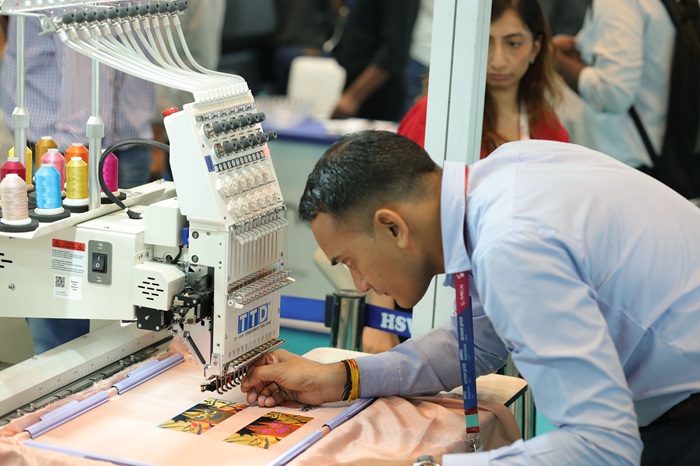
Pune-based Baani displayed various quilting solutions at the recent Garment Technology Expo (GTE) in Bengaluru. The company specialises in quilted jackets, stoles, clothing pieces, bags, pouches and other quilted products, besides custom designing the products as per the client’s needs. Baani is also the Indian distributor for the US-based thread brand Superior Threads which specialises in threads for sewing, embroidery and quilting. Baani received serious inquiries for the displayed threads during GTE.
MonoPoly (100 wt.) is the monofilament thread that is made for ‘invisible stitching’. King Tut (40 wt. 3 ply), the cotton thread, comes in a multitude of variegated colours and is extensively used with all types of machines. The polyester thread MicroQuilter is ideal for micro stippling, detailed quilting, and stitch in the ditch quilting. To make it easier for use with all kinds of machines, both home and long arm, the threads are available both in cone and spool variety.
Nigeria’s TGTSSAN appeals for reduction in exchange rates
The Textile, Garments & Tailoring Senior Staff Association of Nigeria (TGTSSAN) has appealed for a reduction in exchange rate to the federal government, particularly for the textile sector as it has been performing dismally for the last few years. The association attributed this to the difficulty in sourcing foreign exchange at affordable rates to enable investors import machines and other equipment for operation.
The association recommended a ban on foreign import of textile products and urged the government to encourage made-in-Nigeria products. It also stressed on the need to formulate policies that would guarantee continuous survival of the textile industry in the country and ensure effective implementation of policies through the declaration of a “National Dressing Day” in local fabrics.
The association also supported the government’s decision to give local textile firms a 90 per cent rebate on cost of generated power. This was necessary because between 30 per cent and 35 per cent of textile and garment manufacturing costs were energy-related. It also recommended a zero percent CBN interest loan to textile plants to build embedded power plants or pipelines to get gas to their factories.
Strong dollar raises hopes for Indonesia’s textile exports
Indonesia hopes to increase textile exports with the strengthening of the dollar against the rupiah. The textile sector is the third biggest foreign exchange earner for Indonesia. Palm oil industry is first followed by tourism. Textile and textile products industry is a strategic manufacturing sector in the Indonesian economy. The country’s foreign exchange earnings from textile exports are more than $3 dollars annually. Indonesia’s textile production was up eight per cent from January to March 2018.
The increase was triggered by domestic demand and tightening of wholesale and other imports. Indonesia hopes to triple textile and textile product exports in the next five years. If this happens, this sector will be Indonesia’s largest non-oil export contributor and create jobs for six million people.
The industry now wants an integrated cluster and close to the source of raw materials; a tightening of textile imports; affordable factory rental rates; upstream and downstream industries integrated in one region. In 2016, apparel exports decreased 3.2 per cent due to several challenges including high logistics costs and gas and power tariffs being higher than other competitor countries.
India: Imphal’s three apparel making centres being spruced up
The chief minister of Manipur recently inspected the three manufacturing units of Imphal: Apparel and Garment Making Centre, Lamboikhongnangkhong in the west district. The building and machinery of unit-1 of the government-owned centre is currently utilised by Big Concepts Foundation and Unit-3 by a local company called Ningthibee Collections for high quality apparel production.
The three units can produce large number of apparels and garments. After accessing the production unit, the state will sign an MoU with a Mauritian company to supply about one lakh pieces of various apparels per month. The state is planning to sign a MoU with the two local private companies within a week to work together in this regard in public-private partnership model. Around 10 trainers from Delhi will train around 1,000 state youths to start large scale production of apparels, and the centre has machineries for around 350 workers.
Russia’s import of footwear and apparels on the rise
As per Federal Custom Service of Russia figures, in the first half of 2018, Russia imported 28.9 million pair of leather footwear, an increase of 20.9 per cent compared to the same period of 2017. Imports in value terms increased 24.2 per cent to $778.7 million. June, leather footwear import stood at 4.6 million pairs, 91.7 per cent growth compared to May. For six month in 2018, Russia’s apparel import touched $3.2 billion over 11.8 per cent compared to the first half of 2017).
From January to June, 2018 cotton fabric import volume has decreased 5.8 per cent to 116 million sq. mt. while its import value has grown 13.7 per cent to $78.6 million. Russia’s cotton fabric export amounted to more than 42 million sq. mt. and increased by 1.4 per cent compared to the first half of 2017. Export revenues have increased 3.8 per cent and reached $24.3 million.
Pure London to launch campaign for the fashion community
Pure London 2019’s Festival of Fashion will launch a new campaign ‘Redefining Disruption’ for the fashion community. The three-day seasonal show will help attendees navigate global issues in the industry. The event for women’s wear, menswear, accessories, and young fashion will be held from February 10-12, 2019.
Pure London will focus on key points of the campaign namely: ‘Be Bold, Be Brave, Take a Stand, Embrace the change, Challenge the Status Quo, and Join the Power of One’. Bold creative campaign imagery featuring graffiti spray paint effects are inspired by the overarching idea of disruption, according to a press release.
Pure London will continue to evolve and build on the progress made towards creating a more sustainable future for fashion, driving the industry to continue to make their pledges and join the Power of One campaign. Visitors will continue to see over 700 women’s and menswear brands offering ready to wear and premium collections, footwear and accessories as well as the recently re-branded Gen Z section.
Mimaki enables printing on plastic
Mimaki has integrated workflow solutions for creative UV-LED printing on plastic. These include the compact, state-of-the art UV-LED direct printing system UJF-7151plus, the UJF-3042 MkII for high-performance small-format UV-LED printing, the compact flat bed cutting machine CFL-605RT, the ideal multifunctional solution for the production of samples and short runs and the systems solution RasterLink 6.
The UJF-7151 plus uses a robotic arm. The printer is loaded and unloaded automatically via an interface solution. This reduces machine make-ready times and further increases the efficiency levels of Mimaki’s systems.
Mimaki aims at helping customers connect their printing systems to achieve unmanned on-demand production and mass personalisation by integrating robots, conveyor belts, testing technologies, sensors and other peripherals with production lines. Customers can simplify and streamline their processes, since printers, which were typically deployed on a standalone basis, are now connected to their peripherals.
Mimaki is a leading manufacturer of wide-format inkjet printers and cutting machines for the sign/graphics, industrial and textile/apparel markets. It develops the complete product range for each group, hardware, software and the associated consumable items, such as inks and cutting blades. The company excels in offering innovative, high quality and high reliability products, based upon its aqueous, latex, solvent and UV-curable inkjet technology.
Levi Strauss streamlines operations to boost growth
Levi Strauss & Co. has undertaken a series of leadership moves designed to streamline decision-making and consolidate accountability for core business growth drivers. The company has established a new strategy and analytics organization, elevating the importance of data and analytics and pairing it with strategy to shape the future. This reflects the company’s belief that it has an untapped competitive advantage in unleashing the power of data and analytics. The company is currently recruiting for an executive to lead this organization.
Expansion of its retail network along with the emergence of digital has increasingly given the company a direct relationship with consumers — one that did not exist when the company was exclusively a wholesaler. A consolidated product, innovation and supply chain organization has been created. This new organization combines the key product functions of design, merchandising, product development and planning into a single team and integrates supply chain into the consumer journey.
Over the past six years, the company has returned to profitable growth through a strategic focus on building brand energy, driving product innovation and establishing market solutions around the world. Its brands are more relevant and are more connected to popular culture than they have been in decades.
The Woolmark Company TexSelect Award ’18 to be held on Sept 20
The Woolmark Company TexSelect Award will be presented on September 20, 2018 at Première Vision Designs, Paris. The awards will be judged by Natasha Lenart, Fabric and Knitwear Development Manager at Victoria Beckham, and Eda Karadogan, International Luxury Fabrics Manufacturer, Ipeki. Established in 2011, The Woolmark Company TexSelect Award recognises design excellence in fabrics created with 60 per cent or more Merino wool, whether presented as printed, woven, knitted and/or mixed media fabric.
The award will be presented at the TexSelect village. The winner will receive £1,000, in addition to ongoing support from The Woolmark Company and opportunities to learn about developments, innovations and the supply chain for wool. In addition, The Woolmark Company will sponsor a dedicated presence for the winner at Intertextile Shanghai on September 27-29, 2018.