


FW
VF Corp joins Fashion Industry Charter
VF Corporation has become a signatory to the Fashion Industry Charter for Climate Action. In signing the charter, VF Corp furthers its commitment to global climate advocacy and engagement and joins more than 40 fashion and apparel industry companies in the shared pursuit of net-zero emissions by 2050, among other specific targets.
The Fashion Industry Charter was launched in Poland in December 2018. Signatories work as individual organizations and collectively through six working groups to advance commitments that include reducing their aggregate greenhouse gas emissions by 30 per cent by 2030; analyzing and setting a decarbonization pathway for the fashion industry; supporting the movement toward circular business models and acknowledging the positive impact this will have toward reducing GHG emissions within the fashion sector; and establishing a dialogue with governments in key countries to enable renewable energy, energy efficiency and the necessary infrastructure for a systemic change beyond the fashion industry.
Climate action is a central pillar of VF Corp’s sustainability strategy. In 2015, the company announced its goal to use 100 per cent renewable energy in all owned and operated facilities worldwide by 2025. VF Corp is working to establish science-based climate targets with the goal to announce them later this year.
Luxury needs to be redefined
Sustainability has become an element of brand value. But luxury brands in particular seem to be so focused on logistics and supplier transparency that they’ve overlooked vulnerabilities in customer experience and perception, and thus loyalty. Leading brands of the future will be those which successfully redefine luxury in the context of sustainability.
Packaging is just one example of how retailers and brands send mixed signals. Last year British fashion label Burberry dealt with the problem of unsold seasonal inventory by burning it. The aim was to prevent its products from ending up discounted on the secondary market. The luxury market has some catching up to do. It can’t be done well by the usual trial and error method, introducing new products and packaging and waiting a year to measure the results. Technologies exist to test new ideas, to avoid committing capital on hunches. For now, retailers at all levels should be paying more attention to the point of customer contact, whether it is online, unboxing, or in a store.
All retailers and brands will do well to put time, money, and vigor into creating a more practical and authentic approach to sustainability, one that customers can see and touch, and which they can feel good about when making purchase decisions.
Imogo offers new jet dyer
Imogo’s Dye-Max system promises to eliminate the consumption of fresh process water, waste water, energy and chemicals by as much as 90 per cent compared to conventional jet dyeing systems.
The Dye-Max has a working speed of up to 50m/min with the practical speed determined by the fabric weight and application volume. Its application unit consists of a closed chamber containing a series of spray cassettes with precision nozzles for accurate and consistent coverage in combination with the patented Imogo pro speed valve that controls the volume to be applied. The chamber is equipped with an exhaust system and droplet separator to ensure that the environment around the unit is free from particles. The spray cassettes are a key part in the Dye-Max line. There is one set of spray cassettes for each of the three separate dye dispersion feed lines and they can be easily exchanged without the need for tools in less than a minute. This allows for extremely fast changeovers between different colors without the need for cleaning. And because the spray cassettes are removable, all maintenance can be performed off line. After applying the dye dispersion the fabric is rolled onto a shaft and moved to the autoclave for deep dye fixation via heat and pressure.
HanesBrands Q1 net sales up eight per cent
HanesBrands’ net sales for Q1 has gone up eight per cent. GAAP operating profit increased one per cent. Adjusted operating profit increased two per cent. Adjusted EPS increased four per cent. Total company consumer-direct sales, defined as brand retail stores and all online business, increased 16 per cent in the first quarter. E-commerce sales increased for each of the innerwear, activewear and international segments.
The company’s debt leverage at the end of the quarter was 3.5 times adjusted ebitda, down from 3.9 times a year ago. The company continues to expect the leverage ratio to decline to 2.9 times by the end of the year, which is within the company’s target range. US innerwear segment sales decreased three per cent in the first quarter. Operating profit increased three per cent with the operating margin improving 130 basis points to 22 per cent. Sales of innerwear basics increased nearly two per cent. Sales increased for underwear, socks, and shape wear, while the company’s bra turnaround initiatives are continuing. Sales of innerwear in the online channel increased six per cent.
US activewear segment first quarter sales increased 17 per cent and operating profit increased 14 per cent. Operating margin declined 30 basis points.
Bangladesh exports to EU up 10 per cent
Last fiscal year, Bangladesh apparel exports to the European Union rose by 10.58 per cent. Now the EU wants Bangladesh to move towards an environment-friendly production process to reduce the negative impact on nature. The downside of rapidly changing fashion trends is massive waste and a negative impact in terms of carbon footprint. Sustainability in terms of environment and labor standards can ensure market access to the EU.
Bangladesh has seven out of the ten green factories in the world but needs to continue development and innovation to remain in position as a global leader. Technology can further advance the country’s apparel industry.
Sustainability is crucial for Bangladesh and an important component of getting trade facilities from the EU. Apparel makers are creating products which are biodegradable and not hazardous to the environment. Research and innovation can accelerate productivity without compromising on the environment and use of global natural resources. To remain a top choice as an apparel sourcing destination, Bangladesh is looking for even more environment-friendly production options. After Bangladesh’s graduation from LDCs status to developing country, continuous market access to the EU is essential if the current exports are to be sustained. EU markets are very important for Bangladesh as 64.12 per cent of its total apparel exports goes to these markets.
Century Textiles Q4 net sales rise
For the fourth quarter Century Textiles had net sales of Rs 1008.54 crores during the period ended March 31, 2019, as compared to Rs 957.22 crores during the period ended December 31, 2018.
Net profit was Rs 227.62 crores as against Rs 134.27 crores for the period ended December 31, 2018. EPS was Rs 20.38 as compared to Rs 12.02 for the period ended December 31, 2018.
Net sales were Rs 1008.54 crores during the period ended March 31, 2019, as compared to Rs 993.32 crores during the period ended March 31, 2018. Net profit was Rs 227.62 crores as against Rs 108.69 crores for the period ended March 31, 2018. EPS was Rs 20.38 for the period ended March 31, 2019 as compared to Rs 9.74 for the period ended March 31, 2018.
Net sales were Rs 4040.20 crores during the 12-month period ended March 31, 2019, as compared to Rs 3992.62 crores during the 12-month period ended March 31, 2018. Net profit was Rs 668.67 crores as against Rs 371.66 crores for the 12-month period ended March 31, 2018. EPS was Rs 59.87 for the 12-month period ended March 31, 2019, as compared to Rs 33.28 for the 12-month period ended March 31, 2018.
Garment buyers driven by low prices take a toll on labour: Study
Per unit price is the main criterion for 78 per cent of fashion brand buyers. Only 42 per cent brands consider working conditions at contractors’ factories into consideration in selecting manufacturers. This attitude is driven by consumer demands for cheap clothing that is currently in style and delivered quickly. Seeking the lowest possible prices, demanding ever-shorter production times, frequently changing orders and delaying payments on completed work are among fashion brands’ actions that undermine efforts to create safe working conditions and protect the rights of workers, says a study by Human Rights Watch.
The drive for ever-lower production costs and ever-increasing speed inevitably results in negative consequences that fall in the laps of employees. Brand approaches to sourcing and purchasing are not merely a threat to a factory’s financial bottom line. They incentivize suppliers to engage in abusive labor practices and in risky contracting with unauthorized suppliers as a way of cutting costs.
Manufacturers scramble to meet deadlines, often at the cost of employees’ rights and working conditions. Detailed, written manufacturing contracts are not an industry norm. Where they do exist, they are often one-sided; many brands assume no written responsibility for delays or other mistakes made by them. In some cases, unscrupulous brands unfairly charge discounts and penalties to suppliers as a way of cutting their own costs.
Chinese sportswear brands take on global brands Adidas, Nike
Chinese sportswear brands like Xtep and Anta have the chance to beat western giants such as Adidas and Nike. Anta has bought Finland-based conglomerate Amer Sports, which owns Wilson tennis racquets and other sports brands such as Arc’teryx. Anta plans to grow these brands in the Chinese market. Xtep has partnered with conglomerate Wolverine Worldwide to sell outdoor footwear brand Merrell and the running shoe brand Saucony in mainland China. The company will open 400 to 500 stores for each brand within the next five years.
By working with Amer Sports and Wolverine Worldwide, both Xtep and Anta are purchasing or partnering with premium international brands instead of building their own from scratch and targeting brands in niche categories where incumbents Nike and Adidas are not as strong.
This strategy makes sense. Competing with Nike and Adidas head-on in the general sportswear market is bound to be difficult. They have massive marketing budgets and years of global branding experience, so they dominate the premium end of the casual sportswear market.
China’s sportswear market grew by 12 per cent in 2017, making it the second largest sportswear market after the US. Chinese consumers are becoming more sophisticated and the market is fragmenting into different groups of customers.
Adidas Q1 profit up 17 per cent
Adidas net profit increased 17 per cent in the first quarter. First quarter sales rose by a currency-adjusted four per cent. Operating margin rose 1.4 percentage points to 14.9 per cent. Profitability was helped by lower sourcing and marketing costs, favorable currency developments as well as selling more higher priced products and the expansion of online, with e-commerce sales up 40 per cent in the quarter. While sales in Europe fell three per cent in the quarter, they grew 16 per cent in China.
However, Adidas expects supply chain issues to curb sales growth in the first half of the year, particularly in North America, where it has doubled its business in the last three years. It expects sales growth of just three per cent or four per cent in the first half of the year, speeding up in the second half as it ramps up supplies by reallocating factory capacity and prioritizing the US market.
Adidas has benefited from the continued success of athleisure, which has remained a major force shaping clothing today. It’s technically a sports brand and not a fashion brand. But that hardly matters when sports and style have become inseparable and street wear is blending with high fashion.
India: Labor issues cloud India’s knitwear hub Tirupur’s development
"Once touted as the ‘knitwear capital of India, Tirupur, is currently mired by labor issues. Underemployment and rising costs of living, coupled with the continuing impact of policy measures such as the Goods and Services Tax, especially on small-scale manufacturers, is stagnating growth in the city with the shortage of workers leaving medium and larger garment manufacturers dependent on migrant labourers."
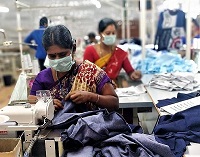 Once touted as the ‘knitwear capital of India, Tirupur, is currently mired by labor issues. Underemployment and rising costs of living, coupled with the continuing impact of policy measures such as the Goods and Services Tax, especially on small-scale manufacturers, is stagnating growth in the city with the shortage of workers leaving medium and larger garment manufacturers dependent on migrant labourers.
Contrary views impact development
Stakeholders rue the fact that there isn’t enough work in the once vibrant textile industry of the city. With declining demand, Kavya Garments owner Dhandapani recently sacked nearly half his tailors. However, a few tailors knock on his doors almost every day looking for work, a sight that is common at job work units across the city.
However, garment units in the city hold a contrary view. As TR Vijaya Kumar, Managing Director, CBC, notes, there is an acute shortage of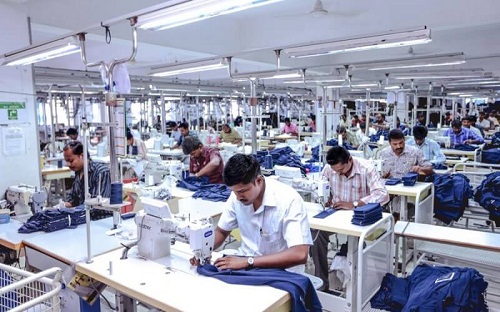 workers in the city for jobs like stitching, cutting, checking quality and ironing. This leaves medium and larger garment manufacturers dependent on people migrating from other states in search of better opportunities. Tirupur can currently accommodate two lakh labourers who can be trained however lack of awareness prevents this form happening.
Kumar claims that every export house in Tirupur is facing around 30 per cent shortfall in labor. This shortage is among the reasons that several garment companies in the region have shifted their units from Tirupur to other cities, states and even countries, according to him.
Refuting this allegation, members of Tirupur’s blue-collar workforce, especially those in job work units, argue that fluctuating raw material prices and increasing competition from migrant laborers, finding stable work has become difficult for them. The local workforce also blames migrant workers, who charge less than the locals, for the loss for their jobs. who agree to work for less money.
Other issues impacting hiring
As a labour contractor states, the current labor shortage is also a result of companies not willing to increase salaries commensurate with worker’s demands after the implementation of GST in 2017. Before GST, the companies would pay them a salary of around Rs 300 per shift. Tailors would get around Rs 350 per shift. But now, with companies facing GST and other problems due to bank procedures, they are not able to give this kind of salary anymore. This has affected around 25,000 small-scale companies.
Some export houses hold demonetisation responsible jobs losses in the city. They say, GST has made employment difficult as the duty drawback scheme has been eliminated, increasing the costs of the manufactures. Companies expect the new government to perform better by granting them some sops and incentives that would enable them to hire new people.
And as DK Pant, Chief Economist, India Ratings points out even if some companies increase their access to the domestic market, their profit margins would be impacted, resulting in further slower hiring. Moreover, factors like Tirupur’s own economic development coupled with an increase in rental, food and transport costs, would result in demand for higher wages, further impacting employment. The unavailability of good quality labor gives rise to a struggle between manufacturers and laborers which each holding the other responsible for the current plight in the industry.











