FW
Calik Denim launches app for designers
Calik Denim, based in Turkey, has launched an app developed to help designers connect the dots between fabric sourcing and fashion trends. Available to Calik Denim’s clients, the app provides designers a one-stop shop for matching denim fabrics with global trends. On the app, buyers and designers will find lists of the top fits for men and women from around the world, as well as image galleries based on color, finishing, fabrics and styling trends. Users can tap their favorite trends to see which fabrics from Calik Denim will give them a similar result. Additional features allow users to search for specific fabrics through a filter option and to request samples from their designated Calik Denim sales representative. Different washing recipes are also available on the app.
For Calik Denim, the app is an important step towards digitization. Responsible innovation is the number one priority for the brand, not only for products, but also for every aspect of its business including marketing. The denim community can expect more outside-the-box thinking from the mill as it continues to develop responsible innovative solutions. Calik Denim will continue to create concrete innovations, projects and technologies and the platforms required to share these innovations. It believes these investments are an essential means for consistent communication with its business partners.
Burberry sets carbon neutral targets
Burberry is aiming to become carbon neutral in its operational energy use by 2022. Burberry’s ambitious science-based target demonstrates the leadership and innovation needed to succeed in a zero-carbon world. For the first time, it is setting targets for greenhouse gas emissions that apply to its extended supply chain. The brand is already carbon neutral across the Americas region, EMEIA retail stores and its UK operations. During 2018-19, the brand achieved a 43 per cent reduction in market-based emissions compared to the 2016-17 base year.
The fashion industry’s environmental impact is significant and growing. To prevent catastrophic climate change, all major apparel and footwear brands are setting science-based targets and pursuing comprehensive strategies to decarbonize their businesses.
Burberry is investing heavily in transforming itself into a much more luxury-focused entity. The transformation has seen the company putting a heavy focus on digital and introducing the B-Series limited-edition monthly drops sold on social platforms, while partnering with Instagram on the Checkout launch for in-app Instagram shopping. In the directly-operated physical space, it has been refreshing its stores and closing 38 smaller, non-strategic retail stores, a process that will continue this year. On the product front, a full-look merchandising initiative has driven improvements in cross-selling, benefiting tops, skirts and trousers.
Uster launches five value modules for Quality Management Platform at ITMA
ITMA 2019 saw the launch of five ‘Value Modules’ for Uster® Quality Expert from Uster Technologies. These modules give spinners an objective and accurate view of the entire spinning process, leading to higher yields and consistent quality: ‘Managing a textile mill with quality in mind’ in practice. Optimize ring spinning, control contamination, etc. The five Value Modules will give tangible benefits to operators, quality managers and mill managers.
 ITMA 2019 saw the launch of five ‘Value Modules’ for Uster® Quality Expert from Uster Technologies. These modules give spinners an objective and accurate view of the entire spinning process, leading to higher yields and consistent quality: ‘Managing a textile mill with quality in mind’ in practice. Optimize ring spinning, control contamination, etc. The five Value Modules will give tangible benefits to operators, quality managers and mill managers. They include:
Ring Spinning Optimisation (RSO): RSO focuses on the most costly part of yarn making – ring spinning –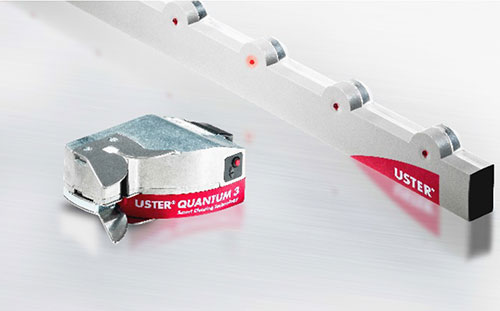 using data from Uster® Quantum 3 yarn clearers at winding and Uster® Sentinel in ring spinning to ensure yarn quality stays constant, even at high speeds. Spinners can correlate end-breaks with winding data, as well as with fiber properties, in a single system. This results in an improved cop build-up quality, fewer quality variations and a reduction in alarms, delivering significant profitability increases to yarn producers.
Uster® RSO 3D extends this functionality to quality mapping of the ring frame, based on individual quality data for each spindle. This helps to identify outlier sides, sections or spindles. Through seamless collaboration with Muratec QPRO EX/FPRO EX spindle identification, Uster® Quantum 3 and Uster® Sentinel, the system can stop faulty spindles or poor quality cops and so prevent poor quality. This reduces the workload for operators, while increasing quality assurance.
Total Contamination Control (TCC): The double protection by Uster® Jossi Vision Shield And Uster® Quantum 3 gives spinners control over balancing quality and productivity – a transparency that enhances cost efficiency and maximizes profits. It means they can make good choices about raw cotton purchases and reduce waste of ‘good’ fiber. Optimizing ejections and cuts gives precise control over levels of contamination, ensuring the yarn meets customer demands.
Alarm Center: This provides direct guidance to machine operators, alerting the appropriate personnel and pointing them to the exact location of an issue. Knowledge from these alarms is stored and used for future reference, enabling even faster reactions.
Mill Analysis: Intelligent, data-based analysis by Uster® Quality Expert provides customers with an excellent overview of mill operations. Information is stored centrally, for easy access and total transparency. The result is savings in both time and money.
Yarn Prognosis: Accurate forecasting of how yarns will perform in downstream processes brings security and confidence to both spinners and their customers. It means spinning mills can isolate below-par quality and remove it, sending out only yarn which meets customer specifications.
Quality Management Platform: The Quality Management Platform contributes directly to improved business security for textile producers. “The profitability and future sustainability of a textile mill depends a lot on the optimization of production and the predictability of produced quality,” says Thomas Nasiou, CEO of Uster Technologies. “Our customers are partners and we want to support them to stay successful and tackle challenges, by providing the best services and systems.”
Lectra redefines 3D virtual prototyping with Modaris® V8R2
"Lectra has launched Modaris® V8R2, the latest version of its patternmaking, grading and prototyping 2D/3D solution. The new version of Modaris, the most widely used modeling solution by leading brands in fashion and apparel, offers greater speed, efficiency and precision in product development. With its powerful 3D simulation and collaboration tools, patternmakers are developing patterns faster and speeding up their decision-making procedures."
 Lectra has launched Modaris® V8R2, the latest version of its patternmaking, grading and prototyping 2D/3D solution. The new version of Modaris, the most widely used modeling solution by leading brands in fashion and apparel, offers greater speed, efficiency and precision in product development. With its powerful 3D simulation and collaboration tools, patternmakers are developing patterns faster and speeding up their decision-making procedures. By reducing or eliminating physical prototyping, product development is less expensive and the time to market is as close as possible to trend detection.
To preserve and strengthen its position as a market leader of product development software, Lectra, with this upgrade of Modaris, is giving particular focus to 3D virtual prototyping. Patternmakers can now share with their partners, 360-degree videos, accessible on any device. Designers in response are able to visualize, comment, and approve the style and fit using the new 3D Style module.
New advances have made it possible to reduce the number of physical prototypes by up to 50 per cent. Modaris V8R2 improves the quality of the solution’s 3D simulations and expands its library with new assets (fabrics, 3D top-stitching effects, realistic scenes, lighting studios, Pantone® and Natural Color System®©.) The solution is now compatible with Vizoo, a high-quality scanner that brings forth a heightened realism to the appearance of fabric swatches, and with other 3D solutions such as Maya, 3DS Max, Iray to make the digital renderings of the prototypes more true-to-life and accurate.
One of the innovative developments of Modaris V8R2 is a special dart feature to help patternmakers add dimension to their garments with ease. Thanks to this new feature, modifying a dart requires half the usual time, resulting in a 50-90% increase in overall patternmaking speed.
Another highlight of this solution, and important nod to the globalized workforce of the fashion industry, is its ability to manage different units of measurement. With Modaris V8R2, Lectra has made it possible for patternmakers and external suppliers the guarantee of size compliance, regardless of the measurement systems used in the countries where production occurs.
Modaris V8R2 is already gaining traction among its pilot customers. Italian womenswear company GGZ was the first to endorse Modaris V8R2. . “Modaris’s new dart feature helps us save up to 50% of pattern modification time. Additionally, 3D prototyping helps us ensure that pattern volumes and proportions correspond to our designers’ expectations early on, dramatically reducing our lead times,” states Majla Gottardo, Patternmaker, GGZ.
Karl Mayer happy with visitor turnout at ITMA-2019
"Karl Mayer’s diverse exhibition area at ITMA 2019 soon became the industry’s favourite meeting point as nearly 1,000 visitors visited the company’s stand during the first four days of the exhibition. International visitors were impressed by the modern design of the stand and by the concept behind its presentation. The company invited visitors to embark on a voyage of discovery through the textile world of tomorrow."
 Karl Mayer’s diverse exhibition area at ITMA 2019 soon became the industry’s favourite meeting point as nearly 1,000 visitors visited the company’s stand during the first four days of the exhibition. International visitors were impressed by the modern design of the stand and by the concept behind its presentation. The company invited visitors to embark on a voyage of discovery through the textile world of tomorrow.
Karl Mayer’s stand at ITMA 2019 focused on the Future of Textiles. Discussions with clients and guests revealed that its concept focusing on innovative textile application in addition to its machine innovations, has been successful. The textile world of experience offers inspiration for innovative application developments and thus approaches for new business opportunities.
The machine show impresses by highly efficient complete solutions for a production which will give the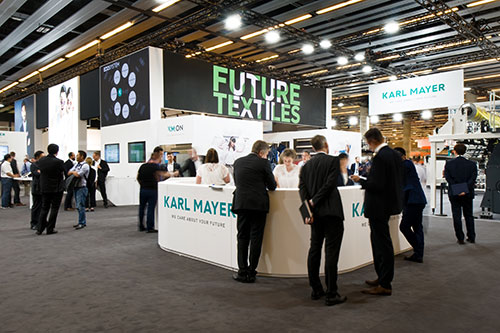 customers an important competitive edge also in the long term: flexible, trendsetting machines with excellent cost:benefit ratios for use in warp knitting, innovations in warp sampling and direct warping for the warp preparation sector, a completely new machine for composite materials. The machines are the subject of many specific project discussions and requests.
Customer’s interest is also high in Karl Mayer’s solutions regarding the responsibility for the protection of the environment. The company displays sustainability and environment at different exhibition islands: from energy-efficient machines, via the processing of resource-saving yarns up to sustainable warp-knitted fabrics and application concepts. One of the highlights of the company’s stand is machine for producing Sustainable Denim.
Lycra moves toward specialty fibers
Lycra has been successfully growing its branded differentiated fiber business for 60 years but has had particular success in the last five years in shifting from a mix of commodity and differentiated fiber business to nearly all differentiated or specialty fibers.
Lycra is now owned by China-based Shandong Ruyi. This has given the brand a chance to be totally independent and committed to the industry–to be faster, more nimble. Much time has been spent connecting with customers with renewed vigor on Lycra products and the company’s role in the market as a supply chain innovator and facilitator.
Lycra is at the forefront of stretch denim and the athleisure trend that followed getting its name known through the intimate apparel and swimwear sectors. Product innovation, long at the core of the company and what set the Lycra brand apart from other spandex and elastane companies, is even more of a focus now. The company is even more committed to bringing out category-changing products that create premiums for its customers. One of the newest innovations is Lycra Fitsense, which allows Lycra fiber technology to be screen-printed onto a fabric or garment for targeted support. Lycra Fitsense allows designers to create lighter weight, breathable, cooler fabrics that offer targeted compression and support.
Lenzing to invest €100 million to reduce carbon emissions
The Lenzing Group will invest €100 million over the coming years to reduce carbon emissions both inside its operational boundaries (scope 1+2) and in its supply chain (scope 3). Due to its ambitious CO2 emission reduction strategy, the Lenzing Group will further contribute towards helping customers to transition their business to a lower CO2 base.
The company Lenzing plans to reduce CO2 emissions per ton of product by almost 50 percent (scope 1+2 and 3) by 2020. The total CO2 reduction of all the planned initiatives will yield 1.3 Mt.
Lenzing will adopt a series of measures in production as well as new innovations and adaptations to new technologies to achieve these ambitious targets. A major contribution will also come from investments in the production of highly eco-responsible products such as Tencel branded lyocell fibres. On top of that, the drastic improvement of energy efficiency and an increase in the share of renewable energy in the energy mix will deliver the targets set.
Jeanologia unveils new sourcing model for apparel production
Jeanologia has unveiled a new sourcing model designed to streamline apparel production from fabric to garment finishing. The technology has the potential to dehydrate and detoxify the world’s most consumed product—jeans—within the next five years.
The model is the first complete production center that includes all of Jeanologia’s technologies and disruptive solutions. This operational model delivers five fundamental benefits to the textile industry: eco-efficient, cost neutral, scalable, agile and digital—connecting design, production and consumer. It is possible to design and produce with zero environmental impact in any location in the world. And by simplifying processes, the model changes how things are produced, making it easier to adjust supply and demand. The technology makes it possible to produce what sells instead of selling what is produced.
The operations model combines Jeanologia’s hardware and software to achieve quick and sustainable results. It includes Laundry 5.Zero, the first garment finishing plant that guarantees zero pollution and achieves a saving of 85 per cent in water. This operational center produces sustainably on an industrial scale by efficiently combining the technologies Laser, G2 ozone, e-Flow, Smart Boxes and the first water recycling system, H2Zero, and by eliminating all the processes that are harmful for workers and the environment.
PDEXCIL to hold India textile expo in Sri Lanka
India International Textiles expo will be held in Sri Lanka, July 29 to 31, 2019. Trade visitors from the garment industry, major importers, wholesalers, bulk buyers and institutional buyers will participate. This is an exhibition cum buyers meet, organized by the Powerloom Development and Export Promotions Council (PDEXCIL). It is a platform for Indian textile manufacturers and exporters to directly interact with Sri Lanka’s textile importers and buyers and apparel manufacturers. Exhibitors from all over India are participating in the event, displaying a variety of textiles. More than 40 Indian exhibitors from major power loom clusters of India such as Surat, Ahmedabad, Erode, Coimbatore, Ichalkaranji and Solapur will display fabrics, yarn and made-ups in various blends, textures, colors and designs suitable for apparel, industrial and technical applications. This includes cotton fabrics, check shirtings, polyester cotton blends, poly viscose, suiting fabrics, terry towels, bath towels, dress materials etc.
India is the second biggest fabric exporter to Sri Lanka. The event will provide a first-hand opportunity for Sri Lanka buyers to interact directly with a diversified group of Indian textile manufacturers and exporters.
PDEXCIL works on the objective of the overall development of the power loom industry in India and promotion of marketing of power loom products.
India May garment exports up 14 per cent
India’s readymade garment exports rose 14.05 per cent in May 2019 compared to the same month last year. In 2018-19, exports dropped 3.43 per cent compared to 2017-18. After the introduction of GST and demonetisation, Indian products became costlier and exports started declining. Exports decreased year-on-year in the last two financial years. In the last six months, the average export growth was about 31.15 per cent over the corresponding period in 2017-18. From October 2018, exports increased by 12 per cent. The sector is finally turning the corner after stagnancy or slight de-growth. Bangladesh is becoming expensive and Vietnam is showing signs of reaching the peak of its capacity. China is exiting the textile sector. All this is helping Indian exports. Reduction in costs delivered by a refund of central and state taxes, new benefits under the Merchandise Exports from India Scheme and the renewed two per cent duty drawbacks have made the industry more competitive. The other advantages for India are design, value addition and skill.
Though Indian products are costlier by 10 to 15 per cent, buyers are still interested in sourcing from the country. Since it is not about the cost alone, but quality and speedy delivery, if India can improve on this, the country can once again emerge as a strong competitor.