


FW
Primark sales up four per cent
Primark sales rose four per cent for the first three quarters of the year. Sales bounced back after a soggy May kept shoppers out of stores. Margins widened to 11.7 per cent in the first half from 9.8 per cent in the year-earlier period.
Primark is a budget fashion retailer owned by Associated British Foods. Primark is driving sales growth by expanding new stores at a breakneck pace. AB Foods expects better purchasing and fewer discounts to help offset a recent recovery in the dollar in the second half. The company has forecast a higher operating margin this year and has been reducing markdowns and benefiting from a weaker dollar that makes it cheaper to source garments from Asia. A stronger July is expected due to the improving weather. Last year had the feel-good factor, with the hot weather, the royal wedding and soccer World Cup, which boosted sales for Primark. A huge new Primark outlet in England has been outfitted with trend rooms that showcase the latest looks as well as Harry Potter and Disney areas. It’s designed to be a concept store for the future. The retailer will expand in the US.
Gap grows at three per cent
Gap has been growing at an average annual rate of 3.4 per cent over the last three years. This growth has been driven almost completely by Old Navy, which contributed more than 95 per cent of the revenue growth over this period. Old Navy’s strong revenue growth coupled with a lower tax rate helped the company’s net income margin expand from 4.4 per cent in 2016 to over six per cent in 2018. However, Gap’s iconic brand, Gap Global, continued to struggle. The brand’s revenues over the last three years have fallen at an average annual rate of 5.4 per cent. Gap Global’s contribution to total revenue has gone down from more than 35 per cent in 2016 to about 31 per cent in 2018.
Banana Republic’s revenue is projected to remain flat while Gap Global’s revenue is likely to continue to decline over the next couple of years. Earlier this year, Gap unveiled a plan to split itself into two independent, publicly-traded companies – an independent Old Navy, and a yet-to-be-christened new company that would include a smaller portfolio of niche brands in denim (Gap), upper middle-class fashion (Banana Republic), female athleisure (Athleta), and men’s performance lifestyle (Hill City).
Dolce & Gabbana adds plus size
Dolce & Gabbana has extended its women’s size range to include XXL. The intention is to pay tribute to women, their morphology and all types of beauty. The Italian luxury label has always glorified a certain type of sensual Mediterranean beauty, and its ad campaigns often feature voluptuous women.
Plus-size women represent an increasingly important market segment and a genuine business challenge. Inclusivity also plays a part, an increasingly influential factor in the new strategies deployed by luxury labels. This explains their gradual shift in approach towards a clientèle which, until now, was overlooked. Retailers in the US are rolling out trendy plus-sized collections. They are dedicating more time and resources into developing plus-sized collections — a sign they are starting to see them as bigger potential revenue streams than they have in the past. They aim at giving plus-size customers the same trends, same colors, same wonderful print and patterns that are available in other women’s lines. The pieces have bright colors and prints, trendy cuts, and fun details, rather than the historical plus-sized collections from traditional retailers whose offerings don’t expand much beyond neutrals and basics. Traditional retailers risk losing business if they don’t give their plus-size lines the same attention, both in-stores and online, as other collections.
Bangladesh garment export earnings up 11 per cent
Bangladesh’s earnings from readymade garment exports grew 11.49 per cent over the last fiscal year. Earnings from knitwear exports were 11.19 per cent higher than the last fiscal year. Earnings from woven items registered a 11.79 per cent growth. The country’s overall merchandise export earnings registered a 10.55 per cent growth.
Apparel exports were helped by safety and compliance upgradation in the apparel industry, helping to boost buyers’ confidence on sourcing more clothing from the country, the US-China trade war, and good performance of apparel exports in non-traditional markets. In particular the US-China tariff war opened an opportunity for Bangladesh as global buyers shifted orders from China to Bangladesh to remain on the safe side. The sector also went on a massive machinery upgradation scheme to ensure product quality and to produce value added goods. Bangladesh’s readymade garment sector contributes 84 per cent to the country’s total export receipts. The US economy was better than it was last year, which also helped the country to export more. However, most apparel export earnings of Bangladesh are from basic goods. To get a better price, the country needs to invest in technology for value addition. Also manufacturers have to establish links with buyers who are shifting from China to other countries.
Budget 2019-20: Textiles allocation reduced, FDI norms for single brand retail relaxed
"Finance Minister Nirmala Sitharaman presented her maiden budget in Modi 2.0 government. However, the textiles sector seems to have been low on her priority list as the Budget allocation for textiles has been reduced to Rs 5831.48 crore in fiscal 2019-20 from Rs 6,943.26 in the last fiscal. Total textile infrastructure like SITP has been reduced from Rs 3729.83 crores to Rs 58.55 crores. What’s more there has been a reduction in custom duty from 5 per cent to 2.5 per cent on import of raw materials under 5101 and 5105 (wool fibre and wool tops)."
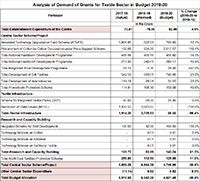 Finance Minister Nirmala Sitharaman presented her maiden budget in Modi 2.0 government. However, the textiles sector seems to have been low on her priority list as the Budget allocation for textiles has been reduced to Rs 5831.48 crore in fiscal 2019-20 from Rs 6,943.26 in the last fiscal. Total textile infrastructure like SITP has been reduced from Rs 3729.83 crores to Rs 58.55 crores. What’s more there has been a reduction in custom duty from 5 per cent to 2.5 per cent on import of raw materials under 5101 and 5105 (wool fibre and wool tops). Moreover there has been an increase in customs duty from 0 to 20 per cent for water blocking tapes for manufacture of optical fiber cables. Reacting to the budget Sanjay Jain, Chairman, CITI says, “It’s neutral and a non event.”
Relaxation of FDI in single brand retail
The FM has proposed further relaxation of foreign direct investment (FDI) norms in single brand retail sector to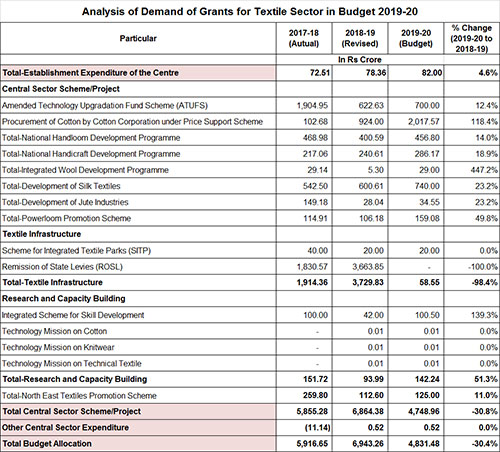 attract more overseas investments. This assumes special significance as several foreign entities had raised concerns over the mandatory local sourcing norms from India. This included the high-end technology companies who had expressed their reluctance to procure goods from India due to the difficulty in meeting the 30 per cent condition.
The Department of Promotion of Industry and Internal trade had mooted a proposal earlier this year to ease these norms. According to that proposal, these relaxations would allow retailers more time to comply with this regulation. The proposal also sought permissions for such firms to start their online operations even before setting up brick-and-mortar shops, provided they are able to attract over $1million of FDI. However, the proposal also mandated these firms to set up their brick-and-mortar shops within two years of starting their online sales.
Tarun Pathak, Research Director at Hong Kong based Counterpoint Research feels easing rules in single brand retail is likely to help many foreign companies to expand their operations by setting their own stores in the country.
Focus on promoting Khadi globally
The government has also focused on promoting Khadi globally, urging its missions abroad to come up with ideas to project Khadi as an employment generation solution and not merely a garment.
The Budget also announced a 2 per cent interest subvention for MSME and corporate tax reduction to MSMEs upto Rs 400 crores. Labour laws have been simplified and restructuring of power distribution has been proposed. Also the formation of National Research Foundation has been announced in the Budget.
As a part of the NDA government’s focus on bringing micro, small and medium enterprises (MSMEs) under the formal economy’s fold, a payment platform for the MSMEs will be set up. This comes in the backdrop of the government’s plan to start an e-commerce platform on the lines of Amazon and Alibaba to sell products from MSMEs and the Khadi and Village Industries Commission.
Given its focus on MSMEs, the government has also announced a pension scheme for 30 million small traders, recognising the plight of shopkeepers, small traders and the self-employed hurt by the November 2016 decision to demonetize high-value currency notes, and the much-debated roll-out of the goods and services tax (GST) in July 2017. All small shopkeepers and self-employed persons as well as the retail traders with GST turnover below Rs1.5 crore and age between 18-40 years, can enrol for this scheme. The scheme would benefit more than 3 crore small shopkeepers and traders.
Reacting to the Budget the Clothing Manufacturers Association of India (CMAI) stated it is a mixed bag for the textile and apparel industry. Rahul Mehta, President, CMAI, stated that the extension of lower rate of 25 per cent corporate tax with an annual turnover up to Rs 400 crores is a welcome step. Currently, this rate is only applicable to companies having annual turnover up to Rs 250 crore. Moreover the infusion of Rs 70,000 crore capital into public sector banks will ease the current credit squeeze. Also, Rs 350 crore allocated for 2 per cent interest subvention for all GST-registered MSMEs on fresh or incremental loans will give a big thrust to MSMEs. Considering that over 80 per cent of the domestic apparel industry is in the MSME sector, all these measures could provide a boost to the sector.
63rd India International Garment Fair - The perfect platform for apparel exports
The 63rd India International Garment Fair [IIGF] was inaugurated by Shantmanu, IAS, Development Commissioner [Handicrafts] that is being held concurrently with 12th edition of Indian Fashion Jewellery & Accessories show (IFJAS) at India Exposition Mart in Greater Noida.
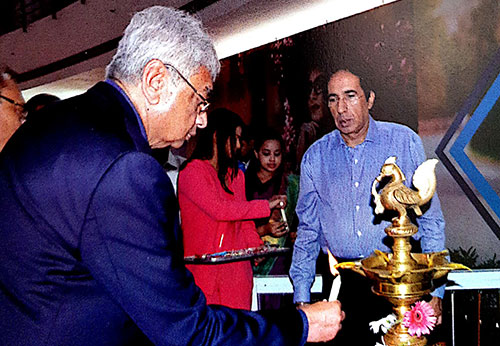
The three day international fair,being held from July 04-06, 2019, covers the Spring/Summer collections of Japan, European Union, USA, and other western markets. This grand fair aims to provide a perfect business platform for the Indian apparel exporters and international buyers and bring together the best sourcing solutions from India.
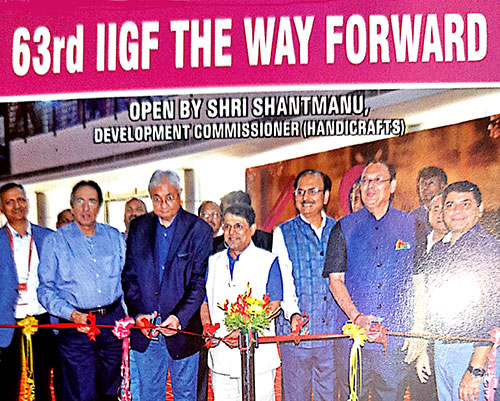
Shantmanu, Development Commissioner [Handicrafts] says, "IIGF is a window for Indian exporters to the emerging markets in Asia, Latin America, Africa and East European countries. Government pays high emphasis on export promotion of apparels and a number of new schemes are also proposed for the current year. The northern and tribal region should be focused in future shows.
Benetton India unveils the July 2019 edition of Rolling Stone India magazine
Sundeep Chugh, CEO & MD, Benetton India alongwith Indian comedian, singer, songwriter and YouTube sensation Bhuvan Bam unveiled the July 2019 of the popular music magazine-Rolling Stone India. The cover of the magazine features Bam on the cover in a complete Benetton look from the brand’s eclectic Spring Summer 2019 collection.
Comsat equips Tecmat sectional wrapping machine with EltexEyETM
Comsat is equipping its latest Tecmat sectional warping machine for weaving preparation with the new EltexEyETM yarn tension monitoring system.

Unlike yarn tension monitors that are fitted solely on the weft insertion systems of weaving machines, the new Eltex technology is for the warping process prior to weaving – and instead of monitoring only the tension of the six-to-eight yarns fed by the weft insertion system the EltexEyETM keeps a close eye on literally hundreds.

With warping that can operate at high speeds, the yarn tension values from all yarns are continuously updated and displayed on the screen. Tension values outside the warning level are indicated both on the sensor’s LEDs and on the screen. This greatly increases yarn evenness and subsequently the woven fabric quality. In addition to being fitted on our latest Tecmat machine, the EltexEyETM can also be retrofitted to existing comsat machines already in operation.
HKRITA signs MOU with International Iberian Nanotechnology Laboratory
The Hong Kong Research Institute of Textiles and Apparel (HKRITA) and the International Iberian Nanotechnology Laboratory (INL) signed an MoU to foster research development and knowledge exchange.
The MoU aims to strengthen collaboration between HKRITA and INL in the development of sensor and wearable technology. These research areas have inspired projects that are developing more precise ways to measure physiological and biomechanical phenomena, leading to the design of new devices and testing methods for the continuous enhancement of wearable solutions. The solutions will play increasingly important roles in improving life in a range of social and occupational settings.
Established in 2006, HKRITA is funded by the Innovation and Technology Commission of the HKSAR Government and hosted by The Hong Kong Polytechnic University. HKRITA engages in applied research to support the textile and apparel industry in order to boost its overall competitiveness, and to drive sustainable improvements and bring benefits to society. By providing one-stop services for applied research, technology transfer and commercialisation, HKRITA makes sustained efforts to promote successful projects for industry application.
The INL was founded by the governments of Portugal and Spain under an international legal framework to perform interdisciplinary research and to deploy and articulate nanotechnology for the benefit of society. The INL provides a cutting-edge research environment in which today’s major societal challenges can be addressed: ageing populations and well-being, mobility and urban living, and social safety and security.
Vietnam, Taiwan organise forum to promote textile cooperation
The Vietnam Chamber of Commerce and Industry recently collaborated with the Chinese National Federation of Industries to organise the Vietnam-Taiwan Industrial Collaboration Forum. The event will connect leading enterprises in the fields of textile, light industry, automation, smart city and other applications. At present, the most intimate textile exchange and trade is happening between Taiwan and Vietnam. In future, the two parties will exchange newest international fashion trend, of which, Taiwan will introduce the highest quality nano-fabric researched and developed by Taiwanese firms to Vietnam, promoting the cooperation between two sides to come into reality.
Vietnam is the largest importer of Taiwanese-made fabric while Taiwan is the second largest territory in importing garment products of Vietnam with import turnover at nearly $400 million last year. As the price of Taiwan’s functional fabrics is higher than that imported from China, so export value of products made of Taiwanese functional fabrics will increase, helping Vietnam to hold a key position in global supply chain.











