FW
Monforts’ partners seek new sustainable production targets
Nicole Croonenbroek, Marketing Manager, Monforts said the company’s partners are constantly setting new targets in respect of sustainable production and, more importantly, going beyond them. One of them, Turkey-based Bossa provides QR codes with which brands can identify the names of individual farms and their locations, as well as detailed information such as the origins of specific seeds and the use of irrigation by growers.
Another Turkish company, Orta Anadolu offers an interactive supplier map detailing the regions where cotton, dyestuff, chemicals and various fibres are supplied with its new Denim Route. Denim Route shares three years of life cycle assessment (LCA) data on each of the company’s featured fabrics via a dedicated app. Users can access the data for detailed information by scanning the QR code on a product’s hashtag.
Pakistan-based Naveena Denim Mills uses a range of sustainable materials in its new Holistic collection, including organic cotton and post-consumer and post-industrial waste cotton that has been shredded and recycled at its in-house unit in Pakistan. While hemp and Tencel bring sustainable and aesthetic qualities to the collection, the company uses Roica’s Cradle-to-Cradle certified degradable option instead of conventional elastane. Naveena Denim Mills replaces polyester with CiClo, a material developed by re:newcell of Sweden that repurposes discarded cotton textiles such as worn-out denim jeans through a process akin to recycling paper.
Pakistan-based Azgard 9, another brand using Monforts technologies, introduced a living and breathing piece of clothing that absorbs carbon dioxide while simultaneously producing oxygen at Digital Denim Week 2021. Behaving basically like a plant or tree, the sustainable denim garment is treated with microbial pigmentation and is currently analysed by all of the company’s global customers, from large luxury fashion groups like LVMH to fast fashion brands like Zara. During its life cycle, the garment will improve the wearer’s immediate environment and produce approximately the same amount of oxygen as an oak tree. This innovative product is also water-resistant and breathable, with advanced antimicrobial and anti-odour properties.
Invista Nylon Chemicals (China) to expand capacity
Invista Nylon Chemicals (China) Co has signed an MoU to double the current nylon 6,6 polymer production at Shanghai Chemical Industry Park (SCIP). The new capacity will increase to 400,000 tonne/year and enable Invista to quickly respond to the growing demand for engineering plastics in automotive, electrical and other application fields.
The capacity will be expanded with an investment of RMB 1.5 billion (renminbi) and strengthen Invista’s integrated nylon 6,6 value chain in China, according to the company.
Located at SCIP, the expanded production line will be equipped with six batch autoclaves and three continuous polymerisation lines. The additional capacity will support the development of engineering polymer, industrial and apparel segments, and satisfy the downstream application requirements for nylon 6,6 products and solutions, including stronger mechanical properties, higher temperature resistance, and higher heat resistance.
Construction of the product lines is expected to begin in the second quarter of 2022 and be in operation in first quarter of 2024, Invista further added. Supporting the expansion is Invista’s upcoming Asia Innovation Center, which will bring strengthened research and service capabilities to support downstream partners as they seize growth opportunities driven by innovation and high-quality development.
Fashinza eyes the leadership position in 2-3 years
Pawan Gupta, CEO and Co-Founder at Fashinza, says his company plans to position itself as the defacto global leader in lifestyle manufacturing in the next two-three years. It plans to offer manufacturing in every continent of the world so that brands can outsource based on a beautiful combination of speed and cost to digitize the supply chain besides helping MSMEs to gain financial stability. The company also plans to implement strategies to improve trend forecasts, which in turn will optimize the SMEs’ capital investments. In the apparel industry, understanding the trends can be the key to improving demands.
Fashinza has created a one-of-a-kind digital marketplace where brands and manufacturers can freely work together with none of the usual supply chain complications being involved. Brands can state their detailed requirements with a few clicks and the marketplace manufactures the products based on their demands. Inventory risks are reduced because we enable brands to experiment with low MoQs. Selecting designs is super easy with its openly available catalogue. The company’s partnerships with fabric suppliers and financial partners further help to expedite the manufacturing process. It has also empowered SMEs to work directly with some of the biggest fashion brands, both domestic and international.
Professor Parikshit Goswami appointed to UKFT’s board
Professor Parikshit Goswami has been appointed to the board of non-profit organization UK Fashion & Textile Association (UKFT) to help the association increase its focus on innovation, R&D and sustainability. Goswami is currently the Director, Technical Textiles Research Centre and the Head of Department-Fashion and Textiles, University of Huddersfield.
Goswami mainly researches on developing products by using flexible materials and applying Chemistry to functionalize textiles. He manages a large portfolio of research concerned with fiber/polymer science, nonwovens, medical textiles, sustainable materials, nano and submicron fibres and plasma treatments for functionalising textiles. He is a member of Society of Dyers and Colourists (SDC), Education, Qualifications and Accreditation Board (EQAB) and is a Trustee of SDC.
Prior to joining the University of Huddersfield, Goswami was the Director -Research and Innovation, School of Design, University of Leeds and he led the Fibre and Fabric Functionalization Research Group.
UKFT works across a wide range of projects to help the UK industry take full advantage of these new technologies and markets and to help change the future landscape of the textile industry in the UK into one where circularity and environmentally sustainable supply chains are the new normal.
Most recently UKFT has started working with IBM, Tech Data and the Future Fashion Factory to design, prototype and pilot a new technology platform to help the UK fashion and textile industry to drive sustainability and profitability through increased transparency within the supply chain. Retailers Next, H&M (COS brand), N Brown, New Look and yarn manufacturer Laxtons will be part of the initial pilot.
Gujarat Cotton Corporation teams up with BTMA to resolve transaction certificate issue
Gujarat Cotton Corporation has teamed up with BTMA members to resolve issues over the non-issuance of transaction certificates for organic cotton supplied to Bangladeshi importers. For more than one year, nine Indian suppliers have not given transaction certificates to 18 Bangladeshi companies for 16,100 tonne of organic cotton imported by them against 23 LCs. Certificates were issued to only three importers, which were later revoked as they were fake.
Last month, BTMA sent a letter to the Indian High Commission in Dhaka, the Cotton Association of India, the International Chamber of Commerce Bangladesh (ICCB) and other parties concerned, seeking measures to this end. According to BTMA, Bangladesh imported 7.5 million bales of raw cotton in FY20, and more than a quarter of it came from India. But, the BTMA does not have information on the amount of organic cotton imported during this time.
BGMEA demands 10 per cent incentive on non-cotton garment exports
Faruque Hassan, President, BGMEA, has demanded 10 per cent incentive on the export of garment items made from non-cotton fibers to encourage investment in the MMF sector. Hassan said, Bangladesh imported 20.52 lakh tonne of fiber in the last fiscal year, of which 93.57 per cent was cotton. Currently, 403 out of the 430 spinning mills operating in the country produce cotton fiber. Hence, investment and production in the MMF-based fiber industry is still low even though it has very high potential, he added.
Currently, Vietnam holds 10 per cent share of the global MMF-based garment market while Bangladesh is still struggling to attain a 5 per cent share in this segment, Hassan added. This market is growing 3 to 4 per cent annually with 75 per cent of garments being produced globally from MMF-based fibers. On the other hand, the global market share of the cotton-based garment industry is growing at just 1 or 2 per cent annually.
Hassan also demanded loan rescheduling facilities for up to December as garment manufacturers and exporters have been struggling amid the ongoing COVID-19 pandemic. He also urged the government not to classify the loans of the garment sector for up to December this year so that they can be more competitive in the business.
Guess’ Q2 revenues increase 57.7 per cent
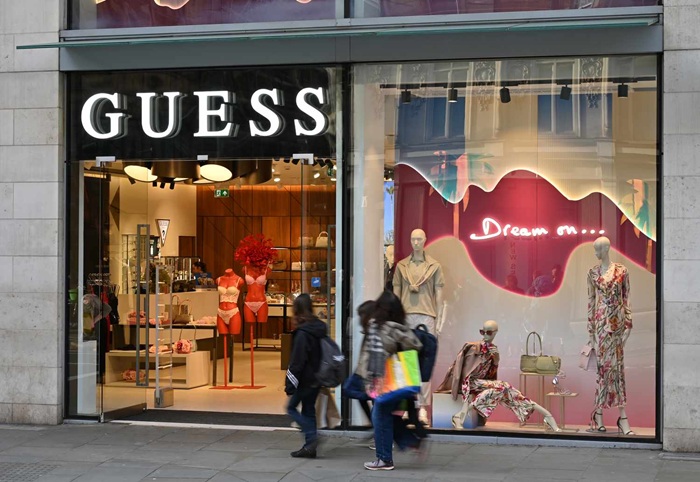
Los Angeles-based apparel retailer Guess’s net revenues increased 57.7 per cent to $628.6 million during the second quarter of the current financial year as improved margins boosted year-over-year revenue gains. Disruptions caused by the COVID-19 pandemic, had led to retailer’s sales declining to $398.5 million last year. Compared to the same period two years ago, when the company generated $683.2 million in revenue, sales decreased 8.0 per cent.
In last year’s second quarter, the retailer recorded a net loss of $20.4 million, or a diluted loss per share of $0.31. Operating margin for the quarter was negative 3.6 per cent compared to $1.22 billion in the same period two years ago. The company’s net earnings for the first half of the fiscal year came to $73.1 million, or $1.10 per diluted share. This compares to a loss of $178.0 million, or $2.72 per diluted share, in the previous year’s first half, and earnings of $3.9 million, or $0.05 per diluted share, the year before. At the end of second quarter, Guess directly operated 1,046 retail stores in the Americas, Europe and Asia, with a further 551 locations being run through the company’s global partners and distributers.
Zhongyuan Group exports drop as logistic costs rise
Zhongyuan Group’s exports to Vietnam, India and Honduras dropped dramatically in recent months due to rising logistics costs and container shortage. Zhongyuan started its export business in 2019. Earlier the company exported 1,000 to 2,000 ton of polyester every month before. However, in recent times, the company’s waiting period for a container increased from a week to a month. Its shipment costs also increased by three, four or even five times for some regions, informs Chen Yiren, Assistant President. The price of its container from China to UK has increased by five times to $14,000. This is affecting the company’s foreign trade
The value of China's textile exports declined by 26.78 percent in July, shows data from China Customs shows. Beside the rising logistic costs, the dropping demand of masks and protecting suits was the other factor behind the decline. Customs data shows that exports of masks and protective clothing accounted for only 6.3 percent of total textile exports in the first half of the year, compared with 22.4 percent recorded last year.
Jason Kent appointed new CEO of BTMA
The British Textile Machinery Association (BTMA) has appointed Jason Kent the new Chief Executive Officer of the group. This also includes subsidiaries nw texnet and The Textile Recorder (Machinery & Accessories) Exhibitions (TREX), effective from Monday 23rd August 2021. A non-executive member of the BTMA board for over eight years, Kent has over 35 years of experience in carpet tufting machinery industry. He is a mechanical technician engineer who ascended through a series of positions of greater responsibility with Cobble Blackburn until its acquisition in 2013 by the Vandewiele Group, where he undertook the role of Managing Director for the tufting machinery business.
He also studied part-time for his MBA back in 2011 and is also a Chartered Fellow of the Chartered Management Institute. Alan Little, Director, says, Jason’s textile machinery background, business development skills and extensive knowledge of the BTMA and its members will help in delivering the strategic vision of the board.
Founded in 1940, the British Textile Machinery Association actively promotes British textile machinery manufacturers and their products to the world. The non-profit organisation acts as a bridge between its members and the increasingly diverse industries within the textile manufacturing sector.
Bangladesh brands sign agreement to extend Accord
Brands and unions have signed an agreement to extend the Accord agreement in Bangladesh and expand its scope to other garment- and textile-producing countries. The agreement has been hailed by labor groups across the country as it paves the way for more robust worker protections globally.
Titled the ‘International Accord for Health And Safety in the Textile and Garment Industry,’ the new agreement extends out to October 2023. It remains a legally binding commitment to ensure worker safety in Bangladesh. Companies including H&M Group and Zara-owner Inditex have signed the new agreement. A full list of signatory brands will be announced September 1, when the new Accord comes into effect.
The Bangladesh Accord was established in the wake of the collapse of the Rana Plaza factory complex in 2013. The disaster killed more than 1,000 people and remains one of the deadliest garment industry disasters to date. Amid widespread public outrage, more than 200 brands signed onto the initiative, which made them subject to legal action if their supplier factories in Bangladesh did not meet health-and-safety standards or failed to fix issues within an agreed-upon time frame. It was an unprecedented level of accountability and remains an unusually robust framework in an industry that is still largely governed by voluntary codes of conduct.