FW
India: Punjab to acquire 250 acre for a textile park under PM-MITRA scheme
The Punjab government plans to acquire another 250 acre to set up a park under the Prime Minister Mega Integrated Textile Region and Apparel (PM-MITRA) scheme in the state. As per reports, the project requires 1,000 acre in all. Of this, 957 acres will be acquired from the Greater Ludhiana Area Development Authority (GLADA), a special development authority of the housing and urban development department.
However, as the land available with GLADA is currently under litigation or under stay by the judicial courts, the government needs to acquire additional area to fill the minimum land requirement for the project. In this regard, the Industries Department of the State government has sent letters to the Principal Secretary, Department of Housing and Urban Development, to fulfill the additional land requirement at the earliest. The Ministry of Textiles has also questioned the department about road connectivity to the proposed site, especially approach road to the Ludhiana-Rupnagar expressway, along with its likely date of completion.
Demand for CmiA-certified cotton surpasses previous records
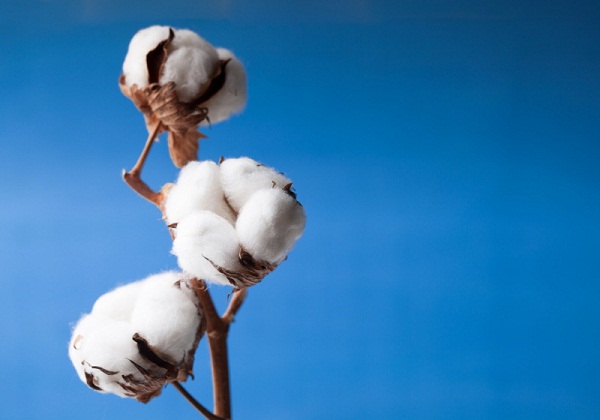
Cotton made in Africa (CmiA) has witnessed a surge in demand going past previously achieved records. Stats reveal, over 600 million worth of CmiA textiles were sold this year almost double that of last year. CmiA’s licensed retail and brand partners also grew around 30 per cent in the past four years.
The initiative boasts of some of the biggest retail and fashion partners in India including Bestseller, Lidl, LPP, and the Otto Group. It produced around 690,000 tons of verified cotton last year, which is around 40 per cent more than previous year. Currently active in 11 countries of the Sub-Saharan Africa continent, CmiA made supports around one million small-scale farmers.
Growing demand in 50 markets
“The record levels of supply and demand achieved by CmiA highlights the importance of sustainable raw materials in international value chains,” says Tina Stridde, Managing Director, Aid by Trade Foundation, administrator of the organization. v The initiative is supported by textile companies across the world, and cotton companies in the entire Sub-Saharan Africa continent. Together, these two entities have been able to boost demand in over 50 textile production markets. “They prepare small scale farmers to deal with current climate change challenges by aligning with market forces and introducing innovative and efficient farming methods,” Stridde explains.
Currently working with small-scale farmers in Benin, Burkina Faso, Côte d’Ivoire, Cameroon, Chad, Nigeria, Mozambique, Zambia, and Tanzania, CmiA has recently partnered with farmers in Togo and Ghana. The organization has also expanded its textile value chain to encompass 240 spinning mills across the world in 2021. Lidl Group, Otto Group and the Ernsting family are the three largest buyers of CmiA. And as Alexander David, Head-International Purchasing Division, Lidl Shiflung & Co KG says, “By using CmiA-verified cotton, we aim to support local farmers in Africa and promote environmentally friendly agriculture.”
Anna Rensing, Head-Quality Development and Product Sustainability, Enrsting adds, “CmiA helps us achieve complete certification for our natural-fiber products. We also plan to increase CmiA’s share in cotton sourcing by 487 percent between 2020 and 2021.”
Monitoring compliance with existing standards
Members currently have to pay licensing fees for procuring verified cotton. The initiative reinvests the proceeds in cotton-growing African regions. It also uses some of these funds to monitor compliance with social, economic and environmental sustainability standards through regular certifications by external auditors at the field and ginnery levels. This ensures verified cotton meets exclusion criteria—like prohibition on irrigation, child labor, genetically modified seeds, and certain pesticides as defined in international conventions. Revenue acquired through this also supports agricultural and business training for small-scale farmers.
An internationally recognized seal for sustainably produced cotton from Africa, the CmiA initiative was established by the Hamburg-based Aid by Trade Foundation (AbTF) in 2005. It is currently one of the world’s leading standards for sustainable cotton. The initiative reinvests the revenue obtained through the licensing of cotton to improve farmers living conditions in the cotton-growing regions of Sub-Saharan Africa.
Pandemic control, stable growth rate to help Vietnam achieve export targets

With the value of its textiles and garments exports surging 20.3 per cent Y-o-Y in Q1FY2022, Vietnam continues to be a leading textile and garment exporter to the US and EU markets. As per the figures from the General Department of Customs, the US is a leading importer from Vietnam totaling $4.3 billion in 2022; followed by the EU with imports worth $896 million and Korea with imports worth $754 million. Recent growth witnessed in Vietnam’s exports and initial control of the COVID-19, will help the textile and garment industry achieve its export target of over $43 billion by 2022.
Increased investments in new technologies
Vietnam is also likely to benefit from brands’ China Plus One strategy and emerge one of the most favorable destinations for manufacturers, import and export distributors, wholesalers and retailers worldwide. Textile manufacturers in the country have upgraded their production technologies besides increasing labor productivity. A prominent manufacturer, Hung Yen Garment Corporation (Hugaco) is boosting investments in equipment, modern technology and digital transformation.
Industrial real estate developers fuel growth
Industrial real estate developers are also contributing to the growth of textile industry in Vietnam. One of the few IPs in Vietnam to meet legal and utility infrastructure requirements, Aurora is building an infrastructure synchronously designed with the country’s largest capacity of water supply and wastewater treatment system.
In 2020, Aurora signed two deals worth $200 million to develop high-tech textile and dyeing projects. Besides developing domestic enterprises, the company focuses on attracting foreign investments to ensure sustainable development of the industry, says Tran Quoc Viet, Chairman & CEO, Cat Tuong Group.
Munich Fabric Start unveils new zone for international manufacturers

One of Europe’s leading meeting points for fashion designers, product managers, buyers and decision-makers, Munich Fabric Start has unveiled a new area for international manufacturing solutions called ‘The Source’.
The space offers turnkey international manufacturers a platform to present end-to-end solutions from PLV to white label in a new ambience and set up. “It offers producers an opportunity to showcase their reliable and flexible sourcing solutions for adjusted quantities and logistics chains,” says Sebastian Klinder, Managing Director, Munich Fabric Start.
Located at the new hall 8, The Source is positioned directly opposite to Munich Fabric Start's MOC event zone, next to Bluezone's Zenith area. The zone benefits both sourcing providers and visitors. The short distances between the zones allow visitors to discuss initial ideas with exhibitors and combine material sourcing with the placement of production orders.
Ideal atmosphere for constructive working
Tailored specially to the ambience, the zone creates an ideal atmosphere for constructive working. The 2,500 sq. mt. space is perfectly equipped to allow garment specialists to present their products and services at the show, adds Frank Junker, Creative Director Munich Fabric Start.
This edition also includes well-established areas such as Fabrics, Additionals, Design Studios, ReSource and Sustainable Innovations. Developments from DOB and Haka from affordable luxury to sportswear, contemporary and off-prices will also be showcased at the event. From August 30 to September 1, 2022, the fully booked International Fabric Trade Show will welcome upto 20,000 fashion professionals to Munich.
New color and material trends
An exclusive preview of Munich Fabric Start, View Premium Selection will introduce new designs, colors and material trends for Autumn/Winter 2023-24 from June 21 to 22, 2022 at the MVG Museum. The event will enable professionals of Munich Europe to experience high-quality product portfolio and uniquely personal and professional atmosphere.
VF Corporation Q4 revenues grow 9%
The fourth quarter revenues of outdoor apparel, activewear, and footwear giant VF Corporation increased by 9 per cent Y-o-Y to $2.8 billion. As per a report by Front Office Sports, the brand’s full-year revenues increased by 28 per cent to $11.8 billion.
VF Corporation houses several activewear brands like Vans Supreme, JanSport, The North Face, Altra Running and Timberland. The revenues of The North Face surged by 24 per cent Y-o-Y to $800 million; those of Vans surged to $1billion. The company’s earnings were partially offset by lower than planned growth at ans. Still, five of VF Corporation’s brands, including Vans, as well as The North Face and Dickies, achieved record sales during the year. The North Face’s revenues grew by 21 per cent to $3.26 billion.
Ongoing Premium Textile Japan 2023 is focusing on textile sustainability

Being held from May 25-26, 2022 at the Tokyo International Forum, this year’s Premium Textile Japan 2023 Spring-Summer edition focuses on growing demand for sustainability in the textile industry in the aftermath of the COVID-19 that hit the industry in 2020.
Welcoming 71 exhibitors in 92.5 booths, the event is being organized by the Japan Fashion Week with support of the Ministry of Economy, Trade and Ministry; Organization for Small & Medium Enterprises and Regional Innovation, Japan; Japan External Trade Organization, Japan Apparel-Fashion Council, The Japan Textile Importers’ Association, Japan Textile Exporters’ Association. Highlights include the JFW Sustainability Project being held alongside the JFW Textile Salon to boost awareness in the industry.
Insights into Japanese fabrics
A Textile Workshop titled ‘Let’s Learn Japan Fabrics!’ has been organized for both days. Inspired by Terakoya meaning ‘temple school’ in Japanese, the workshop features lectures on different fabrics by industry stalwarts from major textile producing regions. It aims to provide deep insights into Japanese fabrics with lectures focusing on their sustainability aspect. Being held in a dedicated area, the lecture being held today was attended by young employees of major apparel and textile manufacturers, retailers, designers in Japan.
Transforming food residues into dyes
Another lecture for May 25 by Yoshihiro Tanimura from Toyoshima & Co. focused on the eco-friendly initiatives of the company. It delves on the process of transforming food residues into natural dyes to produce textiles. The company has established the textile brand in collaboration with food companies like Kagome Co and Sarutahiko Coffee aimed at repurposing coffee waste into dyes.
A lecture on Sustainability with synthetic fabrics and the company’s initiatives is scheduled for May 26, 2022. To be delivered by Mito Yokokawa, Fibers and Textile Marketing Department, Toray Industries, it focuses on sustainability and business development in the company’s manufacturing process using oil as raw material. It will also introduce Toray’s original brand that focuses on using recycled and partially bio-related raw materials.
Savio to attend ITM Istanbul 2022
Savio will be attending “ITM Istanbul 2022” exhibition, taking place in Istanbul, Turkey, from June 14-18, 2022.
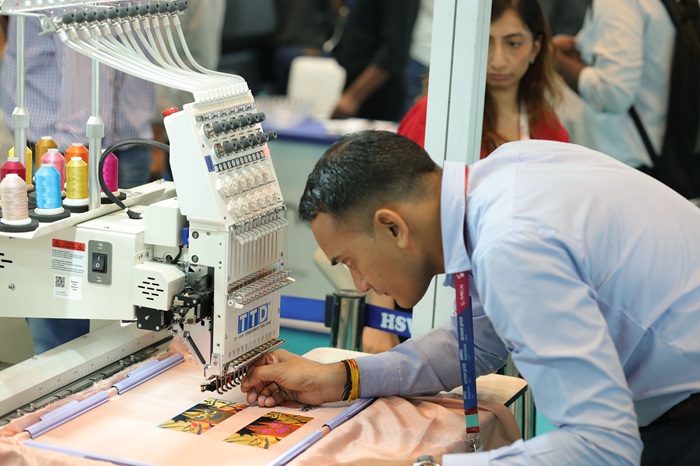
Savio will be exhibiting in Istanbul solutions-oriented machinery portfolio: winding, winding for continuous shrinkage, bulking and heat setting and TFO twisting.
To decide which spinning technology is best suited to your needs, Savio offers numerous solutions to support the quality of the final yarn product.
Savio automatic winders can easily process special yarns, such as the current very demanded product like the dual core spun yarns. The Savio winding unit is equipped with clearing, splicing and tension control devices for ensuring perfect splices and perfect package shape.
Many years of experience and a close collaboration with customers have allowed Savio to offer several solutions for production of acrylic yarns. The effect of the Volufil machine process gives acrylic fibers dimensional stability, higher volume, wrinkle resistance or temperature resistance, which acquires a regular geometrical structure with excellent volume.
Savio Multicone technology and Sirius twisting machines are especially addressed to ustomers producing packages for dyeing and very fine counts, from Nm 200 and above.
Trenggalek Fashion Day visitors amazed by Chairperson’s works
Visitors of the Trenggalek Fashion Day at the Textie Musuem in Jakarta were amazed by the fashion works of Novita Hardini SE, Chairperson, Regional National Craft Council (Dekranasda), Trenggalek Regency.
Accompanying his wife in the effort to introduce MSME products, Mochamad Nur Arifin, the Regent of Trenggalek,believes, Trenggalek Fashion Day can give enthusiasm to MSME activists in the region.
The efforts of the Chairperson of the Trenggalek Regency Dekranasda in expanding the MSME market in this event are starting to be felt. Like the blusukan at Tanah Abang Market (the largest textile center in Southeast Asia) some time ago. This effort does not only get a response from traders. Just introduced, one of the traders in this market asked for 10 pieces of cloth. That night, I asked for another 20 pieces.
Even then, when it was delivered to the seller, the buyer had been waiting for 5 pieces of cloth. This was confirmed by the Head of the Trenggalek Regency Cooperatives, Micro Enterprises and UMKM Service, Agus Setiyono.
According to him, after the Head of Dekranasda made a visit to Tanah Abang Market, the Trenggalek Regent's hard work paid off immediately. Not only the merchants responded, but several pieces of Trenggalek Batik were immediately sold.
Vardhaman Textiles’ net profit in Q4FY’22 increases 29.33%
The consolidated net profit of Vardhaman Textiles increased by 29.33 per cent to Rs 322.12 crore during Q4FY’22. However, net profit declined by 24.8 per cent on a sequential basis. As per an India Infolne report, revenues increased 39.04 per cent Y-o-Y in Q4FY22 to Rs 2,707 crore on consolidated basis. On sequential basis, revenues increased 3.99 per cent during the quarter.
Revenues for full year FY22 increased by 56.7 per cent to Rs 6,622 crore. Sales from the acrylic fibre business remained flat on Y-o-Y basis while sales of the predominant textiles business grew 41.7 per cent to Rs 2,642 crore. Cash from operations grew by nine times during the quarter. The company announced a dividend of Rs 34 per share for employees.
Due to the spike in cost of raw materials, EBITDA margins for the quarter declined from 22.14 per cent to 19.88 per cent Y-o-Y. Net profit margins declined to 11.90 per cent during the quarter compared to 12.73 per cent in Q4FY21.
India: Rise in prices compels government to probe cotton arrivals
The unprecedented rise in raw material prices has compelled the government to order a probe into cotton arrivals in the market. Exporters have also sought long-term policy measures to control rising prices. The prices do not factor in moisture and trash conditions. Excessive moisture can cause an additional 1 per cent loss and a minimum 3 per cent in excessive trash. This leads to Rs 119,600 to Rs 121,680 loss for spinners, says K Venkatachalam, Chief Advisor, Tamil Nadu Spinning Mills’ Association.
Release of cotton in calibrated quantities is adding to their woes, he adds. He advises the government to identify where the cotton is being stopped or hoarded. Spinners have also urged the government to remove cotton from the list of commodities traded on exchanges and make it available to farmers and mills, who are the only stakeholders.
Representatives of mill associations have also urged the government to direct the Cotton Corporation of India (CCI) to buy the cotton from farmers and to sell it only to mills, even in smaller quantities. The CCI should not to sell cotton to traders and multinationals, they advise. Manifold increase in all costs has resulted in an increase in yarn prices. Due to the increase in cotton prices, the working capital of all the mills is reported to have eroded and this has also resulted in a severe financial crunch for mills in buying and stocking cotton, Venkatchalam adds.