FW
Grasim to buy 100 per cent stake in Soktas India
The Aditya Birla Group flagship Grasim Industries has signed an agreement to buy out the 100 per cent stake of Soktas India from its current promoters for Rs 165 crore. Soktas is a wholly-owned subsidiary of the Turkish firm Soktas Tekstil Sanayi ve Ticaret, which produces and markets premium fabrics and has its main facilities at Soke in the Mediterranean country.
The company will fund the entire transaction primarily from internal accruals. The deal will be subject to net debt and working capital adjustments, as of the closing date and also after getting all regulatory approval, according to a statement released by the company.
The acquisition is in line with Grasim’s linen business strategy to strengthen its presence in the premium fabric market. Increasing disposable income, fashion and quality orientation of Indian consumers has resulted in an increase in the demand for premium fabric over the years.
GHCL to launch home textiles products range
Gujarat Heavy Chemicals (GHCL) has launched a range of home textiles products based on health and wellness. GHCL has launched a range of innovative products made with recycled polyester. The bedding products have been designed to support the circular economy. They centre around the concept of “reduce, reuse and recycle. The Rekoop collection is the first bedding line to use 100 per cent source-verified recycled PET, as well as cotton-recycled PET blended products.
The PET bottles are processed at Reliance Industries’ plant at Barabanki through an extruder and transformed into tagged r-PET fiber. The fiber is then spun along with cotton to make cotton/polyester blended yarn at GHCL’s spinning facility in Madurai. The fabric is then woven, processed, cut and sewn into finished bedding products at its integrated home furnishings manufacturing plant in Vapi.
A total of 36 bottles are used to make a single sheet set. By way of recycling PET bottles, the company has helped in the reduction of 7.4 cubic yards of landfill space, saved on consumption of crude oil by at least nine barrels and avoided carbon emission of up to 6.5 tonne. The company has invested Rs. 13.50 billion in the textile business and plans to invest another Rs. 3.50 billion in the next two years.
Chinese sewing machines make inroads into India
Chinese sewing machine brands have captured the Indian market. Providing low cost, high quality and strong technical support, Chinese sewing machine brands have been able to shift the Indian market’s focus from Japanese or European brands towards them.
Jack has opened service centers in all major garment manufacturing hubs of India. More than a 100 Indian technicians have been trained by the sewing juggernaut. Not just garment units and main dealers, the brand provides training to sub dealers and small level distributors too. Jack has divided its business strategy into three segments: basic business with mid-low level customers; developing business with mid-high level customers; and future business with mid-high level customers. In the first category, it aims to sell basic lockstitch, overlock and interlock machines while in the second category Jack is currently focusing on mid-high level customers and wants to provide them intelligent and automatic solutions according to their needs.
Lincoln Sewing Machine has a range of technologies like the LK-1790A machine which is part of an intelligent computer direct drive, flat head buttonhole machine series. This machine performs buttonhole operation using a basting stitch mechanism and is effective on elastic materials such as knits, saving the cost of five laborers.
Turkish textile sector to lose $2 billion annually on no-deal Brexit
The Turkish economy could lose billions of dollars if Britain does not reach a deal with the European Union before March 29 as Turkey exports many products to the United Kingdom via an EU customs union agreement that Ankara signed with Brussels in 1995. Turkish companies would face import tariffs and delays at the British border after a possible no-deal Brexit. According to Mustafa Gültepe, Head of the Istanbul Apparel Exporters Association, the textile sector could lose $2 billion annually in the same scenario.
Britain and Turkey have been discussing future bilateral trade agreement to keep the deals intact to minimise disruption for importers and exporters after March 29, but have not yet reached a deal.
IBC demands reinstation of over 12,000 retrenched garment workers
The IndustriALL Bangladesh Council (IBC) has demanded immediate intervention by the government to withdraw false cases, free imprisoned and reinstate all dismissed workers in the backdrop of mass protests for wage hike across readymade garment manufacturing units. Over a hundred workers were imprisoned, over 12,000 were retrenched and cases were filed against over 5, 000 workers in the aftermath of workers’ protests against a meager wage hike in December 2018 to January 2019.
Despite both the government and the Bangladesh Garment Manufacturers and Exporters Association (BGMEA) assuring that no vindictive actions would be taken in the aftermath of the protests, workers faced severe repression. Employers of 107 readymade garment units used this opportunity to punish innocent workers for participating in union activities, as most of the dismissed workers are plant level trade union activists and union members. About 2, 500 workers were dismissed at the East West Group and Abonti Color Tex factories. In February, 300 workers at Garib & Garib Company were fired without two month’s wages.
Employers are using a database of over 3.5 million garment workers, collected and maintained by the BGMEA to blacklist dismissed workers and union activists from getting jobs in a new company. Many companies have published photos and names of retrenched workers on their website, making it difficult for them workers to find alternative employment.
Fashion becomes ‘big’ as men’s plus size market grows
"This situation allows DXL, the brand catering exclusively to the men’s plus size clothing to dominate. The company is seeing growing demand for trimmer fits across all categories. In bottoms, the company is seeing growing demand for slim-fit joggers in active wear/athleisure assortment and also adding more styles into tapered fit denim at every price point. The company is also adding trimmer fits in knits, sportshirts and dress shirts to create head-to-toe, trend-right looks. "
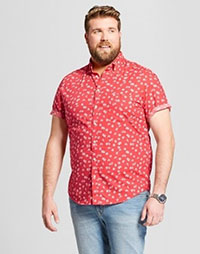 This situation allows DXL, the brand catering exclusively to the men’s plus size clothing to dominate. The company is seeing growing demand for trimmer fits across all categories. In bottoms, the company is seeing growing demand for slim-fit joggers in active wear/athleisure assortment and also adding more styles into tapered fit denim at every price point. The company is also adding trimmer fits in knits, sportshirts and dress shirts to create head-to-toe, trend-right looks. It has in-house technical designers that focus solely on big and tall customers. With 225 retail and outlet stores, DXL sells mostly through brick and mortar stores and features a lot of high-end labels like Ralph Lauren. J.C. Penney and Bonobos keep their special sizes in separate areas.
Customisation for each client
Very few apparel retailers offer plus-sizes for men. However, companies like Stitch Fix, customises its offerings for each of its client, big, husky, tall or short, using data and feedback. Earlier a 30-inch inseam was in demand, for example, however, as some customers complained about the pants being too long, StickFix created shorter options. Similarly, the styling service adjusted sleeve and shirt lengths for bigger men who aren't necessarily tall.
This attention to detail is nudging plus size menswear towards the inclusivity principle that is slowly being adopted by women's fashion. However, designing and manufacturing plus size clothes is tricky as it requires extra attention and work with suppliers. Especially for men, it requires pattern grading production, knowledge about neck size, sleeve size, shoulder span, waist and all-around fit. However, Holmes believes that this can be achieved by using creativity in patterns and fabric cutting.
Proving this right is Phillip White, a businessman dealing in oil, who tapped his own savings and credit cards, crashed textile and apparel conferences and brought his sketches to manufacturers. Within two years he launched his label, Phit Clothing, an inclusive line — from XS to 4XL — of activewear, swim and a jacket, with plans to add denim.
Social media fuels growth of plus-size market
White had to work closely with factories in order to make items across so many sizes, sometimes going back and forth to get them to understand his requirements. He believes there’s more work to be done in grading tights into 4X. However, he is determined to achieve this inclusivity with the help of social media which is helping men of all sizes to find the brands, including his, making the nicer, more current items they want to wear. He also hopes just as Ashley Graham has been the body-diversity trail blazer for women, men too will get their own plus size hero soon.
China to host Global Cotton Sustainability Conference
Global Cotton Sustainability Conference will be held in Chinafrom June 12 to 13, 2019. The global conference provides access to an international audience, prominent stakeholders within the cotton industry and organisations with a commitment to sustainability. The event will bring the entire sector together to shape a more sustainable future for cotton. Industry leaders and experts will get an interactive opportunity to explore topics at field level, in the supply chain and in the consumer-facing business.
Prior to the conference, the Better Cotton Initiative will host its annual member meeting to share organisational updates, report on Better Cotton supply and facilitate a new peer-engagement platform.
Although globally China has retained its position as the major producer of cotton, India has edged out the United States as the second largest producer of cotton. The location of China’s cotton production has tended to shift towards its west, particularly Xinjiang. This shift has had a positive impact on aggregate yields of cotton in China because growing conditions for cotton tend to be more favorable there than in eastern China, especially compared to areas in the Yellow River region. Improvements in farming systems have also played a role in increasing cotton yields in China and elsewhere.
Bangladesh looks to benefit from trade conflict
The trade conflicts between the United States and China will benefit Bangladesh apparel production and exports. Since China’s exports to the US will dip and it will lose competitiveness, and the supply chain will be affected, emerging trade relations could offer an opportunity for Bangladesh to increase its export and capture greater space in the global value chain.
Given the demographic dividend Bangladesh enjoys, this could emerge as a sustained contributor towards creating new job opportunity for the youth. In the next two years, overall exports from Bangladesh can fetch an additional $400 million under the escalation of trade conflicts and GDP can grow by 0.19 per cent in the same period.
Of the $400 million additional export earnings, $00 million are expected from the textile and garment sectors. The apparel sector is likely to benefit the most from the trade tariff tension. Leather and leather goods and ICT may also prosper.
Business may relocate to Bangladesh and other Asian countries. Already for the last few months, new export orders are coming in for Bangladesh. For January to November 2018 Bangladesh’s exports to the US market were up by 5.72 per cent. Apparel exports to the US market jumped six per cent in the same period.
EU may suspend privileges for Cambodia
The European Union will decide whether or not to revoke Cambodia’s preferential trade status. Following concerns over democratic and human rights setbacks in Cambodia, the EU has launched a process to temporarily suspend the Everything But Arms (EBA) deal that grants Cambodia preferential access to the European market. A number of sectors may be impacted by the suspension of EBA, including tourism, construction, and agriculture. However the EBA will probably not be revoked, as Cambodia has plenty of time to negotiate with the EU and defend its position. The temporary suspension of the EBA is an 18-month process.
EBA preferences can be withdrawn in case of some exceptional circumstances, notably in the case of serious and systematic violation of principles laid down in fundamental human rights and labor rights conventions.
Cambodia is expected to remain an attractive destination for foreign investment. It is no surprise if European firms continue to invest in Cambodia even if the EBA is suspended because the country has great potential in several industries. The EU is a key trading partner for Cambodia, especially for garments and footwear. Cambodia is expected to grow by seven per cent in 2019. Growth will be driven by garment exports, tourism, construction and real estate and agriculture.
UK-based WTiN joins AFFOA
Information provider World Textile Information Network (WTiN) has been accepted as a member of the Advanced Functional Fabrics of America (AFFOA). This is one of a growing number of industry partnerships that plug into the information provider’s unrivalled value as a source of intelligence on smart manufacturing and materials.
AFFOA’s mission is to bring about a domestic manufacturing-based revolution in the US by advancing and strengthening the supply chain through the development of sophisticated, integrated and networked textile devices. As a member, WTiN will assist in the creation of business opportunities within the AFFOA community and may host or participate in AFFOA Education and Workforce Development activities.
WTiN, based in the UK has established its leadership position as a provider of intelligence on advanced materials and digitalisation technologies through its recently expanded portfolio of online channels: digital textiles; textile 4.0; performance textiles; protective textiles; and smart textiles. WTiN aims at promoting advanced digital techniques within the luxury fashion sector by giving designers the necessary skills. Its network spans design, manufacturing and retail. For a UK-based information provider to be admitted into the heart of the US community of advanced textile developers is a major endorsement of its global service and the value its team can bring by its communication and analysis of the latest ideas in textile and apparel technology.