FW
London College of Fashion partners Education for Fashion Tech (E4FT)’ project
London College of Fashion (LCF) is partnering the Education for Fashion Tech (E4FT) project funded by the EU. The project aims to create a new training pathway to improve the level of key competencies and skills of students and trainers.
The project is constructing a resource for teachers to include innovative teaching and learning methods. Although a European project, it involves research institutes, companies and higher education centers from across the world.
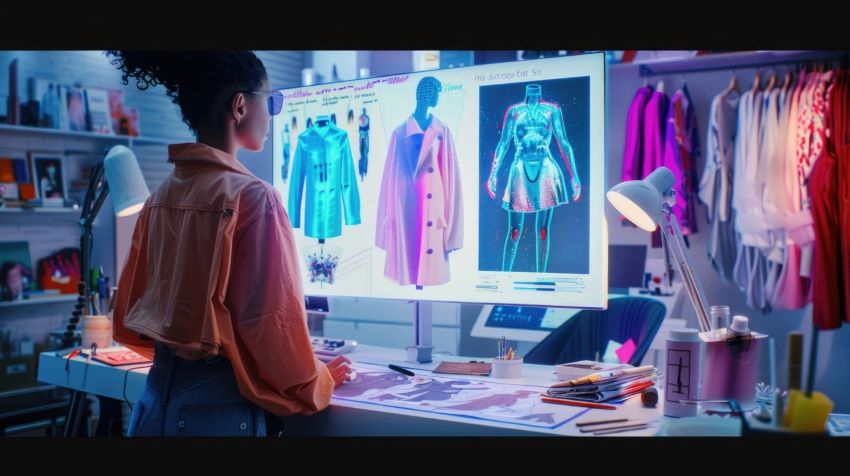
The project defines fashion tech as a technology that provides a fashion experience to the user and includes smart textiles, wearables and digital technologies. Some examples of where this technology is used include ‘improving health’, ‘enhancing senses’ and ‘personal expression’.
Another way in which LCF supports innovation is through the Define project: https://define-network.eu/. This project has formed a European fashion-innovation network bringing together the fashion-technology ecosystem of incubators, accelerators and the start-ups & SMEs they support, along with financiers and other organisations including universities, to share knowledge and encourage new ideas. As such it forms an open network that can be used within Europe and that can be collaborated with by similar initiatives across the world.
DCTV forms collaboration for circular clothing
DCTV has collaborated with brands, retailers, manufacturers, their associations, knowledge institutes and government bodies for introducing a more circular clothing and textiles value chain in the Netherlands. The DCTV team is run by MODINT, Fashion for Good, Circle Economy, ABN-Amro, MVO Nederland and het Groene Brein.
The aim of the project is to reduce the Dutch apparel and textile’s impact on water, raw materials and climate. It includes stimulation of a more durable way to use clothing, stimulating the second hand market and improving the results of material and fibre recycling to be able to actually use a greater share of collected textiles and clothing. Concretely, the project will focus on creating projects involving fibre recycling techniques, circular design, business and brand development and corporate and workwear.
Indian units set base in Africa
Indian textile units, especially garment manufacturing factories, are expanding to new geographies, mainly Africa. The prime reason is duty-free access to the US and EU markets. Among them are the KPR Group and SCM Garments, both from Coimbatore. The two companies have generated over 1,500 jobs.
For a polycot T-shirt, Indian exporters pay 32 per cent import duty in the US if shipped from India. It is duty-free if exported from Africa. For cotton T-shirts, the duty-free access gives 16 per cent advantage to an exporter. For an industry that works on thin margins in India, this is a substantial advantage even if the buyer does not pass on the entire benefit. By 2030, India is expected to be a net importer of clothing. The African market is also growing. By setting up capacities in Africa, Indian companies can tap the potential in both these growing markets in the coming years.
Indian investments across sectors started coming into Ethiopia after 2008 when Ethiopia came up with an attractive investment policy, and Indian industries were looking at frontiers outside India. Apart from Ethiopia, Kenya is attracting investments from garment manufacturers, while Tanzania and Uganda are also opening up. It is not only Indian factories, but textile companies from China, Sri Lanka, and Bangladesh that are investing in these countries.
India textile chemicals market to grow at a CAGR of 3.62% by 2030
The demand for textile chemicals in India, which stood at 323.52 thousand tonne in 2018, is projected to grow at a CAGR of 3.62 per cent to reach 487.63 thousand tonne by 2030.
Government initiatives like Powertex for fabric segment, Amended Technology Upgradation Fund Scheme (ATUFS) for all segments except spinning and setting up of integrated textile parks willfuel market growth in the country.
Moreover, the government has also revised the export rates under Merchandise Exports from India Scheme (MEIS) to 4 per cent. Exporters can also avail financial assistance under the Market Access Initiative (MAI) scheme. The government’s support, which is changing the lifestyles of the consumers by increasing their per capita income, is anticipated to drive the Indian demand for textile chemicals during the forecast period
Some of the major players operating in the country's textile chemicals market are Bodal Chemicals, Kiri Industries, Huntsman International (India), Archroma India, Fineotex Chemical, etc.
Global cotton prices fall
Global cotton consumption is growing at two per cent. However, world production is growing at a slower pace due to falling prices. Global cotton exports fell 6.4 per cent in 2016 compared to 2015. China is the largest exporter of cotton in the world. Some of the significant cotton producing countries are China, India, Pakistan, and the US followed by Brazil, and Uzbekistan. Asia-Pacific dominates global production but most of the cotton produced is domestically consumed. China holds a 29 per cent market share of world cotton production. In India, the domestic textile sector consumes most of the cotton produced in the country. In the US, most of the cotton produced is exported due to the less developed textile industry in the country.
Cotton is commercially used in various forms as cotton fiber, cottonseed, and cottonseed oil. Cotton is a crop that is majorly used in the textile industry. It is a perennial crop that is harvested in moderate rainfall and during a frost-free period with plenty of sunshine. Cotton is a leading cash crop in the US and is a labor-intensive farm crop. It is somewhat salt- and drought-tolerant, which makes it an attractive crop for arid and semi-arid regions.
Gap same store sales down five per cent
Gap’s global same-store sales fell five per cent in 2018. Gap has closed hundreds of stores globally over the past five years, yet that hasn’t translated to improved sales. In effect, the closings have pushed the brand further back in the recesses of shoppers’ minds. Shrinking to grow is not seen as a solution when a company has weak brands that can’t drive traffic.
To try and unlock value, Gap has decided to split up into two companies. Old Navy and NewCo — consisting of Gap, Intermix, Athleta, Banana Republic. Old Navy runs more than 1,100 stores in North America (its largest market) and Asia. But it will likely be hard to drum up interest in NewCo in large part because of the ongoing decay of the Gap brand.
After years of product miscues, weak sales and pressured margins at the hands of rising online apparel competition and mall rents, Gap has settled on a strategy to fix what ills the once iconic brand. Gap feels it remains a relevant brand with strong emotional equities. Logo sales were up 11 per cent globally in 2018. Gap sees this as an indication of the equity of the brand.
Euratex calls for circularity as brands come together for common goals
Textiles and apparel industry association Euratex has launched a manifesto, urging EU policy makers to act to establish a true circular fashion system. The manifesto is the first step of a new strategy that aims to bring the industry together to find ways forward on circularity. The manifesto makes recommendations for future EU actions, and paves the way for a new industry collaboration, which includes discussions on the presence of hazardous chemicals.
Among the recommendations, the manifesto calls for a new toolbox to bring together public and private initiatives, in order to remove barriers, increase awareness, invest in technological innovation, stimulate demand and develop new business models; coordination across all institutions at the EU level to be able to cover the full complexity of circular fashion and textiles; smart regulation to identify and alleviate areas that the industry cannot address alone, and encourage future innovation; and clearly defined roles and responsibilities for each actor in the value chain.
The manifesto shows that finding new ways for unprecedented coordination is possible. It is significant because it is the first time so many organisations in the fashion industry have come together to work with policy makers on a unified approach to circularity.
Ongoing Denim Première Vision show puts the spotlight on sustainability
Denim Première Vision is being held in Italy from May 28 to 29, 2019. The denim trade show is focusing on environmentally responsible denim and new innovations in the sector. It is seeking to give visitors a truly immersive experience. Upon arrival, visitors are plunged into unexpected surroundings that put one more in mind of an artistic performance than a conventional trade show. The space is dominated by four giant screens displaying images from an inspirational film shot by the trade show’s fashion team. Further in, attendees find themselves immersed in darkness, brightened here and there by glowing blue and green lights. The space is delimited by striped blue plastic sheets hung at different levels, behind which visitors can just about make out clothes, barely illuminated by a halo of light. In places, screens broadcast lists of numbers and other obscure signs to create a futuristic digital ambience. The idea is to offer attendees a 360 degree experience, presenting the sector’s autumn/winter 2020-21 trends. This includes the film that welcomes visitors, a cycle of three seminars and the installation space.
Another new addition is the launch of a dedicated denim section on the B2B e-commerce marketplace set up by Première Vision last September, which will now include denim mills exhibiting at the specialist trade show.
Worldskills Competition celebrates 45th anniversary
Known as the Olympic Games of international professional skills and held every two years, the WorldSkills Competition is celebrating its 45th anniversary this year. The competition enables experts to transfer international standards and technology to Macao, whereby optimising the training and education of the fashion and creative industry in Macao and cultivating professionals. Meanwhile, it improves the quality of the fashion and creative industry, forcing the Macao fashion and creative industry to shift from its focus on factory orders and mass production to diversified creative fashion designs, focusing on creating high quality and high-end products, as well as promoting created-in-Macao fashion labels; therefore it makes the entire fashion and creative industry in line with international practice.
After the competition, majority of the local young competitors continue to work and develop in the fashion and creative industry, disseminating the international standards and technologies they have learned to the Macao fashion and creative industry, thus contributing to the upgrading of technologies and skills of the industry. The 45th WorldSkills Competition will be held in Kazan, Russia in August this year.
China’s exports to the US drop
The US-China trade tension has led to a significant drop in China’s textile and apparel exports to the US. Overall, US textile and apparel importers are apparently shifting sourcing orders away from China mainly because of concerns over trade tensions rather than their usual business considerations.
Also, China’s export competitiveness is shifting from apparel to textiles. Even before the tariff war, the competitiveness of China’s apparel exports was weakening. In comparison, China is exporting more yarns and fabrics to the US in recent years. Between 2016 and 2018, China’s yarn and fabric exports to the US enjoyed a 13.1 per cent and 2.6 per cent compound annual growth respectively, compared with a 0.6 per cent decline of apparel. The changing product structure of China’s textile and apparel exports to the US also has an impact on trade flows. For example, as estimated, China lost around $20.4 million apparel exports to the US in the first quarter of 2019 because the sourcing orders shifted towards those product categories with relatively lower market growth. In comparison, the commodity structural effect has favored China’s made-up textile exports to the US market, resulting in more exports in the first quarter of 2019 than otherwise.