FW
China’s textile industry in doldrums as demand products decline
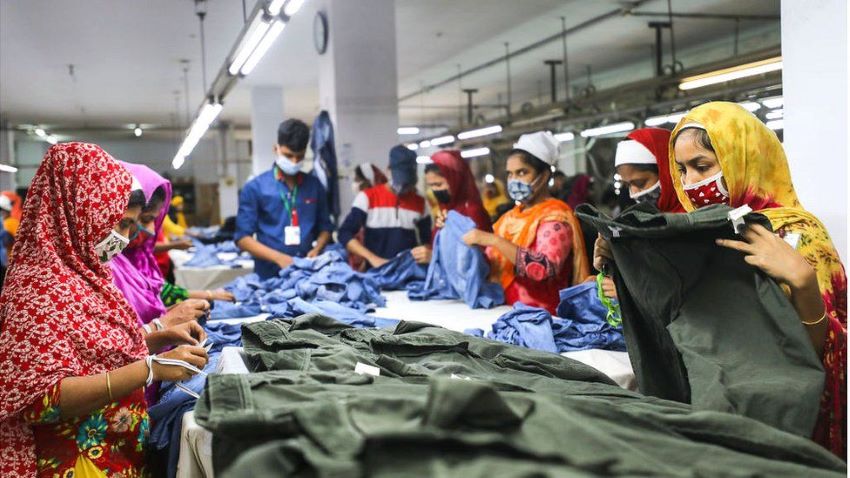
"The Sino-US trade war has dealt a heavy blow to the Chinese economy which is on a continuous decline. The textile and garment industry is also facing rough weathers due to the closure of several production units across the country. As official statistics by China Customs reveal, China’s total import and export value in the first five months declined by 1.6 per cent from the previous year. Its exports to the United States declined by 8.4 per cent year-on-year, while imports fell by 29.6 per cent year-on-year."
 The Sino-US trade war has dealt a heavy blow to the Chinese economy which is on a continuous decline. The textile and garment industry is also facing rough weathers due to the closure of several production units across the country. As official statistics by China Customs reveal, China’s total import and export value in the first five months declined by 1.6 per cent from the previous year. Its exports to the United States declined by 8.4 per cent year-on-year, while imports fell by 29.6 per cent year-on-year. In May 2019, China’s total import and export value declined by 3.4 per cent. Of this, its imports declined by 8.5 per cent. The country’s exports however increased by 1.1 per cent compared with the same period last year.
China’s year-on-year increase in May exports was due to the rush to export before new US deadlines for imposing new tariffs on $200 billion of Chinese goods. However, Xie Tian, a professor at the University of South Carolina’s Aiken School of Business states it would be difficult to maintain long-term growth of these exports as no country has the market and purchasing power of the United States, and no country can tolerate China’s surplus other than the United States.
High material prices and low demand impact textile growth
July and August is generally the textile industry’s offseason in China as most companies go on a vacation. However, this year this vacation has already begun for many garment factories. Large garment exporters along the coast have gone bankrupt as US buyers no longer purchase from China. Zhejiang Shaoxing Keqiao Textile City, China’s largest textile trading market, has closed around one-third of its enterprises. Textile companies are under pressure from two ends as the raw materials prices have increased while at the same time sales have been blocked. This uncertain outlook on trade has made manufacturers wary of taking new orders.
The impact of the Sino-US trade war on the cotton spinning industry chain has far surpassed industry estimates. In the first quarter of this year, China’s share of US apparel imports declined slightly with the proportion of many categories of Chinese clothing declining by double digits. These declines are further likely to accelerate after the increase in tariffs.
Low demand leads to increased inventory
A report by Capital Futures, a China-based research firm indicates demand for Chinese textile products continues to weaken with inventory of most enterprises increasing by over 50 per cent compared to the same period last year. The inventory of individual enterprises increased by 10-15 days’ sales compared with the same period last year, with some even exceeding 40 days.
The increase in cotton and yarn storage has made it impossible for some textile mills to save money to buy lint cotton. While a few small factories have stopped production, many are producing in shifts. In all, a pessimistic wave pervades the entire textile industry which is eagerly waiting for the sun to shine again.
Puma cuts down on emissions
German sportswear brand Puma is committed to reducing emissions from owned and operated facilities. The company will also aim at reducing its emissions coming from purchased goods and services.
Global warming is happening at a faster pace than previously anticipated. The fashion industry has a significant impact on the environment but rapid growth in global apparel and footwear production shows no signs of slowing. Companies like Puma are pursuing comprehensive strategies to decarbonise and do their part to prevent catastrophic climate change.
Globally there has been a huge momentum for the brand, which is making strong progress in the sports performance and sport style categories. Puma’s success comes against the backdrop of the athleisure trend that has gripped the sportswear market. While other companies flaunt performance and technology, Puma focuses on style that makes its products attractive to the casual dresser. Puma is looking at India as a key market of focus for growth and will be making big investments in the country to maintain its leadership position in the Indian sportswear market. Last year, Puma opened 30 more stores and the expansion would continue this year too. Puma currently has 365 stores in 125 cities across India.
Indian garment exports up 14 per cent
India’s garment exports rose 14.05 per cent in May 2019 compared to the same month last year. This follows a downturn in exports experienced in the last two or three years because of increased competition and high cost of exports from the country. After GST, demonetisation and other reforms, which made Indian products costlier, exports started declining. In 2018-19, exports dropped 3.43 per cent from 2017-18. But from October 2018, exports increased by 12 per cent. Exports grew by 4.45 per cent in April 2019 compared to the corresponding month of the previous year.
Factors which are in favor of India include China’s decision to exit the textile sector, Bangladesh’s labor becoming costly and Vietnam’s reaching a kind of plateau. These have made India an important destination once again. Despite Indian products being expensive by 10 to 15 per cent, buyers are still interested in sourcing from India. Exporters are optimistic that with support the industry can grow by eight per cent to ten per cent. In view of issues such as lower incentives and cost pressures in the industry, measures like increased rebate of state and central taxes and levies by 3.2 per cent for some items and 4.5 per cent for the other items were introduced.
India invites companies
India is looking at offering incentives to attract companies moving out of China amid the ongoing trade war with the US. Investments by Chinese companies can flow into smart phones and components manufacturing, consumer appliances, electric vehicles and parts, and daily use items like bed linen and kitchenware, 95 per cent of which are currently imported from China.
Financial incentives such as preferential tax rates and the tax holiday provided by Vietnam to lure companies are among measures being considered. Industries identified for incentives include electronics, consumer appliances, electric vehicles, footwear and toys. Other measures include setting up affordable industrial zones across India’s coastline and giving preference to local manufacturers in government procurement as an incentive to win over companies looking for an alternative production base.
The plan will help grow India’s manufacturing base and aid the Make in India initiative, which aims to boost manufacturing to 25 per cent of the economy by 2020. Doing that will help India narrow its huge trade deficit with China, its largest commercial partner. Economies, including Vietnam and Malaysia, have benefited from businesses trying to sidestep tariffs, while India has largely missed out on any investment gains. India’s effort is part of a larger plan to cut reliance on imports, while boosting exports.
Handmade clothing is trending in the West
Techniques from embroidery to cross-stitching are infiltrating legitimate fashion. Domesticity, whether it’s in a packaged meal kit or a pre-made hand-knit, is all the rage. People are appreciative of something that is handmade. The decade of the 70s was smitten with crafts but interest in them dwindled in the ’80s and ’90s.
At European fashion houses like Christian Dior and Loewe and American brands like Altuzarra and Ulla Johnson, techniques like crochet, macramé and knitting are dominant themes. Designers are identifying strongly with handwork, the social, collaborative, problem-solving aspect of it—of being literally hands-on. Fast fashion has pushed them to look to ways to make clothes that are not copyable by a machine, that are unique in their imperfections, as well. Fashion has fetishized the handmade ever since the sewing machine enabled mass production and conferred special status on anything handcrafted; that’s why the mystique of haute couture—which can employ hand-sewing, embroidery and appliqué—endures.
Handicrafts are seen as a way to combat anxieties about technology. Like yoga or meditation, needlework’s repetitive action has been shown to induce a relaxed state, and can lower heart rate and blood pressure. Designers have an added incentive to produce handmade items. Mass brands can’t easily imitate them.
Dolce & Gabbana become the first luxe brand to extend size range
Italian luxury fashion house, Dolce & Gabbana are the first designer brand to include sizes up to UK 22. All designer brands cater to women who wear up to size UK 16, so the brand, helmed by designers Domenico Dolce and Stefano Gabbana, is pushing boundaries and moving towards inclusivity.
D&G has always celebrated women and femininity. Not only is it extending its size range, but the fashion house will also feature plus-size models in their future campaigns. The Italian brand has been known to cast women of all sizes over the past few years. Several notable cury women walked for the brand, including actor Monica Bellucci and models Ashely Graham and Tess McMillan. Along with this news, Dolce & Gabbana vowed to continue working with plus-sized models and cast them in future advertising campaigns and shows.
Calik Denim launches app for designers
Calik Denim, based in Turkey, has launched an app developed to help designers connect the dots between fabric sourcing and fashion trends. Available to Calik Denim’s clients, the app provides designers a one-stop shop for matching denim fabrics with global trends. On the app, buyers and designers will find lists of the top fits for men and women from around the world, as well as image galleries based on color, finishing, fabrics and styling trends. Users can tap their favorite trends to see which fabrics from Calik Denim will give them a similar result. Additional features allow users to search for specific fabrics through a filter option and to request samples from their designated Calik Denim sales representative. Different washing recipes are also available on the app.
For Calik Denim, the app is an important step towards digitization. Responsible innovation is the number one priority for the brand, not only for products, but also for every aspect of its business including marketing. The denim community can expect more outside-the-box thinking from the mill as it continues to develop responsible innovative solutions. Calik Denim will continue to create concrete innovations, projects and technologies and the platforms required to share these innovations. It believes these investments are an essential means for consistent communication with its business partners.
Burberry sets carbon neutral targets
Burberry is aiming to become carbon neutral in its operational energy use by 2022. Burberry’s ambitious science-based target demonstrates the leadership and innovation needed to succeed in a zero-carbon world. For the first time, it is setting targets for greenhouse gas emissions that apply to its extended supply chain. The brand is already carbon neutral across the Americas region, EMEIA retail stores and its UK operations. During 2018-19, the brand achieved a 43 per cent reduction in market-based emissions compared to the 2016-17 base year.
The fashion industry’s environmental impact is significant and growing. To prevent catastrophic climate change, all major apparel and footwear brands are setting science-based targets and pursuing comprehensive strategies to decarbonize their businesses.
Burberry is investing heavily in transforming itself into a much more luxury-focused entity. The transformation has seen the company putting a heavy focus on digital and introducing the B-Series limited-edition monthly drops sold on social platforms, while partnering with Instagram on the Checkout launch for in-app Instagram shopping. In the directly-operated physical space, it has been refreshing its stores and closing 38 smaller, non-strategic retail stores, a process that will continue this year. On the product front, a full-look merchandising initiative has driven improvements in cross-selling, benefiting tops, skirts and trousers.
Uster launches five value modules for Quality Management Platform at ITMA
ITMA 2019 saw the launch of five ‘Value Modules’ for Uster® Quality Expert from Uster Technologies. These modules give spinners an objective and accurate view of the entire spinning process, leading to higher yields and consistent quality: ‘Managing a textile mill with quality in mind’ in practice. Optimize ring spinning, control contamination, etc. The five Value Modules will give tangible benefits to operators, quality managers and mill managers.
 ITMA 2019 saw the launch of five ‘Value Modules’ for Uster® Quality Expert from Uster Technologies. These modules give spinners an objective and accurate view of the entire spinning process, leading to higher yields and consistent quality: ‘Managing a textile mill with quality in mind’ in practice. Optimize ring spinning, control contamination, etc. The five Value Modules will give tangible benefits to operators, quality managers and mill managers. They include:
Ring Spinning Optimisation (RSO): RSO focuses on the most costly part of yarn making – ring spinning – using data from Uster® Quantum 3 yarn clearers at winding and Uster® Sentinel in ring spinning to ensure yarn quality stays constant, even at high speeds. Spinners can correlate end-breaks with winding data, as well as with fiber properties, in a single system. This results in an improved cop build-up quality, fewer quality variations and a reduction in alarms, delivering significant profitability increases to yarn producers.
Uster® RSO 3D extends this functionality to quality mapping of the ring frame, based on individual quality data for each spindle. This helps to identify outlier sides, sections or spindles. Through seamless collaboration with Muratec QPRO EX/FPRO EX spindle identification, Uster® Quantum 3 and Uster® Sentinel, the system can stop faulty spindles or poor quality cops and so prevent poor quality. This reduces the workload for operators, while increasing quality assurance.
Total Contamination Control (TCC): The double protection by Uster® Jossi Vision Shield And Uster® Quantum 3 gives spinners control over balancing quality and productivity – a transparency that enhances cost efficiency and maximizes profits. It means they can make good choices about raw cotton purchases and reduce waste of ‘good’ fiber. Optimizing ejections and cuts gives precise control over levels of contamination, ensuring the yarn meets customer demands.
Alarm Center: This provides direct guidance to machine operators, alerting the appropriate personnel and pointing them to the exact location of an issue. Knowledge from these alarms is stored and used for future reference, enabling even faster reactions.
Mill Analysis: Intelligent, data-based analysis by Uster® Quality Expert provides customers with an excellent overview of mill operations. Information is stored centrally, for easy access and total transparency. The result is savings in both time and money.
Yarn Prognosis: Accurate forecasting of how yarns will perform in downstream processes brings security and confidence to both spinners and their customers. It means spinning mills can isolate below-par quality and remove it, sending out only yarn which meets customer specifications.
Quality Management Platform: The Quality Management Platform contributes directly to improved business security for textile producers. “The profitability and future sustainability of a textile mill depends a lot on the optimization of production and the predictability of produced quality,” says Thomas Nasiou, CEO of Uster Technologies. “Our customers are partners and we want to support them to stay successful and tackle challenges, by providing the best services and systems.”
Lectra redefines 3D virtual prototyping with Modaris® V8R2
"Lectra has launched Modaris® V8R2, the latest version of its patternmaking, grading and prototyping 2D/3D solution. The new version of Modaris, the most widely used modeling solution by leading brands in fashion and apparel, offers greater speed, efficiency and precision in product development. With its powerful 3D simulation and collaboration tools, patternmakers are developing patterns faster and speeding up their decision-making procedures."
 Lectra has launched Modaris® V8R2, the latest version of its patternmaking, grading and prototyping 2D/3D solution. The new version of Modaris, the most widely used modeling solution by leading brands in fashion and apparel, offers greater speed, efficiency and precision in product development. With its powerful 3D simulation and collaboration tools, patternmakers are developing patterns faster and speeding up their decision-making procedures. By reducing or eliminating physical prototyping, product development is less expensive and the time to market is as close as possible to trend detection.
To preserve and strengthen its position as a market leader of product development software, Lectra, with this upgrade of Modaris, is giving particular focus to 3D virtual prototyping. Patternmakers can now share with their partners, 360-degree videos, accessible on any device. Designers in response are able to visualize, comment, and approve the style and fit using the new 3D Style module.
New advances have made it possible to reduce the number of physical prototypes by up to 50 per cent. Modaris V8R2 improves the quality of the solution’s 3D simulations and expands its library with new assets (fabrics, 3D top-stitching effects, realistic scenes, lighting studios, Pantone® and Natural Color System®©.) The solution is now compatible with Vizoo, a high-quality scanner that brings forth a heightened realism to the appearance of fabric swatches, and with other 3D solutions such as Maya, 3DS Max, Iray to make the digital renderings of the prototypes more true-to-life and accurate.
One of the innovative developments of Modaris V8R2 is a special dart feature to help patternmakers add dimension to their garments with ease. Thanks to this new feature, modifying a dart requires half the usual time, resulting in a 50-90% increase in overall patternmaking speed.
Another highlight of this solution, and important nod to the globalized workforce of the fashion industry, is its ability to manage different units of measurement. With Modaris V8R2, Lectra has made it possible for patternmakers and external suppliers the guarantee of size compliance, regardless of the measurement systems used in the countries where production occurs.
Modaris V8R2 is already gaining traction among its pilot customers. Italian womenswear company GGZ was the first to endorse Modaris V8R2. . “Modaris’s new dart feature helps us save up to 50% of pattern modification time. Additionally, 3D prototyping helps us ensure that pattern volumes and proportions correspond to our designers’ expectations early on, dramatically reducing our lead times,” states Majla Gottardo, Patternmaker, GGZ.