FW
July fabric show in New York
New York Fabric Show will take place from July 22 to 23, 2019. The trade show takes place twice a year -- January and July -- and is meant for designers, manufacturers, private label retailers, event planners, retail fabric stores, and others who buy fabrics and trims. Exhibitors are American and European wholesale suppliers, including mills, converters, importers, and distributors. All provide low minimums, and many have in-stock fabrics and trims. Other resources are also made available at the show.
The show is organized by DG Expo and was started by Susan Power in 2012 in New York City. Since 1988, Susan has been providing sourcing information to apparel and home furnishing industry professionals. DG Expo is a great place to find resources and small cottage industries displaying their unique textile and yarn collections from different parts of the world. It brings together all textile designers and fashion designers who exhibit the purest and unique raw materials creations from different parts of the world.
DG Expo has moved the New York Fabric Show this July to Hudson Yards, a new location on Manhattan’s West Side. The show is just a block away from the Jacob Javits Center. Similar fabric shows are held at San Francisco, Miami, Dallas and Chicago.
Hong Kong Fashion Week attracts over 1000 exhibitors from across the globe
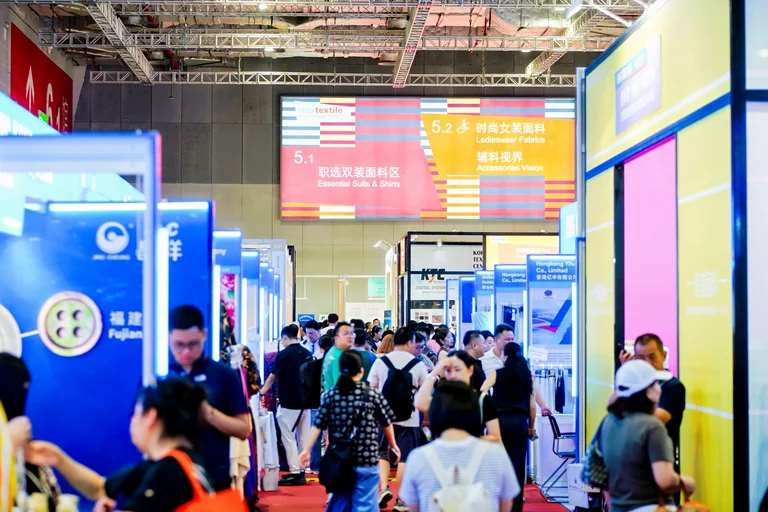
The ongoing Hong Kong Fashion Week being held from July 8 to 11 has gathered around 1000 exhibitors from 12 countries and regions to present the latest fashion designs, international brands, garments, fabrics and accessories. To create more business opportunities for exhibitors, 91 buying missions from 42 countries and regions will visit the show, with more than 3,670 companies represented. Various themed zones have been set up to showcase the latest fashion collections from around the world.
Innovative technologies are helping to kick start a revolution in the fashion industry, and this year’s fair will focus on how high-tech ideas are being incorporated into fashion designs and business processes. Various seminars are being held as part of the fair to bring participants up to date on the latest industry trends and technological developments. One seminar will examine the upcoming trends for men’s wear, women’s wear and accessories for the autumn/winter 2020-21 season, giving industry players a clearer idea of where the business opportunities will be.
Industry leaders will examine e-commerce strategies. An influencer platform explores ways to use artificial intelligence to establish marketing plans for online influencers in a bid to increase brand affinity and facilitate sales conversion.
Green doesn’t mean dull anymore
Sustainability can’t do without design. This is a relatively new concept in sustainable fashion. Consumers no longer have to sacrifice design quality for social and environmental responsibility. So the fashion industry is making strides toward sustainability but without compromising on design.
Consumers’ only choice for green garments used to be ugly and expensive. Now, green fashion doesn’t differ aesthetically from products made using traditional production methods nor is the price point exorbitantly higher. Products need to be disassembled at the end of their life-cycle, which requires not only materials that can be recycled but also better reuse/repair options from labels.
Currently, there are almost no rules requiring companies keep track of their often complex supply chain despite flagrant human rights violations in factories at home and abroad. The 2013 Rana Plaza disaster, in which a garment factory in Bangladesh collapsed and killed thousands of workers, was a wakeup call for an industry that often turned a blind eye to its production methods. Jeans are the fashion industry’s most notorious culprit for waste and chemical production. The textile industry uses 7000 liters of water to produce one pair of jeans. The indigo dye used for the denim wash is painfully detrimental to the environment.
Gap develops foam-dyed denim ‘Dry Indigo’
Gap will roll out foam-dyed denim that dramatically reduces water, chemical and energy use. The new process, called Dry Indigo, can reduce water use by up to 99 per cent, while also using 89 per cent less chemicals, reducing energy use by 65 per cent, and eliminating water discharge when compared to the traditional slasher indigo (or sheet dyeing) process. Utilizing a foam dye that adheres to yarn, the transformative Dry Indigo technique produces a denim fabric that is comparable in hand-feel, aesthetic, performance and washability to traditionally dyed denim. The foam-dyeing technique occurs in a space of less than 65 feet — compared to the hundreds of feet that is typically necessary for a traditional dyeing machine — thereby significantly reducing energy needs.
Gap has a goal of conserving 10 billion liters of water by the end of 2020. Gap has worked closely with supply chain partners to implement numerous water-saving initiatives. In 2016, Gap introduced a smart denim wash program that has enabled the company to save over 229 million liters of water compared to conventional wash methods. Gap plans to derive 100 per cent of its cotton — across all brands — from sustainable sources by 2025. The initiative will include sourcing cotton that is organic and recycled.
Dunzo delivers Puma gear
Dunzo is stocking Puma shoes and the blue fan jerseys. Especially the limited edition One8 golden spikes. Fans can now purchase these shoes with Dunzo through their nearest Puma store in Bangalore, Delhi NCR, Hyderabad, Chennai, and Pune.
Dunzo is a hyperlocal delivery app with a real-time delivery promise. The platform cuts across categories and brings almost anything a user can possibly want and that a merchant can offer online. Collaborations with brands like Puma India put Dunzo at the heart of brand and consumer conversations, bringing them both closer, faster. Dunzo’s three-sided platform comprises merchants, partners, and users, making it an ideal tool for brands to reach their consumers. In the last 18 months, Dunzo has grown 30-fold and is expecting to do upwards of two million orders a month. Dunzo has a repeat user rate of 80 per cent and a transaction frequency of five orders a month per user. The company aims to get micro-market profitable at an order level in the next quarter. The company aims to be the logistical layer of the top ten cities in the country.
German sportswear maker Puma is looking at India as a key market of focus for growth and will be making big investments in the country to maintain its leadership position in the Indian sportswear market.
Italian brand Ermenegildo Zegna buys stake in Dondi group
Ermenegildo Zegna has bought a 65 per cent stake in the Dondi group. Ermenegildo Zegna is an Italian textile producer and luxury men’s wear label. Dondi, also based in Italy, makes knitwear for men and women. Dondi has a wholly internalised production cycle, from fabric design to distribution. For over 40 years, Dondi has been a supplier to leading fashion labels and designers in the luxury segment and operates in markets like the US, France, Germany, Japan, South Korea, the UK and Turkey.
For this operation, the Zegna group has adopted the same formula used with textile producer Bonotto, in which it bought a 60 per cent share in 2016, leaving a minority stake and creative and operational control in the long-established company to its founding family. It is a way for Zegna to preserve Italian textile know-how and ensure control of its supply chain. In 2018, the Italian group also took control of luxury ready-to-wear label Thom Browne.
Ermenegildo Zegna is one of Italy’s most famous family-driven enterprises. Growth has been possible through shrewd diversification of the offering, which now ranges from clothing to accessories and fragrance. Zegna fashion is woven and designed, while its fragrance is composed and distilled. Zegna fashion underscores a man’s elegance and style, while its fragrance accentuates his masculine aura with alluring essence.
Bangladesh reopens textile mills
Some 16 textile mills that had shut down in Bangladesh will be reopened under a public-private partnership. The aim is to combine the resources of the state and the skilled manpower of the private sector for further progress of the country’s textile industry. The public-private partnership project is expected to lead to maximum utilization of manpower and resources; profit maximization; risk minimization; reduced cost.
Meanwhile textile mills in Bangladesh want the five per cent advance tax proposed on import of textile machinery and spare parts to be withdrawn. They say the proposed taxes would discourage investment in the sector and halt expansion of textile mills in the country. The five per cent tax is also proposed on some raw materials used in textile mills such as polyester, tencel fiber and viscose. As of now import of textile machinery is subject to only one per cent customs duty. There are 430 yarn manufacturing mills, 802 fabric manufacturing mills, and 244 dyeing-printing finishing mills in Bangladesh. Proposals the industry has welcomed are those relating to keep the corporation tax rate at 15 per cent for the textile sector for the next three years and a one per cent cash incentive against exports of apparel goods to traditional markets.
Cash flows shrink in Chinese PTA plants
PFY plants in China are witnessing shrinking cash flows. By now, only some PFT bottle chip, PET fiber chip, and polyester filament yarn plants have started maintenance.
Polymerization rate in China declined by six per cent in May 2019. Polyester plants showed stronger risk-aversion awareness when end-user demand weakened and the PTA market was firm. PTA price still enjoys support in the short run. Some downstream plants that had low feedstock inventory at hand even considered cutting the run rate or shutting down temporarily, waiting for the reduction of feedstock prices. Downstream buyers presented a cautious mindset after the sharp up-and-down of PTA futures.
Stocks of finished goods in polyester plants are expected to rise with lower buying enthusiasm of downstream players and these stocks will devalue once feedstock prices slip. Thus, making a good preparation to cut production may be the best choice for polyester plants. Some PFY plants presold a lot previously, so these plants may postpone production a reduction amid the delivery issue. Generally, the operating rate of twisting units, fabric manufacturing plants and polyester plants is expected to decrease for a period, but the decrement may be not big. What happens in the second half of July remains to be seen.
Adidas launches recyclable hoodie and tennis dress
Adidas has launched two sustainable high-performance wear prototypes in collaboration with designer Stella McCartney. The first piece is a 100 per cent recyclable hoodie, made of garment waste, 60 per cent NuCycl and 40 per cent organic cotton diverted from landfills. The process involves transforming old, discarded clothing into raw materials used to create new, premium-quality clothing. Because of the product’s sustainable engineering, the hoodie are fully recyclable and can be remade into new high-performance apparel. The second product is a tennis dress made from cellulose blended yarn and a protein-based material comprised of renewable ingredients such as water, sugar, and yeast. The dress is completely biodegradable.
McCartney has a long history of using sustainable materials. She has been partnering with Adidas since 2005. Last year, the two partnered for a women’s active wear line made entirely of recyclable materials. Specifically, Adidas used plastic found in oceans and organic cotton to manufacture the clothes in the line.
Stalling research for alternative, sustainable materials is no longer an option. With Adidas taking major steps to champion sustainability, it may encourage more popular brand names to do the same. Regardless, what Adidas has shown is that it is possible to create sustainable apparel without compromising on style.
Denny Bruce is the new president of Dickies
Denny Bruce is Global Brand President of Dickies. He will be responsible for all aspects of the brand’s global operations and performance. He will ensure the brand continues delivering compelling products supported by experiential campaigns that drive consumer acquisition. He’ll oversee the brand’s wholesale and direct-to-consumer businesses, including a focus on digital. He will also be responsible for continually strengthening the Dickies team and its capabilities to drive profitable growth through the activation of its strategic plan globally.
Dickies provides workers with tough, durable work wear. At the same time, the brand’s heritage and authenticity have transcended the work wear category. Dickies is a part of VF Corporation, which acquired the brand as part of its 2017 purchase of Williamson-Dickie and its portfolio of work wear brands. Of the 20 brands owned by VF, Dickies is the company’s fourth largest brand by revenue. VF Corporation is a global leader in branded lifestyle apparel, footwear and accessories.
Prior to joining VF, Bruce was at Traeger Pellet Grills. There, he quadrupled the company’s revenue and earnings during a four-year period. Before that, Bruce was vice president of domestic sales at Skullcandy, where he helped create an aspirational lifestyle brand while growing revenues. Bruce has also held roles at Vans and Burton Snowboards.