FW
Adidas launches new initiative for used clothing
Sportswear giant Adidas has launched a new sustainable initiative that rewards customers with coupons in exchange for their old clothes.
The sportswear company has launched this initiative for members of its loyalty club in the United Kingdom. The proposal encourages customers to deliver their used clothing in exchange for a coupon. The company implements this initiative in collaboration with the Stuffstr startup, which, once the customers’ clothes have been collected, is in charge of repairing it, selling it again or reusing it for the production of new clothes. It has already launched a sustainable collection this year in collaboration with Stella McCartney, called Futurecraft.loop.
The clothing return method is applied to those garments with a value starting from 20 pounds or higher through the Creator’s Club app, which will reward customers with coupons. Stuffstr will be dedicated to offering a free collection service for those products that want to be returned and will manage their resale possibilities.
Adidas launched a similar concept in Brazil, in 2012, and in Canada, in 2016, and plans to expand the initiative to other countries next year. Along the same lines, Burberry and The RealReal, the luxury goods shipping market, have recently announced similar bets for circular economy.
ITSA-The most trusted platform for industry leaders celebrates 25 years
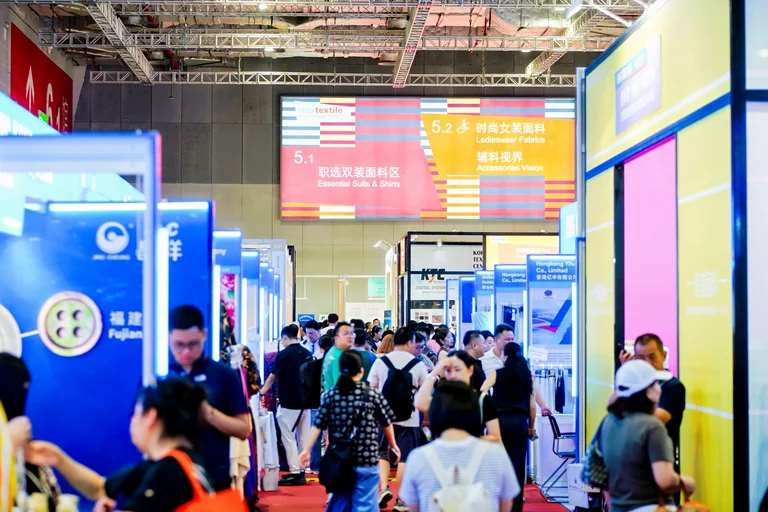
"The recently concluded Autumn Edition of Intertextile Shanghai Apparel Fabrics marked the 25th year of the launch of this trading platform. With 89,662 visitors from over 120 countries and regions, the exhibition proved to be an ideal platform for them to meet global partners. “Exhibitors use this platform to unveil their latest collections,” said Wendy Wen, Senior General Manager, Messe Frankfurt |(HK). "This in turn attracts more visitors from all over the world. At this edition, we welcomed trade buyers from more countries and regions. The fair’s diverse network of suppliers and buyers ensured definite business for its visitors,” Wen added."
 The recently concluded Autumn Edition of Intertextile Shanghai Apparel Fabrics marked the 25th year of the launch of this trading platform. With 89,662 visitors from over 120 countries and regions, the exhibition proved to be an ideal platform for them to meet global partners. “Exhibitors use this platform to unveil their latest collections,” said Wendy Wen, Senior General Manager, Messe Frankfurt |(HK). "This in turn attracts more visitors from all over the world. At this edition, we welcomed trade buyers from more countries and regions. The fair’s diverse network of suppliers and buyers ensured definite business for its visitors,” Wen added.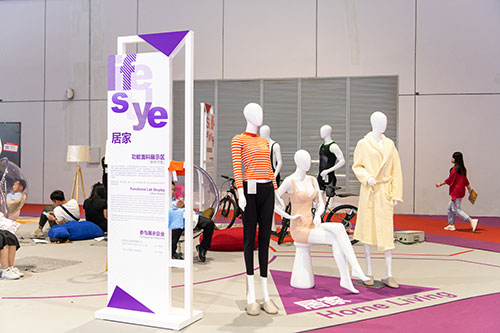
The fair was held concurrently with Yarn Expo Autumn, CHIC and PH Value from 25 – 27 September, at the National Exhibition and Convention Center (Shanghai). It was co-organised by Messe Frankfurt (HK) Ltd; the Sub-Council of Textile Industry, CCPIT; and the China Textile Information Centre.
A one-stop shop for apparel products
Over 4,422 exhibitors from 33 countries and regions exhibited at 2019 edition of Intertextile Shanghai Apparel Fabrics. These also included buyers participating for the last 10 to 20 years. The fair’s product zones, such as Functional Lab and Beyond Denim, offered an easier way to its exhibitors to meet their target buyers.
Roundtable meeting with industry leaders of different countries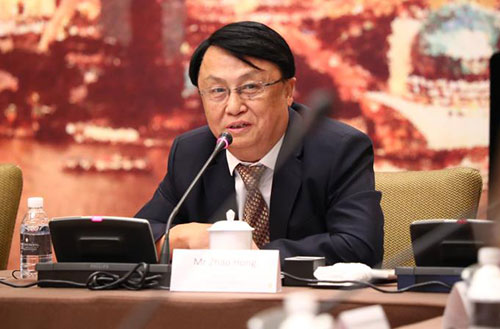
For the first time during the inaugural day at Intertextile Shanghai, a roundtable meeting consisted of association and trade body heads from various countries. Zhao Hong, China Textile magazine, who moderated the roundtable conference, explained “The theme of this roundtable meeting is sharing and getting insights on the future of apparel and textile industry, sustainability and opening to the possibilities of international cooperation.”
It is interesting to note here that this comes at a time when China is grappling with an ongoing trade war situation with the US. China seems to be opening up and looking for more cooperation in the region to keep its position strong and working out with more and more countries through its existing initiatives like One Belt One Road (OBOR).
While making a detailed presentation about China’s textile and apparel industry, its technology, R&D and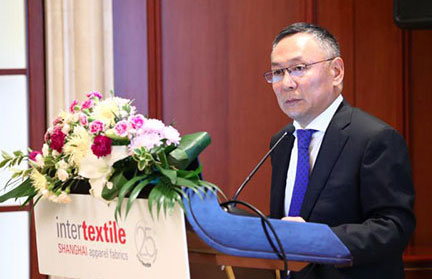 designing drive , Xu Yingxin, VP, CNTAC and President, The Sub-Council of Textile Industry CCPIT, expressed deep concern about the China-US escalating trade conflict over last one year. The USA is China’s biggest importer with a 38 per cent share through wide ranging products.
After 12 rounds of negotiations already concluded between the world’s two largest economies, the friction is likely to impact exports of China if the conflict continues. Small and medium enterprises are more vulnerable, resulting in unemployment and dwindling investments in the textile industry.
Summarizing the situation, he said, “We are seeing an era of uncertainty where we will have to face a Sino-US trade war and we have to be very patient and resistant, but we are simultaneously opening to all markets and we believe in cross country development. “
Though a few of the association heads representing their respective countries were upfront in admitting that the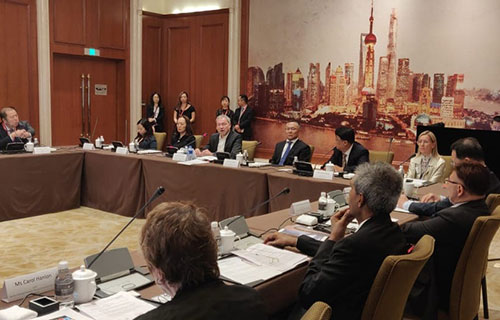 trade war between the two countries is helping them to grow in exports to the US, at the same time, it was widely agreed that the conflict is not good as it is bringing in a lot of uncertainties in global trade and should soon be resolved. Also OBOR is a great initiative and will help all the countries who are participating in it with logistic solutions, lowering prices. It will bring in a lot of growth in global trade.
Country pavilions forecast future trends
The fair also organised country pavilions for visitors interested in more Asia-Pacific trend forecasts. The Japan pavilion featured many Japanese companies which brought the global industry together. One such exhibitor included Asahi Kasei Corporation which was represented by Kiichiro Kobayashi the Manager of its Fibres & Textiles Marketing Dept. Kobayashi views the fair as “the best platform to access the Chinese market as it offers its buyers an opportunity to partner with some of these visitors later.”
The Korea Pavilion achieved remarkable business results just from the first two days of the fair, thanks to their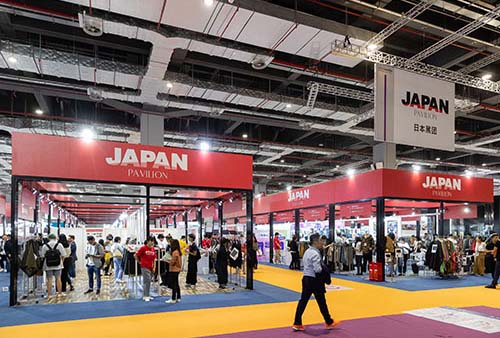 high quality products. “This fair provided us with an opportunity to introduce Korean textiles to an international market effectively,” said Young Sang Yoon, Vice President of Korea Fashion Textile Association, Korea.
Leading European and US trading companies at the sustainability zone: The All about Sustainability Zone featured Testex AG, an independent Swiss testing and certification organisation which was the official representative for OEKO-TEX. Led by its group CMO, Marc Sidller, the company has been hosting a pavilion for the last five years. “This year, we had the opportunity to interact with some of the best European and US trading companies and brands,” Sidler reveals
SalonEurope: The SalonEurope zone also recorded a good visitor turnout. Paul Alger, International Business Director, UK Fashion & Textile Association noted, “We were extremely happy with the visitor turnout.”
Premium Wool Zone: The Premium Wool Zone was attended by companies like Dormeuil who have 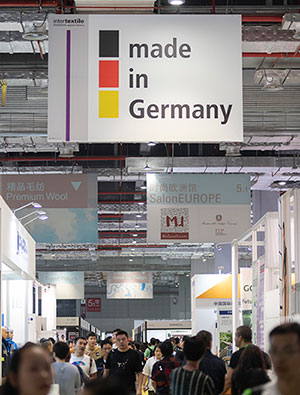 been exhibiting in this zone for the last 10 years. “China is a very important for us and we want it to become our top market in the next few years,” noted Aline Galimberti, the Product Manager of the France-based company.
Verve for Design: The Verve for Design zone was a great hit with visitors thronging the stall on the first day itself. Joe Moreline, Sales, Camilla Frances revealed, “We had buyers mostly from China and Australia. We were surprised to see some of our existing Australian customers too.”
The fringe programme included Asia’s first ever Fashionsustain conference; a round-table meeting focused on international trade and sustainability; the Intertextile Consumer & Lifestyle Trend, themed FutureCast 2021: New Consumer Rules; the Smart Factory Forum, a panel discussion focused on Artificial Intelligence (AI) applications and trends; and an industry crossover with Messe Frankfurt’s new fair Licensing China which included a licensing seminar and display area.
The key to business in China is a face-to-face interaction with the textile industry. Intertextile Shanghai’s 25 years of experience have made this a trusted platform, for both exhibitors and trade buyers in China, to trade textiles.
With its unparalleled products on display, Yarn Expo paves the way for an optimistic future
"With a record-breaking 543 exhibitors from 14 countries and regions, Yarn Expo Autumn 2019 offered an unparalleled range of quality and product diversity. Held from September 25-27, 2019 at the National Exhibition and Convention Centre in Shanghai, the expo showcased an array of fancy, specialty and regenerated yarns, as well as high quality cotton, wool, silk and linen. Its new display zone, Fancy Yarn Vision, proved to be popular stop for buyers to quickly and efficiently see samples from highlighted fancy yarn exhibitors on offer."
 With a record-breaking 543 exhibitors from 14 countries and regions, Yarn Expo Autumn 2019 offered an unparalleled range of quality and product diversity. Held from September 25-27, 2019 at the National Exhibition and Convention Centre in Shanghai, the expo showcased an array of fancy, specialty and regenerated yarns, as well as high quality cotton, wool, silk and linen. Its new display zone, Fancy Yarn Vision, proved to be popular stop for buyers to quickly and efficiently see samples from highlighted fancy yarn exhibitors on offer. Sustainability remained a key trend at event with fringe events by the European and Chinese exhibitors focusing on sustainable products.
Exhibitors note an optimistic future outlook
Despite economic uncertainty within the Chinese market, many exhibitors at the event noted optimistic outlook for their future. This optimism was mainly credited to the resilience of China’s dominant purchasing power. The fair also received a good feedback from its Southeast Asian exhibitors, one of whom included Ravindranathan Narayanasamy, Director of the Cotton Textiles Export Promotion Council, India. Elaborating on this expo, Naryanasamy, “Yarn Expo is growing larger and becoming more international each year. This year, our exhibitors met visitors from Korea, Egypt and Europe. We also received 40 onsite orders at the India Pavilion.
Similarly, the Cotton Council International of USA recorded over 140 visitors at its booth. “We met visitors from Indonesia, Thailand and other Asian countries,” said Shoapiing Li, Senior Manager, China Supply Chain Marketing of the Yarn and Home Textiles Department of the company. “These visitors spanned different industry roles. Some of these have already started contacting our sales team to place orders.”
An effective getaway for brand promotion
The fair resulted in several new business deals being signed amongst its visitors and exhibitors. A prime example of this was the Uztex Group, which signed over three deals at the fair.” These deals will take our company to the next level in the Chinese market,” said Ravshan Kambarov, Commercial Director of the company. “We had orders not only from China but also Turkey and Iran. There are lots of different markets here, mostly from India, Bangladesh, Pakistan and China,” he added.”
The fair also proved to be an effective gateway for Korean companies like HJLite for promoting its products and brand image. “The buyers in this fair are diverse which helps us to explore the Chinese and European markets. People can explore numerous products in one place in a short time,” said Joon Son, Sales Manager, HJLite, Korea. r Steven Shen, Textured Yarn Dept. Director, Everest Textile, Taiwan
A must-attend for visitors
Yarn Expo is ‘must attend’ event for its visitors as it has a significant influence on their company’s business strategy. “The new Fancy Yarn display area at the expo is very handy to find good quality fancy yarn exhibitors and I can find whatever I want here,” says Bonnie Chan, Manager of Raw Materials, Pacific Textiles, one of the visitors at the show. The expo also serves as a platform for networking and partnership exploration. “I sought out 30 potential suppliers that I am interested in, and I look forward to establishing business with them,” said Marcin Kolasa, Product Development, Legs Sp. z o.o, Poland. Going beyond a sourcing channel, this show acts like a stage for displaying high-quality products and innovative concepts,” Rajiv Srivastava, Manager, Neman Brothers & Assoc., USA, summed up.
Interfiliere Shanghai re-emphasises on sustainability with its focus on eco-friendly materials
"A meeting point of all global players in the lingerie and swimwear industry, Interfiliere Shanghai offered a China-based view of textiles and textile accessories for lingerie and swimwear industry. Organised from September 26-27, 2019 in the Chinese capital city, the event reflected the current fashion trends in China. It featured one of the most comprehensive displays of the best in apparel, textiles, and machinery pertaining to this sector."
A meeting point of all global players in the lingerie and swimwear industry, Interfiliere Shanghai offered a China-based view of textiles and textile accessories for lingerie and swimwear industry. Organised from September 26-27, 2019 in the Chinese capital city, the event reflected the current fashion trends in China. It featured one of the most comprehensive displays of the best in apparel, textiles, and machinery pertaining to this sector.

One of the main focus areas of the exhibition included technological developments in the lingerie industry. Xianming- a luxury brand operating for the last 20 years mapped these developments over the years. Its spokesperson noted, “3D printing technology reinvents the traditional way of making a bra. It enables us to create a seamless bra. People with health issues can wear this lingerie or active wear.”
Colors and fabrics trends

Vanessa Causse, a fashion forecaster predicted the lingerie fashion and social micro trends for the upcoming Spring/Summer 2020 season. “This season will focus on the brown and white colors. This black will be different from the usual black color. Fabrics will be made from new fibers like bamboo or bean or a mix of polyamide with spuntech,” she said further adding that “the global slowdown is certainly affecting the lingerie industry. To tackle this, we need to improve our efforts on sustainability.”
Addressing sustainability with new materials and fibers
The importance of sustainability in the Chinese fashion industry was emphasised upon by Martin Lehpur, a fashion consultant for trends and strategies for brands.”China gives importance to green. It is an eco-conscious country and poised to be the first green country in the world. Also, the lingerie brands in China are quick to adapt to changing trends as they do not have any baggage of the past,” Lehpur said.

Marina Chaboune, a sustainability manager based in Indonesia, looked a ways to create new materials and fibers. “There are materials derived from food and agricultural waste such as mushroom leather, pineapple leather, banana fibers, bioplastics, food waste from oil, cooking oil, the meat industry, potato from the chips industry,” Chabone revealed. However, according to her, all these fibers need a certain amount of time to be introduced into the market until they can meet customer demands and needs. Their performance has to be tested by research and development,” she said. There has to be proper lifecycle assessments of materials. If we process something we need less water and energy and release lower carbon emissions. “A lot of spinning mills are converting to include recycled materials in their production space. This is something already quite big and will be much bigger in future,” Chabone summed up.
China’s textile industry gears up for a structural transformation
"Official statistics released by the China Customs reveal the textile manufacturing sector is going through an intense transformation. Few years ago, many garment factories in China refused to manufacture less than 1,000 pieces of clothing on a single model. These factories also calculated their profit margins based on the massive manufacturing orders and low labor costs. However, now brands are becoming more mature and rational."
 Official statistics released by the China Customs reveal the textile manufacturing sector is going through an intense transformation. Few years ago, many garment factories in China refused to manufacture less than 1,000 pieces of clothing on a single model. These factories also calculated their profit margins based on the massive manufacturing orders and low labor costs. However, now brands are becoming more mature and rational. They are gearing up to take stock of the rising mall rentals, increasing labor costs and the expense of maintaining an unsold inventory.
US-based Forever 21 officially exited from the market in May, 2019 while Meters/bonwe, a Chinese fashion brand established by a Zhejiang entrepreneur, closed 1,500 stores over the past three years. The brand had reported losses worth 150 million RMB for the first half of 2019.
Manufacturing becomes factory-owned
The current situation offers Chinese companies an opportunity to upgrade their products and embrace innovation to remain relevant. China’s textile manufacturing sector is experiencing a structural transformation as many fashion companies are shifting manufacturing from Original Equipment Manufacturers (OEMs) into Original Design Manufacturer (ODMs). This type of manufacturing involves the factory in the research, design, concept and engineering of its clothes. These factories also attach the buyers' label on these garments.
Many factories in the Zhejiang province have transformed their manufacturing model by establishing factory-owned independent brands. These brands are exploring marketing and sales on a variety of e-commerce platform rather than relying solely on mall sales.
Need to strengthen textile reforms
Although China was the first country to pass the water protection regulation in 1988, it made the enforcement of this water protection legislation a priority only recently. Its Ministry of Ecology and Environment drafted the ecological criteria entitled The Standard of Water Waste Emissions for the Textile Industry only recently.
Textile factories in the country are also adopting high-tech automation hybrid with traditional production systems to concentrate on "cleaning up" the dyeing process. Similarly, factories in Shandong, Guangdong and Hunan are improving their water management, since International Finance Corporation (IFC) launched the China Water Program in 2012. However, there is a strong need to deepen these reforms in the Chinese textile industry.
First ‘K Generation Talk and Award Ceremony’ held at Shanghai Fashion Week
As a part of Shanghai Fashion Week, Kering and global innovation platform Plug and Play held the first K Generation Talk & Award Ceremony. They recognised three Chinese startups, Melephant, Heyuan and FeiLiu Technology for their disruptive innovations addressing sustainability challenges in the textile value chain.
The K Generation Award was launched in December 2018 to recognise and support Chinese startups who can bring about positive environmental and social impact in alternative raw materials, green supply chain, retail & use and the circular economy.
Melephant, the first awardee and winner of a €100,000 grant, provides natural dyes from organic waste in a circular, no-waste system. Second awardee, Heyuan has an innovative water treatment technology for printing and dyeing. Third awardee, FeiLiu Tech offers supply chain optimisation through AI that allows for small batch runs to avoid over production.
From December 2018 to August 2019, under the leadership of Marie-Claire Daveu, Kering’s Chief Sustainability Officer and Head of International Institutional Affairs, many Chinese startups participated and put forward their own sustainable innovation projects. 50 startups were examined in detail to arrive at the final three winners selected by a jury of leading industry figures in the fields of fashion, luxury, entrepreneurship, sustainability and innovation.
Outland Denim opens new production facility with Jeanologia Technology
Outland Denim-the Australia-based brand recently opened a new stand-alone 23,600-square-foot wash and finishing facility in Phnom Penh, Cambodia, taking its production capabilities to the next level.
Beginning with Outland Denim’s Fall/Winter ’19 collection, jeans will now be washed, whiskered and aged using the facility’s state-of-the-art water and energy-reducing technology by Jeanologia.
Laser finishing removes the need for water-intensive washing and heavy chemical use. Ozone technology uses up to 65 percent less water, 20 percent less energy and 80 percent less chemical use than standard approaches. And e-flow technology transfers wash recipes onto jeans with up to 95 percent less water, 40 percent less energy and 90 percent less chemicals than traditional techniques.
The new facility adds a new layer to Outland’s sustainable manufacturing. Outland uses vegetable dyes, organic dyes and dyes tested for harmful chemicals in all production to combat further human and environmental threats from the use of toxic synthetic indigo dyes.
Coloreel to introduce revolutionary thread coloring unit at US Show
Coloreel will introduce the innovative Coloreel unit at the show Printing United in Dallas, 23-25 October 2019. The brand will exhibit at Hirsch Solutions stand 2200 and present the USA market as the next big thing of the embroidery industry.
The first product to be showcased based on the Coloreel technology includes a groundbreaking thread coloring unit that works with any existing industrial embroidery machine. By instantly coloring a white base thread during the embroidery production, Coloreel enables complete freedom to create unique embroideries without any limitations in the use of colors.
The Printing United show will display the latest solutions for apparel, graphics/wide-format and functional printing applications, while also extending into the commercial, packaging, and in-plant printing segments.
The USA market covers the whole spectra of the embroidery industry with companies in both fashion and sport. The entire USA market is about 85-90 per cent of the whole European market and it contains a lot of single head embroidery machines. The USA market has come far in the personalisation trend, which is growing globally.
Global yarn production increases by 17%
Global yarn production increased by 17 per cent between the final quarter of 2018 and the first quarter of 2019.
Higher output levels were observed in Asia, Brazil, the US and Europe. There was a 27 per cent increase in Chinese yarn production. Global fabric production increased by 3.8 per cent. Global fabric stock levels stagnated.
Global yarn stocks increased by 6.3 per cent worldwide. This results from a 27 per cent improvement in Egypt, a 7.7 per cent raise in Brazil, and a 3.8 per cent increase in Asia. The latter is the consequence of stock growth in Japan and India, stability in Pakistan and decrease in Korea, and Chinese Taipei. Altogether, yarn stocks reached 97 per cent of their previous year’s level for the same quarter. Global yarn orders increased by 12 per cent led by Brazil, Egypt and Asia. In first quarter of 2019, global fabric stocks were one per cent above their first quarter of 2018. Global fabric orders dropped by 19 per cent in the first quarter of 2019, led by a decrease of 32 per cent in Egypt and 25 per cent in Brazil. Global fabric orders were eight per cent above their 2018 level.
Investcorp invests $11.2 mn investment in Bewakoof Brands
Global alternative asset manager Investcorp, invested $11.2 million in Bewakoof Brands - one of the leading direct to consumer online apparel companies in India. The brand provides creative and distinctive fashion at affordable prices for trendy and contemporary Indians.
Bewakoof was founded by Prabhkiran Singh and Siddharth Munot in 2011. Since inception, it has created fashion which resonates with millennials across India and has been widely recognised for its unique designs. In a short period of time, it has created a robust brand offering by building strong capabilities in design, supply chain and a high engagement digital customer platform. This has led to delivering sales of more than 650,000 products per month with a customer base of over 4 million, often making repeat purchases.
Investcorp’s investment in Bewakoof is in line with their strategy to tap into sustainable business models in the mass consumption driven Indian market. Investcorp raised `1,000 crore in its maiden India-focused private equity fund. The new fund targets investment opportunities across three key sectors – mass-market consumer, financial services and healthcare. Other than Bewakoof, the fund has so far invested in four companies namely Incred, ASG, Zolo and Citykart.
Investcorp manages over $28 billion globally and at its core is a mid-market investment specialist. The private equity business of Investcorp has close to 40 years of mid-market investing experience across the North America, Europe and the MENA region with more than $36 billion of transaction value in almost 200 investments across retail, consumer products, technology, business services and industrials.