FW
India set for 20 per cent jump in cotton production
India’s cotton production in the current fiscal year is likely to rise by 20 per cent. The surge in production due to a bigger cultivated area and a boost to yields from above-average monsoon rains is likely to bring down prices. But India still has to import cotton. This is because certain grades such as contaminated free certified cotton and extra long staple cotton are not produced in India.
For the moment though high cotton prices in India have kept the industry burdened with low earnings. Since Indian supplies are uncompetitive due to higher prices, buyers are giving preference to Brazil and the US. The expectation is that bumper cotton production in the new season could damp prices and make exports viable. The minimum raw cotton buying price has been raised by 38 per cent in two years even as global prices were corrected to their lowest level in more than three years. Bulk buying by private bodies apparently shows the good quality of Indian cotton. Depending on the season, India produces 320 to 380 lakh bales of cotton, and despite the increasing minimum support price farmers sell only three per cent to the Cotton Corporation of India as they get a much better price for their produce by private bodies.
Bangladesh High Court bans foreign RMG brand alliance Nirapon for six months
The High Court has imposed a six-month ban on Nirapon, an alliance of 23 foreign RMG brands that oversee building inspection, remediation, and monitoring of listed apparel factories in Bangladesh. The High Court also issued a rule asking Nirapon to explain within two weeks why it should not be ordered to join the RMG Sustainability Council, a tripartite compliance and safety monitoring body of the apparel sector that will formally come into being on November 25.
Nirapon was established as a common platform, by global RMG brands, for whom Bangladesh is an important sourcing destination, to sustain and build on the safety achievements of the past six years. More than 600 factories are functioning under Nirapon, which requires that the National Action Plan be met on a continued basis, as well as synchronised standards for physical, structural, fire, and electrical safety.
After the collapse of Rana Plaza, which killed 1,135 people in 2013, Alliance for Bangladesh Worker Safety, a platform of North American apparel brands and retailers, started to work with Bangladeshi apparel industry to improve safety standards within a five year time frame.
Bangladesh cotton imports on the rise
Bangladesh’s cotton imports will continue to grow in the near future. One reason is that retailers and brands are coming back to Bangladesh with a lot of work orders as China has become very expensive because of the trade war. Another important reason is that much of yarn and fabrics in Bangladesh are made from cotton. One very big advantage for Bangladesh is that consumers, especially in the western world, are coming back to natural fiber from manmade artificial fiber with the view to protecting the environment and for comfort. While cotton fibers are biodegradable, polyester and other manmade fibers do not mix with the soil and damage the water and soil quality.
Between 2015 and 2017 Bangladesh imported 2,26,000 bales of cotton each year, but the quantity tripled last year. Currently, Bangladesh imports 11 per cent of its annual total requirement of cotton from the US, which was just four per cent even three years ago. Over time, America’s export of cotton to Bangladesh will grow because of good quality, competitive prices and timely delivery. Cotton USA has ramped up its marketing efforts in Bangladesh for grabbing a bigger market share. It has opened its office in Dhaka and hired some technical persons for educating about cotton use and trade.
Elleti Group showcases new collection at Kingpins show Amsterdam
Elleti Group featured its “Out of the blue impression” collection during Kingpins show at Amsterdam on 23th -24th October. The collection is inspired by Cubism, a movement that transforms reality instead of representing it. It is dismembered and recomposed by laser geometries until they merge and overlap with their very own pattern.
The use of multi-colored metal coating, coiled hand-made lines, the balance of seamless and defined figures in this collection are a tribute to the Art Nouveau’s artist Klimt. These garments are reworked using natural pigments through the Tie&Dye technique, their dynamism, color and expression taking over the subject represented. The abstractism in them is turned into communication tools through their unexpected combinations of shapes, symbols, and colors. Lastly, the collection represents through its innovative production techniques of plastic foiling and color spray.
Elleti group produces 14 million garments annually. The company leads the way in reconstructing the stylistic development that has been made possible by technological advancements.
Textiles Conference to focus on innovative concepts
This year's Aachen-Dresden Denkendorf textile conference will share innovative concepts on the textile Internet, considering which the transmitter sends touch stimuli to the recipient. The process is driven with fast data transmission via a new 5G mobile radio standard that makes this possible. The conference will explore topics such as scanning bodies of patients, through caregivers via sensitive textile pads and transfers the properties of the body surface with the help of the textile via 5G to the doctor for evaluation.
To be held on November 28-29, 2019, the conference will bring together representatives from the textile industry, science, and user sectors. It discusses topics like 5G and the tactile Internet, for which many new textile solutions will be needed in the future.
With over 90 lectures to focus on new production technologies and products, the conference will give details on all the ladder of topics.
The conference will witness the German textile and clothing industry being the second largest consumer goods industry with around 1,400 companies and around 135,000 employees in Germany. Technical textiles are already highly innovative in many application areas, and German textile companies are important suppliers to sectors such as the automotive, aerospace, and medical and geotechnical sectors. Germany is the world market leader in the field of technical textiles.
China to develop domestic sportswear market to prevent brand exodus
"As the ongoing trade war is pushing biggest labels out of China, a quarter of the country’s production capacity is lying idle. This is also forcing Chinese brands to offer discounts of 10 per cent to local companies. Particularly under pressure are international sportswear brands that are shifting their sourcing overseas resulting in most of the production capacity in the country lying unoccupied."
 As the ongoing trade war is pushing biggest labels out of China, a quarter of the country’s production capacity is lying idle. This is also forcing Chinese brands to offer discounts of 10 per cent to local companies. Particularly under pressure are international sportswear brands that are shifting their sourcing overseas resulting in most of the production capacity in the country lying unoccupied.
This idle capacity in a country comes as big blow to Chinese manufacturers who are already grappling with an economy that is expanding at its slowest pace in the last three decades. The moving out of global firms like Microsoft Corp and Giant Manufacturing Co from China is forcing American companies to seek new alternatives including making their products in-house.
Help for these companies are coming from the world’s largest supplier of consumer goods, Li & Fung, which is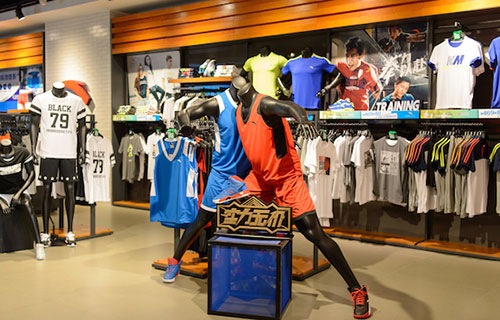 actively helping clients to move sourcing away from China to other regions. It helped one American retailer to reduce its reliance on China from to 20 per cent from 70 per cent within two years. The US-China trade War is also pinching U.S. companies exporting to China, the world's largest consumer market. They are being hit by retaliatory tariffs China has levied on American products.
Leveraging domestic market potential
To counter demand from foreign markets, China can leverage its $4.7 billion domestic sportswear. Hence the market shifts to products that can be both made and sold in China. Chinese sportswear brands like X Step are currently in a sound financial condition. The brand recently acquired a U.S.-based company that added tennis brand K-Swiss, Palladium boots, and Supra shoes to its portfolio.
It now plans to take advantage of manufacturer’s lowered prices by expanding production of international brands in China. Despite all this, China’s $40 billion-a-year market for sports apparel is less than half of the market in the US. However, this may change with time as the gap between domestic brands and international brands will slowly be closed. Younger Chinese consumers, especially those born after 1990, will have a greater affinity to local brands.
Welspun Q2 profit up 66 per cent
Indian home textile major Welspun’s second quarter net profit jumped 66.5 per cent. The company continues to calibrate capex according to cash flows. In the first half of the fiscal, its capex was Rs 460 crores. For 2019-20, the total capex is expected to be Rs 600 crores. The company has started a flooring business under Welspun Flooring. Welspun is looking at offering luxury performance tiles, wall-to-wall carpets and artificial grass for offices and cricket fields. Its emerging businesses are gaining traction. Its recently commissioned flooring solutions plant could provide tremendous growth opportunities in the domestic market as well as the export market.
Welspun is going into advanced textiles. The big bet on advanced textiles includes making disposable towels out of non-woven textiles and filters for the auto and power sector. Advanced textiles will broadbase Welspun’s clientele by adding sectors such as auto, healthcare and FMCG. The company is known for bed sheets and towels and has introduced reversible bed sheets and quick-dry towels. It is one of the largest suppliers of home textiles to retailers like Walmart, Costco and others. The company also sells premium licensed brand products like Wimbeldon, Nickelodeon and Disney. Branded products account for 17 per cent of its revenues.
Indian textile units ask for liquidity support
Indian textile units have asked for liquidity support and a one or two year moratorium. Other issues are pending claims under the various rebate schemes; release of TUFS subsidy; reducing the margin money for working capital from 25 to 10 per cent and the debt-equity ratio norm from 1:1.33 for the entire textile and clothing industry; extending the five per cent interest subvention for all textile and clothing export products; slotting recycled PSF under the five per cent GST rate; and enhanced EPF benefits.
The National Committee on Textiles & Clothing (NCTC) is meeting regularly to discuss various issues ranging from fiber to fashion to arrive at a common understanding of both short term and long term policy measures for domestic and international markets.
For the purpose of long term policy measures, NCTC will hire the services of a competent agency to undertake a study and recommend various policy measures to enable the entire textile and clothing value chain covering all types of fibers and products to remain globally competitive and achieve a sustained growth rate, both in the domestic and international markets. Among the measures proposed by NCTC are imposing adequate safeguards on the imports of fibers, yarns, fabrics, readymade garments and used cloths from China, Bangladesh and Indonesia; including the anti-dumping duty in the duty drawback calculation and enhancing the rates appropriately.
Tommy Hilfiger ropes in Michael Scheiner as new marketing head
Michael Scheiner is chief marketing officer, Tommy Hilfiger. Scheiner has over 15 years of experience at global brands. He joins Tommy Hilfiger from Hollister. His work helped to move Hollister into the top five brands among teens and supported Hollister’s recognition as a top omni-channel retailer. He is expected to lead Tommy Hilfiger into a new era of innovative marketing strategies – particularly across digital and experiential platforms – to reach and engage the next generation of consumers. Additionally the brand will engage him in helping fuel its ongoing digital transformation, enabling it to respond strategically to new disruptions and position Tommy Hilfiger as a leader among its competitors.
Tommy Hilfiger is a leading lifestyle brand, with a globally recognized name and identity. The company’s marketing initiatives have been instrumental to the increasing footprint of Tommy Hilfiger through the consistent growth of global brand awareness and consumer-centric strategies that build and retain a loyal fan base. Today, brand exposure is at an all-time high as a result of standout collections, campaigns, partnerships and impactful consumer activations worldwide. As one of the world’s most globally recognized brands, its marketing teams around the world play a pivotal role in inspiring, exciting and engaging consumers.
Hugo Boss uses AI, tablets at smart factory
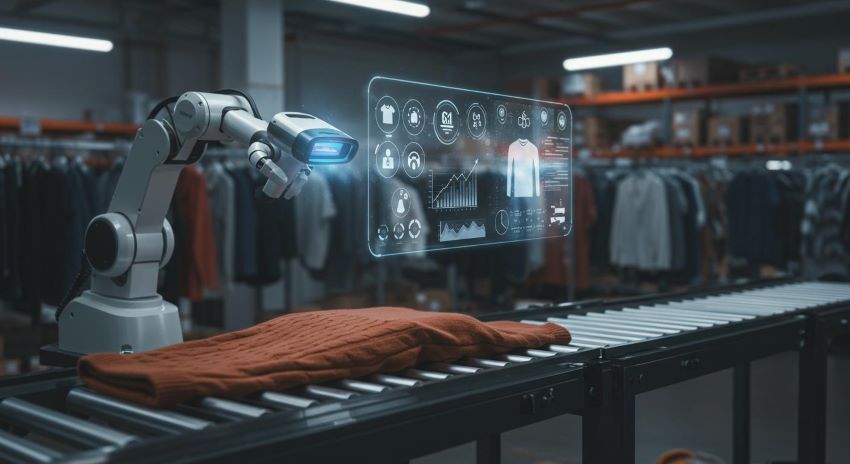
Hugo Boss has deployed artificial intelligence and tablets at its production facility in Turkey. The 65,000 sq. mt. factory with around 4000 employees is reimagining the ways humans and machines interact. The factory produces as many as 9,00,000 suits annually, as well as two million shirts and 5,50,000 pieces of women’s apparel. The plant has also started to deliver single piece orders to pilot stores in Asia. In time the plant will be developed as a platform for products, services, and knowledge.
Between shifts, workers have to clean up workplaces and unplug machines. When it was first implemented, the process would take 40 minutes, whereas now it’s cut down to only five or ten. The flexible shifts enable faster adaptation to fluctuations in demand for the numerous product groups that are made at the plant.
Over 1,600 tablets are used on the shop floor, allowing mistakes to be immediately flagged to the colleague who worked on the previous step where the error was made in the production line, reducing the number of follow-up mistakes. By noticing and acting on the mistake the worker can choose to rehearse the task with the help of a mixed reality game that was developed for the factory. Over 1,000 operations have been taught with the help of a virtual dojo.