FW
Timberland to offset carbon footprint by 2030
Timberland, the footwear and apparel brand owned by VF Corp aims to offset its carbon footprint by 2030 by establishing a supply chain with a ‘net positive’ impact on the planet. The brand will adopt a two-pronged approach that will affect both ends of the pipeline. It will source all natural fabrics and materials from suppliers whose business is based on regenerative agriculture, while also forging ahead with a circular design approach.
Following last year’s pilot partnership with Other Half Processing to build a responsible leather supply chain, Timberland has now pledged to turn regenerative agriculture into new normal by 2030 by extending the practice to sourcing of other materials, including rubber, cotton, wool and sugar cane.
Regeneratively grazed cattle and regenerative crops allow rest and regrowth of grasses, leading to better food for livestock and healthier and more fertile soil that in turn reduces carbon emissions.
Timberland expects to source 30 per cent of its leather from regenerative sources by 2025. On the circular design front, the brand will improve the quota of recycled materials it uses, including PET bottles and pre-consumer wool or leather scraps. It will also approach design such that each apparel, footwear and accessory item is recyclable, avoiding products are destined to the landfill.
Shima Seiki launches yarn sourcing web service
Shima Seiki has launched yarnbank, a yarn sourcing web service. Developed in cooperation with yarn companies from around the world, the service provides registered users free access to the yarnbank archive of yarn information and digital yarn data. Users can also download yarn data free, for use in fabric simulation and virtual sampling on Shima’s SDS ONE APEX4 design system as well as APEXFiz subscription-based design software, which was also announced last month.
By using yarn available for actual production, users are assured the simulations created using yarnbank are not merely realistic images but accurate representations with yarns that can actually be purchased and used in production. Such clear communication is possible with yarnbank by bringing together each player in the supply chain—spinner, knit manufacturer and apparel company—and connecting them digitally to eliminate trial-and-error sample making that is the legacy of obsolete analogue fashion production.
Registration on the website is free to APEX users, while yarn companies can choose from different plans for registering their yarn on yarnbank. For yarn companies, yarnbank serves as a brand-new promotional platform with the opportunity to present their yarns directly to their customers. In that respect, yarn companies can reduce their dependence on traditional sample books as a means to promote their products, saving time, cost and material and doing their part for sustainability.
Bangladesh RMG exports grow 44.63 per cent in August: BGMEA
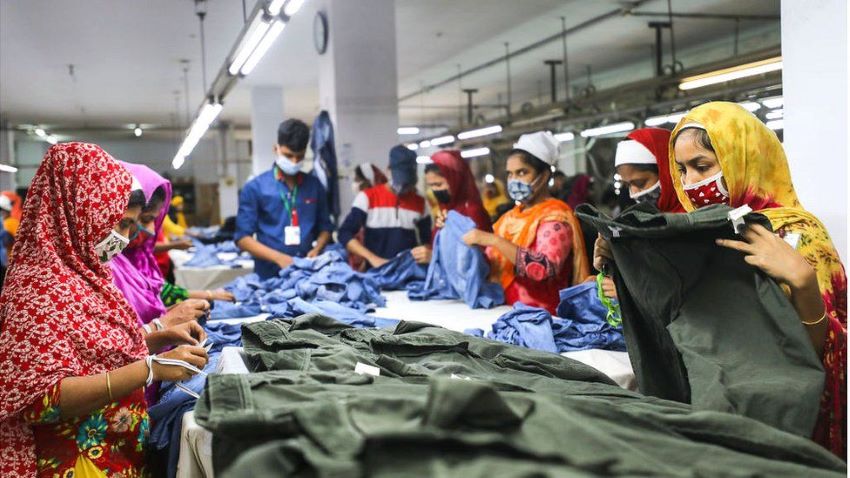
Bangladesh’s readymade garment exports recorded a 44.63 per cent year-on-year growth in August after seven months of negative trend. The country’s export earnings from RMG stood at $3.24 billion from $2.24 billion in the same period of August in 2019, according to National Board of Revenue data compiled by BGMEA.
Rubana Huq, President, BGMEA said, while cotton trousers had maintained the biggest share in terms of increase, man-made fiber-based product categories in tops had also started witnessing a growth. Especially women’s/ girls’ cotton trousers have seen significant growth and their share in our total export is also higher. Huq also said a six-month average would be a better depiction of the export growth situation instead of year-on-year-based monthly figures. Bangladesh’s export earnings from readymade garment witnessed a negative growth for seven month in a row from January to July this year.
The export earnings witnessed a 54.79-per cent decline in the March-May period of 2020 over that of the corresponding period of last year as the coronavirus pandemic hit the sales of manufacturing goods and the global buyers cancelled or suspended import orders.
The country’s export earnings started increasing from June this year although the RMG export declined by 18.84 per cent to $27.70 billion in the fiscal year 2019-20 from $34.13 billion in the FY 2018-19 due to the adverse impact of the coronavirus outbreak globally.
With the reviving of export orders by the global buyers, Bangladesh’s exports in July this year fetched $3.91 billion, the highest-ever earnings in a single month in the country’s history.
Oeko Tex increases certifications by 13 per cent
Oeko Tex has the increased the number of certifications and labels issued by 13 per cent from 21,454 on July 1, 2019 to 24,205 on June 30, 2020. Its focus was largely on the ‘Made in Green’ label, whose demand grew 115 per cent from 1,304 to the current 2,808 valid labels in the financial year 2019/2020.
Issuance of other Oeko-Tex labels, such as Standard 100 and Leather Standard by Oeko-Tex also continued to grow year on year. Newly issued certificates STeP by Oeko-Tex increased 55 per cent to 475 valid certificates worldwide. Detox to Zero was added as mandatory requirement for STeP facilities to support customers optimizing and monitoring their chemical management and wastewater quality. It helps the textile and leather supply chain to avoid use of toxic chemicals and prevent water pollution, which benefits both people and environment.
In addition, STeP became a part of ITC Sustainability Maps, a platform that enables users to better understand the sustainability landscape and to connect with business partners.
According to Georg Dieners, Secretary General, the industry needs to work together to change existing consumption and production patterns to keep the planet’s resources intact and ensure a life for future generations. The organization has made every effort to continue with certification and avoid supply chain interruptions It processed existing certificate renewals without samples to give certificate owners three additional months to gather samples for testing. To provide people all over the world with mouth and nose masks, the Oeko-Tex Association waived the license fee for certification of masks. It also gave Standard 100 certification to over 50 face masks manufacturers between April and June.
Mimaki Europe appoints Takahiro Hiraki as new Managing Director
Mimaki Europe, a leading manufacturer of inkjet printers and cutting systems, has appointed Takahiro Hiraki its new Managing Director. Hiraki joined Mimaki Engineering in 1997 as a sales representative for the Mimaki CF-series. Over the next 20 years, he held various sales positions in the company.
In 2019, Hiraki joined the board of directors and was assigned management responsibility for Mimaki Europe. His appointment as Managing Director of the region this year reflects his commitment to the organization and enthusiasm for this diverse, innovative, and successful part of the Mimaki business.
Mimaki Europe also appointed Ryosuke Nakayama as the new Executive Assistant to Hiraki. Nakayama joined Mimaki Engineering in 2012 and during his 8 years at the company, has excelled in marketing, sales, and product management roles worldwide. Nakayama’s extensive experience, expertise and diverse skillset will be substantial assets to the Mimaki Europe management team.
COVID-19 – An opportunity for India to boost technical textiles market
 Engineered for definite functions, technical textiles are used in the agriculture, healthcare, defense, construction, aerospace, automobile and sports sectors. Global demand for technical textiles is growing at a CAGR of 4 per cent and is expected to reach $220 billion by 2025, says a report titled ‘Technical Textiles: The Future of Textiles,’ by Invest India.
India market to grow to $28.7 billion by 2020-21
As per the report, Asia-Pacific dominates the global technical textiles market with a 40 per cent share while North America occupies a 25 per cent share and Europe 22 cent. Reasons for Asia Pacific’s dominance include: rapid urbanization and technological advancements in its medical, automobile and construction industries coupled with ease of production, low-cost of labor and favorable government policies.
The report estimates Indian market for technical textiles growing at a CAGR of 12 per cent over the past five years. The industry contributes about 0.7 per cent to GDP accounting for approximately 13 per cent of total textile and apparel market. Factors like easy availability of raw materials like cotton, wood, jute and silk along with a strong value chain, low cost labor, power and changing consumer trends have led to India’s strong growth in this sector. A baseline survey of the textile industry by the Ministry of Textiles predicts India’s technical textiles market will grow to $28.7 billion by 2020-21.
Government initiatives to increase growth rate
The report suggests, current consumption of technical textiles in India is 5 to 10 per cent against 30 per cent-70 per cent in some advanced countries. The government has introduced a National Technical Textiles Mission that aims to increase India’s average growth rate in technical textiles to 15-20 per cent besides increasing domestic market size to $40 billion-$50 billion by 2024. The mission will achieve this through market development, market promotion, international technical collaborations, investment promotions, and the Make in India initiative.
The Central government has also introduced initiatives such as allowing 100 per cent FDO in this sector under the automatic route. In 2019, the ministry launched 207 HSN codes to help monitor import-export data and provide financial support and other incentives to manufacturers. The ministry also organizes Technotex India, in association with FICCI.
Besides, the Centre has set up integrated textile parks, eight centers of excellence, and the Amended Technology Upgradation Fund Scheme. In December 2019, it announced $1.4-trillion national infrastructure plan to develop projects in energy, road, railway, urban development, irrigation, and health sectors. The Textiles Ministry also aims to create an ecosystem model to develop mega textile parks for technical textiles besides upgrading existing 19 functional textile parks. It has suggested creating a special fund for R&D worth $13 million in technical textiles. It also proposes to form a National Centre of Research in Technical Textiles that would be tasked with monitoring long- and short-term research.
Industry standards and focus on skilling
The report also emphasizes on the need to establish industry standards and focus on skilling. It concludes by saying the overall development of infrastructure, coupled with the availability of skilled and low-cost labor, focus on research and development activities, and strong manufacturing capabilities make India an attractive investment destination. On its part, India needs to convert its COVID-19 crisis to an opportunity and facilitate better communication between the government and the industry.
Libas Designs to venture into the FMCG segment
Libas Designs which specializes in contemporary and ethnic men's and women's wear, wearing apparel, jewelry and other related items in India, is venturing into the FMCG segment. The company has received in-principle approval from the NSE for change in name of the company from Libas Designs to Libas Consumer Products (LCPL).
Besides engaging in designer ethnic wear, LCPL will undertake manufacturing importing and exporting of various niche FMCG and agro products. The company also plans to acquire Golden Bricks Infrastructure, which is a part of the promoter group and specializes import of rock salt from all over the world and also export of agro products for last two years. The acquisition would give LCPL an access to the various rock salt mines that Golden Bricks has tied up with, and LCPL would in turn import, crush, process and package this slat for third parties. Additionally, LCPL plans to launch its own brand across India.
Japan’s apparel sales drop by 40%: JDSA
As per recent data from the Japan Department Stores Association (JDSA), apparel retail sales in Japan dropped by 40 per cent during the first half of 2020 compared to the same time in 2019. The decline was noted both in the first quarter spanning January-March 2020 as well as in the April-June quarter of the COVID-19 struck. A monthly surge can be seen from mid-May onwards, as the state of emergency has been lifted in stages across the country since May 14, 2020 before being finally ended on May 25 , 2020.
As a consequence, growth was unprecedented in June ’20 over May ’20, which shows a large number of shoppers have come out buying post-pandemic apparels. The yearly decline among the majority of fashion shoppers shows lingering fears of infections in the region. Monthly rise of 217 percent in June ’20 over May’ 20 was huge, which is a strong sign that the post-outbreak rebounding of the apparel industry has begun. In the quarter affected by COVID-19 from April-June ’20, sales of Japanese apparel declined 66.81 per cent to $1.27 billion. Sales declined 22.30 per cent from the same time in 2019 in January-March ’20 quarter to $3.28 billion.
Gap to close over 225 global stores
Hit by difficult times, Iconic American retailer Gap Inc plans to close more than 225 Gap and Banana Republic stores globally this year. As of 1 August, Gap Inc. had a total of 3,814 stores across 42 countries including 1,643 stores of Gap and Banana Republic alone.
The company has many brands in its kitty like Old Navy, Athleta, Janie and Jake brands apart from Gap and Banana Republic.
This decision of closures underlines how the company has been struggling to keep profits up during the pandemic, especially in malls, as a majority of the stores located in malls are being closed for good. Total sales across major brands declined 18 per cent in the second quarter.
However, the saving grace has been the 95 per cent increase in online sales which has been able to offset some of the losses.
Gap and Banana Republic suffered the most with a 28 per cent and 52 per cent decline in sales, respectively, making the store closures inevitable. Athleta, on the other hand, has been a bright spot for the company with net sales rising 6 per cent and comparable sales up 19 per cent.
The exact locations and breakdown of closures is not yet known but the company intends to reveal that during a virtual investor meeting in October.
Hugo Boss hopes a gradual improvement in H2 2020
Hugo Boss expects gradual improvement for the second half of 2020. The brand has not been able to provide reliable sales and earnings forecast for full-year 2020. Nevertheless, it remains optimistic that the global retail environment will continue to gradually improve. This should also positively impact the Group’s sales and earnings development in the second half of the year and allow it to make further progress along with its overall recovery, which has started at the beginning of May.
In the second quarter of fiscal year 2020, both the retail sector and the apparel industry were severely impacted by the global spread of COVID-19. Temporary lockdowns resulting in widespread store closures, a sharp deterioration in consumer sentiment, as well as international travel restrictions weighed on global industry sales.