FW
Bossini sales down 20 per cent
Hong Kong-based brand Bossini’s sales have dipped as much as 20 per cent. It began with continuing protests in Hong Kong, which completely brought a halt to tourist traffic flow from mainland China. Then the Coronavirus outbreak as further impacted sales.
Bossini is a brand with unmistakably chic fashion. There is a collection of alluring abstract print tops, cool geometric print midi dresses, funky graphic print tees and more. There are graphic tees for casual days, dresses for party nights and tops for Monday mornings. Simple, solid colored tops and tunics are wardrobe essentials that every woman must own. Easy to dress up, they can be paired with shorts as well as trousers and a coat. Bossini has a wide range of solid colored tops with tie-ups, high-low hems, tassels and more. The brand also has chevron striped tops for those who are looking to wear the classic style with a little bit of a twist. Also on the shelves on this women’s clothing brand is a wide array of cool graphic printed tees and tops for women. Skinny jeans for women are in lightly washed and low-rise variants. The brand also houses an equally chic collection of skirts that are great fashion-flexible picks.
Adidas, Puma sales dip in China
Sales of brands like Adidas and Puma have fallen because of the Coronavirus outbreak. Adidas’s business activity in Greater China has been around 85 per cent below previous year level since the Chinese New Year on January 25. The brand has faced a significant number of store closures in its network of 500 owned stores and 11,500 franchises in China, while fewer people are shopping at those which remain open. The group’s Greater China region, which includes Taiwan and Hong Kong, has for years been one of the fastest-growing areas of the world for Adidas sales.
Puma’s business in China has been heavily impacted due to the restrictions and safety measures implemented by the authorities. More than half of its own stores and partner outlets are closed at the moment. Puma’s business in other markets, especially in Asia, is also suffering from lower numbers of Chinese tourists. But the company expects the situation to normalise in the short term, keeping it on track to achieve its full-year targets.
Both Adidas and Puma are German sportswear makers. Adidas is celebrating 70 years. In India the brand has a very strong business in football and a very strong business in running. Puma has increased its sales by 84.4 per cent in the last ten years. In the same period, the company’s profit has exploded 72.2 per cent.
Indian cotton yet to reach Chinese manufacturers
India has shipped some six lakh bales of cotton to China. But some are either in the middle of the sea or lying at ports in China as there are no officials to unload the consignments. As a result, the payment cycle is stuck since no banks are open to clearing the letters of credit.
Cotton prices have gone down owing to the weak market sentiment. Private traders buying cotton from farmers at Rs 5,200 per quintal are now offering Rs 5,000 per quintal. The cotton yarn business has been hit more than cotton trade. So far, 28 lakh bales have been exported. Bangladesh, Vietnam and Indonesia are other export destinations. Bangladesh accounts for 20 lakh bales to 22 lakh bales and seven lakh to eight lakh bales go to Vietnam. The Cotton Corporation of India is estimated to have purchased some 68 lakh bales from farmers under MSP operations. While wholesale prices are hovering near the MSP of Rs 5,550 per quintal, traders are cautious of them falling once the quality of cotton arriving in the markets deteriorates.
Cotton export shipments already shipped from October 1, 2019, to January 31 this year are estimated at 20 lakh bales, while the balance 22 lakh bales are expected to be shipped during February 1 to September 30 this year.
Cotton Council International elects officers for 2020
 Richard L. (Ricky) Clarke, III, a merchant from Cordova, Tenn., will serve as president of Cotton Council International (CCI) for 2020.CCI is the National Cotton Council’s (NCC) export promotion arm and carries out programs in more than 50 countries globally under the Cotton USA trademark.
Clarke, who moves up from CCI first vice president, succeeds Hank Reichle, a cooperative official from Greenwood, Miss., who becomes CCI board chairman. Clarke, Reichle and other CCI officers were elected at CCI’s board meeting during the NCC’s 2020 Annual Meeting held February 14-16 in New Orleans, Louisiana.
“I look forward to leading CCI in its mission of making U.S. cotton ‘The Cotton The World Trusts’ for mills, manufacturers, brands, retailers and consumers worldwide,” Clarke said. “Cotton USA promotional events in 2020 will continue to educate this audience and stimulate U.S. cotton sales via networking opportunities throughout the global supply chain.”
Clarke is vice president/senior merchant for Cargill Cotton, Business Unit of Cargill, Inc. His current merchandising responsibilities include sales to several Asian markets.
Other CCI officers elected for 2020 include: first vice president, Ted Sheely, producer, Lemoore, Calif.; second vice president, Carlos C. Garcia, cooperative official, Lubbock, Texas; and treasurer, Steven Dyer, merchant, Cordova, Tennessee. In addition, Gary Adams, Cordova, was elected as secretary and Bruce Atherley, Washington, D.C., elected as assistant secretary.
Elected as CCI directors for 2020 were: George G. LaCour, Jr., a ginner from Morganza, La.; John C. King, III, a merchant from Helena, Ark.; Neal Isbell, a producer from Muscle Shoals, Ala.; and John F. Lindamood, a producer from Tiptonville, Tennessee.
Re-elected as 2020 CCI directors were: Producers – J. Lee Cromley, Brooklet, Ga.; Richard Gaona, Roby, Texas; Craig A. Heinrich, Lubbock, Texas; Matthew R. (Matt) Hyneman, Jonesboro, Ark.; and Paul (Paco) Ollerton, Casa Grande, Ariz.; Ginners –Curtis H. Stewart, Spade, Texas; Merchants – Philip R. (Phil) Bogel, II, Dallas, Texas; Tim G. North, Dallas, Texas; Ernst D. (Ernie) Schroeder, Jr., Bakersfield, Calif.; and William Barksdale, Cordova, Tenn.; Cooperatives – Frederick Barrier, Greenwood, Miss.; Carlo Bocardo, Bakersfield, Calif.; Donald Robinson, Garner, N.C.; Cottonseed – James C. Massey, Harlingen, Texas; Warehouseman - Vance C. Shoaf, Milan, Tenn.; and Manufacturers – Robin Perkins, Sanford, N.C.; and Davis Warlick, Charlotte, North Carolina.
Structural reforms, boards to help textile exporters achieve the $350 billion target
 According to Raja Shanmugham, President, Tirupur Exporters Association, we need to upscale skill inventory across our value chain as global competition is increasing. Agreements between nations are compelling each of them to open their markets for others. One such agreement, the South Asia Free Trade Agreement (SAFTA) enables countries to enter Indian shores and capture a share of its market. “As this inflow of companies is higher than supply, we need to create separate boards to ensure their connectivity to the main center". Regretfully in India still British legacy perennially lives and we somewhere collectively need to put our heads together to assess realistically the ground reality of the day. I have a strong sense that the system needs a fundamental shift in our macro view & approach to fruition; For instance, we need to set up a board in knitwear at Tirupur; in Karur for handlooms and made-ups while Mumbai needs to have a board for woven garments, Surat can have it for Synthetic fabrics & so and so forth to have a better handle of the micro assessment resulting in emergence of international level envious sourcing hubs & centers. This visibly will make it easier for us to achieve the $350 billion target envisaged by the Government of the day,” notes Shanmugham.
It will also enable each of these streams to perform to the best of their capacities. Currently, only liaison work is happening which creates a lopsided rather than holistic development. “It also reduces our manpower deployment and undermines cotton capacity optimization. Thus we get beaten by competing countries like Bangladesh, Vietnam and Cambodia etc. despite of India being complete supply chain country,” adds Shanmugham
Shanmugham views that to prevent this, we need to introduce policies that consider not just corporates but also MSMEs, as per him, "Indian entrepreneurial fabric is woven by MSMEs which contribute bulk of the exports Forex earning particularly when it comes to labour intensive industry like T & C". “MSMEs need to be given an opportunity to unleash their vibrancy. We also need more structural reforms. However, if coronavirus continues, there may be a transfer of orders and we can be one of the beneficiaries. How efficiently we do that remains to be seen however, still for mid to long-term health of the industry structural reforms..structural reforms..structural reforms is the only credible answer,” he further states.
Exquisite new designers create the ultimate showroom experience at Scoop AW20
 The AW20 edition of Scoop, the UK’s leading premium contemporary womenswear show located at Old Billingsgate Market London from the 9th – 11th February, focused on newness; keeping the show fresh, launching new designers and exquisite cutting-edge fashion. Creating a premium ‘showroom’ experience, Scoop welcomed buyers and buying teams from Harrods, Anthropologie, The Cross, The Mercantile London, Harvey Nichols, Iris Fashion, Liberty London, Fortnum & Mason, El Corte Ingles, Mercer Paris, Galeries Lafayette amongst others.
Designed in Greece by Athina Parnasa, Devotion’s signature style of natural confidence and sexy femininity inspired by Grecian-chic culture and tradition came to life in a vibrant collection of show-stopping dresses. Stardust, a new collection founded by a former Scoop exhibitor, also caught the eye of buyers and influencers with its vibrant, tropical and floral prints.
People’s Republic of Cashmere was taken up by leading department stores, who loved the combination of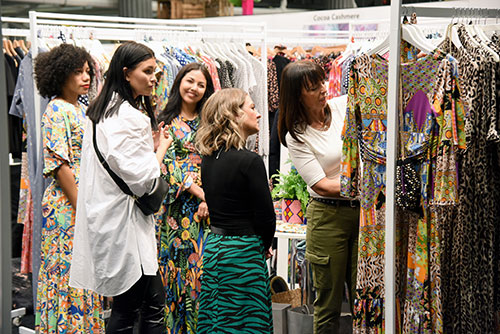 premium quality cashmere with clean Scandinavian design. Founded by Hong Reese-You and Emilie Fenst, designs reflect a sense of relaxed elegance, focusing on comfort, high quality and strong colours all made from 100% fine quality Mongolian cashmere.
Already stocked by Le Printemps and Le Bon Marche, SAC U.S debuted in the UK at Scoop with its reinvented messenger bags with a pop twist that redefines the spirit of the times. Created by Adélaïde Salvi, founder and designer of the accessories brand MySuelly and the creative agency Coming Soon, SAC U.S is steeped in the authenticity of rock and vintage codes, while bringing them up to date with an original design.
Buyers also adored debut designers Santos Jewellery, Liebre Style boots, Flower and Scent candles, and LeBon toothpaste, as well as the new collections from returning designers Self Cinema, Yolke, Andraab, and OOF Wear.
Karen Radley, Founder and Managing Director of Scoop said: “Over the years, Scoop has become renowned by designers and fashion buyers for its exclusive presentation and curated edit of labels from Britain and the rest of the world. This season, I am proud to welcome a number of new designers, many of whom are launching at the show including Lyla Wilde, Orenda, SAC U.S, Ciela Orah, DXMXRK, Devotion, Poppyfield, Sako Loko, Santos Jewellery and many more. We curated the perfect backdrop at Old Billingsgate this season for the designer’s collections.”
Scoop is renowned internationally for its exclusive presentation and expertly curated edit of fashion designers and labels from Britain and the rest of the world, many of whom select the show as their launch pad.
The next Scoop experience returns to the Saatchi Gallery from the 19th - 21st July 2020.
Symposium on emerging opportunities for Indian textiles
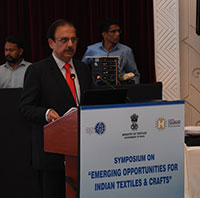 To meet the challenges and opportunities arisen due to outbreak of coronavirus in China, a symposium on ‘Emerging Opportunities for Indian Textiles and Crafts’ was organised by Export Promotion Council for Handicrafts under the aegis of Ministry of Textiles, Govt. of India at New Delhi.
Smt. Smriti Zubin Irani, Hon’ble Union Minister of Textiles was the Chief Guest. Shri Ravi Capoor, Secretary (Textiles) was the Guest of Honour.
Shri Ravi Capoor delivered the key note address to the stalwarts exporters belonging to handicrafts, handloom, textiles, carpet, synthetic along with buying agents association. He said the whole world knows that the global value chain has been adversely impacted due to situation in our neighbourhood i.e China. He encouraged industry to believe that every crisis has an opportunity and Indian industry could leverage the bold moves made by Govt. of India around man-made fibers. Further, the Government support through a dedicated mission around technical textiles should be used to catapult India into the global stage. Lastly Shri Capoor encouraged industry to take advantage of the China+1 policy which companies are using as till now only South East Asia has fully benefited from buyer policy. Indian manufacturers should also diversify their sourcing opportunities to country other than China on immediate basis.
The purpose of organising the symposium was to deliberate on opportunities to position India as alternate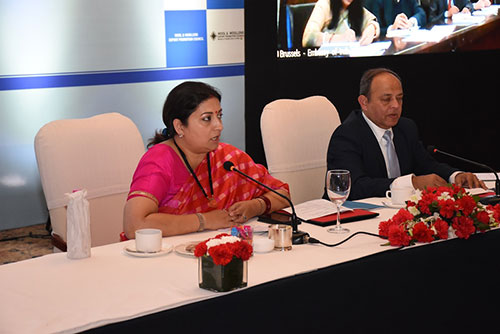 sourcing hub in the current scenario Shri Capoor further said.
Chairmen/ Secretary General/Director Generals and Executive Directors of all EPCs, senior Government officials, various buying houses of overseas buyers were present in the symposium and presented impact on their sector and deliberated on various import/export related issues and suggestions to combat the situation. Large number of member exporters from Moradabad were present in the symposium which included Mr. Nabeel Ahmed, Member-COA-EPCH and Mr. Awdesh Agarwal, Secretary, Moradabad Handicrafts Exporters Association. From Jodhpur, Mr. Hansraj Baheti. Member COA-EPCH, Mr. Lekhraj Maheshwari Member –COA – EPCH from Jaipur were also present.
Hon’ble Minister of Textiles Smt. Smriti Zubin Irani started her address by sharing the good news that 22 crores farmers have soil health by now and benefits of using this technology would improve the agricultural sector on which apparel export is significantly based. The Ministry of Textiles has been interacting with industry very closely and major policy decisions like liberalizing MMF sector and GST concerns in handicrafts industry have been addressed. Some of the new areas which the Government would like to encourage are technical textiles, support to MSME and Government would like to see industry responding by positioning India not only as a sourcing hub but also as an end to end leader in textiles sector. She encouraged all the EPCs to bring MSME units for hand holding towards quality, compliance, R&D and certification which the Government will support. Younger MSMEs with hunger in the belly will be drivers of India’s dominance in the world in the coming times.
Shri Rakesh Kumar, Director General – EPCH while speaking on the occasion made some innovative and bold steps around “Namaste India” to attract overseas buyers towards Indian fairs and thereby to look at India as a compliant and safe hub. Shri Kumar also articulated another innovative marketing approach of using travel agents in USA and EU to drive the “Namaste India” campaign. He availed the opportunity of presence of Secretary Textiles with number of suggestions which included MAI grant for the buyers from developed countries, long term visas, involving embassies and consulates in aggressive marketing and finally assisting foreign buyers to set up dedicated joint ventures with Indian manufactures.
During symposium various issues pertaining to Government support with respect to nodal officer in Embassies for export facilitation and nodal officer in Ministry of Textiles for trade facilitation, issuance of phyto-sanitary certification, support for RoDTEP scheme were raised to which while responding in the end, Secretary Textiles Shri Capoor assured all possible help and appreciated the idea of “Namaste India” campaign to be undertaken by all EPCs in the next two months to project India as sourcing hub destination and encourage maximum visitors to the shows in India. He assured setting up of help desk in the Ministry for facilitating exports and issues pertaining to exports.
It is hoped that as the Government of India is well aware of the current situation of export and import which has been affected due to situation in China and holding of this symposium will further add the inputs placed by different EPCs said Shri Rakesh Kumar, DG – EPCH.
Global apparel industry facing structural decline
Global clothing industry is going through a long-term structural decline with growing awareness among consumers and limiting purchases, even as prices fall. This is destabilising the future of many global companies whose USP is fast-changing and affordable fashion.
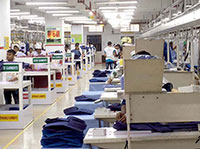 Fast-fashion retailers are waking up to a changed global fashion scenario as the make-buy-trash culture is rapidly giving way to heightened environmental concerns. Big brands producing clothes in large batches may save money both for the company and consumer but it creates environmental waste. The clothing industry is responsible for about 10 per cent of global greenhouse gases and consumes more energy than aviation and shipping combined. The old concept of encouraging shoppers to buy rapidly as trends change where olds clothes either stockpile or find their way to landfills is now changing.
A saturated consumer market
With higher disposable incomes and focus on staying on-trend, consumers already own so many clothes that new purchase doesn’t quite spark happiness. Morgan Stanley analysts feel the apparel market has saturated and is on a structural decline mode, as people are over buying. Leading apparel retailers like H&M, Inditex, Gap, Macy’s, Kohl’s, American Eagle and Abercombie & Fitch are overvalued and don’t know how to find their way out of a financial mess. Some like H&M are offering customers vouchers if they return clothing for recycling and launching new collections using sustainable materials.
With clothing becoming affordable and easily available, consumers keep buying with no concept of buying for special occasions. A consumer in the US is likely to purchase around 65 items and a UK consumer around 50 items a year. In Australia, the average consumer buys 27 kilos of new textiles annually and accounts for 23 kilos of textile waste that goes to landfills. Australian consumers are being encouraged to donate past purchases to charities every time they buy new clothing to help reduce the 311,040 tonnes waste generated each year.
Morgan Stanley suggests Austrian economist Carl Menger's Law of Diminishing Marginal Utility is also to blame as buying too many clothes is leading to little marginal utility or pleasure of buying more. “If volumes have plateaued (or begun to fall) and average selling prices continue to decline, the value of clothing sales will fall too. It is our contention, therefore, that the apparel markets in many developed countries may now be entering a lengthy period of structural decline,” opine Morgan Stanley analysts Geoff Ruddell, Kimberly Greenberger and Maki Shinozaki.
Fast- fashion retailers hit big-time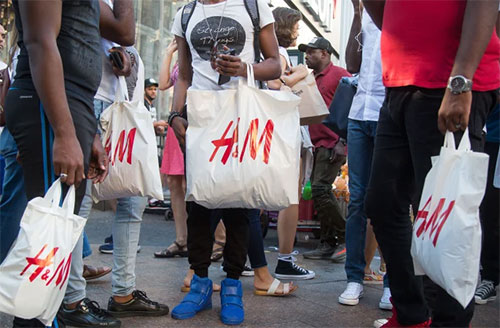
Swedish fast-fashion giant H&M is facing profitability issues having to close stores globally. It recently alarmed investors by reporting $4.3 billion worth inventory on hand which was still increasing, indicating it was producing more than it could sell. H&M had to offer more discounts on older styles to get rid of the excess the same time, having to stock up new styles.
Meanwhile H&M, the world’s second-largest clothing manufacturer behind Inditex’s Zara, announced the closure of 160 stores. It was hit hard in mid-2018, after accumulating more than $4 billion unsold inventory, forcing significant discounting to clear old goods. H&M is also facing great competition from rival Zara, with more fashionable offerings, at a little more expensive pricing. Meanwhile, Japan’s brand Uniqlo, the third biggest player in the US is making significant strides with its core of “timeless basics” along with plans for massive growth in Asia. Other fast-fashion retailers like Charlotte Russe are also going the same way, having filed for bankruptcy. With initial plans on closing about 20 per cent of store, the company could end up liquidating if it can’t find an investor to keep the business going.
Experts feel the world’s leading dozen listed apparel retailers have, on average, seen earnings downgrades almost 40 per cent since the beginning of 2016. This, when combined with the ongoing challenges posed by online channel shift, could make for a difficult backdrop for the apparel retail industry, not just now but in future as well. This structural shift has been going on for the last approximately 20 years, with a gradual shift, yet it is only in the last three to four years that clothing retailers have begun to find trading conditions so challenging.
The industry is undergoing a long-term structural decline as consumers feel their cupboards are spilling out and are limiting their purchases, even as prices fall. The way forward for many global companies whose basic USP is fast-changing and affordable fashion remains uncertain.
Fast changing fashion sensibilities affects market
Both mega retailers like H&M and Zara are facing competition from New Age online-centric players beating everyone at their own game. These brands like ASOS, Boohoo and Misguided in the UK, are building followings by cutting down supply chains to bring out a new fashion portfolio in a week and delivering them promptly. Since it’s the young people who follow fast fashion mainly, the idea of wearing something straight off the ramps, even before it hits the stores, is appealing. Trends are changing from a top-down fashion evolution, dictated by manufacturers and fashion periodicals, to a bottom-up percolation, driven by social media and personal expression. Consumers are now focussing on their own, unique personal styles and they like it now and they like it hot.
With saturation point being reached in fast fashion, there is evidence of movement by consumers of all ages and demographics toward investing in fewer but higher-quality basics that can be mixed, matched and re-worn, even with the addition of some great vintage accessories. Indeed significant changes are underway—away from what’s trending and toward what’s stylish. Consumers have been buying clothes more and the last two decades as most fast-fashion retailers such as H&M and Zara and budget retailers including Primark and Walmart have cut prices after shifting production to Asia.
Most global apparel retailers have seen their earnings drop almost 40 per cent since the beginning of 2016 and it’s going down even further. Small brands are moving to online channels which make it challenging for apparel retailers who are dependent on footfalls in swanky malls and offline sales. Many fast fashion brands like Fashion Nova are disrupting sales targets of other brands, by promoting themselves as a digital-first brand utilizing a social strategy, powered by Instagram. By introducing around 600 to 900 new pieces per week, Fashion Nova now has more than 14 million social media followers, and in 2017, it was one of the most Googled brands in the world.
Environmental concerns affecting frenzied buying
Fast fashion has been responsible for varying levels of environmental pollution. The cycle of buy, wear a few times and bag it for the dustbins is now impacting landfills. Experts feel many people, especially from the more affluent economic segment are now more open to paying higher for products that are sustainable. With clothing volumes plateauing in developed countries, apparel markets can only grow, if prices go up. But as production continues to shift from China to lower-cost countries in Asia, prices will continue to fall. Consumers are becoming reluctant to buy new clothes as the internet makes them more aware. Recycling clothes by donating to charities, putting in recycling bins or passing onto friends and family is catching on big-time but yet to make an actual impact on sales figures of affordable fashion brands.
While all New Age high-tech sustainable fabrics are a wonderful but it’s also expensive and cannot be afforded by everyone. There will be some basic consumer behavior change where people will stop mindlessly buying new clothes and matching accessories. Re-wearing garment styles in different ways and renting out for special occasions will become cooler. Overproduction and overconsumption of fashion, fuelled by cheap global markets and materials earlier and went haywire in the 2000s, will then just be a storm in a teacup, which will be evened out by a new generation.
Kiabza - Decluttering wardrobes and monetizing them
 Actress Evelyn Sharma is taking her the next step towards responsible fashion. To buy only second-hand clothing is her New Year’s resolution for 2020, and it’s an easy one she says! Interestingly, this trend is not limited to celebrities but also common people are having a keen interest in not just exchanging goods with friends and family but also with strangers in exchange of money.
Fashion retail scenario in India has changed with the rise of recommerce fashion startups owing to consumers widely accepting used fashion. With social media playing a critical role in the success and failure of brands these days, pre-owned online fashion startups appeal primarily to millennials who are aware of the latest trends and the best designers. Second hand fashion thus helps consumers save a lot of money and upgrade their wardrobes. Especially the Tier 2 and Tier 3 market where fashion aspiration is high but access to brands are limited, these startups are filling the gaps.
One of the leading brands in this sector, Kiabza is working to transform the way India thinks about pre-owned clothing and fulfill the aspirations of many who want to wear branded clothing at value prices.
Kiabza is a unique ReCommerce website for people to buy and sell branded pre-owned fashion. Kiabza is an online platform for all: For the Sellers, to consign their pre-owned branded clothing and earn easy cash for their products; For the Buyers, to buy the best brands at a great price. The seller can put together branded clothing from his/her entire family closet and KIABZA takes care of everything, right from curating a product to delivering it to the buyer and paying the seller for the same. Kiabza has adopted an inventory-based model and every piece of clothing is individually curated by experts at Kiabza for authenticity and then put through a strict quality control and dry cleaning process.
The Founder & CEO, Nohar Nath has 20 + years of experience in the textile recycling industry having run Kishco Group’s business, which is primarily based on recycling of textiles.
Prada postpones cruise show in Japan
Luxury fashion house Prada plans to postpone its cruise show, which was to be held in Japan on May 21, 2020. The decision has been taken as a precaution in the light of uncertainties regarding the spread of the coronavirus, points out the specialist website.
The Italian company had previously announced its intention to organise its mid-season presentation in Japan without specifying the exact venue where the show would take place.
This latest news will result in a minor alteration to what is a particularly heavy schedule of cruise shows this year. Giorgio Armani is expected to kick off the season with a show in Dubai on 19 April. Hermes will present its show in London on April 28, Chanel in Capri on May 7, Dior in Lecce on May 9, Ermanno Scervino in Monaco on May 14, Versace in the United States on May 16, Gucci in San Francisco on May 18, Alberta Ferretti in Rimini on May 22, and Max Mara in St. Petersburg on May 25.