FW
Bangladesh has huge potential in leather
Bangladesh is aiming for better leather goods exports. The country has raw leather but needs to import almost all other raw materials for final products. By law, imports have to be done in phases and so it takes time to produce the finished goods and export. So the leather and footwear sector is playing second fiddle to the garment sector.
Presently, Bangladesh has around 165 footwear and leather factories and they could bring in bigger export receipts were they compliant and using modern technologies. There are about 60 companies in Bangladesh which export footwear and leather goods. The destinations are mainly Japan, Europe and the US to some extent. Bangladesh produces 400 million sq ft of finished leather annually. But the country can use only 30 per cent of its finished leather. The remaining 70 per cent is exported, mostly to China. Bangladesh can earn three times more from exports of leather goods if all the finished leather produced locally is utilised. Finished leather exports fetch less than a third of a footwear item.
Chinese companies are keen to invest in Bangladesh’s leather and footwear sector and relocate their manufacturing units to the country to avoid extra tariffs that emerged from the US-China trade war.
Fashion and luxury sectors grow with new acquisitions and innovations
"As per the recent Deloitte report, ‘Global Fashion & Luxury Private Equity and Investors Survey 2019,’ mergers and acquisitions in the luxury industry increased to 265 in 2018. Of this, 75 deals were recorded in the luxury hotel sector while the luxury goods sector recorded 145 deals. Of this, 73 deals were recorded in the apparel and accessories sector while 28 were recorded in the watches and jewellery sector. Only cosmetics and fragrances category recorded an increase in the number of deals, which rose from 28 in 2017 to 44 in 2018."
 As per the recent Deloitte report, ‘Global Fashion & Luxury Private Equity and Investors Survey 2019,’ mergers and acquisitions in the luxury industry increased to 265 in 2018. Of this, 75 deals were recorded in the luxury hotel sector while the luxury goods sector recorded 145 deals. Of this, 73 deals were recorded in the apparel and accessories sector while 28 were recorded in the watches and jewellery sector. Only cosmetics and fragrances category recorded an increase in the number of deals, which rose from 28 in 2017 to 44 in 2018.
As Elio Minantoni, Partner, Deloitte Financial Advisory & Corporate Finance reveals, the cosmetics and fragrances sector is increasingly attracting the attention of investors as is the apparel and accessories sector. Of the 70 per cent private equity firms who plan to invest in the fashion and luxury sector in 2019, 79 per cent plan to invest in the apparel & accessories, and cosmetics & fragrances sectors.
Digital luxury to lead with 10 per cent growth
According to Deloitte, the fashion and luxury sector will continue to grow between 5 per cent and 10 per cent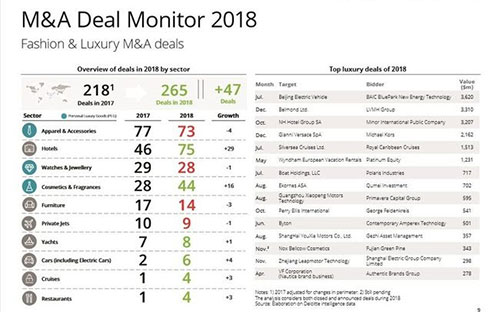 every year. Of this, the digital luxury, cosmetics and fragrances and furniture sectors will grow by over 10 per cent every year. On the other hand, the annual growth rate in the apparel & accessories, hotels and restaurants sectors is expected to range between 5 per cent and 10 per cent. Though the sale of cars and private jets are forecast to slump, those of yachts, jewellery and the selective distribution sector are expected to remain stable.
Growing interest in new technologies
Interestingly, the application of new technologies and digital innovations in fashion is increasing. As the survey reveals, nearly 43 per cent of the participants showed an inclination to invest in disruptive technologies such as innovations linked to the web, big data and analytics, artificial intelligence, robotics and blockchain applications. Geographically, only Europe recorded a significant increase in the number of fashion & luxury mergers and acquisitions in 2018, with 41 extra deals. North America and the Middle East emerged second with one deal less. Asia-Pacific recorded two more deals than Europe while Japan recorded four more. Investors are increasingly veering towards Asia and the Middle East with growth in these regions to average around 10 per cent.
Volume increases but value decreases
Though the number of mergers and acquisitions in the fashion and luxury sector increased between 2017 and 2018, their average worth decreased by 12 per cent to $233 million. Operations by medium-sized companies decreased by 25 per cent while those involving larger companies declined by 22 per cent. This trend is expected to further intensify in 2019.
Fila sees double digit growth in Philippines
Fila recorded double-digit growth in Philippines this quarter compared to the same period last year. This has been possible with organic sales, increased stock delivery, efficient distribution, business development and store segmentation. The label is better known in the country for lifestyle sportswear and sneakers than performance (tennis, basketball) footwear. In any case, while most others in the industry focus on brand awareness, Fila Philippines relies on sales-driven objectives supported by savvy price structures.
Fila is a global licensing brand from Italy. Every country, where it is found, is free to design and adapt styles according to market preferences. The game plan is to fulfill the needs of all markets while staying aligned with global strategies. Fila is the top-selling brand in the online fashion shopping network Zalora. Its own e-commerce is further propelled by influencers, online raffles and discounts. Buzz in social media is also created with product drops, a trend that entails a special release of products that will only be available for a limited time or quantity.
Once known chiefly as cut-rate athletic footwear, Fila has evolved into a fashion trailblazer. Collaborations with famous brands and designers have efficiently rebooted the 108-year-old trademark. Simultaneously, Fila capitalized on the retro movement by releasing its vintage styles, thus reconnecting with old customers and strategically developing new markets.
U.S. Cotton Trust Protocol to provide a verifiable window to the industry
The U.S. Cotton Trust Protocol seeks to give brands and retailers a quantifiable and verifiable window to view the process and improvements of the cotton industry. The protocol is being implemented in partnership with The Cotton Research and Promotion Program, the National Cotton Council, USDA, state universities and private industry.
That is done with the help of Field to Market, which uses verifiable data to show how well U.S. cotton sustainability is advancing. Current numbers include an overall 30 percent increase in soil carbon, 13 percent increase in land use efficiency, 39 percent in greenhouse gas efficiency, 50 percent decrease in soil loss per acre, 18 percent decrease in water use and a 15 percent decrease in energy use.
Uncertainty over MEIS plagues Indian exporters
The Merchandise Exports from India Scheme (MEIS) may be replaced by a new duty refund scheme called the Rebate of State and Central Taxes and Levies (RoSCTL).
A four per cent incentive is given to garment exporters under the MEIS. But in the meantime the uncertainty is creating confusion among exporters. Changes have been announced under the RoSCTL but its implementation is still awaited. Exporters will be given revised reimbursement under the new scheme but they say that before abolishing any existing scheme it should be given at least four to six months’ time. They fear losses as they have quoted prices after factoring in the four per cent incentive under the MEIS. Facing competition from Vietnam and Bangladesh they cannot think of increasing prices. For them the four per cent incentive under the MEIS will be replaced by an eight per cent loss on an average, which they feel they won’t be able to bear. The loss of international markets is expected to lead to the shutdown of many small cottage units.
The proposal to replace the scheme has rattled the apparel sector of the north, mainly concentrated in Ludhiana and the NCR region. Over 1,600 small and big units in Gurugram alone have stopped taking and processing any international orders. Many ancillary units have even asked labor to look for alternate jobs in the next few months.
US home textile industry seeks clarity on tariffs
The US decision to add a 10 per cent tariff to the remaining $300 billion Chinese imports on September 1, 2019, has rattled the American home textile industry. The big problem with this change is the lack of details thus far. The industry is unsure if shipments already en route that could arrive on or after September 1 would be exempt.
The tariff strategy is blamed for slowing US economic growth, creating uncertainty and discouraging investment. There is an opinion in the American industry that tariffs imposed over the past year haven’t worked, and that there’s no evidence of another tax increase on American businesses and consumers will yield new results. They say these additional tariffs will only threaten US jobs and raise costs for American families on everyday goods and have urged the administration to find new tools beyond tariffs to achieve better trade relations. An opposite opinion is that Chinese imports of finished goods into the US market have had the most significant impact and disruption on domestic textile and apparel production, investment and jobs.
Finished apparel, home furnishings and other made-up textile goods equate to 93.5 per cent of US imports from China, while fiber, yarn and fabric imports from China only represent 6.5 per cent.
FTA will give Vietnam tariff benefits
Vietnam will get tariff benefits from the free trade agreement with the European Union. Garments, worth around 10 per cent of Vietnam's exports and currently subject to EU tariffs of around nine per cent, will be by far the biggest beneficiary of the FTA. The tariff-slashing free trade agreement promises to bring an influx of orders and pave the way for Vietnamese garments to dominate the European market. All tariffs imposed on garment-textile products will gradually go down to zero per cent, with 77 per cent of the goods seeing their tariff immediately eliminated right after the pact comes into force.
The EU is the top apparel importer in the world and the second biggest import market of Vietnam’s garment-textile products.
However, staff shortages have already started to manifest in Vietnam's garment industry, where the vast majority of manufacturers are focused on labor-intensive sewing and cutting processes. Factories’ demand for workers has increased by seven per cent since 2018. The industry lacks human resources especially high-level employees who have specialised skills. Finding people to operate dyeing or weaving machines is one thing. These are workers and can be trained. But finding experienced chemical engineers with a thorough knowledge of chemistry and dyeing is another.
Women opting for relaxed denim styles
A study by fashion website Lyst has indicated that women are opting for loosing fitting and relaxed denims over skinny denims. Mom jeans are becoming popular with 200,000 fashionistas opting for these type of jeans in a month. Demand for wide-legged jeans has also increased by 68 per cent while that for pastel coloured jeans has also increased by 103 per cent.
According to Lyst white jeans are also on many womens' wishlist, with searches up 42 per cent since the beginning of March. In the last week of May, white jeans sales came close to surpassing sales of blue jeans for the first time. However, 7 out of 10 shoppers search for blue jeans, making this style of denim the most sought after in the world.
The low rise cut that was beloved of Britney Spears and Girls Aloud in the noughties is also making a comeback with an increase in searches for ‘low cut’ and ‘hipster’ jeans in the last 6 months.
Eurozone fashion sales up two per cent
Fashion sales in the Eurozone in June 2019 rose 2.9 per cent compared to the same month last year. This is an improvement since it dropped 4.3 per cent in April and 2.4 per cent in May. In general, last year was a dark one for retail sales in the sector in the Eurozone. The only months that showed a rise were April, August and October. The rest of the year marked negative with drops higher than two per cent between May and July.
In the European Union (28 countries), textile commerce, garments and footwear grew 3.3 per cent. Despite starting the year with a drop of 0.6 per cent in January, revenues of retail made a comeback in February and March with rises of 3.6 per cent and 3.4 per cent respectively. However in April and May the numbers dropped 1.7 per cent and 1.9 per cent.
In general, retail in Europe has shown positive results. Both in the Eurozone and in the European Union, total sales rose 2.6 per cent and 2.8 per cent respectively compared to last year. By countries, Croatia and Rumania were the territories with the best performance, with jumps of 7.4 per cent and 5.7 per cent.
Gen Z dictates denim trends
Denim brands in the US are figuring out how to appeal to Gen Z. These are consumers born since 1996. They will account for 40 per cent of all US consumers by 2020. Shapeless T-shirts, sweatshirts, dresses and other low-key staples like denim appeal to Gen Z because they’re effortless and without pretense, which is exactly what they aspire to be, says Zion Market Research.
Most of these consumers prefer their denim jeans be made of 100 per cent cotton or cotton blends. Vintage vibes delivered in lighter weights is just what the younger set prefers. After years of wearing athleisure’s joggers and yoga pants, 94 per cent of Gen Z consumers say lightweight jeans are more comfortable than heavier weight options. Lightweight denim is defined as under 12 ounces per square yard, midweight ranges from 12 to 16 ounces and heavyweight denim comes in above 16 ounces. Even though these young consumers spend the least on their denim, Gen Z shoppers say price isn’t the most important factor when they buy new jeans. Rather, they put a higher value on fit, comfort and quality.
Globally, the denim jeans market was valued at $44.02 billion in 2018 and is expected to grow to $85.4 billion by 2025.