FW
Bangladeshi associations come together to hold annual exhibition on textile and apparel technology
Bangladesh’s primary textile and garment trade bodies have established a joint operational framework to accelerate technological modernization across domestic manufacturing facilities. The Bangladesh Textile Mills Association (BTMA) and the Bangladesh Garment Manufacturers and Exporters Association (BGMEA) entered into an MoU to launch the annual Bangladesh International Textile and Apparel Machinery Exhibition (BITMA) in Dhaka.
Managed by a 10-member joint committee with equal organizational representation and annually rotating leadership, the platform facilitates direct technology transfer in artificial intelligence, robotics, and water-efficient processing. Bringing international technology suppliers directly to Dhaka gives local manufacturers a distinct operational lead in global competition, states Shawkat Aziz Russell, President, BTMA.
Backward integration mitigates LDC graduation risks
As Bangladesh prepares for graduation from Least Developed Country (LDC) status, strengthening domestic primary textile capacity is essential to retain duty-free market access under stricter GSP Plus rules of origin. Apparel manufacturers are expanding capital investments in automated spinning and synthetic fiber processing to reduce raw fabric import dependence. Their focus remains on integrating green technology and advanced automation to secure our image as an ethical, high-value manufacturing hub, notes Mahmud Hasan Khan, President, BGMEA.
Eyeing $100 blllion national garment exports
Established in 1983, the Bangladesh Garment Manufacturers and Exporters Association represents over 4,000 garment factories servicing primary retail markets across Europe and North America. BGMEA targets $100 billion in national garment exports by expanding high-value woven and knitwear production, supported by robust financial performance across domestic supply chains.
Gartex Texprocess paves the way for automation acceleration ahead of new FTAs
Indian garment and textile manufacturers are scaling capital expenditure in automated sewing machinery, digital textile printing, and automated processing systems to capture expanded access under recent free trade agreements with the UK and EFTA nations.
At Gartex Texprocess India 2026 in New Delhi, 185 exhibitors and 700 participating brands demonstrated over 1,200 advanced production technologies across 14,850 sq m. Indian factory operators are aggressively modernizing production floors as global retail buyers reallocate sourcing volumes toward compliant South Asian suppliers. Serious buyers are actively evaluating long-term investments in technology and capacity to align with international efficiency standards, states Raj Manek, Executive Director, Messe Frankfurt Asia Holdings.
Waterless processing mitigates environmental risks
With Western buyers enforcing stricter environmental auditing, denim fabricators are replacing resource-intensive washing lines with laser finishing and waterless ozone machinery. A case in point is denim producer Ginni International which reduced facility water consumption by 60 per cent after adopting closed-loop washing technology, protecting operating margins against rising industrial water costs while fulfilling European circular economy requirements.
High capital costs constrain mid-tier upgrades
Despite growing order pipelines, medium-sized manufacturers face high borrowing costs and extended import delivery times for advanced machinery. Industry bodies are urging expanded government technology adoption subsidies to ensure domestic suppliers maintain cost competitiveness against regional exporters in Vietnam and Bangladesh.
Projecting 15% annual growth in participation
Jointly organized by MEX Exhibitions and Messe Frankfurt India since 2016, Gartex Texprocess India is the country's primary B2B exhibition for textile machinery, digital printing, and denim technology. Serving global technology providers and domestic textile mills, the platform projects 15 per cent annual participant growth, supported by India's expanding $150-billion textile manufacturing sector.
State capital infusion accelerates technical textile diversification in Tiruppur
Tamil Nadu has launched the Technical Textiles Transformation Scheme (TTTS) alongside a Rs 10 crore allocation to establish the Tirupur Textiles Technology Centre (TTTC). The state initiative facilitates international research partnerships, technology transfers, and specialized mentorship to shift local manufacturers toward medical, automotive, and defense textiles. Tirupur currently produces nearly 90 per cent of India's cotton knitwear exports, but reliance on traditional garments leaves local suppliers vulnerable to global demand fluctuations. The new scheme bridges technical knowledge gaps for micro, small, and medium enterprises (MSMEs), equipping facilities to process engineered synthetic filaments and protective fabrics.
Infrastructure upgrades mitigate operational bottlenecks
Moving beyond conventional cotton apparel demands substantial capital upgrades and green processing infrastructure. Under the Tamil Nadu Technical Textiles Mission, participating units receive milestone-based financial assistance covering up to 50 per cent of technical support fees, capped at Rs 50 lakh per enterprise. Early adopters like Tiruppur-based knitwear maker Loyal Textile Mills successfully integrated functional technical fabrics, expanding product offerings into flame-retardant industrial wear. Establishing a dedicated technology centre in Tirupur provides local MSMEs direct access to advanced machinery and international market intelligence, states Durai Palanisamy, Chairman, Southern India Mills' Association.
Targeting expanded technical textile output
Operating under the Department of Handlooms, Handicrafts, Textiles and Khadi, the Directorate of Textiles manages state industrial policy, infrastructure funding, and cluster development for Tamil Nadu's $25-billion textile ecosystem. The department targets expanded technical textile output and sustainable factory upgrades across regional manufacturing hubs like Tirupur, Karur, and Coimbatore.
Global polyester fiber market to reach $191.4 billion by 2033
The global polyester fiber market is projected to reach $191.4 billion by 2033, expanding at a 4.5 per cent CAGR from its $140.7 billion valuation in 2026. Sourcing expansion across technical fabrics and activewear continues to fuel volume growth, with apparel taking more than 43% of total fiber consumption. Apparel makers are increasingly blending polyester staple fiber with natural cotton to engineer wrinkle-resistant, moisture-wicking performance textiles. However, price volatility in petroleum-derived raw materials—specifically purified terephthalic acid (PTA) and monoethylene glycol (MEG)—creates persistent margin pressure for spinning mills, prompting a major shift toward circular feedstock.
Circular processing infrastructure protects operating margins
To insulate operations against petroleum price spikes and satisfy European circular economy mandates, synthetic yarn manufacturers are expanding chemical and mechanical recycling infrastructure to process post-consumer bottle flakes into certified filament. Case in point: global petrochemical manufacturer Indorama Ventures integrated advanced recycling facilities capable of converting over 50 billion PET bottles annually into high-denier apparel yarns, safeguarding profit margins while securing long-term volume contracts with major athletic brands. Transitioning toward certified recycled filament allows mills to maintain price parity while meeting strict brand sustainability mandates, stated Aloke Lohia, Group CEO, Indorama Ventures.
Targeting 15% annual recycling capacity growth
Indorama Ventures Public Company is a global intermediate petrochemicals producer and manufacturer of polyester yarns, PET resins, and specialty fibers. Operating across Asia, Europe, and the Americas, the company targets 15 per cent annual recycling capacity growth, sustaining strong financial performance supported by steady fiber demand since its founding in 1994.
Digital market linkages accelerate handloom exports growth in India
India’s handloom and artisanal apparel sector is restructuring its supply chain from localized cottage production into a digitally integrated, export-oriented manufacturing network. Official trade figures show handloom exports reached $142.23 million between April 2025 and February 2026, driven by expanding retail demand in the United Arab Emirates and the United States, which together received 59.1 per cent of total overseas shipments. To achieve a $10 billion export target by 2031, government agencies are integrating over 150,000 handloom enterprises directly into public procurement portals and international e-commerce channels. Furthermore, mandatory 20 per cent central government procurement allocations for handwoven goods provide stable baseline domestic revenue for domestic weaving units.
Input subsidies neutralize cost volatility
High yarn prices and fragmented artisan networks continue to strain operating margins across primary weaving centers in Karur, Panipat, and Varanasi. To mitigate raw material cost inflation, the Raw Material Supply Scheme provides a 15 per cent price discount on natural yarn disbursed through direct bank transfers. Simultaneously, technological upgrades under the Small Cluster Development Programme are generating measurable operational improvements. Case in point: regional weaving units adopting electronic jacquards expanded daily fabric output by 53 per cent lifting weaver monthly earnings from Rs 9,600 to Rs 15,000. Standardized raw material subsidies and direct digital linkages are establishing a reliable, commercial-grade apparel supply chain, states Neelam Shami Rao, Secretary, Ministry of Textiles.
Policy framework: Handloom development infrastructure
Established in 1976, the Office of the Development Commissioner for Handlooms oversees policy implementation, yarn subsidies, and infrastructure development for 35 lakh Indian weavers. Specializing in natural handwoven fabrics, home textiles, and garments, the agency targets $10 billion in exports by 2031 through cluster modernization and global brand integration.
High-margin elevational strategy drives demand for Ralph Lauren apparel
Ralph Lauren Corp recorded a 14 per cent Y-o-Y growth in Q1, FY27 net revenues to $1.96 billion, surpassing Wall Street projections. This performance was driven by direct-to-consumer momentum and direct average unit retail (AUR) expansion of 15 per cent, reflecting sustained global demand for premium apparel. The brand’s net income reached $262.2 million, supported by intentional reductions in promotional activity and double-digit retail growth across core international markets.
Regional expansion offsets European wholesale slowdown
Asia emerged as the primary growth catalyst, with sales increasing by 24 per cent to $589 million, fueled by a greater than 40 per cent gain in mainland China. North American revenues expanded by 13 per cent to $740 million, while European market growth moderated to 7 per cent amid macroeconomic headwinds. The company’s top and bottom-line results exceeded expectations, supported by diversified growth drivers and stronger full-price selling, states Patrice Louvet, President and CEO.
Strategic capital allocation strengthens guidance
To mitigate potential global trade volatility and margin risks, management raised full-year constant-currency revenue growth targets to 5 per cent–6 per cent. Modernized direct-to-consumer operational models continue to protect gross margins, which expanded to 73.7 per cent during the quarter.
A luxury fashion leader
Founded in 1967, Ralph Lauren Corporation designs and distributes premium apparel, accessories, home collections, and fragrances. Operating globally across flagship retail, digital, and wholesale channels, the company targets sustained margin expansion through premiumization and key city retail ecosystems, projecting mid-single-digit revenue growth for fiscal 2027.
Export pressures force Sri Lankan T&A sector to restructure operations
The value of Sri Lanka’s apparel and textile (T&A) exports declined by 5.8 per cent to $2,398.1 million in H1, FY26 from $2,537.3 million recorded over the same period last year.
Of this, garment shipments declined by 5.8 per cent to $2,264.1 million, while primary textile exports contracted 5.8 per cent to $134.0 million. Manufactured textile items also dipped 22.8 per cent to $22.2 million. High interest rates and freight volatility have squeezed order volumes from primary Western buyers.
Industrial dominance anchors recovery focus
However, despite these contractions, textiles and garments exports accounted for 50.8 per cent of Sri Lanka’s total industrial exports, demonstrating the sector's crucial economic footprint. Central Bank data shows, the nation’s total textile imports declined by 7.1 per cent to $1,348.6 million in H1 2026, pointing to disciplined inventory management across domestic supply chains. Exporters are shifting focus toward high-value niche merchandise and regional supply chains to hedge against Western market shocks.
Cost pressures demand regional efficiency
Rising energy charges and raw material costs continue to compress profit margins across regional production hubs. Maintaining market share requires shifting focus from high-volume commodities to specialized, sustainable product categories, states Yohan Lawrence, Secretary General, Joint Apparel Association Forum. A case in point is regional manufacturer Linea Clothing which stabilized operating margins by integrating energy-efficient automation and sourcing eco-certified yarn locally, proving that structural upgrades offset global price competition.
Scaling zero-carbon smart production
Sri Lanka's textile and garment industry produces eco-friendly knitwear, performance activewear, and intimate apparel for global brands like Victoria's Secret and Nike. Targeted expansion focuses on scaling zero-carbon smart manufacturing and strengthening trade links across Asian markets. Revenue remains anchored to major Western buyers despite current export head-winds.
The 10.3 mn-tonne cotton trade boom will be driven by scarcity, not surplus

The global cotton trade is entering an unusual expansion phase. Trade volumes are expected to rise steadily over the next four years, yet production is moving in the opposite direction. Rather than reflecting abundant supply, the projected increase in international shipments signals a reshaping of sourcing networks as textile manufacturers compete for increasingly constrained raw material.
The latest International Cotton Advisory Committee (ICAC) outlook projects global cotton trade to grow from 9.4 million tonnes in the 2025/26 marketing year to 10.3 million tonnes by 2028/29. The increase comes despite global production slipping by 2 per cent to 25.8 million tonnes in 2026/27 while mill consumption remains broadly stable at 25.5 million tonnes. The implication is clear: future trade growth will depend less on larger harvests and more on inventory drawdowns, diversified sourcing and efficient logistics.
Trade grows despite tighter supply
The traditional relationship between production and trade is weakening. Cotton-producing countries are retaining larger shares of their crop for domestic processing, while importing countries are diversifying suppliers to reduce supply disruptions.
Table: Global cotton market outlook
|
Metric |
2025/26 |
2026/27 |
2027/28 |
2028/29 |
|
Global trade (mn tonnes) |
9.4 |
9.6 |
10.1 |
10.3 |
|
Production (mn tonnes) |
— |
25.8 |
— |
— |
|
Consumption (mn tonnes) |
— |
25.5 |
— |
— |
|
Trade growth |
2.00% |
2.10% |
5.20% |
2.00% |
For textile manufacturers, this means procurement is becoming a function rather than a purchasing exercise. Securing reliable fibre is dependent on supplier diversification, inventory planning and geopolitical risk management rather than simply negotiating lower prices.
Brazil changes the balance
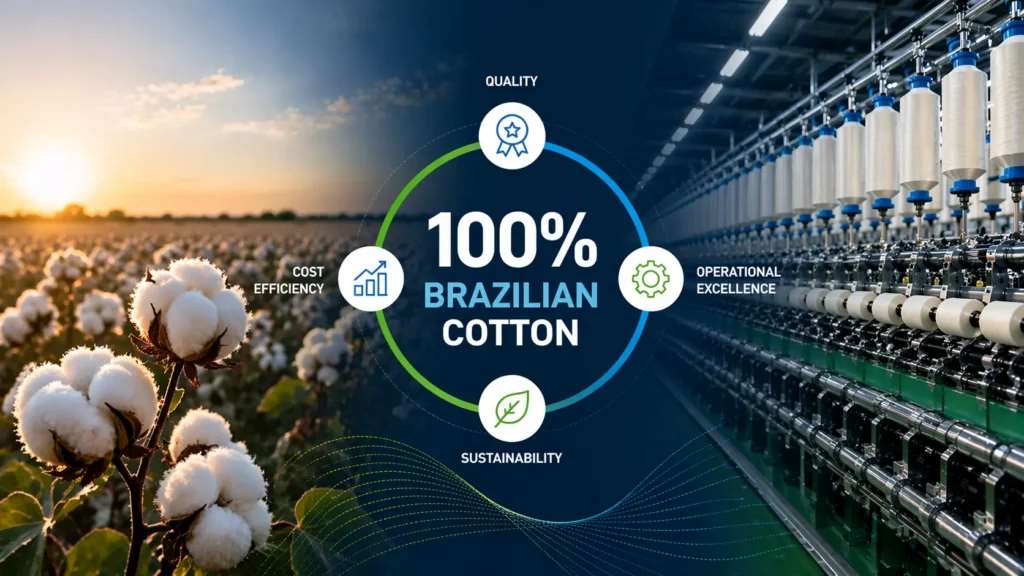
The biggest shift continues to be Brazil's emergence as the world's dominant cotton exporter. After increasing exports by 14 per cent during 2025/26 riding on a record harvest, Brazil now commands roughly one-third of global export trade. Even though planted acreage is expected to fall as growers shift land towards more profitable corn production amid rising fertiliser costs, exports are projected to remain around 3 million tonnes because of strong yields and existing inventories.
The US, long regarded as the benchmark supplier for international mills, remains under pressure. Production has fallen as drought conditions persist across much of the cotton belt despite expectations of improved yields from favourable weather patterns. Carry-over inventories should allow exports to recover modestly next season, but the gap with Brazil has fundamentally narrowed.
Australia continues to play an outsized role relative to its production, maintaining export volumes through inventory drawdowns even as harvests decline. West African suppliers are recovering after pest-related crop losses, while European Union exports remain anchored by Greek production.
The buyers are changing too
The geography of cotton consumption is also evolving. China has returned aggressively to international markets after sharply reducing imports two seasons earlier. Higher domestic fibre prices and additional import quotas have encouraged mills to rebuild overseas purchases, with Brazil now supplying more than half of Chinese imports.
Vietnam's growing apparel industry is driving one of the fastest increases in cotton demand. Because the country produces virtually no cotton domestically, its growing spinning sector remains almost entirely dependent on imported lint, with the US retaining a dominant market share through favourable trading arrangements.
Bangladesh remains one of the world's largest importers despite temporary declines caused by energy shortages and shipping disruptions. Pakistan is raising imports to compensate for weaker domestic harvests.
Perhaps the most notable change is occurring in India.
Although India has the world's largest cotton acreage and expects production to recover, domestic mills and yarn exporters are absorbing a growing share of local output. As a result, imports have grown following temporary duty relief on selected cotton varieties, signalling India's gradual evolution from a traditional exporter into an important consumer market.
Table: Major cotton importers (2025/26)
|
Importer |
Imports (mn tonnes) |
Key suppliers |
|
China |
1.6 |
Brazil, Australia, United States |
|
Bangladesh |
1.6 |
Brazil, West Africa, India |
|
Vietnam |
1.6 |
United States, Brazil, Australia |
|
Turkey |
1 |
Brazil, United States, Azerbaijan |
|
India |
1 |
Brazil, Australia, United States |
|
Pakistan |
0.81 |
Brazil, United States, Australia |
The sourcing patterns reveal a broader trend. Brazil has become the preferred supplier across Asia, while the US remains strongest in Vietnam. Bangladesh relies on Brazilian fibre, partly because consistent quality and efficient shipping routes have helped mills maintain production despite wider logistics disruptions.
Logistics an advantage
Cotton procurement is no longer determined solely by harvest size.
Shipping reliability, inventory availability and trade policy influence purchasing decisions. Brazilian exporters have benefited from competitive pricing, commercial diplomacy and relatively efficient logistics into Asia. Meanwhile, Chinese policy adjustments, including additional import quotas and selective tariff changes, are reshaping buying behaviour.
At the same time, disruptions around Middle Eastern shipping routes have added costs across agricultural supply chains, while higher fertiliser prices continue to squeeze producer margins. These pressures are encouraging farmers in several countries to shift acreage towards alternative crops, limiting the scope for rapid production growth. Competition from synthetic fibres further complicates the picture by capping cotton's pricing power even as physical supply tightens.
A market driven by resilience
The next phase of global cotton trade will be defined less by production cycles than by supply-chain resilience. The projected rise to 10.3 million tonnes of global trade reflects manufacturers' growing dependence on international sourcing as production remains constrained and consumption stays resilient. Export leadership is shifting towards Brazil, Asia is becoming even more central to demand, and countries such as India are redefining their role within the global cotton economy.
For textile companies, the challenge is no longer simply finding the lowest-cost fibre. It is building procurement networks capable of withstanding climate volatility, geopolitical disruptions and increasingly fragmented trade flows. In cotton, resilience has become the industry's most valuable commodity.
From Volume to Value: How fashion supply chains are defending margins through 2030

For decades, the global textile and apparel industry measured success through factory utilisation. Full order books, high machine occupancy and uninterrupted production were considered indicators of commercial strength. That equation is now breaking down. Today's manufacturers are discovering that running factories at full capacity does not necessarily translate into higher profitability.
According to the Global Textile & Apparel Outlook (2026-2030) by Gherzi Textil Organisation, the global textile market is expected to grow from $2.10 trillion in 2026 to $2.60 trillion by 2030. Yet the industry's challenge is no longer generating revenue but protecting profits amid rising production costs, geopolitical uncertainty and increasingly complex compliance requirements.
Contract manufacturers continue operating with net margins of just 5-12 per cent, while apparel brands maintain healthier gross margins of 30-50 per cent, although these too are being threatened by cautious consumer spending and persistent markdowns. The competitive advantage is shifting from production volume towards speed, flexibility and disciplined margin management.
Table: Market value growth
|
Year |
Market Value |
|
2023 |
$1.80 trillion |
|
2026 |
$2.10 trillion |
|
2030 (Estimated) |
$2.60 trillion |
Cost leadership alone no longer wins
While sustainability dominates marketing campaigns, commercial sourcing decisions continue to be driven largely by economics. Polyester accounts for more than 52 per cent of global fibre production, remaining the industry's preferred material because of its affordability, durability and manufacturing consistency.
However, sourcing inexpensive synthetic materials has become considerably more complicated. Regulatory scrutiny across major importing markets demands complete supply chain visibility, proof of origin, forced-labour compliance and traceability documentation.
Low-cost sourcing without proper documentation now exposes brands to border delays, additional tariffs and reputational risks.
Robert Antoshak, Managing Partner at Gherzi Americas, observes that companies are being forced to reassess long-standing sourcing assumptions. Tariffs, compliance obligations, geopolitical tensions and supply-chain resilience have become central competitive factors. Low-cost procurement without documentation and operational flexibility is no longer commercially sustainable.
The industry's priorities have consequently grown beyond unit cost optimisation to include digital traceability, regulatory preparedness and supplier transparency.
Nearshoring faces limits
The idea of relocating apparel production closer to end markets has gained considerable traction over recent years. Yet translating boardroom ambitions into operational reality remains difficult.
Manufacturing ecosystems developed across Asia over several decades cannot be replicated quickly. Regions such as Central America, Mexico and Eastern Europe continue to face limitations in upstream textile processing, raw material availability and skilled labour capacity.
Asia-Pacific still accounts for approximately 58 per cent of global textile production, supported by deeply integrated fibre, chemical, spinning, weaving and finishing networks.
Meanwhile, labour economics remain uneven. Manufacturing wages exceed $23 per hour across many developed economies, while emerging production centres continue operating within a $2-6 per hour range. Even these lower-cost regions are witnessing wage inflation, labour shortages and infrastructure constraints, reducing some of their traditional cost advantages.
According to Radhika Shrinivas, Partner at Gherzi Americas, companies relocating production without securing upstream fabric, trims and accessory sourcing risk immediate disruptions in delivery schedules and customer commitments. Nearshoring, therefore, demands ecosystem development rather than simple factory relocation.
Speed emerges as the new competitive currency
The apparel industry's biggest transformation may be occurring in sourcing strategy itself. Rather than abandoning Asia entirely, global brands are increasingly adopting dual-sourcing models that combine cost efficiency with responsiveness.
A mid-sized North American activewear company cited in the report shows this transition. Previously dependent on East Asian suppliers for nearly all technical apparel production, the company divided sourcing responsibilities between automated South Asian manufacturers for high-volume basics and nearshore facilities in Mexico and Central America for seasonal, fashion-sensitive products.
The results demonstrate why sourcing diversification is gaining momentum.
Lead times fell from 85 days to 35 days, unsold inventory markdowns declined by 18 per cent, and gross margins remained above 42 per cent, despite higher regional labour costs. The improvement came not from chasing the lowest wages but from reducing inventory risk, responding faster to market demand and shortening replenishment cycles.
David Uricoli, Partner at Gherzi Americas, argues that the industry's winners over the next five years will be companies capable of simultaneously shortening reaction times, protecting profitability and complying with evolving regulatory requirements.
New measure of supply chain strength
The textile industry entering the next decade bears little resemblance to the one built around scale alone. Production capacity remains important, but it is becoming a baseline capability rather than a competitive differentiator. Margin resilience now depends on integrated sourcing ecosystems, digital supply-chain visibility, regulatory compliance and operational agility.
As global textile revenues continue their steady grows to $2.6 trillion, the companies creating long-term value will not necessarily be those producing the largest volumes. Instead, they will be those capable of balancing cost efficiency with speed, traceability and resilience in an increasingly fragmented global trading environment. The industry's next competitive edge will belong to supply chains that are not merely larger, but smarter, faster and substantially more adaptable.
The new retail math, smaller footprint, faster returns, sharper focus

The US retail industry is passing through one of its most impactful change in decades. What appears on the surface to be a wave of store closures is, in reality, a large-scale redistribution of consumer spending and retail space. After 7,325 store closures in 2024, projections indicate that nearly 15,000 stores could shut doors between 2025 and 2026 as department stores, mall-based retailers and legacy chains complete long-delayed rationalization programs. Yet industry observers say this is not a retail collapse. Instead, it reflects a reordering of where consumers shop and what they value.
The biggest casualty is the traditional middle market. For years, mainstream retailers thrived by offering broad merchandise assortments through extensive store networks. Today, shoppers are gravitating toward either extreme value propositions or highly targeted products that solve specific needs, creating what many analysts describe as a ‘barbell economy’.
The middle market squeeze
The changing economics of physical retail have forced many established brands to rethink their store footprint. For long, large store networks generated visibility, convenience and demand. However, rising operating costs, changing consumer habits and the growth of digital commerce have weakened those advantages. Retailers are now evaluating locations based on profitability and demand density rather than market presence alone.
Department store operator Macy’s exemplifies this transition. Through its ‘Bold New Chapter’ strategy, the company is closing 150 underperforming stores by the end of 2026 while concentrating investment on approximately 350 stronger-performing locations. The pressure extends beyond department stores. Children’s apparel retailer Carter’s is expected to close roughly 150 stores as it deals with tariff-related cost pressures and workforce reductions. Grocery giant Kroger is also streamlining operations, planning to shut around 60 locations to improve network efficiency and supply-chain economics.
The message from these decisions is clear: physical stores are no longer strategic assets simply because they exist. They must generate measurable returns and support a broader omnichannel ecosystem.
Value retail takes the lead
While traditional operators shrink their footprints, discount and off-price retailers are aggressively expanding. Inflationary pressures and higher consumer price sensitivity have altered shopping behaviour, making value- retail one of the strongest growth engines in the sector. Discount and essential retail formats now account for an important share of new store openings.
Table: Expansion plans among key retailers
|
Brand |
Planned retail openings (2026 Projection) |
Focus |
|
Dollar General |
450+ stores |
Rural "food deserts" & high-frequency consumables |
|
Ollie’s Bargain Outlet |
75 stores |
Closeout inventory & extreme value |
|
Uniqlo |
20+ stores |
High-turnover functional basics |
|
Nordstrom Rack |
Continued expansion |
Off-mall, high-margin brand liquidation |
The common thread among these retailers is a focus on productivity rather than scale alone. Dollar General continues to expand into underserved communities while developing larger DG Market formats that capture grocery spending. Ollie’s Bargain Outlet benefits from a steady stream of excess inventory generated across the broader retail ecosystem.
Meanwhile, Uniqlo is building its growth around wardrobe essentials and functional basics rather than seasonal fashion cycles. Nordstrom Rack has also emerged as a beneficiary of changing shopping habits by offering consumers branded products at discounted prices through convenient off-mall locations. Rather than maximizing square footage, these retailers are optimizing inventory turnover, customer frequency and margin efficiency.
A bookstore’s unlikely comeback
Perhaps the most striking example of retail reinvention comes from Barnes & Noble. Once viewed as a symbol of brick-and-mortar decline, the bookseller is now pursuing an expansion strategy that includes approximately 60 new stores. Its resurgence stems from abandoning standardized retail formulas in favour of local relevance. Under the new model, individual store managers have greater autonomy over product selection and merchandising. This approach allows each location to reflect the preferences of its local community while benefiting from the scale and logistics capabilities of a national retailer.
The strategy has produced encouraging results, including an 11.1 per cent increase in foot traffic during mid-2024. By combining local curation with national infrastructure, Barnes & Noble has positioned itself between independent bookstores and the algorithm-driven efficiency of e-commerce giants. The turnaround highlights a broader industry lesson: consumers reward authenticity, local relevance and differentiated experiences.
The rise of smaller stores
Another defining trend is the move toward smaller, more efficient store formats. Retailers are discovering that profit often improves when square footage decreases. Smaller locations require lower capital expenditure, reduced staffing costs and faster inventory turns while still allowing brands to maintain a physical presence. Outdoor retailer REI and apparel company L.L. Bean are among the brands experimenting with compact formats that deliver specialized experiences without the costs associated with traditional big-box stores.
This small-box approach reflects a broader shift toward precision retailing, where stores are designed around specific customer missions rather than broad product assortments.
Utility over brand theatre
Consumer priorities are also evolving. Private-label products have become more attractive, with store-brand sales reaching an estimated $271 billion. Younger consumers, particularly Millennials and Gen Z, are viewing private labels as credible and often more authentic alternatives to premium-priced national brands.
At the same time, shoppers are placing greater emphasis on utility and functionality. Performance apparel, everyday essentials and problem-solving products continue to gain market share, while undifferentiated fashion and discretionary categories face growing pressure. The shift suggests that retail success increasingly depends on delivering tangible value rather than relying solely on brand prestige or marketing narratives.
The new retail formula
As the industry moves through 2026, retail growth is becoming more selective and data-driven. The strongest performers are concentrating on either high-margin premium segments or high-volume value retail, while many traditional middle-market operators struggle to maintain relevance. Digital integration has also become essential, with services such as ‘Buy Online, Pick Up In Store (BOPIS)’ helping retailers convert online demand into store traffic.
The retail sector once expanded through blanket geographic coverage and ever-larger footprints. Today, success is determined by targeted expansion, localized relevance and operational efficiency. The industry is not witnessing the end of physical retail. Instead, it is entering a new era where fewer stores, stronger economics and sharper consumer propositions are defining the next phase of growth.