FW
TencelLuxe to increase capacity by 25%
Sales of Tencel™ Luxe, the lyocell filament yarn brand under Lenzing’s textile specialty brand, grew five times the volumes achieved previous year in 2021 and is on track to increase its existing production capacity by 25 per cent in 2022 to cater to growing demand.
Tencel™ Luxe targets all corners of the luxury and premium market to facilitate co-branding opportunities, bringing Tencel™ Lyocell filament yarn to public figures and runways. It has repeatedly appeared in collections by renowned designers such as Italian sustainability ambassador Flavia La Rocca, multi-disciplinary artist Osman Yousefzada at London Fashion Week and eco-couture house PeetDullaert , which recently celebrated its 10th anniversary during Paris Couture Week.
In the pipeline for this year, Tencel™ Luxe will continue its collaborations with Dutch cult design duo Viktor & Rolf, who are using exclusive Tencel™ Luxe fabric developments for their haute couture and bridal collections, conscious luxury brand Bav Tailor, and Vogue UK’s “One to Watch” Anciela, whilst expanding its partnership portfolio through collaborations with brands including DeepikaGovind, Taneira and Safaa.
Tencel™ Luxe will also be showcased in exciting new collaborations with Patrick Mcdowell at London Fashion Week 2022 and LVMH Prize finalist Róisín Pierce at Paris Fashion Week 2022.
UK apparel imports hit by Brexit, COVID
Badly hit by Brexit and COVID-19 pandemic, the value of UK’s apparel imports has been declining from 2019, when it became imminent that Brexit is going to take place. The subsequent onset of COVID-19 only increased this declining trend. However, home textiles imports performed better in 2020.
UK’s apparel imports peaked in 2018 at $26.502 billion, compared to $24.308 billion in 2017. But the declining trend started since 2019 when the import value was $25.809 billion. It further decreased to $22.943 billion in 2020 and 20.886 billion in 2021. Imports in the first four months of this year stood at $7.634 billion.
However, home textiles imports decreased only last year to $4.212 billion in 2021 from its peak of $7.974 billion in 2020. The value of imports was almost at the same level in the preceding three years – $5.364 billion in 2017, $5.548 billion in 2018 and $5.593 billion in 2019. The figure stood at $1.274 billion in January-April 2022.
Cotton dominates US apparel imports with 49.22% share: OTEXA
Imports of cotton apparels continue to dominate the US’ apparel imports with 49.22 per cent share in overall US apparel import values.
As per an OTEXA report, the US imported apparels worth $40.94 billion during the January to May 2022 period, of which $20.15 billion is shared by cotton apparels.
The share of MMF apparels was $18.89 billion – 46.14 per cent of the total import values.
The data further indicates that $1.09 billion was spent to source apparels made from silk and vegetable fibres, while wool apparels’ import was worth US $ 801.25 million.
Vietnam remains the top destination for the US apparel buyers for cotton apparels as the country shipped US $ 3.17 billion worth of apparels made from cotton to USA in the said period.
Bangladesh and China followed Vietnam with $2.91 billion and $2.63 billion worth of cotton apparel shipment to the US. India’s cotton apparel export to the US valued $2.02 billion in the same period.
China’s FMCG sales decline by 0.70%: NBS
Total retail sales of China’s consumer goods fell by 0.70 per cent in H1 ’22, according to the latest statistics released by National Bureau of Statistics (NBS) of China.
From January to May 2022, the retail sales in China increased to RMB 21,043 billion ($ 3,120 billion), of which RMB 628.20 billion ($93.12 billion) was contributed by apparel and accessories.
The apparel and accessory sales plunged by 6.50 per cent in the first half of 2022 on yearly basis.
However, particularly in June ’22, the sales increased by 1.20 per cent, signaling the economy is opening up after months of lockdown in various cities of China.
China’s online retail sales reached RMB 6,300.70 billion (US $ 934 billion), an increase of 3.10 per cent year-on-year, whereas the online retail sales of clothing improved by 5.10 per cent.
BGMEA urges support for Bangladesh’s apparel industry growth
Apex garment makers’ body in Bangladesh, BGMEA, has urged IMF’s support to realize the apparel industry’s vision that would spur Bangladesh’s developments in the next few months.
Faruque Hassan, President, BGMEA, underlined this during his recent meeting with Rahul Anand, Miission Chief for Bangladesh, IMF who paid a courtesy call to Hassan along with other IMF team members, including Resident Representative in Dhaka Jayendu De, and Seniors Economists RituBasu and Estelle Xue Liu.
At the meeting, both the sides discussed issues pertaining to the apparel industry of Bangladesh including its current situation, opportunities and strategies to meet future challenges and sustain growth while also deliberating on the issue of possible impacts of LDC graduation in terms of tariff changes and market access.
India projects brings together specialist organizations
Commissioned by Fashion for Good as part of the Sorting for Circularity; India Project, a study conducted in collaboration with Sattva Consulting, Saahas Zero Waste, and Reverse Resources brings together specialist organizations in strategic impact, waste, resource and data management, and the scaling of textile recycling infrastructures.
To enable an effective transition towards circularity, the study titled Wealth in Waste: The Opportunity for India to Bring Textile Waste Back into the Supply Chain,’ aims to fill the data gaps that exist in the textile waste landscape in India. By building a better understanding across three key streams, domestic post-consumer waste, pre-consumer waste and imported waste, and by mapping stakeholders, and geographical flows and recognizing challenges in the current infrastructure, the study aims to help ecosystem players to orchestrate actions and devise solutions and mediate accordingly.
Outlining the potential for collaborative and systemic interventions to fortify circularity in the Indian textile waste industry and reintroduce it into the supply chain, the study presents a three-step approach to driving this transition;enabling visibility and access to waste; harnessing the recycling potential of India, andestablishing systems, infrastructure, and regulations for waste management.
Pure London to host Source Fashion in February 2023
For the upcoming edition of February 2023, Pure London will host Source Fashion that will replace Pure Origin as part of a brand evolution reflecting a new vision for sustainable, ethical, and inspirational material and textile sourcing.
Source Fashion will debut on the February 12 – 14, 2023 and aims to become a leading sourcing destination amongst the European buying community where buyers, manufacturers and raw material suppliers can meet, exchange information and make business together.
Pure London, the UK’s fashion buying show, held at Olympia London, in London from 17 to 19 July, closed successfully.
From raw materials and trims to fabrics and packaging, Pure Origin, which has been running alongside Pure London, has brought inspiration to designers and buyers around the world. With an urgent need for retailers to adopt a diversified, transparent, and ethical supply chain, Source Fashion can become a gateway to UK retail for setting a new standard for how inspiration, collaboration and awareness will shape the future of responsible product sourcing, from field to fashion.
The Change Masters Conference makes a successful debut
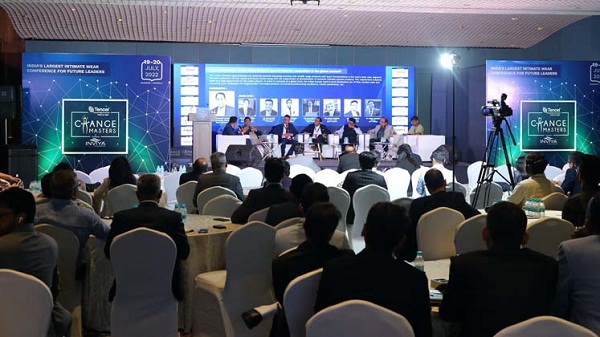
Held on July 19-20, 2022, at The Radisson Hotel, Lonavla, Maharashtra, the Change Masters Conference was a first-of-its-kind B2B event for the intimate wear industry in India.
Propelled by the idea of encouraging young leadership and new business processes, the Change Masters Conference was introduced by Yusuf Dohadwala, Founder, Peppermint Communications, and CEO, Intimate Apparel Association of India (IAAI),. The conference brought together experienced professionals and the under-45 youth brigade from the inner wear segment.
Attended by over 100 brands
The event was attended by over 100 intimate wear brands, factories and retail stores who discussed industry issues. Comprising panel discussions and presentations by more than 20 eminent personalities and speakers from the industry, the Conference was supported by Tencel, Inviya, R|Elan and INTICEDE.
The event commenced withRakesh Grover, President, IAAI; Raj Kumar Jain, Deputy Chairman, NITRA; Sanjay Jain, Vice President, FOHMA/WBHA; and HarminderSahni, Managing Director, Wazir Advisors, lighting the ceremonial lamp. This was followed by presentations by Wazir Advisors. Day 1 culminated in a networking cocktails and dinner extravaganza for all the speakers and delegates.
Making India future-ready
Day 2 of The Change Masters Conference started with the panel discussion on ‘Roadmap to Building Future Ready Brands.’ The panel discussion highlighted several important factors such as holistic development, branding, updated processes and thinking out of the box.
The second panel discussion was on ‘Roadmap to Building Future Ready Brands, Manufacturing and Retail.’ The discussion focussed on:
• The key for any brand's success is to solve existing problems
• Awareness and education amongst consumers about wearing the right fit and type of inner wear that young brands like Nykd by Nykaa and Zivame are addressing
• Data is a key driver for brands like Clovia as they collect over 1.5 million data points and feedback from their consumers.
• Quality and feedback from consumers is of primary importance.
The third panel discussion covered ‘Future Leaders’ Viewpoint,’ which invited opinions from young thought leaders to present ideas on market disruptions and innovations. The panels were accompanied by sponsor presentations as well as an interesting session by Sarika Hussain on Unparalleled AI Revolution in Fashion and Garment Industry.
Leaders speak
"The Change Masters Conference is a pioneer event and a great opportunity for the industry to interact, network with like minded individuals and understand the Indian consumer. This understanding and insight into the consumer base and the various aspects of a brand, helps address larger issues, says LavanyaPachisia, COO, Zivame.
“The Change Masters Conference offers India an opportunity to move from $2 billion to $10 billion in exports. For this, larger capacities have to be set up and we have potential to do,” adds PrashantAgarwal, Joint MD, Wazir Advisors.
Vietnam exports fibers and yarn worth $2.37 billion from Jan-May’22
Surpassing the Republic of Korea, Vietnam has become the world’s sixth largest fiber and yarn exporter after shipping abroad $2.37 billion worth of these items in the first five months of 2022.
As per a Vietnam plus report, exports of textiles and garments, fibre, yarn and fabric brought home $18.73 billion during the period, rising 20.81 per cent year-on-year. That includes $14.99 billion in textiles and garments, $376.8 million in geotextiles and $979.8 million in materials.
According to Vietnam Cotton and Spinning Association (VCOSA) China accounted for 60 per cent of Vietnam’s total textile and garment exports.
Meanwhile, the US and Europe, which are the world’s biggest textile and garment importers, have reduced shipments from China, giving Vietnam a chance to expand its market share.
VCOSA added Vietnam’s economic integration into the world, especially the participation in free trade agreements such as the Comprehensive and Progressive Agreement for Trans-Pacific Partnership (CPTPP) and the EU - Vietnam Free Trade Agreement (EVFTA), also promises breakthrough developments for the fibre and yarn segment.
US apparel sourcing from Ethiopia surges 31.96%
US’ apparel sourcing from Ethiopia surged by 31.96 per cent to $700.09 million during January to May ’22, as per OTEXA.
Ethiopia dethroned Kenya to become the top African apparel export country to the US market in the first two months’ period; however, Kenya picked pace in next three months and regained its top spot.
Kenya shipped $196.92 million worth of apparels to US, noting 13.39 per cent Y-o-Y surge, while Ethiopia could ship just $167.95 million) apparels to US in January to May ’22.
On third spot was Madagascar that shipped $44.78 million worth of apparels to the US in Jan.-May ’22, noting 48.68 per cent yearly increase. Madagascar stayed ahead of Lesotho which shipped $114.89 million worth of apparels to the US in the mentioned period.