Textile tests need to be rigorous
Testing mechanisms for performance textiles are often not based on reality.
The most widely accepted standard currently, ISO 11092, does not put the textile to the test in real world conditions. The ISO 11092, which sets its test conditions at 35 degrees Celsius outside temperature and a relative humidity of 40 per cent, cannot measure the performance of breathable textiles in subzero winter temperature and snow/rain.
The test, for example, does not address the problem of condensation building up inside the clothing when the temperature drops below 14 degrees Celsius. In a dangerous case, this can cause the clothing to freeze up. When the temperature is high, on the other hand, breathability can be reversed, drawing hot steam and vapor inside the garment, boiling the wearer.
There is a need for breathability tests in cold, wet and dry conditions that measure condensation within the layers of a garment system. Such tests can be life-saving as performance garments are used by many working in extreme conditions. An India military serviceman caught in a mountain accident wearing an Ardmel garment was able to survive for nine days under extremely cold temperatures. While the serviceman died of other complications after he was saved, he did not suffer from any cold injuries. Had he worn a garment that could not prevent condensation, he would have died earlier of hypothermia.
Pressure on Indian spinners’ margins may ease
For the fourth consecutive quarter companies in India’s spinning sector have reported a year-on-year decline in volumes.
Reasons include a fall in exports due to weak demand from one of the key markets, China; and a focus on inventory clearance prior to GST implementation, which affected offtake and hence production volumes.
The challenges have been further accentuated by consistently firm cotton fiber prices resulting in subdued contribution margins as well as strengthening of the Indian currency vis-a-vis currencies of competing nations, thereby affecting realisations.
Nevertheless the debt coverage metrics continue to improve on a year on year basis, given the secular decline in term debt level and decline in borrowing costs. Improved supply of cotton fiber is, however, expected to provide some respite to domestic spinners during the second half of fiscal year 2018.
The level of global cotton production in 2018 is estimated to exceed consumption, after two consecutive years of shortfall. The resultant cotton surplus therefore will create a downward bias in prices which, besides easing pressure on contribution margins of the spinners, is likely to bring down their working capital requirements. This augurs well for the domestic cotton spinning industry.
Further, Indian yarn exporters are trying to diversify export markets to increase their sales volumes.
Pakistan’s spinners face low demand
The spinning sector in Pakistan is the backbone of the textile value chain. It has faced the brunt of the high cost of doing business in the last few years, which has made it unviable. Today the spinning industry is incurring heavy losses by selling yarn below its cost due to poor demand from domestic consumers.
Pakistan’s total production of yarn in the year 2016-17 was 3,428,730 tons whereas cotton yarn exported in the same period was 4,55,345 tons i.e. only 13.28 per cent of the total production of the year. Similarly in 2015-16 total production of cotton yarn was 3,405,559 tons whereas only 12.44 per cent or 423,624 tons was exported. Thus about 87 per cent of the cotton yarn produced in the country is available for the local market whereas the domestic downstream industry consumes only about 70 per cent of the total production of yarn.
Since production of yarn is substantially more than local consumption, the industry feels yarn exports must be encouraged at all costs, otherwise it will result in permanent massive closure of mills and resultant unemployment.
Owners of Pakistan’s textile mills have strongly rejected the suggestion to stop the four per cent rebate on the export of yarn.
Nike’s gross margins fall
Nike has reported its weakest quarterly sales growth in nearly seven years.
Nike still gets about 70 per cent of its revenue from retail customers but has been investing heavily in e-commerce, partnering with Amazon and offering heavy discounts on its own website. The company is building up more stock to sell through online channels but may also indicate lower sales through traditional outlets. Gross margins fell 1.8 per cent to 43.7 per cent, pointing to greater discounting in a market Nike warned would shrink overall in the current quarter as more stores shut.
Nike expects challenges to remain in North America for at least several more quarters.
Analysts from some of the world’s major brokerages remain upbeat on the company’s plans to invest in a variety of different distribution channels but say it will happen too slowly to offset the growing battle for market share.
European rival Adidas has continued to snap at Nike's heels, even if the latter's North American business is still more than three times larger. Both face growing competition from others including Under Armour.
US sports good chains have been shutting stores and cutting prices as fewer shoppers visit malls and online shopping grows.
Lectra continues partnership Faurecia
Lectra has renewed its partnership with Faurecia. The cutting process for the production of seat covers, headrests and interiors is an increasingly strategic part of Faurecia’s activity. Faurecia supplies vehicle complete seats, frames, mechanisms and trim covers to major carmakers worldwide, whose manufacturing processes are gradually evolving toward Industry 4.0.
Faurecia aims to double production of existing manufacturing facilities by reinforcing operations with advanced manufacturing technologies. The company’s extended partnership with Lectra entails focusing on operational excellence initiatives across its automotive seating division.
Faurecia currently has more than 60 vector fabric cutting solutions in production worldwide. Standardization of the vector fabric-cutting solution—endowed with preventive and predictive maintenance capabilities and the highest-performance cutting system available on the market to date—will be instrumental to the implementation of these initiatives throughout the division’s fabric cutting facilities. Its digital enterprise project aims to achieve operational excellence in virtually every aspect of its organization. Together with Lectra, Faurecia will make this a reality in the cutting room, with smart automation and predictive maintenance.
Lectra is a world leader in integrated technology solutions dedicated to industries using fabrics, leather, technical textiles and composite materials. Given the profound transformations gripping manufacturing, helping customers ready their operations for the Fourth Industrial Revolution has become Lectra’s core mission
Lacoste returns to catwalk to celebrate 85th anniversary
French label Lacoste celebrated its 85th anniversary and returned to Parisian catwalks after showing in New York for 14 years.
Lacoste's masculine looks featured an array of ultra-comfy long johns, sky blue cable-knit sweaters, baggy trousers and faded jeans in typical ’80s style. For women, the label alternated preppy outfits like the trousers-cardigan combo in cream-colored fabric trimmed with a navy blue stripe, and ruched summer dresses decorated with Lacoste’s signature motifs: the crocodile, tennis balls and sunglasses.
Centerstage, the Chassol trio played a punchy electro-jazz piece, the ideal band and sound to accompany a mix-and-match collection featuring jogging pants alongside chic little dresses, corset dresses worn with tennis sneakers and sport socks, and retro tracksuits combined with moccasins. Also, loose, colorful wind-breakers draped over navy blue dresses with gilded buttons, and classic blazers fashioned out of sweatshirt fleece. All of this in Lacoste's traditional colors: navy blue, green, red and white.
It was a blend of genres, from a very sophisticated preppy style to contemporary sportswear, first seen when Lacoste made its street wear debut in the 1980s and 90s.
In 1933, René Lacoste famously cut the sleeves of his white poplin shirt to make the first polo.
United Colors of Benetton sees colors everywhere
United Colors of Benetton presented an exhibition “I See Colors Everywhere” from 24th September to 28th September, at Milan’s Triennale Design Museum. Visitors to the exhibit were told the story of colour, as told by garments from the new Spring-Summer collection and works by Fabrica, Benetton’s art and communications research center.
The exhibition “I See Colors Everywhere” celebrated this heritage by presenting a broad spectrum of editorial and creative productions by Fabrica in a space where design, art and society encounter and enter into dialogue with each other.
This was curated by a team of Fabrica designers, led by Sam Baron, and is divided into eight sections, each dedicated to a colour that will be explored and celebrated through videos, posters, music, photos, illustrations, objects, performances and interactive installations produced by Fabrica over the course of more than 20 years of activities.
The exhibition was accompanied by a magazine-catalogue, editorial penned by Myriam Ben Salah, writer and curator of cultural programming at the Palais de Tokyo in Paris. The catalog provided an additional level of interpretation of colors.
Donear Industries awarded as Power Brand
Donear Industries has been felicitated and awarded the title of “70 Most Trusted Power Brands.” “The Most Trusted Power Brand awards” is one of the most prestigious Awards for brand positioning & recognition. Recently, the Power Brands Mumbai Summit took place here in Mumbai. Ajay Agarwal Executive Director has received the award from Shaan and Divya Dutta.
On this occasion Agarwal stated that the Power Brands, thus is a individual enterprise, a mega celebration of achievement, highlighting the success of brands and the individuals behind them.
Donear provides its customers a well-diversified range of the fabrics - unmatched in comfort, versatility, lightness and styles. It is the fastest growing company and one of the top three textile brands in India, Donear produces 50 million Meters of fabric annually. The company has a strong position in the market due to innovative products and designs and consistency in quality and delivery schedules.
Recently, company took over Grasim Bhiwani unit and Graviera brand
After heaven on earth, Playboy founder is now in heaven
Playboy founder Hugh Hefner, 91, is dead. He helped usher in the 1960s sexual revolution with his groundbreaking men's magazine and built a business empire around his libertine lifestyle.
He kept a harem of young blondes that numbered as many as seven.
Thanks to Viagra he continued exercising his libido into his 80s.
He was determined to stay young and never grow up, and as long as the women felt the same about him, that’s all that mattered.
Hefner settled down somewhat in 2012 at age 86 when he took Crystal Harris, who was 60 years younger, as his third wife.
His so-called stunted childhood led to a multi-million-dollar enterprise that centered on naked women. At the raucous parties in his mansions, legions of male celebrities swarmed to mingle with beautiful young women.
Long before the Internet made nudity ubiquitous, Hefner faced obscenity charges in 1963 for publishing and circulating photos of disrobed celebrities and aspiring stars but he was acquitted.
Hefner created Playboy as the first stylish glossy men’s magazine and in addition to nude fold-outs, it had intellectual appeal with top writers. In-depth interviews with historic figures such as Fidel Castro, Martin Luther King Jr., Malcolm X and John Lennon also were featured regularly.
Budapest celebrates Indian fashion
Both traditional and fusion Indian fashion was celebrated at the Balna in Budapest, Hungary, in an event organised by the Embassy of India and Gait-N-Grace’s Managing Director, Vinay Gupta.
As part of a late celebration of India’s 70th year of independence, the embassy held the “Alluring India 2017” fashion show and it was the first event of its type to both display traditional and fusion Indian fashion on a large scale in Hungary and to have live social media event coverage. The event took place on September 21 and was in collaboration with the Incredible India tourism campaign.
The event featured a fashion show that included traditional garments such as lehengas, sarees, and gowns, but more experimental garments were also displayed to give a rounded picture of current Indian fashion as well as its heritage. A live saree draping demonstration showing different styles also took place. One of the designers featured in the fashion show was Charu Parashar of the brand Parashar who showed two bridal collections entitled “Regal Saree” and “Various Moods” and another was Payal Keyal of the brand Keyal who showed contemporary versions of traditional garments.
An array of guests attended the event including Rahul Chhabra, the Indian Ambassador who introduced the event. A mix of ambassadors, officials, and businessmen gathered to witness this display of Indian fashion and culture and a dinner was also served that included Indian specialities. Cultural ties between Hungary and India appear to be strengthening and there will also be an Indian film festival in the country from October 3 to 11.
More...
CISMA holds forum on household sewing machines
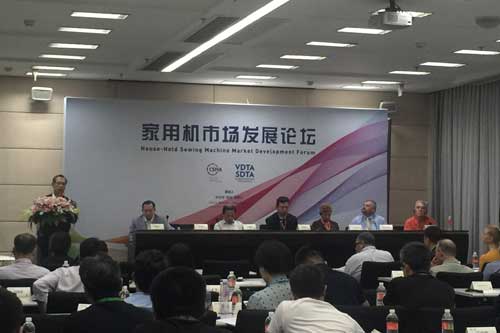
A forum on household sewing machine development was held as part of CISMA 2017.
It was attended by machine manufacturers, sales representatives, classroom representatives, and media representatives from mainland China, the United States, Japan, China Taiwan, etc. A total of more than 80 people attended the meeting.
During this CISMA exhibition, there is a special zone for patch-work collections. Visitors can enjoy the patch-work contest and training.
Lin Zhicheng, from the Shenxing group, gave a speech of service and quality management. Chen Yan, from the SGSB Group, spoke on Internet and the traditional household sewing machine industry. Wu Mingren, from Xi Jia, Taiwan, shared his experiences of household sewing machine store marketing. Chris Martin and Dali Vuicin from the United States gave their views on household sewing machine marketing.
International Development and Cooperation Forum held at CISMA
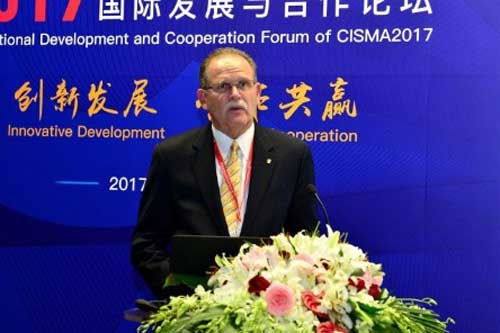
International Development and Cooperation Forum was held at the Shanghai New International Expo Center, during CISMA 2017.
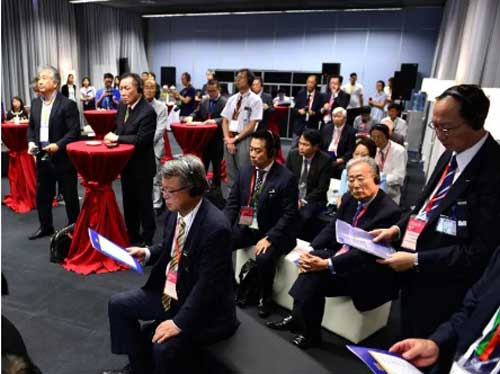
A total of more than 60 people attended the forum. Chen Ji, Secretary General of China Sewing Machinery Association, presided over the forum. Vice president of China Light Industry Association, China Sewing Machinery Association, He Ye attended. There were overviews of the global garment industry and the international leather industry. There was a session on intelligent manufacturing trends, manufacturing innovation and development.

The forum was sponsored by the China Sewing Machinery Association. The aim is to make CISMA a more professional, broader and more open platform for the international sewing machine industry.
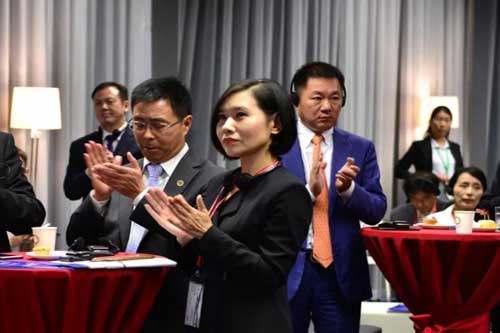
With the new round of technological revolution and industrial transformation, the global sewing machinery industry is facing a lot of opportunities, but also faces many new challenges. China’s sewing machine industry is going in for technology upgradation. There is upstream and downstream industry consensus, clear goals, and win-win cooperation.

Over the next five to 10 years, China's sewing machinery industry will continue to implement innovation to speed up the new generation of information technology and promote the optimization of industrial structure. The business model will be transformed and upgraded. Intellectual property rights will be created.
Da Hao unveils cloud platform at CISMA
Da Hao Technology Sewing Machinery works actively to promote the development of intelligent sewing machinery systems.

The aims are to achieve a comprehensive application of the new generation of intelligent network integrated electronic control systems to be used in embroidery machines, industrial sewing machines, horizontal looms and other fields, to achieve high-speed development in sewing equipment and networking applications , to upgrade the manufacturing industry with information technology, to establish an advanced manufacturing and management system.
Da Hao Technology Sewing Machinery is located in Beijing. At CISMA, experts from Da Hao released the cloud platform of Da Hao sewing equipment intelligent plant solutions and introduced wireless module products. This solution transforms the information service industry through a combination of information technology and industrialization.
A&E launches polyester thread for athletic wear, high performance apparel
American & Efird (A&E) the industrial textile manufacturer has launched a new recycled polyester sewing thread designed especially for athletic wear and high-performance apparel. The new air-entangled sewing thread is made with Repreve recycled polyester, a brand of US yarn supplier Unifi.
The thread is derived from recycled post-consumer plastic bottles and aims to provide textile manufacturers within the performance apparel, active wear, athleisure, and intimate apparel markets a recycled alternative to existing sewing threads.
The launch comes at the same time as the company has expanded its zero-waste-to-landfill facilities in the US to seventeen, with four more facilities expected to recycle 100 per cent of its waste in 2018.
The textile thread manufacturer achieved its initial targets for zero-waste-to-landfill in 2015 and has been converting more facilities since then. One T-shirt can be made using the new fiber derived directly from the recycling of only six plastic bottles. Unifi has recycled over four billion plastic bottles since the brand was launched and it now supplies materials to companies such as Ford, Patagonia and Fossil.
Unifi has blends of Repreve Permacore core-spun polyester thread and Wildcat textured polyester sewing thread.