Arvind opens water treatment facility with Gap
Gap and Arvind have partnered on a new water treatment facility. This will do away with the use of freshwater at Arvind’s denim manufacturing unit in Ahmedabad. The facility will save eight million liters of fresh water every day in the textile production process. This amounts to 2.5 billion liters a year.
Gap is a retailer and Arvind is a textile manufacturer. This is a milestone for both companies in their endeavor to reduce the amount of water used in production and, hence, preserving freshwater sources. The mill in Ahmedabad will work entirely with reclaimed water using Membrane Bio Reactor technology that treats wastewater from surrounding areas without infusing any chemicals in the process. The project is an example of innovative, sustainable solutions unlocked through partnership across the apparel industry.
Water will come directly from the local municipality through a new pipeline to help go a step forward in water preservation and prevention of water scarcity. Through this collaboration with Gap, Arvind hopes to not only achieve its water goals but eliminate the use of water in its textile production process. In the last two decades Arvind has made significant efforts towards water reduction and recycling. About 90 per cent of its water comes from recycled sources.
Ralph Lauren adopts digital identities
Ralph Lauren has introduced digital product identities to its range for supply chain transparency. The move will also help the brand with better insights about manufacturing, orders and inventory of their products thereby helping the brand improve its efficiency. The initiative, starting with Polo, will allow customers to scan the product label through their smart phones and confirm its authenticity. Each product label is equipped with its unique digital product ID that contains the product detail. The customers will also be able to get other product-related details in addition to receiving styling tips and recommendations. Furthermore, the brand will gain from improved real-time supply chain visibility allowing it to track details starting from the source – eventually leading to better inventory management.
US-based apparel giant Ralph Lauren uses technology to deliver more for its consumers and ensure the integrity of its products throughout the lifecycle. The application of this technology means every Polo product will be born-digital, which represents a new milestone in data intelligence innovation in this sector.
The brand targets working professional men in their early-to-mid 30s, new-to-the workforce women in their mid-to-late 20s, and the creative class. The last few years have been about cutting costs including closing 50 stores, eliminating more than 1,000 jobs and removing three lines of management.
Reebok unifies logo
Reebok will unify its logo and wordmark. The two graphic elements will be integrated into all sports and fashion products, including clothing and footwear. The logo was first introduced in 1992 and has been used in different ways since its launch. The new logo is the evolution of the original in order to connect the brand’s heritage with its future.
German sportswear company Reebok is owned by Adidas. Their products stayed entirely separate from one another — until now. As the sneaker industry shifts, evolves, and changes, these two major brands are joining forces for the first time ever. Reebok and Adidas have jointly launched a sneaker called Instapump Fury Boost, the shoe merges Adidas’ technology Boost with Reebok’s silhouette Instapump Fury. Boost is a cushioning technology from Adidas. It uses a material called thermoplastic polyurethane that compresses under pressure for better shock absorption and instantly bounces back to its original shape. Adidas originally introduced Boost in 2013. Reebok first launched the Instapump Fury sneaker in 1994. At the time, the sleek sandal-like design stretched over a thin GraphLite shard that bridged a gaping split sole unit. The Instapump Fury pushed the limits of what was possible in the world of athletic footwear and became a cult classic lifestyle favorite. There was no other athletic shoe like it. Now it is being rereleased with the Boost technology from Adidas and other minor changes and upgrades.
Swiss researchers develop better ways of recycling used clothing
Researchers at Lucerne University of Applied Sciences and Arts and Texaid in Switzerland have developed new methods to spin the old clothing into a coarse yarn which is suitable for making carpets. These design and material researchers also created prototypes from the short fibers and even from the dust which arises when fabrics are torn. These prototypes could be used for noise insulation and finding new methods to spin fine yarn from used textiles -- so fine that it can be used to manufacture new clothes again. The purpose of the new research is to make these textiles be recycled for high-quality uses
With its headquarters in the Canton of Uri and one of the leading service providers of textile recycling in Europe, Texaid collects around 37,000 tonne of old clothes in Switzerland each year. Around 30 percent of these textiles collected are in too poor condition to be worn again as second-hand clothing.
Prices of polyester filament yarn fall in China
Prices of polyester filament yarn in China kept falling in the second half of 2019. Stocks of grey fabric accumulated in September and the operating rate of fabric mills rose. In October, stocks of grey fabric declined by around six days, and players became more cautious in restocking. Some plants cut the run rate. Stocks of knitted fabrics dropped, mainly winter fabrics like plush fabric and water-jet fabric. Stocks of lining and silk-like fabric were especially high.
Downstream plants have a chance to hoard stocks when feedstock price is low. In addition, if feedstock price remains firm or hits a new low, some plants may prepare feedstock in advance. Some PET bottle chip plants plan to have a turnaround in November, but some polyester units that had a turnaround before will resume operation. Polyester fiber plants are unlikely to intensively cut the run rate in November supported by rigid demand and taking the spring festival into account.
New units in the upstream market are still anticipated to start operation but some are delayed. No change in capacity expansion is expected. Besides, the anticipation of end-user polyester demand will be revised slightly. Downstream players are not very confident on demand in the second half of the year.
19th International Sourcing Expo Australia to showcase a wide range
The 19th edition of Australia’s premier international sourcing show-The International Sourcing Expo Australia will occupy 16,500 gross sq m to showcase a full a spectrum of product and service offerings from off-the-shelf clothing through to made-to-order pieces, fabric, and functional textiles.
The expo will be held from November 12,2019 at the Melbourne Convention & Exhibition Centre alongwith the Footwear & Leather Show Australia and China Clothing Accessories Textiles.
The event will have 700 textile apparel and footwear manufacturers and agents from 20 plus countries. There will be 4000 trade visitors participating in the show. Exhibitor participation from India, China, Bangladesh, Pakistan, Hong Kong, Fiji, Indonesia, Vietnam, South Africa, Ethiopia, Taiwan, Turkey, Australia, United States, Peru, Brazil, Mexico, Singapore, and United Arab Emirates.
Attracting sourcing managers for Australia’s large fashion retailers, niche fashion brands, online outlets and designers, the show allows buyers to meet with many reputable suppliers more than they could physically visit on an overseas trip.
Stefanno Pilati to showcase first independent collection at Pitti Immagine Uomo 97
Random Identities, the first independent venture by Stefano Pilati, will be showcased at Pitti Uomo 97 that will be held from January 07 -10, 2020. The collection offers ready-to-wear garments for the digitised era.
“It is, first of all, an enormous pleasure to present the new project of Stefano Pilati, Random Identities, in a premiere showing at Pitti Uomo in January says Lapo Cianchi, Director of Communications and Events at Pitti Immagine and the natural, expected, outcome of a relationship of mutual esteem and friendship.
Channeling the lessons of a dizzyingly comprehensive career across top fashion houses, among them Armani, Prada, Yves Saint Laurent, the collection showcases Pilati’s expertise in design and tailoring. The designer’s industry insider connections have been parlayed towards producing exceptional quality, with a digital-first model.
Going beyond the original contribution that Stefano offers to the public on the concepts of genre and identity besides overcoming the boundaries of the strictly clothing related reality, Random Identities arises or at least seems to arise from an inner an impulse of Pilati to express himself through fashion, an obsession to dress that is the result of decades of integrity, work, and continuous learning”.
The label’s menswear-oriented garments inhabit a strain of head-turning provocation that is nonetheless deftly controlled by monochromatic color choices and stark detailing. Inspired by the dress style of Pilati himself, the label's categories strike a look that balances refined, rigid cuts with everyday wearability.
Moda to offer complete overview of the fashion season
Bringing together over 1,200 collections under one roof at the NEC Birmingham, Moda, a Hyve Group plc event, will deliver the complete season's overview to over 9,000 fashion buyers. The show will bring fashion to life with 16 catwalk shows across the three days from February 23-25, 2019 to inspire buyers and sell brands, alongside a comprehensive retail-focused seminar programme, interactive workshops and networking events.
Visitors can expect to see a compelling line-up offering newness and industry favourites, with brands such as Caprice, Tamaris, Xti, Refresh, Carvela, UNISA, Peter Kaiser, Alpe, Fly London, Nero Giardini, Marco Tozzi, Keddo, S Oliver, Jana, Lunar, LOTUS, Ravel, EMU Australia, Shepherds Of Sweden, IGI, MUSTANG, Blowfish, MODA in Pelle, HB Shoes, Vionic, etc.
Lisa Govier, Footwear Director at Moda says: “The Moda team has worked incredibly hard to create the right environment for footwear brands this season and we are over the moon to announce a roll call of over 100 brands coming together at Moda, offering the most exciting, efficient and effective buying platform for visitors. Our dedicated buyer acquisition team will now help facilitate introductions between brands and retailers to deliver superb ROI for our exhibitors whilst also introducing buyers to exciting new brands that may not be on their radar, via our speed-networking programme.”
Hyve Group plc is a next generation global events business whose purpose is to create unmissable events, where customers from all corners of the globe share extraordinary moments and shape industry innovation. The group aims to create the world’s leading portfolio of content-driven, must-attend events delivering an outstanding experience and ROI for its customers.
AATCC scholars to present latest research at committee meetings
"AATCC, headquartered in Research Triangle Park, N.C., USA, provides test method development, quality control materials, and professional networking for members in about 50 countries throughout the world."
 Two undergraduate scholars will present their latest research to the Concept 2 Consumer Interest Group during AATCC’s committee meetings on Wednesday, November 13, 2019.
Michelle Kerstein, Senior at North Carolina State University Wilson College of Textiles, majoring in Fashion and Textile Management, will present her research on consumers and the circular economy. Kerstein is a recipient of AATCC Foundation Darsey Family Scholarship. She will discuss her latest findings on the increased awareness that consumers have on the negative impacts of the textile and apparel industries. Kerstein will be discussing how manufacturers and retailers need to work with and engaging consumer base by supporting models that increase clothing use, clothing swaps, clothing rentals, and the secondhand market. She will also discuss how companies can invest in safe and renewable materials that excite consumers and discover solutions that turn used clothes into new-like textile recycling and upcycling.
Reannan Riedy, Senior Retail Entrepreneurship student in the Jim Moran College of Entrepreneurship at Florida State University will present her undergraduate research on phase change materials (PCMs) at the fall committee meetings. Riedy has been a member of Dr. Meredith McQuerry’s research team in the FSU Textile Testing Laboratory since 2017. She has presented her research findings at the International Textile and Apparel Association Conference, the National Fire Protection Association Conference, and the AATCC International Conference. Her recent work to develop a simple, valid, and feasible methodology for quantifying the presence of PCMs on a textile material’s surface will be presented. Riedy will discuss the latest findings in a laundering durability study that she conducted to determine the useful life of a proprietary, micro-encapsulated active cooling and technology finish segment.
AATCC, headquartered in Research Triangle Park, N.C., USA, provides test method development, quality control materials, and professional networking for members in about 50 countries throughout the world.
Adidas expects sales to increase by 8% in 2019
Adidas expects its sales to increase at a rate of between 5 percent and 8percent on a currency-neutral basis in 2019 with significant sequential top-line acceleration during the fourth quarter. The company’s gross margin is forecast to increase to a level of around 52.0 percent in 2019. The operating margin is expected to increase between 0.5 percentage points and 0.7 percentage points to a level between 11.3 percent and 11.5 percent.
In the third quarter, the company’s currency-neutral revenue grew by 6 percent. This improvement reflects high-single-digit growth in Sports Performance, driven by increases in the training, running and outdoor categories. Its gross margin increased by 0.3 percentage points to 52.1 percent (2018: 51.8 percent). The brand’s net income from continuing operations decreased by 2 per cent to € 644 million. It’s revenues in the first nine months of 2019, increased by 5 percent on a currency-neutral basis.
More...
Exclusivity and customised offerings to help kids’ wear segment boom
"Natalie Kotlyar, Leader of BDO’s national retail and consumer products practice, believes as the US birth rate has been relatively stable this year, children’s apparel market has been stagnant. BDO expects e-commerce and big-box retail to capture the majority of children’s apparel sales, as consumers strapped for time–especially those with young children–are looking for the most convenient options: shopping on-the-go or at one-stop shops"
 Kids wear market has got a major fillip with numerous apparel brands expanding into the children’s market. This includes brands like Rent the Runway which launched a kid’s wear range earlier this year; Stitch Fix also launched a kid’s subscription box last year while Brooks Brothers is planning to launch new infant wear collection. Indeed kid’s wear category is thus gaining more attention than usual from brands of late.
Kid’s apparel’s business is highly competitive as nothing sells at full price. The business belongs to the buy-now-wear-now category as it relies heavily on the weather. People do not buy kid’s clothes in advance due to changing sizes. This poses a huge challenge for brands that are always looking to grow. Secondly, the labor required on the kid’s apparel – the work for a girls dress is the same as an adult dress, and there’s no break on labor costs because it’s a smaller item.
Kid’s wear to grow despite recession
Natalie Kotlyar, Leader of BDO’s national retail and consumer products practice, believes as the US birth rate has been relatively stable this year, children’s apparel market has been stagnant. BDO expects e-commerce and big-box retail to capture the majority of children’s apparel sales, as consumers strapped for time–especially those with young children–are looking for the most convenient options: shopping on-the-go or at one-stop shops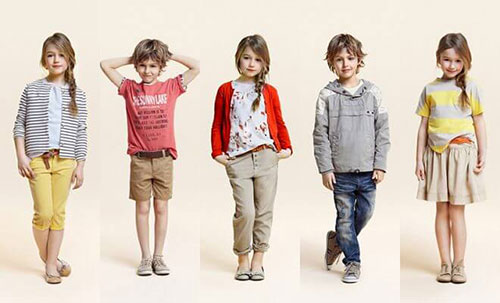
One big retailer that seems poised to capture a majority of the kid’s market share is Target, which launched its private-label line Cat & Jack in 2017, and tallied $1 billion in sales within the first year of this launch. The brand has now reached $2 billion in volume. This also includes its adaptive apparel options for differently-abled children.
Though the looming recession may affect consumer spending on apparel, the kid’s wear category is expected to remain more or less unscathed as consumers will continue to spend money on kid’s clothing.
Millennials and mini-me
New avenues of shopping are also opening. For instance, just like Mom & Me stores for women and their daughters, many brands are now setting up Daddy & Me stores for men and their sons. The kid’s apparels in these stores are a mini reflection of the menswear range. All the styling and adaptations are closely tied to men’s in the mini-me version.
Hana Ben-Shabat, Former Partner in A.T. Kearney’s consumer goods and retail practice and now founder of strategic research consultancy Gen Z Planet, credits the uptick in the matching trend to growing social media influence and the rising celebrity culture. Some kid’s wear brands have already garnered incremental children’s apparel sales by capitalsing on this trend.
However, the younger Gen Z cohorts are likely to opt out of this mini-me gear as they reach their tween and teen. As these kids are more aware of the fashion trends due to the rising social media influence, they don’t like their clothes replicating the same trends and opt for authenticity in their clothes. Therefore, to explore this booming market brands needs to offer a unique value proposition based on the needs of these young mothers and their kids.
AR comes into fashion
The fashion industry is merging with the technological revolution. This includes Augmented Reality, Virtual Reality, Animation, Social Shopping, Machine Learning etc. This initiative will not only enhance consumer experience but also redefine the standards of the industry. One of the notable aspects of this progression is that it can restructure the production, marketing, and customer services. JITGM (Just In Time Garments Manufacturing) is a process based on the Augmented Reality concept. Consumers can use this technology to analyse the different elements such as fabric, color, prints, style via AR images. The application will provide different variants of the finished products. The final order will be placed based on approval and selection. Companies can print, cut, sew and dispatch the garment within 48 hours and make the delivery to the consumers.
High demand for clothes in the global market has adversely impacted the environment. The textile industry utilises excessive water and electricity for production. The dyes and chemicals used cause pollution and disrupt the natural ecosystem. Companies and research institutions are continually working on various techniques to minimise the damage. This has also led to the invention of efficient machinery that would lower resource consumption and deliver quality products.
Birla Cellulose reduces water use
Birla Cellulose aims at reducing its water intensity by 50 per cent. This will be achieved by the application of new technologies based on the principles of reduce, reuse, recycle. Birla Cellulose is in the process of applying the most stringent norms across all its fiber manufacturing sites, by going beyond the applicable regulatory norms, and implementing European standards for wastewater discharge. Birla Cellulose is committed to improve the availability of water, the most precious shared resource, for the people and the planet. This is in alignment with the strategy of Birla Cellulose in making the business more sustainable by being the leader in implementation of sustainable business practices in the manmade cellulosic fiber industry. The best practices in the area of water management and innovations that allow multiple reuse of water, and technologies such as membrane processes to clean up and recycle wastewater, have been applied across all fiber sites of Birla Cellulose. This has resulted in some of the sites creating new benchmarks for water intensity in the global viscose industry.
The textile industry is one of the largest consumers of water during the production of fiber and fabric and for irrigation of crops like cotton. Climate change and water scarcity are the two biggest concerns of the global community today.
Hugo Boss Q3 online business up 36 per cent
Hugo Boss’ online business grew 36 per cent in the third quarter. E-commerce was powered by improvements to the Hugo Boss website and expansion into Scandinavia and Ireland. The strong online momentum is expected to continue into the fourth quarter.
Known for its smart suits, the company’s strategy of introducing more casual and sportswear styles to appeal to a younger audience has been paying off, with third-quarter sales of its trendier Hugo label rising a currency-adjusted six percent. However, sales fell eight per cent in the Americas due to a fall in demand in the United States as well as a decline in the wholesale channel as it sells more garments online. Overall, the group’s own retail business, which includes e-commerce, saw currency-adjusted sales rise three per cent in the third quarter, while the wholesale business fell five per cent. Sales growth slowed to two per cent in Asia due to a significant double-digit sales decline in Hong Kong, which usually accounts for a quarter of its greater China sales, partially offset by continued strong momentum on the mainland.
As unrest escalates in Hong Kong, stores have been forced to close on important weekend shopping days, prompting Hugo Boss to shift stock from Hong Kong to other Asian markets.