"
" The textile industry has received a policy reprieve after the Ministry of Finance eliminated the 11 per cent import duty on raw cotton until October 30, 2026. The temporary suspension of both the Basic Customs Duty and the Agriculture Infrastructure and Development Cess (AIDC) is designed to address a growing domestic cotton shortage that has pushed up raw material prices and weakened the competitiveness of Indian textile exporters.
The move marks the fourth tariff intervention in the cotton sector this year, highlighting the mounting pressure on policymakers to balance the interests of farmers, spinning mills and export-oriented apparel manufacturers. With India simultaneously pursuing ambitious trade opportunities through newly operational agreements with the US, the EU and the UK, ensuring access to competitively priced cotton has become critical for maintaining export momentum.
Supply gap forces policy response
The government's decision comes against the backdrop of a growing mismatch between cotton production and industrial demand. Current estimates indicate domestic cotton production of 291 lakh bales against annual mill consumption requirements of approximately 312 lakh bales, creating a deficit of 21 lakh bales before accounting for inventory requirements.
The shortage has been aggravated by shipping disruptions linked to geopolitical tensions in West Asia, which have delayed cargo movements and increased logistics costs. The resulting supply squeeze triggered a sharp increase in domestic cotton prices, with lint rates rising from around Rs 52,000 per candy to nearly Rs 63,000 per candy within six weeks.
Table: India's cotton and textile market
|
Textile segment |
Annual volume/target value |
Deficit/growth |
|
Domestic Cotton Production |
291 lakh bales |
-21 lakh bales (Shortfall) |
|
Spinning Mill Raw Demand |
312 lakh bales |
Equilibrium Baseline |
|
Ready-Made Garment Exports |
$15.80 bn |
-1.4% Annualised Contraction |
|
Yarn, Fabrics & Made-ups Exports |
$11.58 bn |
-4.0% YoY Decline |
|
Total Apparel Sector Exports |
$35.79 bn |
-2.2% Sector-Wide Drop |
|
National Export Roadmap Target |
$100 bn by 2030 |
Requires 17% CAGR |
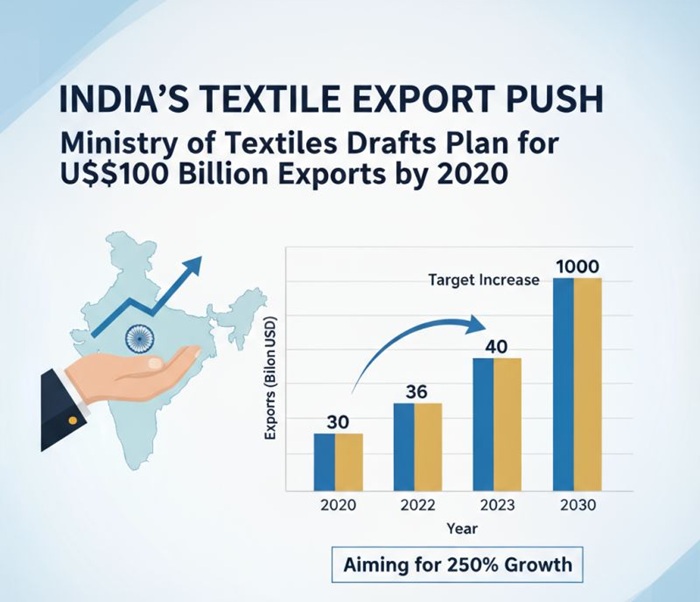
The data underscores the challenge facing the textile sector. While the government is targeting a substantial increase in exports, recent performance across apparel, yarn and made-up categories has shown contraction, largely due to cost pressures and weakening competitiveness.
Rising costs ripple through the value chain
Cotton typically accounts for 80-85 per cent of spinning costs, making raw material inflation one of the most influential variables in textile manufacturing economics. As cotton prices rose, spinning mills passed on higher costs to yarn buyers, triggering a chain reaction across fabric manufacturing, processing and garment production. Exporters operating on fixed-price contracts found it increasingly difficult to absorb these cost increases. Industry stakeholders opine, several manufacturers have either slowed production schedules or deferred expansion plans while awaiting greater pricing stability.
A Sakthivel, Regional Chairman of the Apparel Export Promotion Council (AEPC) says that apparel exporters require predictable raw material pricing to compete effectively in global markets. And the removal of import barriers allow manufacturers to source cotton at internationally competitive rates and improve order visibility ahead of major retail buying seasons in Western markets.
The experience of Tirupur-based Euro-Tex Apparel reveals the pressure facing exporters. The company reportedly faced a 20 per cent increase in yarn procurement costs within a month while negotiating seasonal contracts with UK retailers. Unable to transfer those costs to buyers, management reduced factory utilisation by 25 per cent to protect operating margins.
The importance of premium cotton
The import requirement extends beyond simply filling a volume deficit. Industry estimates suggest roughly 70 per cent of expected imports will comprise medium-to-long staple cotton used to maintain continuous spinning operations. The remaining 30 per cent is the higher-value Extra-Long Staple (ELS) cotton variety such as American Pima and Egyptian Giza. India currently produces less than 15 per cent of its domestic ELS requirements, making imports essential for premium textile categories.
ELS cotton serves as the foundation for luxury apparel, fine-count yarns and high-end home textile products. Manufacturers estimate that value addition through spinning, weaving and garmenting can multiply the export value of imported ELS fibre several times before it reaches Western retail shelves.
Competitive pressures intensify
Industry associations have long argued that import duties placed Indian manufacturers at a disadvantage relative to regional competitors such as Bangladesh and Vietnam, where cotton imports are largely duty-free. As per Confederation of Indian Textile Industry (CITI), the previous tariff structure added approximately 8-10 cents per kg to the cost of combed yarn production. This differential became particularly problematic during periods when domestic cotton prices exceeded international benchmarks.
Manufacturers in Gujarat and Maharashtra reported situations where local yarn production costs rose above global market levels, prompting some companies to shift towards synthetic blends or reduce operating schedules. The downstream impact was also visible in export-oriented clusters such as Ludhiana and Panipat. Northern Loomworks, a home textile exporter based in Panipat, reportedly faced shortages of high-grade long-staple fibre needed for premium bed linen production. The company was forced to decline a major export order and leave nearly 40 per cent of its weaving capacity idle for several weeks.
Industry leaders including CITI Chairman Ashwin Chandran and Southern India Mills' Association (SIMA) Secretary General K Selvaraju have welcomed the duty waiver, describing it as an essential measure to preserve capacity utilisation and maintain international competitiveness. Balancing farmers and exporters While the waiver offers immediate relief for textile manufacturers, it also revives a long-standing policy dilemma. Lower-cost imports can help mills and exporters, but they may also place downward pressure on domestic cotton prices, affecting farmer incomes. This concern explains why the government opted for a temporary window rather than a permanent tariff removal. So far experience show that unrestricted imports during harvest periods can weaken domestic market prices and increase pressure on Minimum Support Price mechanisms. Analysts say, frequent short-term interventions, while effective in addressing immediate shortages, can also encourage speculative stockpiling and create uncertainty across the value chain. Ajay Sahai, Director General of the Federation of Indian Export Organisations (FIEO), believes the current waiver serves as an emergency support mechanism but also highlights the need for a more predictable long-term tariff framework that aligns the interests of growers and processors.
Long-term productivity takes centre stage
The government's broader strategy extends beyond temporary import relief. The recently approved Mission for Cotton Productivity, backed by the allocation of Rs 5,659 crore over five years, aims to strengthen domestic supply fundamentals through better seeds, modernised ginning infrastructure and targeted agricultural extension services. The programme seeks to increase average cotton yields from 440 kg per hectare to 755 kg per hectare by 2031. Achieving that objective would reduce dependence on imports, improve raw material availability and support India's long-term textile ambitions.
As organised manufacturers invest in automation, higher-count spinning and premium textile production, access to stable and competitively priced cotton will continue to be important for industry growth. The current duty waiver may provide short-term breathing space, but India's ability to achieve its export aspirations will ultimately depend on creating a more productive and predictable cotton ecosystem capable of supporting the entire value chain, from farm to fashion.