CAI revises export estimates for 2020-21 season
Cotton Association of India (CAI) has revised Indian Cotton export estimates for the 2020-21 season at 65 lakh bales against 60 lakh bales projected till last month and 54 lakh bales projected a few months ago. Cotton futures traded firm at Rs 22,300 per bale on May 24. Futures delivery for May on the MCX index increased by 0.86 per cent to Rs 22,290 per bale while it increased by 0.85 per cent to Rs 190 in June. The value of May and June’s contracts traded so far is Rs 75.87 crore and Rs 81.44 crore, respectively.
According to Mohit Vyas, Analyst, Kotak Securities, higher stock revision by CAI, hit on-demand amid COVID blues and recent sell-off in ICE Cotton futures are likely to keep domestic cotton prices range-bound with negative bias in coming sessions. The forecast of the timely onset of monsoon in the country by IMD and Skymet this season is also likely to weigh on natural fiber prices in coming sessions.
Kontoor Brands to expand operations
Kontoor Brands plans to expand operations by increasing investments in Wrangler and Lee, focusing on the China market and growing digital business. As per a Women’s Wear Daily report, the company has made certain critical investments in Europe and Asia. It launched the Wrangler brand in China in December last year. The company also aims to strengthen its Lee brand in the country besides expanding its digital offerings. Another plan includes growing its digital business from 5 per cent of revenues in 2020 to 10 per cent by 2023.
The company also plans to expand category offerings in outdoor and fishing apparel, graphic T-shirts, women’s apparel and hybrid work and casualwear which is likely to be a feature of customers’ eventual post-COVID-19 wardrobe. An American clothing company, Kontoor Brands was a spin off from the V F Corporation in May 2019. The company sells denim under the Lee, Wrangler and Rock & Republic brand names. It also operates the VF Outlet chain of factory outlet stores.
Include philanthropic causes on labels, tags, urge Los Angles-based label makers
Los Angeles-based label manufacturer Hi-Tech Printing & Labeling says fashion designers should include information about the causes they support on their clothing tags and labels. The company states, this will ensure consumers are reminded of the brand and the organizations or messages they support throughout the shopping process and each time they wear the item, further increasing the likelihood that they’ll return for future purchases.
Hi-Tech Printing & Labeling believes, in order to maintain the tags and labels’ durability for a longer period, they need to remain intact and legible through multiple cycles in a washing machine and dryer.
Retailers and designers also need to consider different types of tags and labels for individual pieces to ensure maximum comfort, says the Southern California manufacturer. While stronger woven labels pair well with looser-fitting outerwear, items that are more likely to come into direct contact with the skin, such as t-shirts, should have labels that are soft and comfortable to wear, like cotton tags, it adds.
Indorama Synthetics to expand capacity of Nagpur plant
Subsidiary of Indorama Ventures (IVL), Indorama Synthetics (India) plans to upgrade its equipment and expand manufacturing capacity at Nagpur with an investment of Rs 6 billion. As per reports, IVL operates all three of its business segments – Combined PET, Fibers, and IOD – in India.
IVL’s expansion plan include setting up a new PET resin manufacturing facility, adding more balancing equipment, and specialty yarns to its portfolio. The company plans to add 700 tons of capacity at its PET resin facility in Nagpur which will be operational by the second quarter of 2022. The facility will help strengthen IVL’s position as India’s largest resin producer, with a total capacity of over 1 million tons annually.
The plant at Nagpur, which IVL has managed since 2019, is also the company’s first fibre manufacturing site in India, offering a wide range of staple fibres and filament yarns. Under the investment plan, it will meet global brands’ increasing demand for more high-quality and sustainable textile products.
Exempt apparel exporting units from lockdowns, urges AEPC
The Apparel Export Promotion Council (AEPC) has urged the government to exempt apparel exporting units from lockdowns and declare apparel exports as essential services. A Sakthivel, Chairman, AEPC said most apparel exports are season and fashion sensitive, and their salvage value becomes zero if the production and shipment are not done in time
Many neighboring and competing countries have already accorded apparel exports the status of essential services, he added. Exports units are unable to execute orders due to lockdowns resulting in loss of export earnings and buyers. Sakthivel also urged buying houses and agents to convince international clients that the situation in India is getting better by the day. Buyers should be urged not to cancel orders as India is likely to bounce back by mid-June, Sakthivel added.
Worker vaccination only way forward for Sri Lanka’s garment industry
 Initially admired for its prompt response to the first COVID-19, Sri Lanka however, failed to protect citizens from the second wave. Particularly vulnerable were its garment workers in free trade zones like Katunayake.
As per Ground views report, the spread of COVID-19 in Sri Lanka is not restricted to pockets or clusters. It has spread to most densely populated areas in the country. Most garment workers in the country have tested positive for COVID-19, shows data from the Epidemiological Unit of the Ministry of Health.
Failure to prioritize health infrastructure
Joint Apparel Association Forum (JAAF) holds, several factors responsible for this. The Sri Lankan government and its COVID-19 Task Force Team have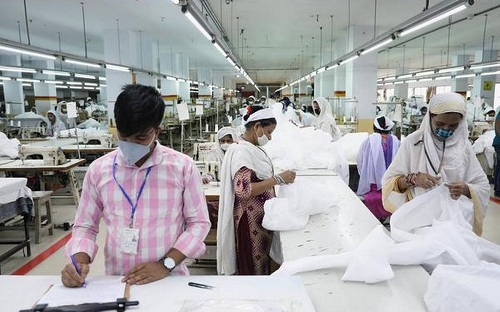 failed to adopt a sustainable strategy and prioritize public health infrastructure during this global public health crisis. Global shortage of vaccines has further added to industry’s woes, says, Jeremy Harrar, Director, Wellcome Trust. The government needs to focus on protecting garment workers, adds Prasad Welikumbara, Political Critic and Social Media Activist.
Most workers reside in unregulated boarding houses located in densely populated neighborhoods adjacent to FTZs. Infected workers are being quarantined in their homes which they often share with two or five people. Many of these houses do not have separate kitchen, toilet and bathing facilities, the primary requirements for people in quarantine.
No support to garment workers
The government has also failed to support garment workers. Most workers are paid far below the prescribed minimum wages leading to them feigning good health and underreporting mild symptoms. Erratic availability of COVID-19 vaccines is also prompting them to skip vaccination and report to work instead.
Only a few factories like the Maliban Textiles washing plant and factories from the Katunayaka FTZ are ensuring all workers get vaccinated. A reason for this vaccination is the lack of cooperation between the government, COVID-19 Task Force and JAAF. Though in February this year, JAAF requested the Ceylon Chamber of Commerce to jointly fund the vaccination of 500,000 garment workers, there has been no response from the government so far.
Sri Lanka allows free trade zones and significant export sectors such as apparels to function even during curfews and lockdown periods. However, lack of proper vaccination puts the entire sector at risks besides threatening to derail the national economy. The sector needs to pressure the government to ensure ethical and equitable distribution of vaccines. It also needs to vaccinate working classes ensure protection of all workers.
Kontoor Brands to invest in Wrangler, Lee, expand business in China
Emboldened by the company’s top-line growth in recent quarters, and optimistic about a demand for a more casual wardrobe, Kontoor Brands plans to invest in its Wrangler and Lee offerings, expand in China, and grow its digital revenues.
As per Women’s Wear Daily, the company has ramped up investments in China even though most of its business is based in the US. It is also gearing up to expand its overall digital offerings, a strategy increasingly embraced by retailers during the super-charged online shopping era of the ongoing COVID-19 pandemic. Since the spin-off, the company’s digital wholesale business has grown through tie ups with retailers including Amazon, walmart.com, and Kohl’s. In China, the company also relaunched Lee’s X-line, its digital only collection.
Kontoor plans to grow its digital business from 5 percent of revenues in 2020 to 10 percent by 2023. It also plans to expand its category offerings in areas including outdoor and fishing apparel, graphic T-shirts, women’s apparel and hybrid work and casualwear for what it hopes will be a feature of customers’ eventual post-COVID-19 wardrobe.
Fast Retailing commits Rs 220 million to COVID-hit in India
The parent company of Uniqlo, Fast Retailing Co has committed Rs 220 million (around $3 million) for those affected by COVID-19. As per India Retailing, the company will donate Rs100 million to two non-profit organizations, GiveIndia and the AkshayaPatra Foundation. In addition, it will also provide more than 600,000 UNIQLO AIRism masks to frontline workers.
Through GiveIndia, funds will be utilized for the immediate provision of such medical equipment as oxygen concentrators and to strengthen healthcare infrastructure in critical states, as wellas providing cash relief for the families of the deceased. The donation to the AkshayaPatra Foundation will be used to provide cooked meals and dry ration supplies to low-income daily wage workers who are impacted by the surge of COVID-19. The donation of UNIQLO AIRism masks by Fast Retailing will be distributed to front-line workers and those providing essential services.
realize a better society. Its programs not only provide millions of garments to those in need but also emergency financial assistance in times of natural disaster. Working with the United Nations High Commissioner for Refugees (UNHCR), the company also provides support for refugees and displaced people around the world.
Asia Pacific e-commerce sales to double by 2025
E-commerce sales in the Asia Pacific region are expected to nearly double by 2025 reaching $2 trillion, according to global market research company Euromonitor International.
The region is predicted to see the highest retailing sales growth in 2020-2025, following Latin America, with digitalization, connectivity and demographics representing the key drivers in the region’s shift into an innovation hub post-pandemic.
In this year’s whitepaper ‘Top 100 Retailers in Asia 2021’, Euromonitor looks at how the APAC region world-class mobile connectivity enables digital transformation and is supported by extremely tech-savvy consumer segments in the region.
In 2020, businesses receiving online orders recorded 37.6 per cent growth and will reach 44 per cent by 2025. Livestreaming experienced an explosive growth in 2020 in tech-advanced markets. Countries like China and emerging economies in Southeast Asia including Indonesia and the Philippines witnessed a surge in social commerce through WhatsApp, Instagram and Viber, says Quan Yao Peh, Research Analyst, Euromonitor International.
Vardhaman Textiles posts Rs 243.47 crore profit in Q4
In its fourth quarter ended March 31, 2021, Vardhaman Textiles posted a net profit of Rs 243.47 crore as against a loss of Rs 170.52 crore posed in third quarter ended December 31, 2021. Total income increased to Rs 1,994.47 crore during the third quarter ended March 31, 2021 as compared to Rs 1,806.85 crore during the previous quarter. EPS increased to Rs 42.83 as against Rs 29.97 EPS reported during the quarter ended December 31, 2020.
On a yearly basis, Vardhaman Textiles posted a net profit of Rs 243.47 crore for the period ended March 31, 2021 as against net loss of Rs 145.71 crore during the period ended March 31, 2020.
The company’s income for the financial year ended March 31, 2021 increased to Rs.1,994.47 crore from Rs.1637.19 crore reported during the year ended March 31, 2020. Its EPS for the period increased to Rs 42.83 as compared to Rs.25.60 for the period ended March 31, 2020.
More...
ROICA™ unveils new brand identify
ROICA™ by Asahi Kasei has unveiled a new brand identity which merges performance, innovation and responsible imprint. The company focuses on two main strategies: continuous R&D and innovations in sustainability and partnerships with leading responsible innovators across the entire value chain.
ROICA™ identity will be activated in all its communication tools and channels, such as a renovated website and social media presence The visual identity is then represented in five different designs, each for one of the five applications that can be enhanced by ROICA™ yarns: Activation for performative sportswear garments, Aqua for smooth swimwear, Style#Fit for casual wear and athleisure,
Since 1971, ROICA™ has been raising the bar in fashion, lingerie, activewear, hosiery and textiles with smart innovation. It now marks a unique milestone in the world of stretch by creating cutting edge tools, such as the hangtags that provide, through simple and well-designed icons, clear and concise functional information showing for each application the values and performances of each single ROICA™ product: ROICA Colour Perfect ™, ROICA Resistance™, ROICA Feel Good™, ROICA Eco-Smart™, ROICA Contour™.
The company has also introduced a branding policy that indicates the allowed blends for smart yarns belonging to the unique ROICA Eco-Smart™ family. Its constant investments in R&D, people and technology have allowed the company to engineer agile, multi-facetted and sustainable stretch yarns which redefine the new circularity, delivering the style, support and finish, trusted to match the performance demands and ambitions of the new generation contemporary consumer.
Soorty launches new size inclusive workplace collection
Pakistan-based integrated denim manufacturer Soorty launched a new size inclusive workplace collection that embraces disabilities and diversity in the workforce. As per Sourcing Journal, the Seasonless II collection spans all seasons. The genderless collection features existing concepts that focus on longevity, adaptability and intelligence in denim. It includes Resync, a line of fabrics supported by one-size-fits-all technology. The trans-seasonal, adaptive fabric sculpts the body with 360-degree stretch comfort that fits a range of four sizes—two sizes up and two sizes down. The innovation makes it possible for jeans to comfortably mold to various body shapes and sizes, spanning both men’s and women’s garments.
The Resync range was launched in February to make products that can adapt with consumers’ fluctuating sizes and ultimately keep them from the landfill. It partnered fashion size and fit software Scircula, which developed an e-commerce fit solution, which collects customer size, fit and buying behavior data in real-time to provide insights at the SKU level.
Soorty’s new collection also includes Redream, a collection of fabrics made of non-virgin components, such as post-consumer and post-industrial waste, GRS-certified recycled polyester, Lycra T400, Ecomade T400, CoolMax Ecomade and Repreve.
Primark launches new collection from recycled cotton
Primark has launched a new leisurewear collection under its Primark Cares label. As per Sourcing Journal, the new collection contains garments made from recycled cotton sourced from unused fabric waste and recycled clothes. The collection is certified by circular fashion company Recover, which aims to close the loop on fashion.
The eight-piece range is available at 179 Primark stores globally. Each garment is made with 15 per cent and 25 per cent recycled cotton. The rest is mix of materials, including sustainable cotton from Primark’s Sustainable Cotton Program, organic cotton and polyester. With prices ranging from $5 to $14, the new collection includes hoodies, joggers, sweats, Ts and leggings in navy, white, black and gray with hero items such as a V-neck T-shirt style and a matching hoodie and jogger set.
The Primark Cares initiative conveys its seriousness towards its responsibility by supporting people who make its clothes and those involved in protecting the environment. Primark Cares labels can be found across a wide range of products in its stores.
US industry coalition supports proposal to include domestic procurement policies for PPE
A broad coalition of industry organizations and labor unions have supported Senate Majority Leader Chuck Schumer and Senate Minority Leader Mitch McConnell’s proposal to include robust domestic procurement policies for PPE in the U.S. Innovation and Competition Act (USICA) that is currently being reviewed by the Senate.
The coalition specially requested the senators to extend rules for PPE procurement substantially similar to the Berry Amendment to the federal government’s largest buyers of these products, including the Departments of Homeland Security, Health and Human Services, Veterans Affairs, and Defense.
It thanked them for including such a provision in Section 4153 of the USICA, which is substantially similar to the bipartisan Make PPE in America Act (S.1306) introduced earlier this year by Senators [Gary] Peters and [Rob] Portman. It emphasized that the emergent US PPE industry needs the purchasing certainty provided by long-term government support. It urged the government to extend domestic purchasing requirements for PPE in US Innovation and Competition Act to four critical departments with the largest federal purchasing power for these products—DHS, HHS, VA, and DoD.