The sharp dip in EU apparel imports is not, at first glance, the kind of headline exporters celebrate. January’s 15.48 per cent fall in EU apparel imports to €7.03 billion signals a consumer market under stress, where retailers are buying less, paying less, and pushing suppliers into a brutal margin war. Yet for India’s apparel exporters, this downturn may paradoxically mark the most strategic opening in a decade.
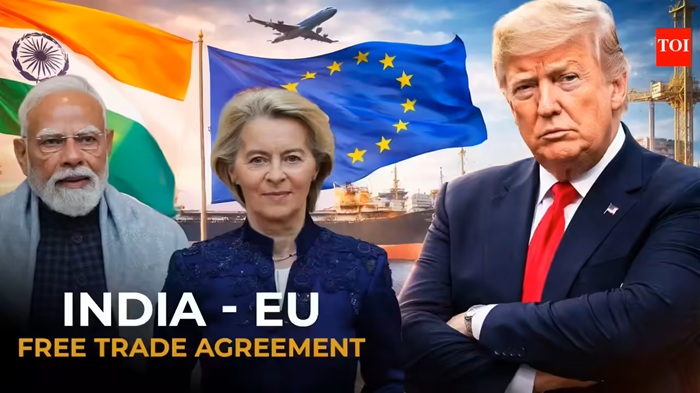
The reason lies in timing. Europe’s slowdown is arriving just as the India-EU Free Trade Agreement resets the landed-cost equation in India’s favor. With duties of up to 10-12 per cent on apparel and textiles effectively moving to zero across almost the full tariff universe, India is no longer entering Europe with a built-in price handicap. In a shrinking market, share gains matter more than absolute demand growth. That is where the FTA transforms a weak macro environment into a strategic sourcing opportunity.
From tariff disadvantage to price parity
For years, Indian exporters operated in Europe with an invisible tax on competitiveness. While Bangladesh benefited from preferential access and Turkey monetized geographic proximity, India’s exporters had to absorb tariff friction that often made them 8-12 per cent more expensive on a landed basis. The new FTA eliminates that structural drag. Government and industry estimates suggest the agreement opens a $263.5 billion EU textile and apparel import market with zero-duty access, correcting the disadvantage India historically faced against Bangladesh, Pakistan, and Turkey.
This matters even more in today’s demand environment. Europe’s retailers are clearly consolidating suppliers, rewarding either extreme price efficiency or differentiated value. India can now compete in both areas. At the mass-market end, duty removal gives Indian cotton basics, knitwear, denim, and value fashion immediate landed-cost relief. In categories where buyers are forcing annual price resets, even a mid-single-digit cost edge can decide the sourcing shift.
At the premium end, India’s strengths in organic cotton, MMF blends, embroidery, occasionwear, and artisanal textiles become commercially stronger because the tariff wedge no longer dilutes premium realization.
What the EU import stats means for India
Earlier EU imports data showed China defending share through price aggression, Bangladesh suffering a sharp demand squeeze, Turkey shifting toward higher-value categories, and Pakistan sacrificing price for volume. For India, that data is less a snapshot of competitors and more a sourcing map of where orders can migrate next.
Table: EU apparel import performance (Jan 2026 vs Jan 2025)
|
Country |
Value (€ mn) |
Growth value |
Volume growth (kg) |
Unit price growth |
|
World |
7,033.60 |
-15.48% |
-8.36% |
-7.76% |
|
China |
2,224.89 |
-6.90% |
+1.21% |
-8.01% |
|
Bangladesh |
1,428.91 |
-25.25% |
-17.49% |
-9.41% |
|
Turkey |
619.98 |
-29.12% |
-31.66% |
+3.72% |
|
Vietnam |
362.86 |
-7.34% |
-13.00% |
+6.50% |
|
Pakistan |
288.81 |
-17.06% |
+49.01% |
-44.34% |
Bangladesh’s 25.25 per cent export decline to the EU is particularly relevant. Much of that business sits in core basics viz, T-shirts, innerwear, fleece, kidswear, and entry-level woven bottoms segments where India’s integrated cotton ecosystem and large-scale garment clusters can now compete more effectively post-FTA.
Turkey’s premium shift creates another opening. As Turkish factories move further up the value curve, parts of the mid-premium fashion volume they leave behind especially fashion knits, embroidered women’s wear, and occasion-led collections could increasingly flow toward Indian hubs such as Tiruppur, Noida, Jaipur, and Surat. The table, therefore, suggests India’s biggest opportunity is not broad-based EU demand recovery. It is order displacement from stressed competitors.
The new India playbook: Tiruppur to Surat
The FTA’s commercial effect will not be evenly distributed across India. The biggest winners are likely to be export clusters already capable of speed, compliance, and scale. Tiruppur stands to gain first from knitwear migration, especially in cotton-rich basics and sustainable loungewear programs, where Europe’s value chains are consolidating around fewer strategic partners. Exporters there are already positioning the FTA as a demand accelerator after a difficult period of US tariff volatility.
Noida and Bengaluru could benefit from fashion-forward woven garments and fast replenishment women’s wear, particularly as EU buyers rebalance away from China-centric sourcing. Surat’s MMF and synthetic dress materials ecosystem may see a parallel opportunity as Europe’s occasion and value-fashion segments seek lower-cost alternatives to Turkish and Chinese polyester blends. For home textiles, Panipat, Karur, and Welspun-led ecosystems gain a direct landed-cost boost in a category where European retailers remain margin-obsessed.
But the real battle is no longer price alone
The FTA gives India the entry ticket. It does not guarantee market share. Europe’s demand slowdown is increasingly linked factors like: ESG regulation, textile waste rules, digital product passports, traceability, and anti-greenwashing scrutiny. Suppliers winning the next sourcing cycle will need compliance architecture as much as manufacturing depth.
This is where India’s opportunity becomes more sophisticated than simple tariff arbitrage. The exporters that can combine zero-duty access with recycled content, clean documentation, water traceability, and faster replenishment cycles will capture outsized gains.
The draft origin rules under the FTA also offer practical flexibility, allowing tolerance thresholds for non-originating inputs in several textile categories. That improves supply-chain planning for exporters using imported specialty yarns, trims, or technical fabrics while still qualifying for preferential access. In effect, the FTA turns compliance excellence into a monetizable margin lever.
Why 2026 could be India’s share-gain year
Industry projections now suggest India’s textile and apparel exports to Europe could rise 20-25 per cent annually once the FTA is operationalized, with some estimates projecting a doubling of exports to over $11 billion in five years. What makes this realistic is not a booming Europe. It is a weak Europe forcing retailer rationalization.
When buyers cut vendor bases, they typically reward suppliers that offer geopolitical stability, fiber diversity, large domestic raw material ecosystems, and increasing ESG readiness. India now checks all four boxes more convincingly than it did even 12 months ago. That makes 2026 less about chasing Europe’s declining import bill and more about capturing a bigger slice of a smaller pie.
The irony of the current market is striking. Europe’s fashion demand is cooling, but India’s export opportunity is heating up. The FTA has arrived at precisely the moment when global brands are reassessing overdependence on China, questioning Bangladesh’s resilience in basics, and paying closer attention to supply-chain transparency. In that environment, India does not need Europe to grow fast. It only needs Europe to reshuffle suppliers. And January’s import table suggests that reshuffle has already begun.