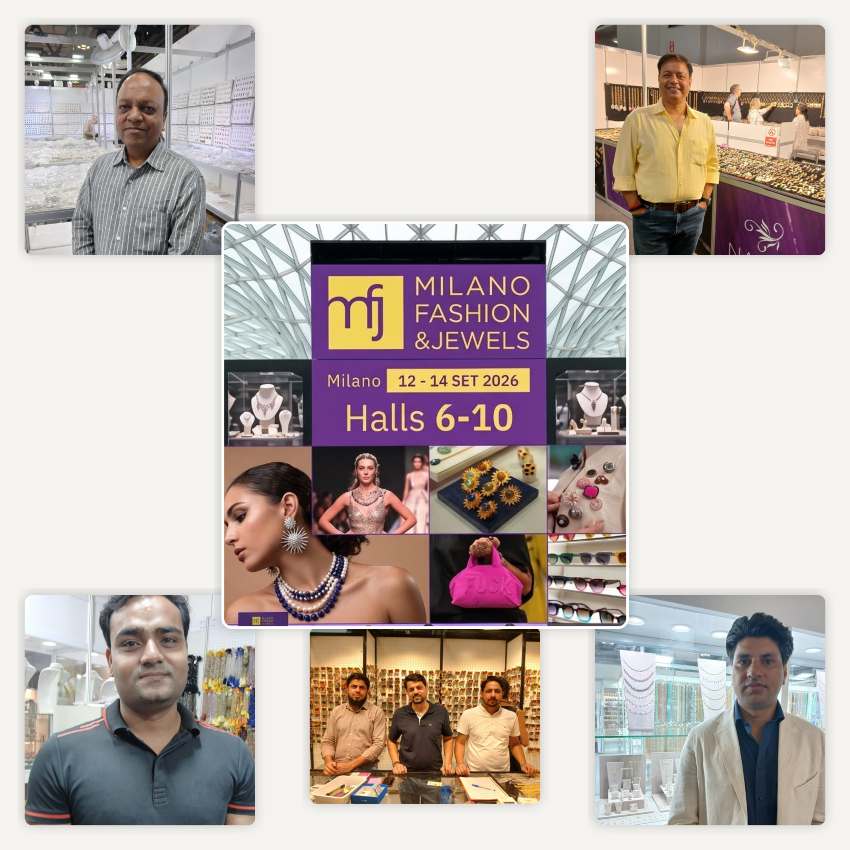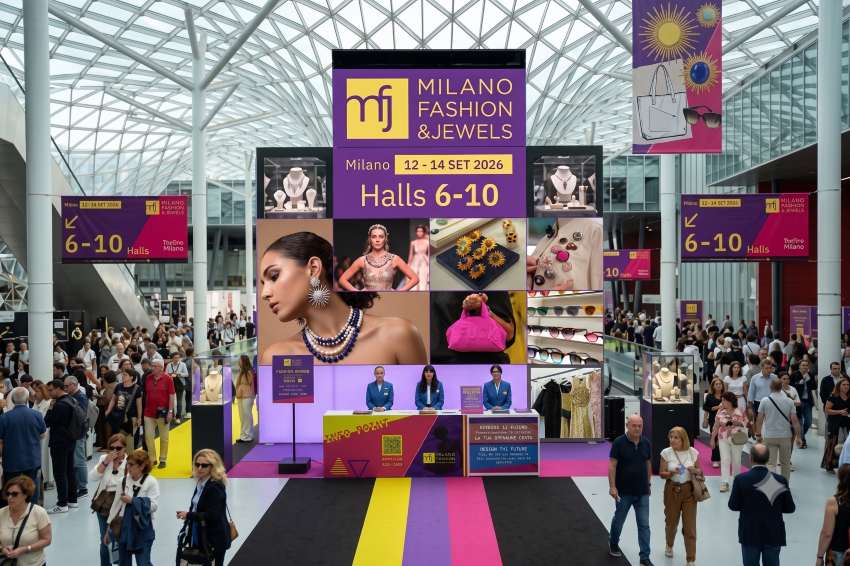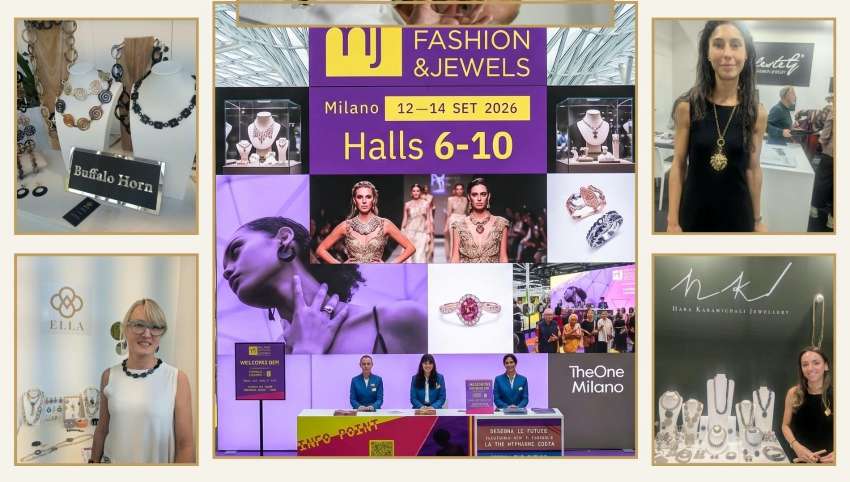
A counter-movement against industrial uniformity is reshaping European bijouterie, transforming authentic craftsmanship into a powerful lever for high-margin boutique growth. At the September edition of Milano Fashion & Jewels (MFJ) at Fiera Milano, independent design ateliers from Greece, Germany, and Italy demonstrated how regional handcrafts, ancestral techniques, and historic iconography can be translated into contemporary, ergonomic jewellery that protects retail price integrity. As concept store curators and multi-brand buyers push back against mass-produced, price-sensitive inventory, artisanal micro-studios are carving out a distinct commercial edge. Rather than producing static historical replicas, these designers re-engineer traditional methods—from Anatolian textile crocheting and ancient Celtic horn carving to Renaissance lost-wax casting—into adaptable, featherlight wearable objects that command healthy margins on the retail floor.
The commercial rationale was articulated on the fair floor by Filomena Sannino, Exhibition Manager and Head of Fashion Events at Fiera Milano, who emphasized that independent retailers are actively seeking distinctive narrative propositions to elevate their physical showcases, "Today, the buyer is becoming more of a curator, looking for something new and different for the store... Our challenge is to ensure that the buyer leaves Milan with something new to put in the window... Buyers want good design, but they also want reasonable minimum quantities, fast delivery, and products sufficiently different from what they already carry."
Global demand shifts toward craft and heritage
This creative evolution unfolds against a resilient global backdrop for non-precious and demi-fine fashion adornment. Global industry trade reports value the international costume and fashion jewellery market at approximately $40.5 billion to $43.8 billion, with projections indicating an expansion toward $65 billion to $70 billion by the early 2030s, advancing at a Compound Annual Growth Rate (CAGR) between 6.5% and 7.8%. Within this ecosystem, European regional design hubs,particularly across the Mediterranean and Central Europe; are outpacing generic mass manufacturing by capturing high-margin, niche retail segments. Retail data indicates that independent concept stores and multi-brand boutiques increasingly prioritize artisan-crafted and narrative-led merchandise, where distinct product provenance allows retailers to achieve healthier markup margins without entering discount price wars against industrial assembly lines.
Ergonomics and Structural Evolution: The new artisan paradigm
The survival and retail success of historic crafts today depend heavily on their everyday usability and anatomical comfort. Heavy, rigid, or high-maintenance metalwork often struggles on modern retail shelves where buyers seek effortless versatility. In response, forward-thinking European ateliers are modifying raw materials to achieve high visual impact with minimal physical mass. In Athens, Greece, the studio of Hara Karamichali has taken a 1920s family textile crochet technique originating from Izmir and substituted fabric yarns with fine silver- and gold-plated copper wire, colored enamels (smalto), and semi-precious stones. This technical leap yields flexible, one-size-fits-all rings and bracelets that compress or expand to mold directly to the wearer's body, eliminating sizing inventory friction while maintaining an accessible wholesale price range of €25 to €63.
In Munich, Germany, independent designer Ella Schmuck pairs organic water buffalo horn with hand-mixed dyes and bespoke metal mountings, transforming historic Celtic knot motifs into large, voluminous statement pieces that remain almost weightless on the wearer. Meanwhile, in the Tuscan craft corridor near Florence, family-run atelier Celeste G. preserves Renaissance lost-wax casting and manual enamelling, maintaining total vertical bench production to deliver intricate sacred heart and cross motifs crafted in brass and hand-painted vitreous enamel.
Architectural Wire Weaving: Knitting metal for the human form
At the Greek showcase, Hara Karamichali Jewellery offered a prime illustration of how displaced intergenerational textile arts can evolve into museum-caliber contemporary adornment. Founded by designer and former art educator Hara Karamichali, whose creations have entered permanent collections at the Museum of Arts and Design (MAD) in New York, the Ilias Lalaounis Jewelry Museum in Athens, and the National Gallery in London—the atelier was represented in Milan by her daughter, Maria Elena Karamichali.
The studio's underlying craft traces back to 1922, when Hara’s grandmother was displaced from Izmir to Athens, carrying with her an Anatolian domestic crochet technique. While the grandmother worked exclusively with soft fabric threads, Karamichali re-engineered the methodology by substituting yarn with fine-gauge, electro-plated copper wire worked alongside smalto and mineral settings.
Maria Elena Karamichali explained how this transformation creates anatomical adaptability and fuels cross-border wholesale expansion, "It’s a traditional technique that my mother was taught from her grandmother, who came from Izmir. In 1922, the war happened and the grandmother had to come back to Athens. That crochet was a traditional technique there, and she taught it to my mother. My mother transformed it: at the beginning, they crocheted with a fabric, but our material is wire, copper wire, gold-plated, silver-plated, rose gold, and coloured with enamel. She is one of the first Greek designers who turned a traditional Greek technique into contemporary jewellery. Her works are in many museums; in the Ilias Lalaounis Jewelry Museum in Athens, in New York at the MAD Museum, in Germany, and in London at the National Gallery.
"Our bestselling pieces are the rings. It’s one size: you can change the tabs to the hands and fingers, you can make it larger, but also at the same time press it smaller. Most of her jewellery adapts to the woman’s body. The bracelet you can stretch to make bigger, or press to make smaller, adapting directly to your body. And everything is very light. One ring costs €25 for small, €27 to €28 for medium, and €30 for large at wholesale. The necklace is around €63. It is in the mid-range. Every year our business is growing and expanding. Italy and France are our biggest markets, and we have now opened to Asia, working really well in China and Taiwan."
Organic Geometry: Achieving monumental scale without weight
In Central Europe, Ella Schmuck, an emerging studio based in Munich, Germany, is addressing the retail demand for bold, architectural silhouettes without the ergonomic burden of heavy cast metal. Working directly with natural water buffalo horn, designer Ella hand-carves modular structures inspired by historic Celtic knotwork, ancient symbols of eternity and fortune. The horn segments are shaped, sliced, and joined with metal accents, then custom-tinted using hand-mixed organic dyes.
Presenting her work for the first time at Milano Fashion & Jewels, Ella detailed how material selection solves the tension between physical scale and wearable comfort as, "My brand is Ella, from Munich, Germany. Every product, every necklace, every earring is unique because buffalo horn is a natural material. The colours are mixed by hand, and I can customize every piece: I can make the chain longer for a taller woman or shorten it if someone prefers a smaller fit; I can make almost every piece to measure.
"My design ideas come from historic patterns, like Celtic knots that have existed for centuries as signs of infinity and good fortune. The jewellery is large and voluminous, but extremely lightweight. Every woman is unique and should feel confident and visible without being weighed down. The Italian exhibitors around my booth have been very open and supportive, telling me to keep going because the product is beautiful, natural, handmade, and of very high quality. The business is growing steadily across Germany, Austria, and Italy."
Tuscan Iconography: Preserving benchwork in family laboratories
In Italy, the survival of artisanal workshops is closely tied to regional craft clusters that defend authentic bench manufacturing against automated mass casting. Founded in 1985 by Andrea Trambusti near Florence, Celeste G. operates as a vertically integrated family workshop dedicated to historic Tuscan spiritual iconography. Rather than outsourcing component assembly or casting to external industrial hubs, Andrea and his daughter Sara maintain full internal laboratory operations centered on lost-wax casting, manual assembly, and hand-applied vitreous enamel.
Sara Trambusti described how maintaining an end-to-end studio preserves their creative identity and shields the business from generic retail trends, "We are a family company, open since 1985. My dad founded the company and I grew up inside. We make everything inside, everything is handmade, real Made in Italy fashion jewellery crafted with brass and different crystals. Inside our company, everyone is able to do everything; me and my dad, we design and produce everything.”
Sara adds further, "Our primary stylistic strength lies in sacred hearts and crosses. Every single piece is manually painted with enamel by hand, one by one. Our business is going very well. In Italy we supply 130 shops, and across the Russian export market we have more than 30 wholesale customers. When buyers see the authentic benchwork and hand-finishing, they know the quality is real."
Technique as market defense
The presence of studios like Hara Karamichali, Ella Schmuck, and Celeste G. at Milano Fashion & Jewels reflects a wider structural shift across the accessories landscape. In an international trade arena increasingly dominated by automated machine stamping and volatile bullion costs, independent micro-artisans cannot survive by competing solely on base metal weight or price-per-gram. By re-engineering historic folk techniques into lightweight, ergonomic, and narrative-rich adornments, these ateliers offer multi-brand retailers authentic design differentiation, comfortable wearability, and verifiable heritage, turning ancestral craft into a durable commercial asset.
MFJ: A part of Milan Eco-system as unified sourcing infrastructure
Milano Fashion & Jewels closed its September 12–14 edition at Fiera Milano with over 600 participating brands from 31 countries, an international exhibitor share of 44%, and 33% first-time exhibitors. Positioned within the wider Fashion Link Milano calendar alongside MICAM, MIPEL, TheOneMilano, Lineapelle, and Simac Tanning Tech, the event formed part of an integrated sourcing ecosystem that welcomed 37,000 professional visitors across its concurrent fashion trade platforms.