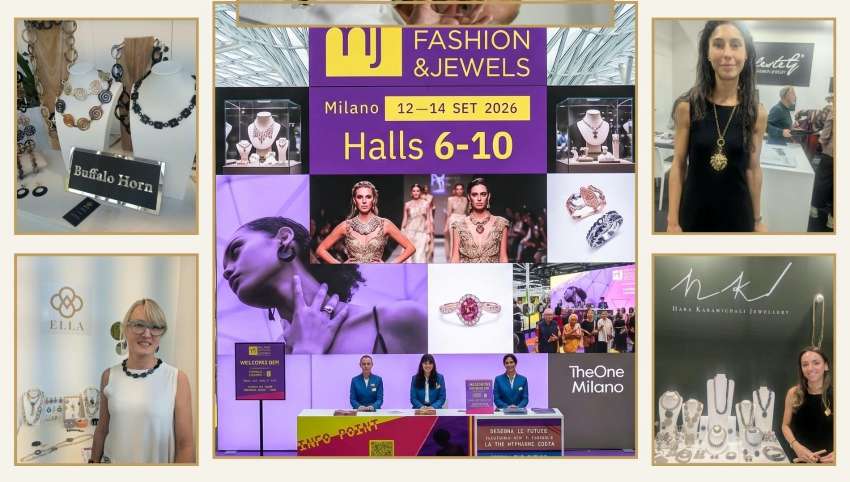
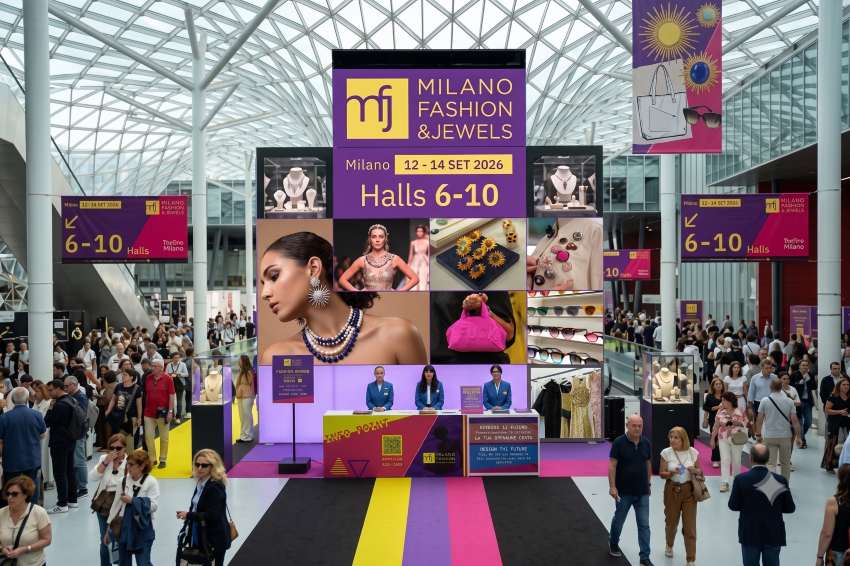
Escalating global bullion volatility and raw material pricing pressures are forcing a fundamental reassessment across the mid-tier fashion jewellery trade. At the September edition of Milano Fashion & Jewels (MFJ) at Fiera Milano, the commercial conversation shifted decisively from aesthetic novelty alone to margin defense and retail price viability. Driven by historic price surges across precious metals alongside fluctuating import duties and regional input cost differentials, manufacturers are executing a pragmatic strategy: re-engineering sterling silver (925) into ultra-lightweight architectures or transitioning directly into brass and alternative base metals.
At the center of this adjustment is an evolving buyer mandate defined by the fair’s organizers. As Filomena Sannino, Exhibition Manager and Head of Fashion Events at Fiera Milano, observed: buyers are no longer assembling purchasing lists; they are evaluating the entire commercial equation; price, minimum order quantities, delivery windows, and differentiation. The operational question on the exhibition floor has fundamentally moved from “Do I like it?” to “Can I sell it?”
Bullion deficits and the breakdown of bridge price architecture
This structural adjustment reflects broader macroeconomic pressures documented across global precious metal and accessories markets. Industry trade reports value the global silver jewellery sector at approximately $38.2 billion to $38.6 billion, with projections indicating an expansion toward $57.2 billion to $63.5 billion into the 2030s, advancing at a Compound Annual Growth Rate (CAGR) of 4.6% to 5.1%. Concurrently, the wider fashion and costume jewellery segment is projected to grow from roughly $42 billion toward $68 billion at a CAGR of 6.8% to 7.2%. However, this growth is navigating historic supply-side strain. According to findings from the Silver Institute and Metals Focus in the World Silver Survey, the physical silver market has endured six consecutive years of structural supply deficits, draining over 760 million ounces from global above-ground vault inventories.
The resulting bullion price volatility has directly depressed physical fabrication volumes. The World Silver Survey reports that global silver jewellery fabrication contracted by roughly 8% to 13% under price pressure, led by a 20% drop in India due to record local rupee prices and tariff volatility, while European fabrication fell by 10%, centered in Italy amid export margin pressures. Historically, sterling silver operated as the accessible bridge between costume bijouterie and fine gold, offering retailers a 2.5x to 3x wholesale markup on solid-cast pieces. Today, sustained input inflation has compressed those margins to single digits, forcing retail buyers to reject heavier, solid-cast silver pieces that exceed consumer price ceilings. Consequently, the market has bifurcated: fine mass is giving way to hollowed, lightweight 925 silver for upper-tier counters, while high-volume mid-tier assortments are shifting to brass, bronze, and plated foundations.
Coloured gemstones as the core anchor of product value
For legacy export houses built on precious metals, surging bullion rates require shifting consumer perception away from intrinsic metal weight toward lapidary value. In Jaipur, the historic global capital of coloured gemstones, exporters are leveraging cutting and polishing capabilities to defend price structures.
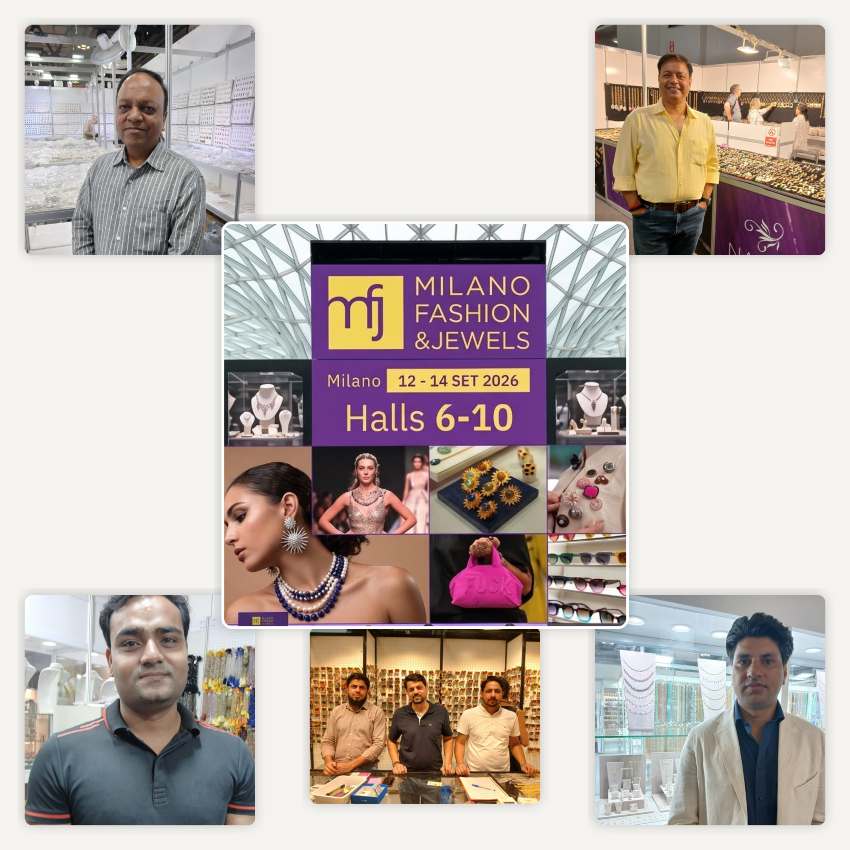
Neeraj Kejriwal of Silver Images India Pvt. Ltd., a Jaipur-based exporter who has exhibited at the Milan fair for 26 years, highlighted the operational stress created by widening price differentials and duties, "The problem right now is with silver... the price has increased and there was a 15% duty, creating a big gap between international prices, the Italian price, and the Indian price. You are getting the basic raw material at an expensive rate, so selling it after adding craftsmanship becomes difficult. In Jaipur, the entire jewellery market stands on gemstones,that is our anchor. The global market has surged, but earlier there wasn't such a vast gap between brass fashion jewellery and silver at retail. Today, if you proceed on old terms, buyers cannot absorb it."
Kejriwal pointed out that while gold operates in a separate luxury demographic unaffected by costume price barriers, silver previously dominated consumer impulse buying. With metal prices climbing, manufacturers can no longer rely on metal weight alone to justify price tags; distinctive stone settings, proprietary cuts, and colour stories must carry the retail justification.
The commercial shift to brass and natural minerals
While some houses refine their silver production, a growing segment of producers has abandoned silver entirely in favor of brass paired with natural gemstones. This transition preserves the visual gravitas and tactile appeal of genuine minerals while shielding the retail price tag from bullion volatility.
Operating a family manufacturing unit in Jaipur with a European showroom in Madrid, Jewel Craft Design made this strategic transition directly in response to metal instability, adding, "We work with brass and semi-precious stones. We used to make silver jewellery five years ago, but due to Covid and because the price of silver is not stable, we had to move to brass. It remains affordable for the customer. Silver has become very expensive, which limits how many designs you can make; if you introduce more variety in silver, the price escalates. In Europe, if you sell with natural gemstones, the value remains very high. People appreciate natural stones, and that trust is where our strength lies."
The brand emphasized that maintaining affordability across disparate European retail zones, from price-conscious boutiques in Spain to higher-margin outlets in France; requires an agile base metal foundation. By absorbing design costs into brass, brands can maintain expansive, diverse collections that mid-tier buyers can curate without exceeding their inventory open-to-buy budgets.
Pankaj Sharma of Nailah Jewels, who transitioned from domestic retail to a 100% export model focused on handcrafted brass, echoed the wider market dynamic, "When silver prices go high, overall metal sentiments rise. But silver sees a far more drastic impact because its baseline value is much higher. We do pure handmade, labor-oriented work in brass, launching our designs here in Milan. The requirements for silver buyers and brass buyers can overlap, but brass allows retail margins to remain protected."
Engineering lightweight castings for rapid trend rotations
For houses dedicated to the European fine-finish aesthetic, abandoning sterling silver is not an option. Instead, the solution lies in advanced technical fabrication: thinning profiles, employing hollow-form casting, and blending regional production strengths.
Gem Hub S.R.L., an enterprise bridging Jaipur gemstone procurement with fine silversmithing in Vicenza, Italy, exemplifies this hybrid engineering model. Mahesh of Gem Hub noted the sharp evolution in buyer behavior across the European circuit as, "Our company opened 10 years ago in Milan, first selling gemstones and then recognizing the potential of Italian-made 925 silver fused with precious gemstones from Jaipur. As the price of precious metals increases, the market slows down. Clients still come, but buying power is impacted. Because metal prices are rising, clients explicitly demand lightweight jewellery."
To deliver these lighter weights without sacrificing durability or tactile luxury, Gem Hub combines stone-setting machinery with traditional Italian bench assembly. Furthermore, the speed of trend cycles has contracted dramatically. "Ten to fifteen years ago, you could run one line for two years," Mahesh noted. "Now globalization has turned it into a six-month trend cycle. That fast turnover makes heavy inventory an unnecessary retail risk."
Milano Fashion & Jewels strategically positioned in a unified sourcing infrastructure
Milano Fashion & Jewels closed its September edition at Fiera Milano with over 600 participating brands from 31 countries, an international exhibitor share of 44%, and 33% first-time exhibitors. Positioned within the wider Fashion Link Milano calendar alongside MICAM, MIPEL, TheOneMilano, Lineapelle, and Simac Tanning Tech, the event formed part of an integrated sourcing ecosystem that welcomed 37,000 professional visitors across its concurrent trade platforms.