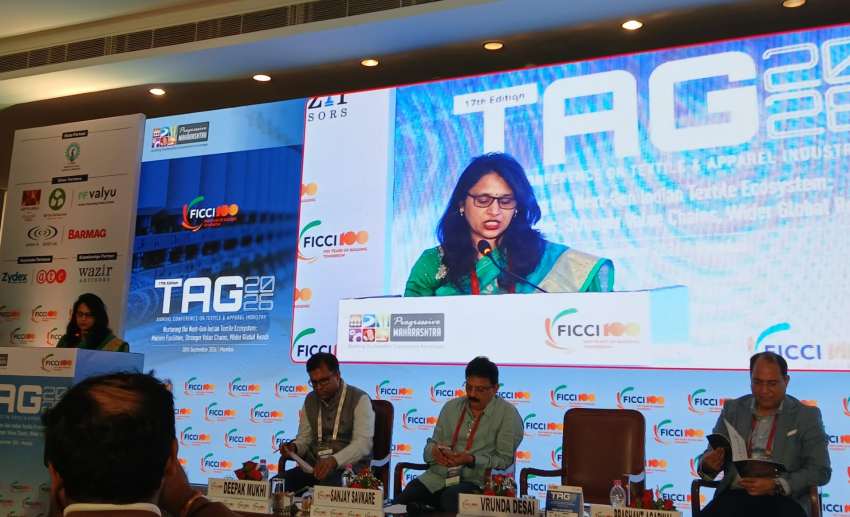
To break a six-year export stagnation hovering near $40 billion, India’s textile and apparel sector is undergoing a fundamental strategic realignment. During Bharat Tex 2026, Giriraj Singh, Union Minister of Textiles, unveiled the India Textiles & Apparel CXO Blueprint 2030, a roadmap developed by the Clothing Manufacturers Association of India (CMAI) and the Global Alliance for Textile Sustainability (GATS). The document marks a departure from traditional volume-based growth, urging manufacturers to prioritize capability-led competitiveness to capture a greater share of the global market, which has outpaced India’s export growth in recent years.
Operational resilience through technology and traceability
The blueprint identifies five pillars - circularity, traceability, resource efficiency, product diversification, and AI-led technology - as essential for long-term viability. With over 52 per cent of current exports confined to just 134 product categories, the sector is under pressure to diversify into higher-growth segments like technical textiles and man-made fibers. Santosh Katariya, President, CMAI, emphasizes, success now rests on creating greater value for global brands. For instance, firms integrating AI-driven quality control and closed-loop water systems are already reporting improved compliance and operational efficiency, proving that sustainability is now a core business prerequisite rather than a peripheral luxury.
Targeting $100 billion exports by 2030
The Clothing Manufacturers Association of India (CMAI) is the leading apex body supporting the nation's apparel sector, which employs nearly 45 million people. While historically rooted in cotton and traditional textiles, the industry is currently diversifying into high-value apparel and technical textile segments to achieve a $100 billion export target and a $250 billion domestic market valuation by 2030.