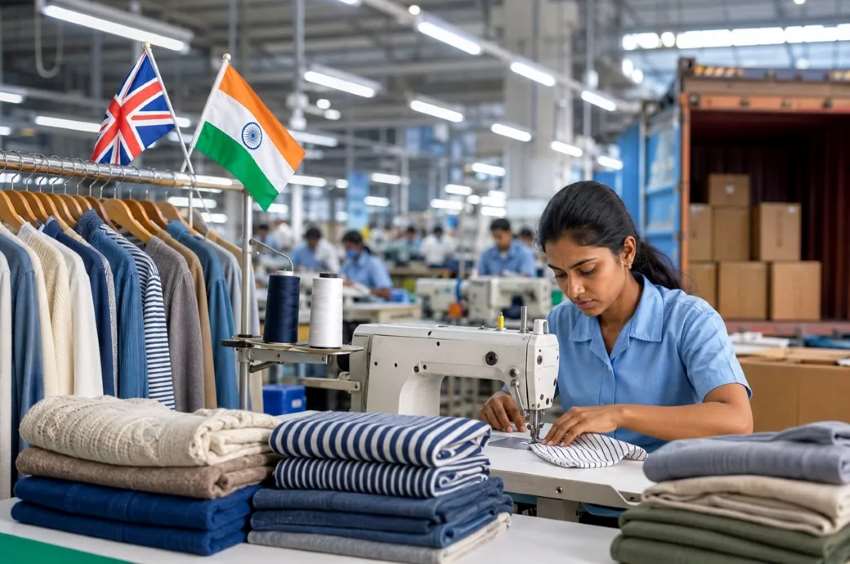
India's textile and apparel industry is ready for one of its biggest export opportunities in decades as the India-UK Comprehensive Economic and Trade Agreement (CETA) comes into force from today, July 15, 2026. By eliminating tariffs on 99 per cent of Indian tariff lines entering the UK, the agreement removes a long-standing cost disadvantage for Indian exporters and also improves their competitiveness in one of the world's largest fashion markets.
For years, Indian apparel and home textile exports attracted duties ranging from 8 to 12 per cent, while competitors such as Bangladesh benefited from preferential access. The new agreement effectively levels the playing field, allowing Indian suppliers to compete on quality, scale, innovation and supply-chain capabilities rather than sacrificing margins to offset tariff costs.
The impact extends well beyond export numbers. As per industry estimates India's textile and apparel exports to the UK is currently valued at $1.4 billion, and this could double to $2.8 billion by 2030. The agreement also strengthens India's broader ambition of achieving $100 billion in textile exports globally by the end of the decade.
India's textile and apparel sector, valued at nearly $179 billion, contributes around 2 per cent to GDP, 11 per cent to manufacturing gross value added and nearly 9 per cent of the country's total exports, making the agreement strategically significant for both industry and the economy.
A competitive reset
The UK's apparel market has been steadily diversifying sourcing away from China amid geopolitical uncertainty and supply-chain risk. The India-UK pact arrives at a time when British retailers are actively looking to broaden their supplier base. Leading retailers such as Primark, ASOS and Marks & Spencer already maintain sourcing relationships with Indian manufacturers, and the tariff elimination is expected to encourage larger procurement volumes across apparel, home textiles and fashion accessories.
As per Confederation of Indian Textile Industry (CITI), the agreement gives India the advantage needed to increase its market share. Rating agency ICRA expects textile exports to witness annual growth of 11-13 per cent as Indian suppliers capture a larger share of the UK's £14.28 billion apparel and home textile import market. Even before the agreement took effect, India's apparel shipments to the UK had grown by 13.4 per cent, while China's share of UK apparel imports declined by over 6 per cent, indicating that sourcing diversification was already underway.
Table: Top textile & apparel import sources & future outlook
|
Country |
Estimated 2024 import value (apparel & home textiles) |
Per cent share |
Strengths |
Post-CETA outlook |
|
China |
£3.65 bn |
25 |
Large-scale manufacturing and competitive pricing |
Market share gradually declining as buyers diversify |
|
Bangladesh |
£3.21 bn |
22 |
Large garment manufacturing base and cost competitiveness |
Remains a major supplier but faces stronger competition |
|
India |
£1.25 bn |
8.5 |
Integrated value chain, raw material diversity, ethical production |
Expected to raise share to nearly 12% by 2030 |
|
Turkey |
£1.17 bn |
8 |
Design capability and proximity to Europe |
Premium positioning with shorter lead times |
|
Pakistan |
£1.00 bn |
6.8 |
Competitive basics manufacturing |
Faces pricing and margin volatility |
Focus beyond cotton
The agreement also aligns with an important change within India's textile manufacturing. While India has traditionally been known for cotton-based production, global fashion demand has shifted towards performance wear, sportswear, technical textiles and blended fabrics. Reflecting this change, man-made fibres (MMF) and blended yarns now account for 52.2 per cent of domestic textile consumption, overtaking cotton for the first time.
Government initiatives such as the Production Linked Incentive (PLI) scheme have given a boost to investments in synthetic fibre manufacturing, technical textiles and value-added fabric processing. The UK agreement now offers these newly created capacities with duty-free access to premium international buyers. Besides garments, exporters expect strong demand for home textiles, upholstery fabrics, bed linen, towels and industrial textiles as lower landed costs improve India's competitiveness in Britain's premium home furnishing market.
Need to build scale
While tariffs have disappeared, execution will determine how much of the opportunity India can capture. One of India's longstanding challenges has been its fragmented manufacturing base. Unlike competing countries that operate mega integrated factories, many Indian apparel manufacturers continue to operate through smaller production units that often struggle with scale, consistency and lead times.
The government's PM MITRA programme aims to address this gap through seven integrated textile parks that combine spinning, weaving, dyeing, processing and garment manufacturing within single industrial ecosystems. Projects such as the Virudhunagar PM MITRA park in Tamil Nadu are expected to reduce logistics costs, improve production efficiency and shorten delivery timelines—factors increasingly valued by global retailers following pandemic-era supply disruptions. Experts believe stronger integration will also improve capacity utilisation across MSMEs while encouraging automation, digital manufacturing and higher productivity.
Sustainability as a market requirement
Tariff-free access alone is no longer sufficient to win export orders. British retailers require suppliers to demonstrate environmental compliance, ethical sourcing and complete supply-chain transparency. Sustainability has become a procurement prerequisite rather than a value addition. Major export clusters such as Tiruppur have invested extensively in zero-liquid-discharge treatment systems, renewable energy, recycled textiles and water-efficient processing.
Meanwhile, the Cotton Textiles Export Promotion Council (TEXPROCIL) has introduced blockchain-based cotton traceability, enabling buyers to digitally verify fibre origin from farm to finished garment. Such traceability is expected to become increasingly important as UK and European retailers strengthen due diligence requirements and environmental reporting.
Companies prepare for growth
Large exporters are already positioning themselves for increased UK demand.
Raymond Lifestyle for example has diversified its export portfolio by reducing dependence on the US market while expanding its presence in the UK and Europe. The company is scaling production at its Andhra Pradesh manufacturing facility from three to 11 production lines and expects export volumes to grow 20-25 per cent during the current financial year as CETA-driven orders begin flowing.
Similarly, India's largest apparel exporter, Shahi Exports, is well positioned. With over 50 vertically integrated factories, the company supplies several leading global fashion brands and has invested significantly in renewable energy and sustainable manufacturing. Its integrated model is expected to help it capitalise on larger sourcing commitments from UK retailers seeking reliable, compliant and scalable partners.
As global sourcing strategies continue to diversify beyond China, the India-UK trade agreement offers Indian manufacturers a rare combination of tariff competitiveness, policy support and increase production capacity. The next phase will depend on how effectively the industry scales operations, strengthens compliance and delivers the speed and consistency demanded by international fashion buyers. If executed well, CETA could become the catalyst that reshapes India's position in global textile trade over the coming decade.