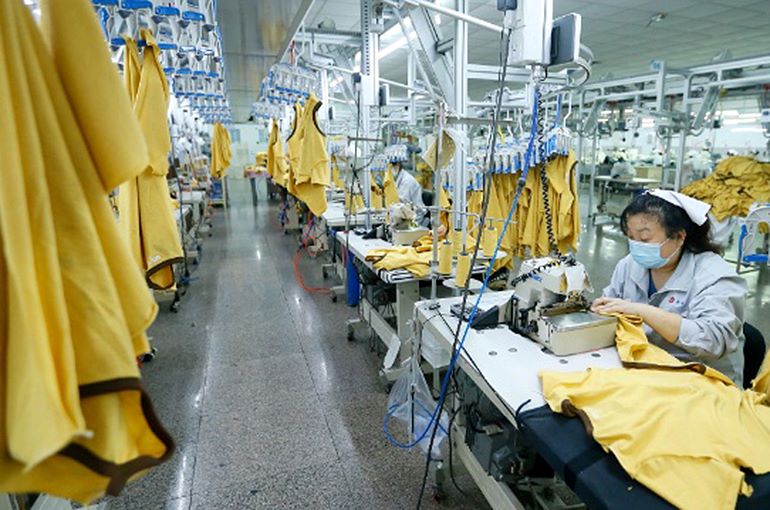
In a significant development, the General Brotherhood of American Apparel Workers (GBWAA), a union for garment workers at American Apparel’s southern California manufacturing facilities has called for a boycott of the brand’s merchandise, pointing to mass layoffs and reduced compensation and benefits that have intensified since new management in January 2015 began a process of post-bankruptcy restructuring throughout the corporation.
Currently, GBWAA is awaiting a certification election date from the National Labor Relations Board, and workers with the union say they are calling for the boycott because American Apparel consumers must know corporation is not the high-wage, sweatshop-free company once marketed itself to be, especially since Paula Schneider replaced American Apparel founder Dov Charney as chief executive officer of the corporation.
According to the Union president Stephanie Padilha dos Santos, if people are used to buying American Apparel and think that the company is great and that the whole concept of paying fair wages in industry was what made the company a huge success, then we invite you now to boycott the brand because it is no longer sweatshop-free.
Padilha alleges that the company has been outsourcing production to other ‘sweatshops’ around Los Angeles, while reducing the once relatively high wages earned by production workers at the company, which were the highest in the world, according to the company.
Meanwhile, in another round of layoffs, over 500 workers are reported to have been laid off this April as part of what Schneider has called a ‘redesign of production process.’

- 1
- 2
- 3
- 4
- 5
- 6
- 7
- 8
- 9
- 10
Crude correction gives polyester a fresh cost advantage
A sustained correction in crude oil and petrochemical benchmarks is reshaping the economics of synthetic yarns, widening the cost gap... Read more
Chinese apparel majors trade volume for margin in premiumisation push
China’s apparel and consumer goods market is moving beyond the traditional volume-at-any-cost model, with leading domestic brands betting on premium... Read more
India’s MMF push faces rising risk from China’s petrochemical dominance
India’s ambition to build a globally competitive synthetic textile industry is facing constraints as downstream capacity alone cannot solve: concentration... Read more
Shein’s Vietnam retreat exposes the limits of nearshoring
The global apparel industry has spent the past few years pursuing a straightforward strategy: reduce dependence on China by moving... Read more
Regional pavilions compete on fiber strengths and supply chain niches at Yarn Ex…
The trade floor at Yarn Expo Autumn 2026 in Shanghai, held between Aug 25-27, capitalizing on a sharp rebound in... Read more
Inside activewear's shift from stitched mesh to precision engineered textiles
The global functional apparel market, on track to touch $640 billion, is looking at a production shift as activewear manufacturers... Read more
Brazil’s cotton dominance puts Asian spinners on a new sourcing map
Brazil’s emergence as the world’s largest cotton exporter is no longer simply an agricultural success story. It has given a... Read more
Textile industry sees long-term growth but $100-bn export goal stays a stretch: …
India’s textile and apparel industry is entering a phase of optimism, but that confidence is tempered by a hard export... Read more
Apparel trade slumps as global textile mills move upstream
Global manufacturing is growing, but finished apparel is failing to capture that growth. United Nations Industrial Development Organization (UNIDO) data... Read more
Global apparel value chain converges in Shanghai as Intertextile Autumn 2026 ope…
The global apparel and textile community gathered in full force yesterday, August 25, 2026, as the Autumn Edition of Intertextile... Read more