As the European textile sector confronts structural shifts driven by the Ecodesign for Sustainable Products Regulation (ESPR) and Extended Producer Responsibility (EPR), the industrial supply chain faces a critical bottleneck: the chasm between laboratory-stage fiber innovation and commercial-scale manufacturability.
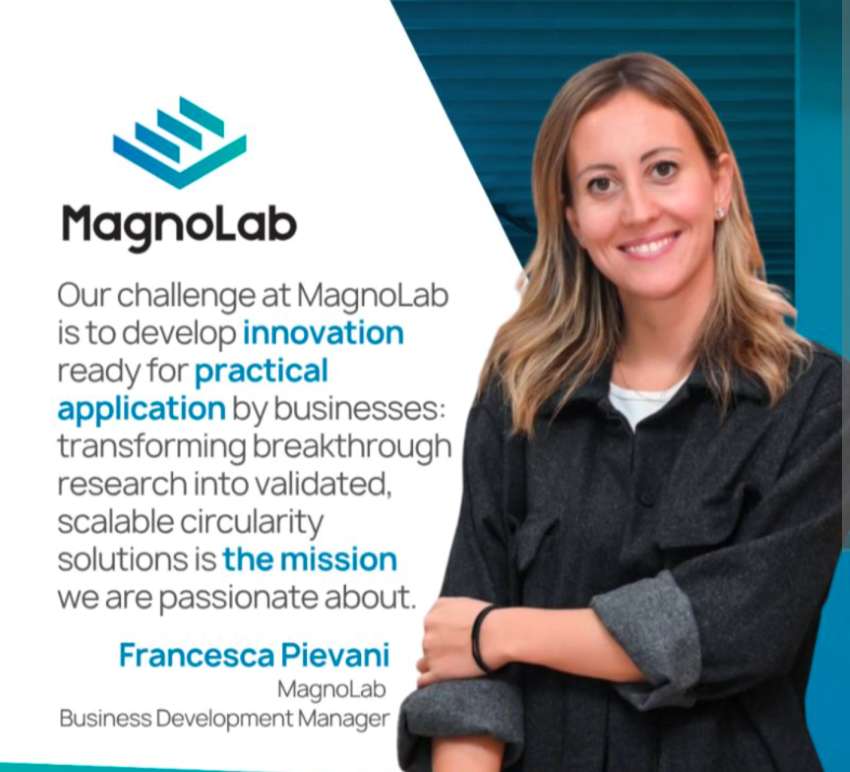
During the 66th edition of the Filo exhibition in Milan, Francesca Pievani, Business Development Manager at MagnoLab, spoke in an exclusive interview conducted by Sanjay Chawla, Founder and Global Convener of FashionatingWorld. Pievani detailed how the Italian network has structured a shared industrial infrastructure designed specifically to de-risk textile R&D and validate circular solutions on the factory floor.
A Collaborative Pilot Engine: From fibre to finished garment
The defining barrier to scaling circular materials, whether mechanically recovered waste or chemically separated polymers—is that individual mills rarely own the end-to-end processing lines needed to pilot an experimental fiber without disrupting commercial loom schedules.
Anchored in the textile district of Biella, Italy, MagnoLab was established to bridge this operational gap. Operating as a privately funded corporate network rather than a subsidized trade body, it unites key Italian players across the value chain (including groups such as Marchi & Fildi, Filidea, Maglificio Maggia, DBT Fibre, and Di.Vè) to create an end-to-end pilot innovation hub.
"As MagnoLab, we are a network of several companies that cover the entire textile process, from fiber management to fiber development," said Pievani. "We collect our strength and we start to work. We make innovation both in product and process. If someone wants to innovate in a product or process, we can validate it because we are very technical and have strong expertise and know-how. We manage the entire process and give our client the feasibility of a new product."
Unlike theoretical labs, the facility houses operational pilot machinery across opening, preparation, spinning, circular and flat knitting, weaving, and finishing. This allows technical teams to test an untried raw material directly through downstream garment realization.
"If a new client wants to innovate a new fiber, they give us the fiber and we test it across all the different phases, not only as a fibre, but also as a final garment to see which construction best enhances its performance," Pievani explained. "We analyze the fibre, create the tops, analyze the tops, spin the yarn, analyze the yarn, and then determine which fabric structure is ideal. It is not a linear exercise; it relies on deep technical know-how developed within this specialized district."
Pushing the thresholds of recycled content
A central pillar of MagnoLab’s technical validation work focuses on raising the inclusion rates of recycled feedstocks without sacrificing tensile strength, yarn uniformity, or finishing consistency.
While commercial spinning often caps post-consumer mechanically recycled cotton at lower ratios due to shortened staple lengths, MagnoLab’s targeted trials have engineered high-performing yarns incorporating up to 50% to 60% recycled cotton fibre, and between 65% and 70% recycled wool content in specialized runs. "That is why we are concentrating heavily on the quality of recycled yarn," Pievani noted. "We work with top-tier technical partners to push the envelope on yarn performance. In specific project parameters, we can achieve up to 65% to 70% recycled wool, and around 50% to 60% for cotton. However, it depends entirely on the incoming feedstock quality, it does not mean you can achieve that with every fiber lot that enters the plant."
Beyond single-fibre streams, the network is addressing one of the industry's most challenging circular hurdles: poly-cotton blends.
"Managing blends is exceptionally complex," Pievani pointed out. "We are currently managing a new project focused on recycling poly-cotton, which requires orchestrating both mechanical and chemical recycling pathways. When we pilot these recycling processes, we begin with structured small-scale trials, for instance, running a 300-kilogram pilot lot of poly-cotton to rigorously determine whether the material pathway is technically and industrially viable before moving toward scaled production."
An operational network over digital platforms
MagnoLab’s operational architecture is physical, functional, and non-commercial. The network encompasses more than 27 partner enterprises, ranging from major fabric and yarn producers like the Achille Pinto Group to specialized artisanal workshops, acting strictly as an innovation validator rather than a finished goods manufacturer. "It is a private network of companies, not a state-funded association," emphasized Pievani. "Digital networks are useful for information, but we need an operative, physical network. We must send physical material, run it on machines, and mechanically validate the process. Furthermore, we are strictly a technical validator and innovation center; we do not manage the commercialization or downstream production. We have international clients outside Europe who come to us to test and validate the feasibility of a new product or process, and they remain completely free to manufacture the final product in their own domestic supply chains."
The Demand Deficit: The missing link in global circularity
While upstream technical capabilities are advancing rapidly, Pievani candidly observed that industrial willingness to innovate is colliding with sluggish market uptake. Without enforced regulatory deadlines or sustained brand procurement commitments, the circular textile economy faces an acute demand deficit. "Everyone is moving toward sustainable solutions, but there is no corresponding pull in demand," Pievani observed. "We need to understand how real market demand will be generated. This remains the single biggest challenge. In Italy and across Europe, many companies are waiting for clear regulations to take full effect, but timelines continue to shift. You cannot leave suppliers in uncertainty, it creates immense pressure across the manufacturing base."
Filo: A strategic hub of the European textile
Held biannually in Milan, Filo is the premier international B2B trade exhibition dedicated exclusively to top-of-the-range yarns, fibers, and upstream textile materials. Organized by AssoServizi Biella and co-located at Fiera Milano Rho alongside Lineapelle, Filo serves as the strategic opening hub of the European textile calendar.
The platform focuses on high-end woven and knitted textiles, research-driven sustainability, and technical traceability, connecting international filatures, raw material innovators, and luxury apparel brands at the foundational stage of the global fashion supply chain.