
Since 2014 China has emerged as India’s biggest trade partner and a country with which India has a large trade deficit. Exports to India account for only two per cent of China's total exports. India’s imports from China rose by more than seven per cent in October 2016, while exports to China fell by 11 per cent, widening the trade deficit to a record 48 billion dollars.
China-India trade cooperation has deepened over the years and the bilateral trade has grown 24 times in 15 years, from 2.9 billion dollars in 2000 to 71.6 billion dollars in 2015. In 2015, China imported two billion dollars worth of cotton and more than 100 million dollars worth of black tea from India, bring benefits to 1.2 million cotton growers and 50,000 tea farmers and sellers in India.
Since China started its reforms and opening-up policy in 1978, its economy has expanded rapidly and, after three decades of spectacular economic growth, China has gained a strong foothold in global trade. Now it is the biggest trading partner for more than 130 countries.
With its fantastic economic growth, China has, in fact, forced the rewriting of the history of global trade. The Made in China label is establishing China's place as a major player in a global economy. India, Pakistan, Bangladesh, US, Europe, parts of Canada, Australia, Africa and several other countries import from China.

- 1
- 2
- 3
- 4
- 5
- 6
- 7
- 8
- 9
- 10
The Gen Z quality test is disrupting fashion’s middle market
Gen Z is changing the business of value fashion by treating apparel purchases less like impulse consumption and more like... Read more
The Gen Z quality test is disrupting fashion’s middle market
Gen Z is changing the business of value fashion by treating apparel purchases less like impulse consumption and more like... Read more
Inditex, Uniqlo lead as fashion retail’s cost and inventory divide widens
The global apparel industry’s 2026 earnings cycle has exposed a growing divide between retailers that convert sales into returns and... Read more
Nike’s D2C retreat backfires as wholesale reclaims sportswear’s growth
Nike’s aggressive shift toward direct-to-consumer (D2C) selling was meant to give the sportswear giant greater control over pricing, customer data... Read more
Break Free from the Spinning Trap and 10-Year Export Stagnation: Wazir Advisors …
India’s textile exports have remained virtually flat at $15–16 billion for an entire decade, while competitors such as Bangladesh and... Read more
Bangladesh’s RCEP bid gives apparel a new export route post-LDC tariffs
Bangladesh’s bid to join the Regional Comprehensive Economic Partnership (RCEP) has moved into a formal accession process, giving their $38... Read more
India’s apparel exports fall 11.2% as cotton dominance meets synthetic shift
India’s readymade garment (RMG) exports fell 11.2 per cent year-on-year to $7.882 billion in the first half of 2026, from... Read more
GST reforms could unlock liquidity across India’s textile manufacturing chain
India’s textile value chain could gain from new changes to the Goods and Services Tax (GST) framework, particularly through faster... Read more
From pilot to plant its financing, not chemistry that blocks textile recycling
The global textile industry is discovering a hard limit to circularity: technology is advancing faster than finance. Only three of... Read more
End Cluster Fragmentation, Processing Gaps: Sanjay Savkare unveils Solar & I…
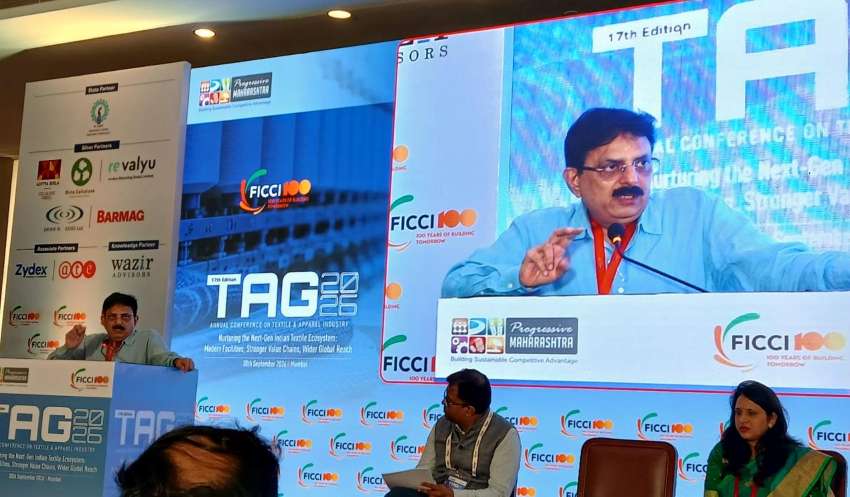
In an address at the 17th annual FICCI TAG 2026 conference, Sanjay Savkare, Minister of Textiles, Government of Maharashtra, called... Read more