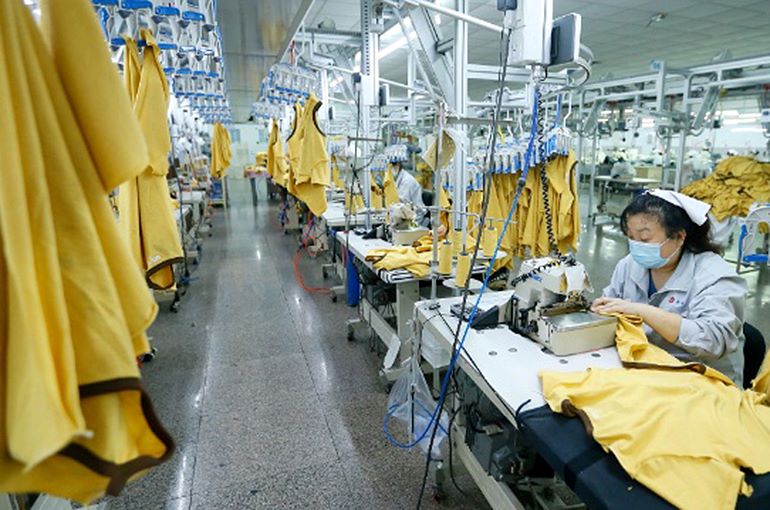
Cambodia's $5.5-billion garment industry witnessed a significant decrease in the numbers of the strikes and lost work days as compared to 2013, reveal latest industry figures. The Garment Manufacturers Association in Cambodia (GMAC), which represents the sector’s more than 500 export factories, collected these figures after unprecedented number of strikes in 2013 in Cambodia’s crucial but volatile garment sector. As per GMAC’s latest stats, the number of strikes fell by more than 25 per cent, from 147 in 2013 to 108 in 2014. The number of lost work days fell even more, from 8,89,000 to 5,13,000, a decrease of 40 per cent. These figures exclude the 15 days nation-wide strikes that brought much of the industry to a halt in late December 2013 and early January 2014.
GMAC chairman Van Sou Ieng points out that 15 days were not included because the association considered them to be political events rather than industrial actions. He blamed the peak in strikes and lost working days in 2013 on the opposition CNRP, which he accused of whipping up discontent among garment workers for votes in an election year.
The CNRP had promised higher wages to garment workers if elected to power. After the strikes, the negotiations between the unions, factories and government for yet another boost to the minimum wage helped to defuse tensions and bring the number of strikes down, believes Sou Leng. Agreeing with Leng’s views, Ath Thorn, president of the Coalition of Cambodian Apparel Workers’ Democratic Union, and one of the leaders of the Dec. 2013 strikes, said that the elections had helped fuel a rise in strikes in 2013.
Both, Thorn and Sou Leng, are clear about the idea that the drop should help revive confidence in Cambodia that international brands lost in 2013.

- 1
- 2
- 3
- 4
- 5
- 6
- 7
- 8
- 9
- 10
Global Sourcing Expo Sydney 2026: Bridging the gap in global apparel procurement
The upcoming Global Sourcing Expo Sydney, scheduled for June 16–18, 2026, at the International Convention Centre (ICC) Sydney, is poised... Read more
Zara’s precision retail model leaves global competitors drowning in inventory
The global apparel sector is currently grappling with a punishing inventory overhang, yet Inditex, the parent company of Zara, has... Read more
Beyond the mall collapse, the profit push driving 2026 retail closures
The American retail sector has entered 2026 in the midst of one of its most impactful recalibrations in decades. Over... Read more
Status, Rewired: Health, AI and experience are displacing heritage luxury
The global luxury industry is not facing a demand fall it is confronting a redefinition of value. As bellwethers like... Read more
No More Easy Wins: Why global retailers are losing ground in China
China’s retail sector has entered a new phase, one defined not by aspiration, but by scrutiny. The long-standing advantage enjoyed... Read more
India’s 45°C economy is reshaping apparel retail and consumer spending
The intensifying heatwaves sweeping across the Indian subcontinent are no longer mere meteorological anomalies; they have become the primary engineers... Read more
FY26 Textile Scorecard: Integration, specialization are winning the margin battl…
As the curtains close on FY2025-26, India’s textile industry is revealing a sharp divide. On one side stand integrated and... Read more
Intertextile Shenzhen 2026: Pioneering the Future of Textile Innovation
As Shenzhen cements its status as China’s premier hub for manufacturing, artificial intelligence, and startup cultivation, Intertextile Shenzhen Apparel Fabrics... Read more
The Devil Wears Prada 2 reflects fashion’s power shift, where consumers replace …
" " The release of The Devil Wears Prada 2 has sparked a debate far bigger than a Hollywood sequel. What... Read more
The 30-minute problem reshaping the $63 bn leggings market
The global leggings makers are racing to solve one of the apparel industry’s most expensive hidden problems: discomfort that appears... Read more