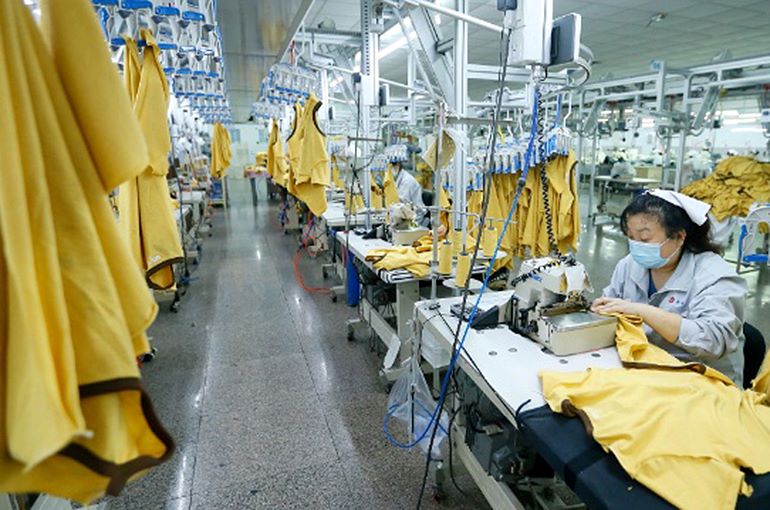
Bangladesh will need about 3.6 million skilled workers in the garment industry by 2021. Total labor (skilled and unskilled) demand for the garment industry will be almost six million, says a joint study done by Bangladesh Institute of Development Studies (BIDS) and the Ministry of Finance. The report titled ‘Labor Market and Skills Gap in Bangladesh (Macro and Micro Level Study)’ says the country only had 10.4 per cent trained laborers in 2013 while the rest 89.6 per cent workers were untrained. Domestic skill labor demand will be 72.41 million in 2020. Of this, demand will be 2.91 million in the agro-food sector, 4.42 million in construction and 5.98 million in the readymade garment sector.
Bangladesh is second largest garment exporter in the world after China. Although the garments make up 82 per cent of exports, employment growth in the sector has slowed down. However, other manufacturing sectors have been generating about 3,00,000 new jobs annually since 2010. The World Bank is helping Bangladesh diversify exports beyond the garment sector.
The project will improve competitiveness of existing and potential export-oriented industries such as leather, footwear, plastics and light engineering, where Bangladesh has demonstrated a competitive edge. It will help create more than 90,000 jobs in sectors other than readymade garments and boost the economy and help it integrate further into world trading system, and provide better jobs to youth entering the labor market in the next decade, with a particular focus on improving female labor participation.

- 1
- 2
- 3
- 4
- 5
- 6
- 7
- 8
- 9
- 10
China’s inward turn, domestic demand is rewriting the export model
China is undergoing one of its most consequential economic recalibrations in decades, driven by geopolitical instability, rising Western protectionism, and... Read more
Why Shein sees itself as a technology company, not a fashion brand
The modern fashion industry has traditionally been defined by creativity, merchandising expertise and global sourcing networks. Yet few companies have... Read more
India’s textile sector turns crisis into competitive advantage
India’s textile and apparel industry has emerged from one of the most turbulent periods in its recent history, transforming a... Read more
India’s Export Divide: Textile mills advance, apparel makers face global headwin…
India’s textile and apparel (T&A) sector entered FY2027 with a striking internal contradiction. While the country’s overall merchandise exports increased... Read more
China’s inward turn, domestic demand is rewriting the export model
China is undergoing one of its most consequential economic recalibrations in decades, driven by geopolitical instability, rising Western protectionism, and... Read more
Egypt bets on a $2 bn green textile city to become Europe’s next sourcing hub
Egypt is making a decisive play to become one of the world's most important apparel manufacturing destinations after securing a... Read more
EU textile imports hit $295.66 bn as price wars mask manufacturing stress
The European Union’s textile and apparel imports grew to $295.66 billion in 2025, a 9.4 per cent year-on-year increase from... Read more
Landmark India-UK trade pact to supercharge textile export margins
The long-awaited India-UK Comprehensive Economic and Trade Agreement (CETA) is officially scheduled to commence on July 15, 2026. This breakthrough... Read more
Is it the end of aspirational luxury? Asia’s consumers demand more than logos
While the global personal luxury goods market remains broadly stable at around €358 billion, the apparent resilience masks a deeper... Read more
Vietnam wins, India slips as US apparel sourcing undergoes massive reset
A trade realignment is transforming the global apparel market, yet India’s manufacturing has stalled at the starting line. Newly released... Read more