RAFI marks 10th anniversary with a shift to diversified multi-national sourcing model
The Russian Association of Fashion Industry Participants (RAFI) marked its tenth anniversary in 2025 by fundamentally shifting its focus toward a diversified, multi-national sourcing model.
At the center of this milestone was the 20th season of Bee-Together.ru, the association's premier outsourcing platform, which concluded its November session with a record-breaking conversion rate: nearly 80 per cent of participating brands successfully secured new manufacturing contractors. As the Russian fashion market adapts to supply chain realignments, the event hosted over 200 factories from six nations, signaling a transition from localized production to a sophisticated, cross-border outsourcing network.
Strategic sourcing diversification and the rise of ‘CIS+ Manufacturing’
The November 2025 expo at the Radisson Slavyanskaya underscored a significant geographic broadening of the Russian apparel supply chain. While local exhibitors remained a cornerstone, the presence of over 60 factories from Uzbekistan and 25 from Kyrgyzstan highlighted the growing dominance of the CIS region in providing high-volume, cost-effective garment production. In particular, Uzbekistan has emerged as a critical partner, supported by high-level diplomatic engagement from the Uztextilprom Association. This ‘CIS+’ model is designed to navigate 2026 industry challenges with increased flexibility, allowing Russian marketplaces and large retail chains - represented by over 2,000 professional buyers - to mitigate logistical risks through direct manufacturer-to-brand communication.
Indo-Russian synergy: The rebirth of leather and footwear partnerships
A pivotal development in RAFI’s 2025 strategy was the relaunch of specialized B2B business sessions, specifically targeting the high-demand leather goods sector. In collaboration with the Council for Leather Exports (India) and the Embassy of India, the association facilitated a dedicated trade show where 20 Indian manufacturers showcased premium leather samples to Russia's market leaders, including Finn Flare, Bosco, and Zasport. The inauguration by Nikhilesh Giri, Deputy Chief of Mission, Indian Embassy, emphasized a mutual commitment to developing footwear and accessory production. This initiative directly addresses a gap in the Russian premium segment, where buyers are increasingly seeking high-quality, natural materials to replace departing Western luxury labels.
Established in 2015, the Russian Association of Fashion Industry Participants (RAFI) is a central hub for B2B connectivity in the textile and garment sectors. Over the past decade, it has connected 2,715 manufacturers with over 13,000 Russian corporate customers.
The Second Life of 3D: Why this tech is more alive than ever in fashion

The fashion industry is no stranger to cycles of hype and disillusionment, and 3D technology has been no exception. At the recent PI Apparel NY event, a panel titled ‘3D is Dead. Long Live 3D’ laid bare the current sentiment surrounding this transformative technology. Far from declaring its demise, the discussion served as a powerful declaration of 3D's enduring relevance, recalibrating expectations from magical quick fixes to strategic, impactful implementation.
The 3D journey from hype to reality
The journey of 3D in the apparel industry began with a promise of revolutionary speed and efficiency. Early adopters envisioned a world where physical samples would be obsolete, design iterations would happen at lightning speed, and sustainability goals would be effortlessly met. However, as Christian L. Harris, a Digital Expert on the panel, noted, "The early hype around 3D has worn off. The quick wins didn’t land for all. And for some, the whole thing feels like a false start."
This sentiment resonates with many who invested in 3D tools expecting overnight transformation. Pat Trautman, President and a panelist, highlighted a critical distinction: "What is dying is the myth that 3D delivers magical results. Implementing 3D isn’t just a tech rollout. It’s a shift in mindset, process, and culture."
The Reality: 3D is alive and evolving
Despite the initial missteps and inflated expectations, the core message from the PI Apparel NY panel was unequivocally clear: 3D is not dead; it's thriving. Safir Bellali, Strategic Advisor for DPC and Digital Innovation, and 3DRC Education Chair, emphasized, "It’s alive, evolving, and more capable than ever of driving meaningful change across design and product development."
The key lies in understanding that 3D is a powerful enabler when integrated with intent and supported by a robust strategy, comprehensive training, and a people-centric approach. As the panelists reiterated, expecting instant gratification from 3D without a fundamental shift in operations is a recipe for disappointment.
The tangible benefits
When implemented correctly, 3D technology delivers a compelling suite of business impacts that go beyond the initial hype. These benefits are not just theoretical; they are quantifiable and are being realized by forward-thinking companies.
Benefits of effective 3D implementation
• Faster decisions: Virtual prototyping drastically reduces the time spent on physical sample creation and review cycles.
• Smarter workflows: Digital assets streamline communication between design, development, and manufacturing teams, reducing errors and rework.
• Lower sampling costs: Reduced reliance on physical samples leads to significant savings in materials, shipping, and labor.
• Stronger collaboration: Centralized 3D models and virtual environments foster seamless collaboration across geographically dispersed teams.
To illustrate these benefits, let's look at some hypothetical data and case studies that reflect the industry's progress.
Table: Impact of 3D adoption on product development metrics (illustrative data)
|
Metric |
Before 3D adoption |
After 3D adoption (Well-implemented) |
Percentage improvement |
|
Sample Lead Time |
6-8 weeks |
2-3 weeks |
50-75% |
|
Physical Sample Costs |
$100,000/collection |
$25,000/collection |
75% |
|
Design Iteration Cycles |
5-7 |
2-3 |
40-70% |
|
Time to Market (New Styles) |
12-18 months |
8-10 months |
33-44% |
|
Material Waste (Sampling) |
Significant |
Minimal |
~90% |
A look at some case studies
Agile Apparel Co: streamlining design decisions
Agile Apparel Co, a mid-sized sportswear brand, faced challenges with long design iteration cycles due to reliance on physical samples. After a year-long strategic implementation of 3D design software, including robust training for their design and development teams, they witnessed a significant transformation. "Our decision-making process has accelerated dramatically," stated their head of product development. "We can now review multiple design options virtually within days, rather than waiting weeks for physical prototypes. This has cut our sample lead time by 60 per cent and allowed us to be far more responsive to market trends."
Sustainable Styles Inc: Reducing environmental dootprint
Sustainable Styles Inc, known for its eco-conscious approach, integrated 3D technology primarily to reduce its environmental impact from sampling. By shifting a significant portion of their sampling process to 3D, they achieved a remarkable reduction in physical sample production. "Before 3D, we were producing hundreds of physical samples each season, leading to considerable material waste and carbon emissions from shipping," explained their Sustainability Officer. "With 3D, we've reduced our physical sample count by 85 per cent, lowering our footprint and aligning with our core values."
Implementation with intent
Justin Schlothauer, Global Senior Director of Digital Product Creation at Under Armour, a leader in digital transformation, provided a real-world perspective on the panel. His presence underscored that industry giants are committed to leveraging 3D for strategic advantage.
Karina Ochoa de Baker, Creative Director & Consultant, reiterated the sentiment that "The tech is here. The value is proven. Now it’s about implementation with intent." This encapsulates the forward-looking vision for 3D in the fashion industry. The focus is no longer on ‘if’ 3D will deliver, but ‘how’ it will be integrated into the fabric of an organization's operations, culture, and strategy.
The message from PI Apparel NY is clear: the age of unrealistic expectations for 3D is over. In its place, a more mature, strategic understanding of 3D is emerging. This isn't a death knell, but a call to action for purposeful adoption, promising real, tangible benefits for those ready to commit to the long-term transformation. "3D is dead. Long live 3D." indeed. The future of fashion is undeniably digital, and 3D is at its core.
HSG acquires controlling stake in Golden Goose
The global luxury landscape has been reshaped by the HSG’s acquisition of a controlling stake in the brand Golden Goose. Valued at approximately €2.5 billion, the deal marks one of the most significant infusions of Chinese capital into European fashion to date.
While Temasek and True Light Capital have secured minority stakes, the entry of HSG - formerly Sequoia China - signals a pivot toward a tech-integrated, ‘community-first’ luxury model. Expected to close by summer 2026, the transaction aims to leverage HSG’s prowess in consumer technology to scale the brand’s digital and Asian footprint while safeguarding its ‘Made in Italy’ artisanal heritage.
Industrial powerhouse at the helm
The appointment of industry titan Marco Bizzarri as Non-Executive Chairman provides a critical industrial anchor to the transition. The mastermind who scaled Gucci from €3.9 billion to nearly €10 billion, Bizzarri will partner with hard-charging Silvio Campara, CEO to steer the ‘perfectly imperfect’ sneaker label. This leadership duo enters a position of strength: Golden Goose reported a 13 per cent revenue jump in the first nine months of 2025, reaching €517.1 million. Despite a broader slowdown in the luxury sector, the brand’s direct-to-consumer (DTC) channel grew by 21per cent, proving that its ‘co-creation’ experiential retail model is successfully insulating it from the ‘quiet luxury’ downturn affecting traditional heritage houses.
Founded in Venice in 2000, Golden Goose defined the ‘luxury sneaker’ category with its signature distressed aesthetic. It focuses on a high-touch lifestyle model, integrating the Forward Store concept for repair and personalization. The brand operates 227 directly operated stores (up from 97 in 2019) with a massive 79 per cent revenue dependency on DTC channels, particularly strong in EMEA and the Americas.
Inditex closes 60 Zara stores across the world
Unveiling a paradox in its 2025 fiscal strategy, Zara’s parent company, Inditex has closed 60 stores worldwide of the brand while simultaneously hitting record financial heights. The Spanish retail giant reported a 3.9 per cent increase in net income to €4.6 billion for the first nine months of the year, even as it streamlined its physical network to 1,528 Zara locations.
This ‘quality over quantity’ shift is a deliberate move to replace smaller, high-street units with massive, technologically integrated flagships. Óscar García Maceiras, CEO highlighted a key transformation in Osaka, Japan, where a former Zara site is being reimagined as a standalone Zara Man boutique, signaling a new era of gender-specific, curated retail spaces.
Tech-driven growth and premiumization
While the brand’s store count has dipped, its profitability per square foot has surged. Inditex’s gross margin reached a robust 59.7 per cent, fueled by the rollout of ‘soft-tag’ RFID technology and AI-edited e-commerce modeling that slashes operational overhead.
Early Q4 data shows a 10.6 per cent jump in constant currency sales through December 1, proving that Zara’s pivot toward ‘lifestyle’ retail - exemplified by the debut of the Zacaffè coffee shop concept in Japan and Spain - is resonating with consumers seeking an immersive experience. Despite the closures, the group plans a 5 per cent increase in gross floor space through 2026, focusing on prime global ‘trophy’ locations rather than mass-market saturation.
The flagship brand of Inditex, Zara is world-renowned for its ‘fast fashion’ model that moves designs from catwalk to store in under three weeks. It now focuses on an ‘Omnichannel’ approach, blending high-tech physical boutiques with a dominant global e-commerce platform.
BGMEA faces structural challenge as exports decline
The Bangladesh ready-made garment (RMG) industry is facing an unprecedented structural challenge as export momentum falters across both established and emerging frontiers. New data for the July–November period of FY 2025–26 reveals a 3.19 per cent Y-o-Y decline in non-traditional markets, with earnings slipping to $2.67 billion. This downturn is particularly alarming as it coincides with a 1.03 per cent contraction in the European Union, Bangladesh’s largest regional destination. While the US market showed a thin 3.06 per cent growth to $3.22 billion, exporters warn this is a ‘fragile recovery’ under the shadow of a new 20 per cent reciprocal tariff regime that took effect in August 2025.
The pivot to non-cotton and value-added segments
The sector’s internal dynamics show, knitwear exports have plunged by 6.34 per cent due to aggressive price-cutting from Indian and Chinese rivals, whereas woven garments have remained marginally resilient with 0.05 per cent growth. Industry leaders, including former Mohiuddin Rubel, Director, BGMEA, argue, the ‘cotton-dependency’ trap is the industry’s greatest vulnerability. Currently, 75 per cent of global apparel demand is for man-made fibers (MMF) and synthetic blends, yet these account for only 27 per cent of Bangladesh's shipments. To counter the 50 per cent reduction in government cash incentives and rising 14 per cent bank interest rates, factories are now being urged to fast-track investments in ‘smart’ functional fabrics and technical apparel to capture higher margins.
As the industry approaches its LDC graduation in 2026, the absence of an elected government and persistent labor unrest - totaling over 1,600 road blockades this year - have shaken buyer confidence. Beyond the factory floor, the struggle is becoming a matter of commercial diplomacy. Exporters are calling for the revitalization of overseas commercial wings to penetrate high-potential markets like Japan and Brazil, which showed rare growth of 0.98 per cent amidst the general slump. Without a coordinated move toward ‘circularity’ and a shift into the non-cotton segment, analysts warn that one-third of the country's mid-tier factories could face closure before the end of the next fiscal year.
As the apex trade body, BGMEA represents over 4,500 garment factories, acting as the primary negotiator between the industry, the government, and global retail giants.
SGCCI launches SITME 2026 in partnership with SEA
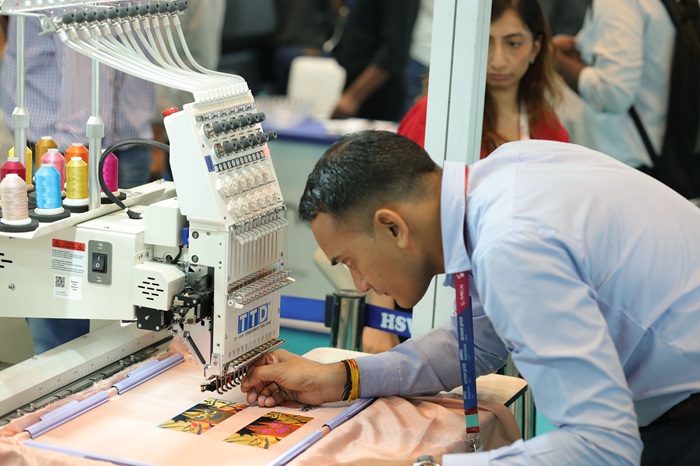
The Southern Gujarat Chamber of Commerce & Industry (SGCCI) has announced the launch of the Surat International Textile & Machinery Expo (SITME 2026) in partnership with the Surat Embroidery Association (SEA).
Scheduled for January 9–12, 2026, SITME 2026 is set against the backdrop of the Surat International Exhibition and Convention Centre (SIECC) in Sarsana. This four-day event is designed to pivot Surat from a mere fabric hub to a manufacturing powerhouse for high-tech embroidery machinery. This strategic shift aligns with the recent government deferment of the Quality Control Order (QCO) for textile machinery to late 2026, providing local manufacturers a crucial window to upgrade their domestic production capabilities to match international benchmarks.
Scaling productivity through computerized automation
With over 2.5 lakh embroidery machines currently operating in Surat, the city is recognized as the world’s second-largest embroidery cluster, employing nearly 12 lakh individuals. SITME 2026 arrives at a critical juncture where the industry is moving away from manual labor toward a 68 per cent market dominance of multi-head computerized systems. The expo will feature over 100 advanced machines from 60 major manufacturers across India, showcasing a ‘No-Touch’ automation and IoT-enabled predictive maintenance. These technologies are vital for local job workers facing rising labor costs, as they allow for simultaneous high-precision stitching across multiple heads, significantly reducing defects in high-value wedding and festival apparel.
Beyond pure machinery, the exhibition highlights Surat's evolving role in the global textile value chain, contributing 15–20 per cent of India’s man-made textile exports. As the industry faces a ‘Double Whammy’ of global tariffs and regional competition, the focus at SITME 2026 remains on value addition through ‘chaotic customization’ and sustainable threadwork.
As per Nikhil Madrasi, President, SGCCI, the expo acts as an ‘Industry for Industry’ platform, empowering more than 25,000 expected buyers to source the latest indigenous tech, effectively reducing the region’s historical reliance on machinery imports from China and Korea.
An apex business body in South Gujarat, SGCCI is dedicated to promoting trade, industry, and the ‘Brand Surat’ global identity through large-scale B2B exhibitions and policy advocacy.
Global kids apparel market to grow to $322.53 billion by 2035
Valued at $217.84 billion in 2025, the global kids apparel market is on a trajectory to reach $322.53 billion by 2035. This steady 4.0 per cent annual growth is being propelled by a sophisticated shift in parental priorities that favor durability and ethical production over ‘fast fashion’ disposability. Undergoing a fundamental transformation, the market is evolving from a traditional commodity market into a high-tech, sustainability-focused industry. The industry is seeing a massive migration toward eco-friendly materials and ‘smart’ textiles that offer functional benefits beyond simple aesthetics.
Material innovation and the rise of smart textiles
The integration of advanced textile technology is moving from the fringes to the mainstream. Brands are increasingly pivoting to organic cotton, bamboo fibers, and recycled polyesters to satisfy stringent safety protocols and environmental concerns. Beyond sustainability, ‘smart textiles’ are emerging as a significant value-add. Innovations such as temperature-regulating fabrics, UV-protective coatings, and stain-resistant nanotechnology are becoming standard features in premium children's wear. These functional advancements allow garments to adapt to a child’s active lifestyle, providing a tangible justification for the premium pricing often associated with high-quality kids' apparel.
While North America remains a dominant force due to high per-capita spending and a concentrated presence of global brands like Nike, Gap, and Carter’s, the Asia-Pacific (APAC) region is set to witness the most aggressive expansion. Urbanization and rising disposable incomes in India and China are creating a burgeoning middle class with an aspirational focus on branded kidswear. European markets follow closely, distinguished by a mature consumer base that leads the world in the adoption of sustainable clothing practices and circular fashion models. This regional diversification is forcing global players to adopt localized omnichannel strategies, blending physical specialty stores with robust digital platforms.
This shift toward ethical resilience is becoming a key differentiator, as brands that successfully communicate their sustainability credentials are the ones securing long-term consumer loyalty in an increasingly crowded global landscape.
The kids apparel industry encompasses a wide range of products - from infant sleepwear to pre-teen activewear - serving a demographic that requires frequent wardrobe updates due to rapid physical growth.
VP Radhakrishnan urges modernization and FTAs as India’s apparel exports surge 10%
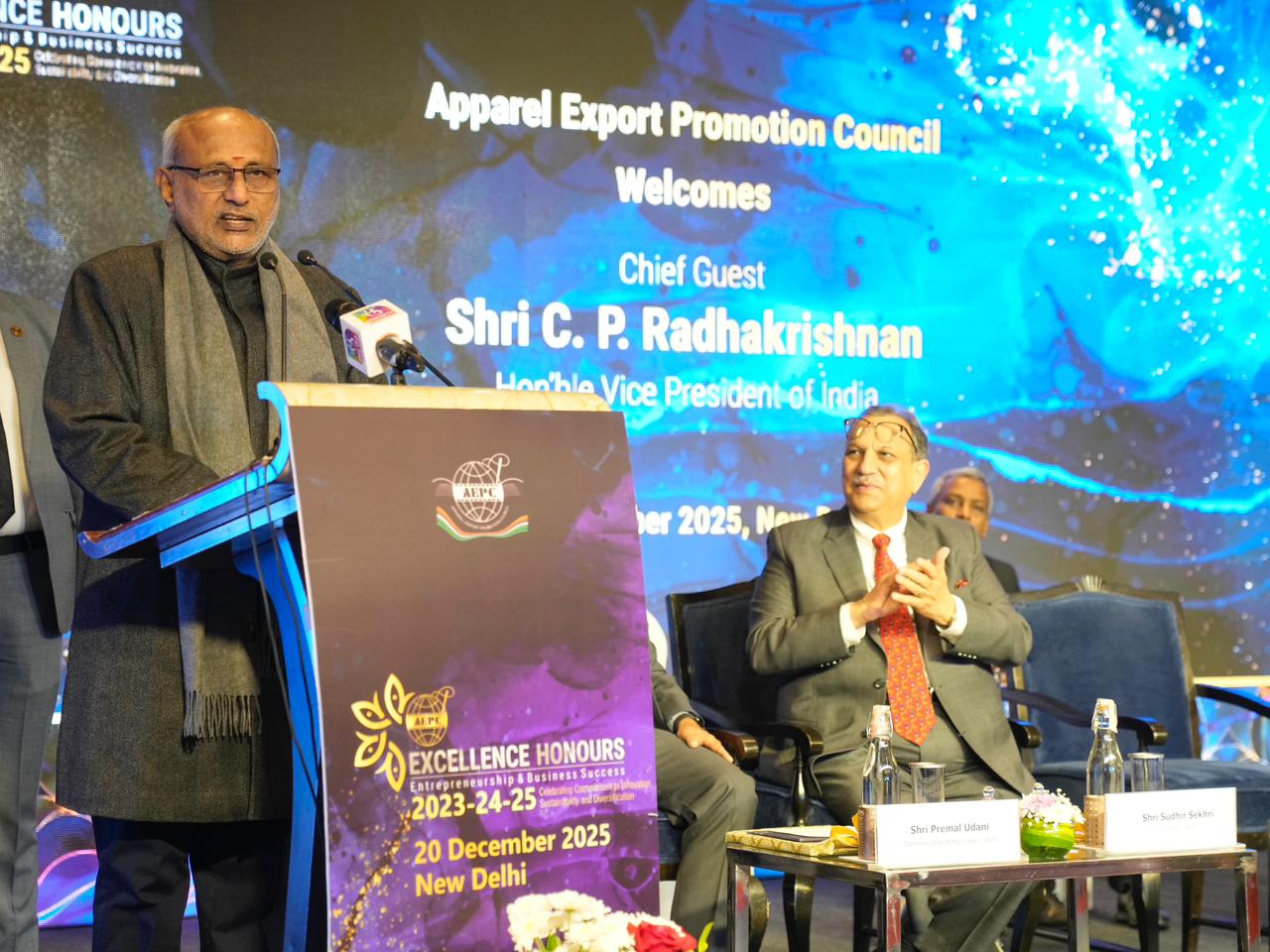
Highlighting the textile sector's role as India's second-largest employer, Vice President C. P. Radhakrishnan called for a strategic push toward Free Trade Agreements (FTAs) and factory modernization to secure India's position as a global fashion powerhouse.
Speaking at the AEPC Excellence Honours held at Hotel ITC Maurya on Saturday, the Vice President presented awards to 27 companies for outstanding export performance. Harish Ahuja of Shahi Exports Private Ltd. was the evening's top honoree, receiving the gold trophy as the Global Export Champion for 2023-24-25.
Resilience amid global headwinds
Despite a volatile global economy, the Apparel Export Promotion Council (AEPC) reported a 10% growth in exports for the 2024–25 period. November 2025 alone saw an 11.3% jump over the previous year, bringing cumulative Ready-Made Garment (RMG) exports for April–November to $10.08 billion.
"Textiles offer a much better return per dollar investment and are critical for economic growth," the Vice President stated. He emphasized that FTAs are essential to provide Indian exporters a "level-playing field" against competitors like Bangladesh.
The road to $40 bn
The Indian government has set an ambitious target of $40 billion in apparel exports by 2030, part of a larger $350 billion textile market goal. Vice President Radhakrishnan credited initiatives like the PM MITRA Parks and the Production Linked Incentive (PLI) Scheme for creating a future-ready ecosystem.
AEPC Chairman Sudhir Sekhri noted that while geopolitical tensions and supply chain disruptions remain challenges, the industry’s shift toward sustainability and ethical sourcing is strengthening "Brand India."
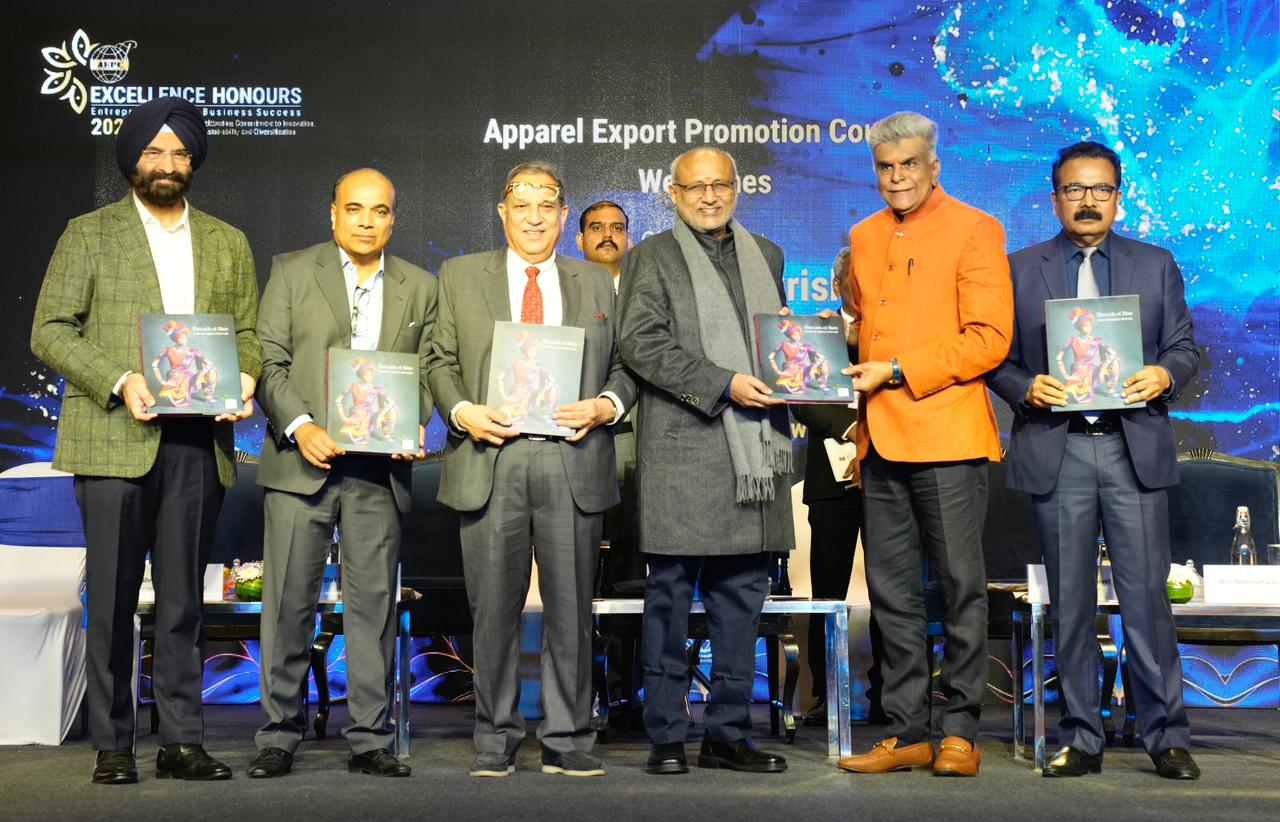
The event also saw the launch of “Threads of Time: Story of India’s Textile,” a coffee table book chronicling the nation’s journey from ancient looms to modern global leadership.
India, Oman target $2billion rise in T&A exports with CEPA
Marking a watershed moment for the nation’s textile and fashion industry, India and Oman have signed the India-Oman Comprehensive Economic Partnership Agreement (CEPA) This landmark deal eliminates the long-standing 5 per cent import duty on Indian textiles, unlocking a strategic gateway to the broader Gulf and African markets. Industry analysts predict this ‘zero-duty’ access will catalyze a $2 billion rise in overall exports over the next three years, with apparel serving as a primary engine of growth.
Duty-free access redefines export competitiveness
Under the new framework, Oman has granted immediate duty-free access to 98.08 per cent of its tariff lines, covering virtually all Indian textile and readymade garment (RMG) exports by value.
This move is strategically timed as Indian exporters face rising protectionism in Western markets. The CEPA makes Indian fashion products instantly more price-competitive against regional rivals, allowing Indian MSMEs and women-led fashion enterprises to capture a larger share of Oman's retail landscape, which is increasingly pivoting toward sustainable and high-end ethnic wear.
Beyond bilateral trade, which has recently exceeded $12 billion, Oman serves as a critical logistical hub for ‘Made in India’ apparel heading to East Africa and Central Asia. The agreement also eases professional mobility, allowing Indian fashion houses to station talent in Oman for up to four years to oversee operations. This ‘co-location’ opportunity enables brands to set up regional distribution centers, reducing lead times for the fast-fashion segment. As India targets $100 billion in textile exports by 2030, the Oman CEPA provides the necessary momentum to diversify beyond traditional Western blocks.
Mexico hikes tariffs on Asian imports by 50%
Mexico is set to fundamentally disrupt global apparel supply chains starting January 1, 2026, with a sweeping new tariff regime. The Mexican Senate recently approved amendments to the Law on General Import and Export Duties, raising tariffs to between 35 per cent and 50 per cent on goods from non-FTA countries, specifically targeting Asian giants like China and India. This move is not just about revenue - estimated at $3.76 billion annually - but is a strategic pivot to shield domestic manufacturers and align with US trade priorities ahead of the 2026 USMCA review.
Erosion of the Asian-Mexican near-shoring model
The new policy strikes at the heart of the ‘trans-Pacific bridge,’ where manufacturers source Indian yarn or Chinese fabric to assemble garments in Mexico for duty-free entry into the US
Under the upcoming rates, yarn duties will climb toward 25 per cent, while finished garments could hit the 50 per cent ceiling. This marks a structural shift that will force a radical localization of the supply chain, notes one regional trade analyst. For Indian exporters, who currently ship roughly $410 million in textiles and clothing to Mexico annually, the increased landed costs may render mass-market categories uncompetitive, leaving only high-end niche products viable.
While the Mexican government frames this as a defense of local jobs, the broader impact serves as a catalyst for regionalized production. Brands are now pressured to source fibers and fabrics from within the North American bloc to maintain USMCA compliance. This ‘protectionist wall’ presents a dual challenge: while it offers Mexican mills a competitive edge against low-cost imports, it simultaneously raises production costs for Mexican garment exporters. As supply chains tighten, the industry must decide between absorbing these costs or embarking on a high-stakes migration toward 100 per cent regional sourcing to preserve their near-shoring advantage.
Mexico serves as a critical manufacturing hub for the North American fashion market, specializing in denim, knitwear, and technical industrial textiles. The sector is a cornerstone of the national economy, primarily serving the United States and Canada through the USMCA framework.
More...
Nike maneuvers through the middle innings’ of a complex corporate comeback
Nike Inc is maneuvering through what Elliott Hill, CEO describes as the ‘middle innings’of a complex corporate comeback. Under the aggressive Win Now strategy, the Beaverton giant has dismantled the centralized, data-heavy structure of the previous era in favor of a decentralized ‘Sport Offense.’
Finalized in early December 2025, this shift eliminated high-level roles like Chief Technology Officer and Chief Commercial Officer to flatten the organization. By elevating geographic GMs to the Senior Leadership Team and appointing Venkatesh Alagirisamy as the new COO, Nike is betting that localized, faster decision-making will reignite the brand's cooling innovation engine.
Wholesale revival amidst digital declines
The most stark data point from Nike’s fiscal Q2 2026 results (ended November 30, 2025) is the dramatic reversal in channel performance. While Nike Direct revenues declined by 8 per cent, dragged down by a 14 per cent crash in digital sales, the company’s pivot back to wholesale partners like Foot Locker and JD Sports delivered a robust 8 per cent growth, reaching $7.5 billion. This rebalancing of the portfolio marks a formal end to the Direct-to-Consumer at all costs’ era. Hill notes, strengthening partner relationships is critical to ensuring product availability where consumers shop, especially as high-street competition from On Running and Hoka intensifies.
Despite achieving a modest 1 per cent revenue growth to $12.4 billion, Nike’s bottom line remains under significant duress. Net income for the quarter fell 32 per cent to $792 million, largely due to a 300-basis-point margin compression triggered by higher North American tariffs and an aggressive $1.3 billion spend on ‘Demand Creation.; To counter these pressures, Nike is rebalancing its product portfolio away from aging ‘lifestyle’ retros like the Air Force 1 and toward performance breakthroughs. The January 2026 launch of the Nike Mind footwear platform and the Structure Plus running shoe are expected to be the first major tests of this renewed athlete-centered focus.
The world's leading designer and distributor of authentic athletic footwear, apparel, and equipment, Nike’s portfolio boasts of brands like Nike, Jordan and Converse.
Golden Goose transitions into a lifestyle brand with launch of Golden Goose Arena
Golden Goose has successfully transitioned from a specialized footwear label into a diversified ‘lifestyle ecosystem.’ This evolution reached a fever pitch this month following the launch of the Golden Goose Arena in Milan’s CityLife district, a first-of-its-kind hub featuring nine padel courts and immersive community wellness facilities. This move reflects a broader strategic pivot by Silvio Campara, CEO to embed the brand into the ‘daily rituals’ of its consumers. By moving into the fitness and social spheres, Golden Goose is insulating itself against the volatility of the global sneaker market, which analysts suggest is reaching a point of ‘distressed saturation.’
DTC supremacy and the surge of ready-to-wear
The financial data for the nine months ending September 30, 2025, underscores the success of this holistic shift. The brand’s revenues rose by 13 per cent to €517.1 million, with the Direct-to-Consumer (DTC) segment now commanding 79 per cent of total net revenues - up from 74 per cent in 2024 - driven by a sophisticated ‘phygital’ retail strategy. While footwear remains the anchor, the brand’s expanded ready-to-wear (RTW) and ‘activewear’ collections are seeing triple-digit growth in key urban markets like Tokyo and Dubai. This product rebalancing allowed the company to maintain a best-in-class 33.6 per cent Adjusted EBITDA margin, even as competitors struggled with rising logistical costs.
Central to the brand’s 2026 outlook is the Haus initiative - a series of global creative incubators. Following the successful Marghera launch, the brand inaugurated Haus Ginza in Tokyo this quarter, serving as a residency for local artists and a hub for the ‘Co-Creation’ model. This experiential retail approach, where artisans customize apparel and accessories in real-time, has resulted in a 45 per cent repeat customer rate. By transforming stores into ‘dream factories’ rather than mere points of sale, Golden Goose is effectively decoupling its valuation from traditional retail metrics and positioning itself as a cultural curator for the ‘Next Gen’ luxury consumer.
Founded in 2000 in Venice by Alessandro Gallo and Francesca Rinaldo, Golden Goose disrupted the luxury market with its ‘perfectly imperfect’ aesthetic. The brand is globally recognized for the Super-Star sneaker, which pioneered the high-end distressed look.
Cotton imports rise threefold to 41.40 lakh bales in 2024-25
As per official data recently tabled in Parliament, India’s cotton imports skyrocketed from 15.20 lakh bales in the 2023–24 season to a staggering 41.40 lakh bales in 2024–25. This nearly three-fold increase serves as a critical ‘safety valve’ for the industry, following a season where domestic production dipped to its lowest levels in nearly two decades due to erratic rainfall across the primary ‘cotton belt’ of Gujarat and Maharashtra. By allowing imports to bridge the demand-supply gap, the government has ensured that the nation’s spinning mills - the backbone of the rural industrial economy - avoid the idle capacity that threatened the sector earlier this year.
Tariff relief and global price convergence
The pivot toward international markets was accelerated by a strategic intervention from the Ministry of Textiles, which extended the 11 per cent import duty exemption on raw cotton until December 31, 2025. This policy shift has successfully narrowed the gap between high domestic rates and softening global benchmarks. International prices for the equivalent S-6 cotton varieties have declined from approximately 79.15 US cents per pound in August to around 73.95 cents this December. Domestically, this has forced a correction, with prices cooling from Rs 57,000 to approximately Rs 52,500 per candy. This price convergence is vital for Indian exporters who are currently battling a punishing 50 per cent tariff wall in the United States; lower raw material costs are now the only viable lever to maintain price competitiveness against rivals like Vietnam and Bangladesh.
Beyond mere volume, the rise in imports - particularly from the United States, Brazil, and Australia- is driven by a demand for ‘contaminant-free’ and Extra Long Staple (ELS) cotton. Indian textile giants are increasingly blending these specialized foreign fibers with domestic crops to meet the stringent strength and uniformity standards required by high-street European retailers. To balance this influx, the Cotton Corporation of India (CCI) has aggressively scaled up its MSP operations, procuring over 31.19 lakh bales worth Rs 13,492 crore as of mid-December to ensure that the surge in foreign fiber does not result in distress sales for Indian farmers.
Global textile industry bets on $21 billion AI shift as Messe Frankfurt launches ‘Texpertise Focus AI’

The global textile and apparel industry is standing at a technological precipice, with the market for Artificial Intelligence (AI) in the sector projected to riseto $21 billion by 2033. This ten-fold increase from 2023 figures marks a decisive pivot from experimental technology to a core operational necessity. In response, the world’s leading organizer of textile trade fairs, Messe Frankfurt has launched a new strategic initiative titled ‘Texpertise Focus AI.’
The initiative to be launched at the Heimtextil fair in Frankfurt in January 2026. It aims to institutionalize AI across the entire textile value chain, signaling a formal industry-wide transition toward data-driven manufacturing and design.
The intelligence core of the global value chain
The initiative reflects a maturing market where AI is no longer a niche digital tool but a fundamental driver of efficiency. Current data indicates, approximately 13.5 per cent of European industrial firms have already integrated AI into their workflows as of 2024.
The transformation is particularly acute in production, where researchers at the German Institute of Textile Technology (ITA) estimate, upto 70 per cent of standardized production tasks could eventually be automated. By placing AI at the center of its international fair calendar, Messe Frankfurt is positioning itself as the primary orientation point for a sector grappling with a deepening skills shortage and the need for higher production resilience.
Designing the future through’Woven Intelligence’
The ‘Texpertise Focus AI’ program aims to spotlight the intersection of high-end design and computational technology. A cornerstone of the January 2026 launch will be the Architonic Live Talk featuring a London-based architectural futurist, Tim Fu.
Under the theme ‘Woven Intelligence: Designing Spaces in the Era of AI,’ the program will explore how generative AI enables meaningful collaboration between physical craft and digital architecture.
This synergy is further explored in Patricia Urquiola’s immersive installation, ‘Among All,’ which uses AI to simulate material properties and accelerate creative workflows, demonstrating that digital tools can enhance rather than replace human intuition.
Driving the ‘twin transformation’ of sustainability
The strategic shift is inextricably linked to the industry’s environmental imperatives- a concept known as the ‘twin transformation’ (the convergence of digitalization and sustainability).
Currently, the global industry produces 116 million tons of fibers annually, yet only 1 per cent of post-consumer waste is recycled. AI is emerging as the key to closing this circularity gap. By leveraging image-recognition systems for waste sorting and AI-based forecasting to prevent overproduction, manufacturers can significantly reduce the resource intensity of their supply chains. These advancements will be a focal point at Texprocess in April 2026, where the emphasis will move to hardware-software integration and life-cycle analytics.
Reshaping the workforce and production ;andscapes
As AI automates routine tasks, the textile workforce is undergoing a structural realignment. The industry is seeing the emergence of new job profiles centered on data analytics and digital process control. This evolution is vital for addressing labor shortages while simultaneously increasing output quality. Messe Frankfurt’s global rollout of this initiative will tailor its content to local market characteristics, ensuring that from fiber production to the point of sale, the ‘responsible use’ of AI becomes the standard.
By 2026, the ‘Texpertise Focus AI’ umbrella will serve as a permanent searchable directory and live demonstration platform, effectively acting as a bridge between current textile traditions and a highly automated, sustainable future.