A Sector at Crossroads: Why India’s textile sector needs more than relief in Budget 2026

As Finance Minister Nirmala Sitharaman prepares to table the Union Budget 2026 on February 1, few sectors are watching the clock as closely as textiles and apparel. Employing more than 45 million people directly and supporting millions more indirectly, the industry stands at a moment of deep uncertainty and latent opportunity. A fragile global recovery, the shock of a steep 50 per cent tariff on Indian exports to the US effective August 2025, and the steady advance of duty-free competitors have exposed structural vulnerabilities that incremental policy tweaks can no longer mask. What the sector is seeking from Budget 2026 is not relief alone, but a fundamental re-weaving of India’s competitiveness in global and domestic markets alike.
A world redrawn by trade and tariffs
The external environment confronting Indian exporters in 2026 resembles a high-stakes chessboard. Since August 27, 2025, shipments to the US, India’s single largest apparel export destination have been hit by a 50 per cent reciprocal tariff. The impact has been immediate and visceral. In Ludhiana’s winterwear units and Tiruppur’s knitwear factories, orders have slowed, buyer negotiations have grown brittle, and margins that were already thin have been pushed to the edge. For many MSMEs, the tariff shock has not merely reduced profitability; it has raised existential questions about survival.
Yet even as one door narrows, another appears to be opening. Negotiations for the India-EU Free Trade Agreement are expected to conclude by January 27, 2026, and for the textile sector, the timing could not be more critical. Mukesh Kansal, Chairman, CTA Apparels, sees it as far more than a tariff adjustment. In his view, duty-free or reduced-duty access to the EU would recalibrate India’s cost structure vis-à-vis countries that currently enjoy preferential access, while also reinforcing India’s credibility as a compliant and responsible sourcing hub. This matters profoundly in a European market increasingly shaped by sustainability mandates, traceability requirements, and ethical sourcing norms. In effect, the FTA offers India a chance to pivot from being merely competitive on price to being indispensable on trust.
Large exporters echo this emphasis on continuity and predictability. Pearl Global Industries, which reported a 12.7 per cent year-on-year revenue growth to Rs 2,541 crore in the first half of FY26 despite global headwinds, illustrates what scale and diversification can still achieve. Group CFO Sanjay Gandhi argues that progress on FTAs with the EU and the UK could act as a powerful catalyst just as global demand begins to normalize. However, he is equally clear that trade agreements alone are insufficient. Without stable policies, efficient logistics, and sustained investment in skilling, India risks squandering the very opportunities that geopolitical realignments are creating.
The domestic force behind the Viksit Bharat vision
While exports dominate headlines, domestic consumption remains the industry’s most reliable anchor. India’s aspiration of becoming a Viksit Bharat rests heavily on sustaining a virtuous consumption cycle, and textiles sit at the heart of that equation. Gautam Singhania, Chairman and Managing Director of Raymond Group, has repeatedly underscored that policies supporting consumer sentiment and disposable incomes can generate a meaningful multiplier effect across retail, manufacturing, and employment.
This dual dependence on domestic demand and export competitiveness is captured in the industry’s medium-term projections.
Table: India’s textile & apparel market projection (FY25-FY30)
|
Segment |
Market size (2024-25) |
Projected size (2029-30) |
Growth drivers |
|
Total Market |
$178 bn |
$350 bn |
Domestic Consumption & MMF |
|
Exports |
$38 bn |
$100 bn |
FTAs (EU, UK) & PLI 2.0 |
|
Employment |
45 mn (firect) |
60 mn+ |
PM MITRA Parks & MSME scaling |
Source: Invest India & CITI, January 2026
The numbers tell a story of ambition tempered by conditions. Doubling the total market to $350 billion within five years assumes not just rising incomes but a decisive shift toward man-made fibres, where India has historically lagged despite global demand skewing strongly in their favor. Similarly, the leap from $38 billion to $100 billion in exports hinges on the successful conclusion and implementation of FTAs, alongside the effectiveness of schemes such as PLI 2.0. Employment growth to over 60 million, meanwhile, rests on whether mega infrastructure initiatives like PM MITRA Parks can genuinely integrate MSMEs into globally competitive value chains rather than remaining islands of large-scale manufacturing.
The industry’s call for stability and modernisation
It is against this backdrop that the Confederation of Indian Textile Industry (CITI) has framed its pre-Budget memorandum. Rather than a laundry list of incentives, CITI’s submission reads as a blueprint for futureproofing a sector that must adapt to volatile commodity cycles, tightening sustainability norms, and shifting trade regimes. Chairman Ashwin Chandran situates textiles as central to the Viksit Bharat goal, arguing that its labour intensity and export potential make it uniquely suited to inclusive growth.
At the core of CITI’s argument lies raw material volatility. Cotton prices, buffeted by global supply shocks and domestic policy distortions, have eroded predictability for spinners and garmenters alike. The proposal to remove the 11 per cent import duty on cotton and to establish a Cotton Price Stabilisation Fund is less about cheap imports than about aligning domestic prices with international realities. Without such alignment India risks undermining its own competitiveness at the very first stage of the value chain.
Sustainability forms the second pillar of the industry’s expectations. As global buyers tighten carbon and compliance benchmarks, especially in Europe, MSMEs face the paradox of needing to invest in green technologies without access to affordable capital. A dedicated Green Technology Scheme, as proposed by CITI, could bridge this gap, enabling smaller units to transition to clean energy and resource-efficient processes without being priced out of global markets.
The third pillar is infrastructure and technology. With the Technology Upgradation Fund Scheme (TUFS) effectively exhausted, the call for a National Textile Fund reflects the industry’s recognition that modernization cannot be episodic. Continuous upgrading of machinery, logistics, and digital capabilities is now a baseline requirement rather than a competitive edge.
Tiruppur, a cluster under pressure, a mirror of the future
Few places illustrate the stakes of Budget 2026 as vividly as Tiruppur. Producing nearly 70 per cent of India’s knitwear exports, the cluster has been described by many exporters as ground zero of the US tariff shock. For MSMEs operating on wafer-thin margins, the sudden loss of price competitiveness has felt like a death knell. Orders have shifted to countries with preferential access, and cash flows have tightened to the point where even compliance investments feel out of reach.
Yet Tiruppur also reflects the sector’s resilience and capacity for reinvention. Entrepreneurs like Tejasvi Madan, Founder direct-to-consumer label Beyond Bound, views the Budget not merely as a relief package but as an inflection point for India’s fast-moving apparel ecosystem. Her call for a uniform GST structure speaks to the daily frictions that startups face, where inverted duty structures distort pricing and working capital. Equally significant is her emphasis on focused incentives for women-led enterprises, aligning India’s policy framework with the ethical and diversity benchmarks increasingly demanded by global buyers.
A budget that decides the industry’s trajectory
As India sets its sights on a $350 billion textile and apparel industry by 2030, the Union Budget 2026 will play a defining role in shaping the path ahead. Decisions on raw material duties, trade support mechanisms, infrastructure funding, and tax rationalization will collectively determine whether India remains trapped in a low-cost manufacturing paradigm or evolves into the world’s preferred hub for high-value, sustainable apparel.
The stakes extend beyond balance sheets and export targets. For millions of workers, clusters, and entrepreneurs, the Budget will signal whether policy is prepared to match rhetoric with structural reform. In that sense, February 1 is not merely a fiscal milestone. It is a moment when India must decide how it intends to weave its textile future into the fabric of a changing global economy.
Lectra partners TextileGenesis to replace paper-based organic cotton records with digital data
The global textile sector is entering a new era of accountability as the ‘green-washing’ era ends and the age of digital verification begins. With the global organic cotton fabric market projected to grow from $454 million in 2025 to $647 million by 2032, the pressure to eliminate fraud is at an all-time high. Leading this charge, Oeko Tex has partnered with TextileGenesis, a Lectra company, to replace vulnerable paper-based records with a secure, digital chain of custody.
Tokenization: The new standard for fiber integrity
Central to this alliance is the implementation of Fibercoin technology. This system assigns a unique digital token to every physical kilogram of certified organic material. As the cotton moves from Indian ginning mills to Bangladeshi garment factories, these tokens mirror the physical flow, preventing the ‘double-counting’ often found in manual systems. Amit Gautam, CEO, TextileGenesis, notes, this digital twin approach effectively ‘eliminates the reliance on PDF transaction certificates,’ which have historically been susceptible to manipulation.
Regulatory compliance and market valuation
This digitization is a strategic response to the EU’s Green Claims Directive and Digital Product Passport (DPP) requirements coming into effect throughout 2026. For manufacturers, the stakes are high: the organic textile industry is forecast to reach a staggering $305.73 billion by 2035, growing at an 18 per cent CAGR. By integrating Oeko-Tex’s rigorous GMO testing with real-time digital tracking, brands can now substantiate sustainability claims with auditable data, securing their position in a high-premium, eco-conscious market.
Oeko Tex is a premier international association of 17 independent research and testing institutes. Specializing in chemical safety and ecological textile certifications, the organization issued over 57,000 certificates in the last fiscal year. Its growth strategy focuses on digitizing the Oeko Tex Organic Cotton standard to meet 2026 Global Transparency Mandates.
Policy volatility threatens Bangladesh’s RMG competitiveness amidst yarn import dispute
A recent recommendation by the Ministry of Commerce to withdraw bonded warehouse facilities for 10–30 count cotton yarn has triggered significant instability across Bangladesh’s textile and apparel sectors. This move, which effectively imposes an estimated 40 per cent cumulative duty on imports, has been met with sharp resistance from the Bangladesh Garment Manufacturers and Exporters Association (BGMEA) and the BKMEA. Industry leaders describe the policy as a ‘unilateral decision’ that prioritizes upstream spinning mill interests over the downstream garment sector, which accounts for over 80 per cent of national export earnings. The dispute comes as apparel exports already contracted by 2.63 per cent during the July–December 2025 period, with a staggering 14.23 per cent plunge recorded in December alone.
Operational disruption and cost escalation
The fiscal impact of this policy shift is substantial. Currently, Bangladeshi spinning mills sell 30-card yarn at approximately $3.00 per kg, while Indian manufacturers supply equivalent quality for $2.60 - a 40-cent differential that exporters claim is critical for global price parity. The withdrawal of bonded facilities at this juncture could be a death warrant for the knitwear sector, states Mohammad Hatem, President, BKMEA. Conversely, the Bangladesh Textile Mills Association (BTMA) has threatened an indefinite shutdown of all textile mills starting February 1, 2026, if the protections are not enforced, citing unsold inventory worth Tk 120 billion and the ‘dumping’ of cheap foreign yarn.
Strategic risks and market outlook
Beyond immediate production costs, economists at the CPD warn of broader geopolitical repercussions. Restrictions on land-port imports from India have already contributed to a 6.5 per cent decline in Bangladesh’s regional exports. As Vietnam secures zero-duty access to key markets via new Free Trade Agreements, the additional 33 per cent to 40 per cent tax burden on raw materials could drive international buyers toward more stable competitors. The government now faces the challenge of balancing long-term industrial security for domestic spinners with the immediate survival of the nation’s premier export engine.
The RMG sector is Bangladesh’s economic backbone, employing 4 million workers and targeting $44.49 billion in exports for FY26. While domestic spinning meets 90 per cent of knitwear yarn demand, the industry relies on imports for high-count woven fabrics. Current growth is challenged by 14 per cent export dips and rising energy costs, necessitating a shift toward high-value technical textiles.
Centric Brands teams up with Palm Tree Crew to transform into a comprehensive global apparel powerhouse
New York-based Centric Brands LLC has entered a JV with the lifestyle collective founded by DJ Kygo and Myles Shear, Palm Tree Crew to transform the brand into a comprehensive global apparel and accessories powerhouse. The move leverages Centric’s $3 billion operational platform to scale Palm Tree Crew’s cultural influence across diverse consumer categories.
Scaling experience-led apparel through operational excellence
As the global fashion industry faces a projected low single-digit growth period in 2026, market leaders are shifting focus toward ‘experience-driven’ sectors that command higher consumer loyalty. This venture focuses on high-margin Men’s and Women’s apparel, utilizing Centric’s sophisticated design and sourcing infrastructure. By integrating Palm Tree Crew’s ‘tropical luxury’ aesthetic with Centric’s distribution network - which spans major department stores and digital platforms - the partnership seeks to capture the rising demand for lifestyle-centric self-expression.
Strategic portfolio diversification amidst economic volatility
The collaboration follows Centric’s recent aggressive expansion, including the acquisition of Fownes Brothers and the Vingino Group to expand its international kids and accessories divisions. Culturally relevant brands are central to our growth strategy, states Jason Rabin, CEO, Centric Brands. While macroeconomic headwinds and shifting tariffs challenge undifferentiated retailers, Centric is mitigating risk by investing in brands with built-in communities. Palm Tree Crew’s existing ecosystem of festivals and hospitality provides a unique, low-cost marketing funnel, positioning the new apparel lines for sustained, profitable global growth.
Centric Brands is a leading lifestyle collective managing a portfolio of over 100 iconic licenses, including Calvin Klein and Tommy Hilfiger. With an estimated annual revenue exceeding $3.1 billion, the company is currently expanding its physical and digital footprint globally, targeting high-growth lifestyle and ‘experience-first’ apparel categories through 2028.
NIFT launches VisionNxt to reduce dependence on western trend agencies
As the National Institute of Fashion Technology (NIFT) celebrates its 40th anniversary this week in Mumbai, the institution is shifting its focus from traditional design education to high-tech industrial stewardship. With India’s domestic apparel market projected to reach $350 billion by 2030, the NIFT International Conference 2026 serves as a strategic launchpad for VisionNxt, the nation’s first AI-enabled fashion forecasting lab. This indigenous tool aims to reduce the industry's $50 million annual dependency on western trend agencies by providing geo-specific data tailored to Indian demographics.
Artificial Intelligence meets indigenous craft
The conference highlights a critical commercial transition: the integration of Emotional Intelligence (EI) and Big Data into the textile value chain. VisionNxt utilizes a proprietary taxonomy of over 100 Indian and Western product categories to predict consumption patterns with 86 per cent accuracy. By digitizing the ‘Indian look,’ NIFT is enabling manufacturers to optimize production cycles and reduce inventory waste - a move essential for the 10.5 per cent revenue growth expected in the apparel sector this fiscal year.
Strategic policy and global export integration
Union Minister of Textiles, Giriraj Singh, emphasizes, the 2026 roadmap prioritizes ‘Vikas aur Virasat’ (Development and Heritage). This involves leveraging NIFT’s 41,000-strong alumni network to scale technical textiles, a segment forecast to hit $45 billion by late 2026. Through collaborations with the British Council and University of the Arts London, NIFT is positioning Indian handlooms within a ‘zero-waste’ circular economy, ensuring that the country’s 11 per cent CAGR in textile exports remains sustainable amidst tightening global environmental regulations.
NIFT is India’s premier statutory body for fashion education, operating 20 campuses with 15,000 students. It provides professional leadership to the textile and apparel sectors through research-led initiatives like VisionNxt. Under the Ministry of Textiles, NIFT aims to drive India toward a $100 billion export target by 2030 through digital innovation and craft-cluster development.
Guess announces strategic reset for Spring/Summer 2026 season
In a definitive move to recapture market share and navigate a volatile retail landscape, Guess, Inc has announced a strategic ‘reset’for its Spring/Summer 2026 season. Central to this transformation is the appointment of global entrepreneur Chiara Ferragni as the new face of the brand - marking her return to Guess after 13 years. This high-profile partnership coincides with a pivotal corporate restructuring, as the company enters the final phase of a $1.4 billion take-private transaction led by the Marciano family and Authentic Brands Group, expected to conclude in early 2026.
Synergizing heritage with digital-first influence
As traditional luxury brands face a projected low single-digit growth period, Guess, Inc is leveraging Ferragni’s 28 million followers to bridge its 1980s heritage with modern social media language. The campaign focuses heavily on ‘phygital’ engagement, highlighting the Camden Bag as the season’s ‘IT’ accessory. Data suggests, 38 per cent of Gen Z luxury discovery now occurs via TikTok and Instagram, a segment Guess aims to secure through this partnership following a challenging 2025 where Asian revenues dipped by 20 per cent.
Global rationalization and the Rag & Bone integration
Beyond the glamor of the Ferragni campaign, Guess, Inc is executing a rigorous store rationalization plan, closing underperforming US locations to shift investment toward high-growth markets in Europe and the Middle East. The 2026 strategy also focuses on scaling Rag & Bone, acquired in 2024, to diversify the portfolio into the ‘quiet luxury’ space. By consolidating infrastructure and leveraging its new joint venture with Chalhoub Group, Guess, Inc anticipates unlocking approximately $30 million in operating profit for the 2027 fiscal year.
Guess, Inc. is a lifestyle powerhouse directly operating 1,058 stores across roughly 100 countries. Specializing in denim, handbags, and contemporary apparel, the company is currently transitioning into a private entity to enhance agility. With annual revenues near $3 billion, its 2026 growth plan prioritizes premium brand acquisitions and digital-first marketing to recapture global momentum.
Sri Lanka apparel exports leverage social sustainability to secure global market share
Sri Lanka’s apparel industry is formalizing a strategic transition from price-based competition to ethical value-added manufacturing to navigate intensifying global regulations. At a high-level industry forum in Colombo on January 13, 2026, sector leaders emphasized, social sustainability has evolved into a ‘competitive moat’ for maintaining access to high-value markets. This shift comes as the industry reports a 5.42 per cent Y-o-Y increase in cumulative apparel exports for the first eleven months of 2025, reaching US$ 4.57 billion. Growth was particularly robust in the European Union (excluding the UK), which surged by 13.07 per cent as buyers increasingly prioritize certified transparent supply chains.
Regulatory compliance as a commercial advantage
The industry’s early adoption of independent certifications like Worldwide Responsible Accredited Production (WRAP) is now paying dividends as the EU’s Corporate Sustainability Due Diligence Directive (CS3D) moves towards national implementation by July 2026. Avedis Seferian, CEO, WRAP, confirmed, Sri Lanka’s established ‘Garments without Guilt’ framework provides a template for the mandatory human rights and environmental transparency now required by Western regulators. By integrating real-time social audit data into digital traceability platforms, Sri Lanka’s exporters are mitigating the ‘audit fatigue’ common in regional competitors while fulfilling the rigorous traceability mandates of global brands.
Market diversification and strategic trade gains
Beyond sustainability, the sector is capitalizing on significant trade liberalizations. Effective January 1, 2026, the UK’s Developing Countries Trading Scheme (DCTS) has removed earlier ‘double transformation’ rules, allowing Sri Lankan manufacturers to source inputs globally while retaining duty-free access to the British market. This newfound flexibility, combined with a 2.4 per cent growth in US-bound shipments despite tighter margins, supports the Joint Apparel Association Forum’s (JAAF) long-term target of achieving US$8 billion in annual apparel exports by 2030. Industry experts suggest, integration of ESG data into commercial decision-making is no longer a cost center but the primary currency of trust in global trade.
The Joint Apparel Association Forum (JAAF) represents Sri Lanka's largest export earner, contributing nearly 40 per cent of national merchandise export earnings. Focused on the ‘40 by 30’ strategy, the sector targets US$ 8 billion in apparel revenue by 2030 through specialized niches in intimate wear and high-performance sportswear.
Bartolomeo Rongone to end tenure as CEO, Bottega Veneta in March 2026
Kering has confirmed, Bartolomeo Rongone, Chief Executive Officer, Bottega Veneta, will conclude his tenure on March 31, 2026. This move follows a six-year period defined by the successful elevation of the ‘quiet luxury’ aesthetic and the commercial scaling of the house’s signature Intrecciato craftsmanship. Under Rongone’s leadership, the brand became a critical defensive pillar for the Group, achieving revenues of approximately €1.7 billion in 2024- a year when Kering's consolidated revenue contracted by 12 per cent. The transition marks a pivotal moment for the conglomerate as it seeks to maintain the momentum of its highest-performing houses while managing broader portfolio volatility.
New governance under Luca de Meo
The executive departure is the first major leadership adjustment under Luca de Meo, who assumed the role of Group CEO in September 2025 as part of a significant governance restructuring. De Meo, a turnaround specialist from the automotive industry, is currently overseeing a ‘phase of stabilization’ intended to reverse declines at flagship brands like Gucci. Leo Rongone has been instrumental in sharpening the brand’s desirability, states de Meo. The upcoming appointment of a successor will be a strategic signal to the retail market, as Kering prioritizes operational efficiency and brand exclusivity to combat a projected 2–5 per cent decline in global personal luxury goods sales for the 2025–2026 cycle.
Focus on craft and distribution integrity
Analysts view this change as an opportunity to further integrate Bottega Veneta into Kering’s updated industrial architecture, which emphasizes direct retail control and sustainable manufacturing. While other houses within the portfolio have faced creative transitions, Bottega Veneta remains anchored by Creative Director Louise Trotter, whose 2025 debut resonated strongly in the North American and Asia-Pacific regions. The primary challenge for the incoming CEO will be navigating an increasingly polarized consumer landscape where high-specification leather goods must justify premium price points through heritage and ‘lifetime care’ service models.
Kering is a Paris-based global luxury powerhouse managing iconic houses including Gucci, Saint Laurent, and Balenciaga. Specializing in leather goods, apparel, and high jewelry, the Group employs 47,000 people and generated €17.2 billion in 2024. Founded as PPR in 1963, Kering now prioritizes organic growth and sustainable retail excellence across key European and Asian markets.
Francesca’s Boutique commences immediate liquidation of 450 stores
Houston-based specialty retailer, Francesca’s Boutique has commenced an immediate liquidation of its 450-store portfolio following an acute liquidity crisis. While the company has historically utilized Chapter 11 to restructure - most notably in 2020 - this latest collapse appears terminal.
Reports from industry insiders and Women’s Wear Daily indicate, the closure was precipitated by an estimated $250 million in unpaid vendor invoices. This breakdown in supply chain trust led to an abrupt holiday-weekend decision to shutter all boutiques, with employees and merchants receiving minimal prior notification. The retailer’s current ‘warehouse sale’ features clearance pricing as low as $5 to $15, signaling an aggressive push to convert remaining inventory into cash to satisfy secured creditors.
The failure of the mall-dependent boutique strategy
The demise of Francesca’s underscores the mounting structural pressures on mall-based specialty retail in the 2026 fiscal cycle. Despite an $18 million acquisition by TerraMar Capital and Tiger Capital in 2021, the brand struggled to decouple its revenue model from traditional indoor shopping centers, which saw a 1.1 per cent Y-o-Y decline in foot traffic during 2025. Furthermore, the rise of aggressive cross-border e-commerce competitors has eroded the ‘treasure hunt’ value proposition that once defined the brand. Analysts suggest, Francesca's inability to scale its digital ecosystem while managing rising operational overhead - including utility and labor costs - created an unsustainable debt-to-income ratio that precluded further private equity intervention.
Founded in 1999, Francesca’s Boutiques operated as a women’s apparel and accessories boutique across 45 US states. The brand specialized in high-turnover, ‘free-spirited’ fashion for Gen Z and Millennial consumers. Following a 2020 bankruptcy, the firm attempted a turnaround focused on curated lifestyle products, but persistent supply chain debts and shifting consumer habits led to its 2026 total liquidation.
Francesca’s Boutique commences immediate liquidation of 450 stores
Houston-based specialty retailer, Francesca’s Boutique has commenced an immediate liquidation of its 450-store portfolio following an acute liquidity crisis. While the company has historically utilized Chapter 11 to restructure - most notably in 2020 - this latest collapse appears terminal.
Reports from industry insiders and Women’s Wear Daily indicate, the closure was precipitated by an estimated $250 million in unpaid vendor invoices. This breakdown in supply chain trust led to an abrupt holiday-weekend decision to shutter all boutiques, with employees and merchants receiving minimal prior notification. The retailer’s current ‘warehouse sale’ features clearance pricing as low as $5 to $15, signaling an aggressive push to convert remaining inventory into cash to satisfy secured creditors.
The failure of the mall-dependent boutique strategy
The demise of Francesca’s underscores the mounting structural pressures on mall-based specialty retail in the 2026 fiscal cycle. Despite an $18 million acquisition by TerraMar Capital and Tiger Capital in 2021, the brand struggled to decouple its revenue model from traditional indoor shopping centers, which saw a 1.1 per cent Y-o-Y decline in foot traffic during 2025. Furthermore, the rise of aggressive cross-border e-commerce competitors has eroded the ‘treasure hunt’ value proposition that once defined the brand. Analysts suggest, Francesca's inability to scale its digital ecosystem while managing rising operational overhead - including utility and labor costs - created an unsustainable debt-to-income ratio that precluded further private equity intervention.
Founded in 1999, Francesca’s Boutiques operated as a women’s apparel and accessories boutique across 45 US states. The brand specialized in high-turnover, ‘free-spirited’ fashion for Gen Z and Millennial consumers. Following a 2020 bankruptcy, the firm attempted a turnaround focused on curated lifestyle products, but persistent supply chain debts and shifting consumer habits led to its 2026 total liquidation.
More...
European fashion industry braces for operational disruptions as Trump announces 10% tariffs on eight nations
The European fashion and luxury industry is bracing for a severe operational disruption following US President Donald Trump’s announcement of a 10 per cent tariff on eight European nations, effective February 1, 2026. Linked to a geopolitical demand for the purchase of Greenland, the levies are scheduled to escalate to 25 per cent by June, potentially upending a multi-billion dollar apparel trade. Industry body Euratex reports, the US remains the primary non-European destination for textile and clothing exports, valued at approximately €6.5 billion annually. The prospect of these ‘Greenland tariffs’ has triggered emergency summits in Brussels, with leaders weighing a €93 billion retaliatory ‘bazooka’ package targeting U.S. liquid gas and machinery.
Supply chain paralysis and pricing volatility
Operating on long-term seasonal forecasting, European ateliers currently face a climate of ‘operational paralysis.’ For high-end houses in Italy and France - where fashion contributes 5.1 per cent and 3.1 per cent to national GDP respectively - the tariffs represent an immediate threat to margins. Analysts suggest, luxury conglomerates like LVMH and Kering may be forced to pass these costs to US consumers, where prices for iconic items like the Chanel 2.55 flap bag have already doubled since 2017. Current trade data reveals, while European apparel exports to the US rose by 7 per cent in late 2025 due to front-loading, a sharp correction is anticipated as shipping lead times make it impossible to avoid the February 1 deadline.
Strategic move towards market diversification
In response to the escalating trade war, European manufacturers are accelerating a strategic shift toward Asian and domestic markets. Retail square footage for luxury brands in the US had increased by 65 per cent in early 2025, but that investment is now being re-evaluated in favor of ‘proximity sourcing’ and nearshoring. While the US Supreme Court is expected to rule on the legality of these emergency tariffs by June 2026, the current uncertainty is driving firms to diversify. As one executive noted, the industry is essentially ‘holding fire’ until conditions stabilize, risking years of brand-building in its second-largest global market.
The EU textile and clothing industry comprises 160,000 companies, predominantly SMEs, employing 1.5 million workers. It generates an annual turnover of €180 billion, with the U.S. serving as its most critical individual export market. Recent strategy shifts focus on high-value ‘Smart Textiles’ and digital traceability to maintain global competitiveness.
Egypt plans integrated manufacturing complex in New October City
The Egyptian textile sector is undergoing a profound structural evolution, exemplified by the recent $350 million agreement to establish an integrated manufacturing complex in New October City. This partnership between Elsewedy Industrial Development and the Hong Kong-based Crystal International Group leverages Egypt’s private free zone system to enhance the nation’s competitive standing in the global apparel value chain. By consolidating spinning, weaving, and dyeing operations within an 800,000-sq-m facility, the project aims to mitigate supply chain fragmentations that have historically hindered local value addition.
Export momentum and market diversification
This investment arrives as Egypt’s apparel exports demonstrate significant resilience, surpassing the $3.1 billion mark in late 2025 - a 22 per cent Y-o-Y increase. Industrial analysts project, the textile manufacturing market will reach approximately $26.02 billion by 2026-end. The New October City complex is positioned to capitalize on this trajectory, particularly as European and North American retailers increasingly prioritize ‘nearshoring’ to reduce lead times. Currently, Egyptian shipments reach European ports in approximately 10-12 days, a significant logistical advantage over the 30-day cycles typical of South Asian competitors.
Sustainability and high-tech integration challenges
Despite the optimistic growth, the sector faces a rigorous transition toward the 2026 EU Digital Product Passport requirements and the Carbon Border Adjustment Mechanism (CBAM). The new industrial hub is designed to integrate advanced water-recycling and energy-efficient systems to satisfy these stringent environmental mandates. Crystal International Group’s commitment to achieving Net Zero by 2050 aligns with Egypt's broader industrial strategy to replace aging state-owned infrastructure with automated, low-emission technologies. This shift is critical as rising industrial energy tariffs, which reached nearly $0.14 per kWh in 2025, place a premium on operational efficiency and waste reduction.
A global leader in apparel manufacturing, Crystal International operates a multi-country network supplying major retail brands. The group specializes in denim, knits, and sportswear, with a primary focus on sustainable production. Leveraging its 2026 expansion into Egypt, the company seeks to double its regional capacity, targeting $12 billion in sector-wide exports by 2031.
India-Oman CEPA operationalization to eliminate import duty on Indian T&A products
The operationalization of the India-Oman Comprehensive Economic Partnership Agreement (CEPA), scheduled in Q1, FY26, is set to eliminate the prevailing 5 per cent import duty on Indian textile and apparel products. This fiscal adjustment provides immediate price competitiveness for Indian exporters, who currently hold the position of the second-largest supplier to Oman, trailing only China. Industry data indicates that India’s textile exports to the Sultanate reached approximately $132 million in 2024. With zero-duty access now covering 98.08 per cent of tariff lines, the Ministry of Commerce anticipates a significant uptick in the shipment of high-demand categories, including home textiles, synthetic yarns, and ready-made garments.
Leveraging Oman as a regional distribution hub
Beyond direct bilateral trade, the agreement facilitates a broader commercial objective: utilizing Oman’s strategic logistics infrastructure to access the wider Gulf Cooperation Council (GCC) and African markets. By capitalizing on the Port of Duqm and integrated free zones, Indian manufacturers can establish re-export centers to mitigate regional supply chain disruptions. The CEPA is not merely about tariff reduction; it is a structural mechanism to integrate Indian apparel clusters into global value chains, notes an official from the Confederation of Indian Textile Industry (CITI). This strategic alignment is essential as India pursues a sector-specific export target of $100 billion by 2030, necessitating a transition from traditional Western markets toward emerging hubs in West Asia.
Addressing competitive hurdles and quality benchmarks
While the CEPA provides a preferential framework, Indian exporters face rigorous competition from low-cost Asian manufacturers and a growing demand for sustainable, high-specification technical textiles within Oman’s expanding hospitality and healthcare sectors. To maximize the agreement’s utility, Indian firms must align production with Oman’s strict regulatory standards and rising consumer preference for eco-friendly materials. Industry analysts suggest, successful execution will depend on capital investments in local Omani distribution networks, ensuring that the initial tariff advantages translate into sustained long-term market share.
India’s textile industry is a cornerstone of the national economy, contributing significantly to industrial output and employment. Traditionally focused on cotton and artisanal products, the sector is now diversifying into technical textiles and man-made fibers. Current growth strategies emphasize high-value apparel and sustainable manufacturing to meet evolving global trade standards.
From Fibre to Power: China’s total takeover of Bangladesh’s textile inputs reshapes India’s future

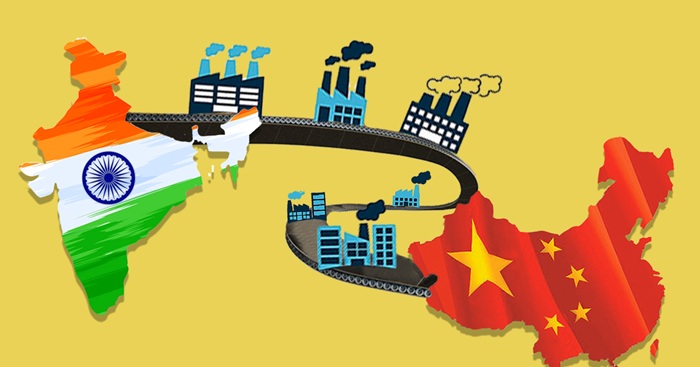
The restructuring of the Bangladesh textile sector, long one of the world’s most influential garment manufacturing ecosystems has moved far beyond a traditional rivalry between suppliers. What is unfolding instead is a deep and deliberate remapping of Bangladesh’s upstream fibre and fabric sourcing model, and the epicentre of that realignment is China. India, which for decades maintained a commanding presence in yarn supplies, is confronting a challenge that attacks its competitive foundation. In the space of just one year, China has transitioned from being the dominant supplier of synthetics and woven fabrics to becoming Bangladesh’s near-exclusive pipeline for cotton yarn as well. The relationship between the two countries has shifted so dramatically that India’s long-standing edge in yarn now appears newly vulnerable.
China’s embedding in Bangladesh’s textile core
A granular look at Bangladesh Trade and Tariff Commission (BTTC) data reveals the extent of China’s entrenchment. Today, over 80 per cent of Bangladesh’s textile and apparel supply chain is powered directly by Chinese raw materials, technology, or intermediate goods. Nowhere is this dominance more pronounced than in the woven and MMF-driven fabric segment the lifeblood of Bangladesh’s global RMG exports.
By 2024, China had already seized nearly four-fifths of Bangladesh’s total fabric imports, accounting for an extraordinary 78 per cent of inflows. This position was not merely a reflection of low pricing; it represented China’s structural superiority in scale, product diversity, high-performance MMF innovation, and its ability to offer specialty fabrics at speeds unmatched by any other country. For a manufacturing hub like Bangladesh, which relies almost entirely on imports for MMF yarns, technical fabrics, and performance synthetics, China has become more than a supplier it has evolved into a supply-chain enabler.
This near-monopoly reflects the culmination of China’s long-term strategy to dominate higher-value textile inputs. Bangladesh’s woven sector, which underpins the bulk of its over $47 billion RMG exports, is now fundamentally dependent on Chinese upstream capabilities. What was once a multipolar supply structure is turning into a Beijing-centred fibre-to-fabric fortress.
The unravelling of India's yarn dominance
For years, India held the commanding position in Bangladesh’s cotton yarn imports, supplying more than half of its requirements. This leadership rested on reliable quality, shorter transit time, cross-border transport efficiencies, and well-established relationships between Indian spinners and Bangladeshi knitwear units. In 2024, India accounted for 53.66 per cent of Bangladesh’s total yarn imports, giving it a substantial competitive foothold even as China’s fabric dominance grew.
But early 2025 altered the equation almost overnight. A series of trade and political tensions between India and Bangladesh, culminating in border closures and restrictions on land-port yarn shipments, created a vacuum that China filled with clinical speed. By January-February 2025, China had supplanted India outright, capturing 95.61 per cent of Bangladesh’s total yarn imports, while India’s share fell to negligible levels. This was not a marginal transition but a wholesale inversion of the previous year's landscape.
capability to scale up supply rapidly.
Table: India and China’s share in Bangladesh market
|
Segment |
Supplier |
Share in 2024 |
Share in Jan-Feb 2025 |
|
Fabric Imports |
China |
78.46% |
92.26% |
|
India |
8.47% |
Negligible |
|
|
Yarn Imports |
India |
53.66% |
Negligible |
|
China |
37.52% |
95.61% |
Source: Fibre2Fashion's TexPro, BTTC Data (Aggregated and projected figures)
The shift was equally dramatic in the fabric category. China’s already large 78.46 per cent market share in 2024 surged to an overwhelming 92.26 per cent in the early months of 2025. India, which previously held 8.47 per cent in fabrics, ceded virtually the entire space.
The table translates to a stark picture: China did not merely gain share; it assumed full control of both yarn and fabric supply chains simultaneously, across categories where India once held structural advantages.
In fabrics, China expanded from an already dominant 78 per cent in 2024 to over 92 per cent in the first two months of 2025, leaving India’s earlier 8 per cent footprint all but erased. In yarn, the segment traditionally led by India China’s rise from 37.5 per cent in 2024 to nearly 96 per cent in early 2025 reflects a takeover so complete that it redefines competitive baselines. India’s fall from 54 per cent to negligible in the same period underscores how geopolitical disruptions can swiftly cascade into supply-chain reconfigurations.
For India, the lesson is clear: market share built on cost parity and geographic convenience can collapse when policy friction intersects with an aggressive competitor’s willingness to scale up at speed.
Inside the industry shockwave
The ripple effects of Bangladesh's sourcing shift are being acutely felt by Indian textile majors, and Arvind Ltd provides a revealing lens into this disruption. As one of India’s largest integrated textile conglomerates spanning cotton yarn, denim, woven fabrics, and a growing MMF portfolio, Arvind has long benefited from Bangladesh’s proximity and its enormous appetite for Indian cotton yarn.
Arvind’s historical strength lay in premium cotton yarns and high-quality woven fabrics, backed by decades of brand equity and a reputation strengthened through its leadership in denim. Bangladesh, with its huge knitwear export engine, has been central to Arvind’s export volumes.
But the new sourcing realities present a structural challenge. The loss of yarn volumes to China threatens the company’s pricing power and utilization rates both crucial in a global market where spinning margins are already under pressure. Even though Arvind is actively investing in MMF and technical textiles, and shifting its portfolio toward higher-value segments, the immediate impact of losing a major export destination cannot be ignored.
Experts note that the Indian model built on cotton cost competitiveness no longer aligns with global textile evolution. China’s advantage now lies in integrated fibre-to-fabric ecosystems, where synthetics, functional materials, and technical textiles drive the premium end of global apparel. Arvind and its peers must therefore compete not on price alone but through product complexity, innovation, and value-added blends—categories in which China has raced ahead.
India’s counteroffensive
The near-total loss of yarn share has served as an inflection point for India’s textile strategy. Recognizing the depth of the challenge, the government is building a multi-phase roadmap aimed at restoring competitiveness and expanding India’s T&A exports from roughly $40 billion to $100 billion by 2030.
Much of this plan revolves around structural cost correction. Raw material prices, taxation layers, transportation inefficiencies, and power costs are under scrutiny as India works to level the playing field with both China and Bangladesh. Parallelly, India is fast-tracking FTAs with the EU and UK markets where Bangladesh currently enjoys duty-free access due to its LDC status, a benefit that will diminish as Bangladesh graduates in the coming years.
The cornerstone of India’s long-term strategy, however, is the shift toward MMF and technical textiles. Under the PLI scheme, India aims to build domestic capacity in these future-forward categories, reducing reliance on cotton-centric production and enabling the industry to join the global transition toward performance synthetics, recycled fibres, and engineered textile solutions.
This shift is essential not only for competitiveness but also for rebalancing India’s export portfolio. A diversified fibre mix will insulate the sector from cotton price volatility and ensure it competes in the same product spaces where China has achieved dominance.
A new vulnerability for Bangladesh
While China’s rapid expansion into Bangladesh’s textile inputs gives it unparalleled leverage, it also exposes Bangladesh to long-term risk. A supply chain over-concentrated in one country is inherently fragile. Any disruption, from geopolitical tension to freight escalation or environmental regulation could destabilize Bangladesh’s production pipeline.
For India, the moment calls for a decisive realignment. Rebuilding trust with Bangladesh, removing non-tariff obstacles, restoring multi-modal connectivity, and accelerating MMF investments are no longer optional. They are critical steps if India is to reclaim lost ground and transition from a cotton-dominated supplier to a future-ready textile power. Bangladesh’s shift has delivered a clear message to India: the global textile hierarchy is being reshaped not by costs alone but by speed, fibre innovation, and integrated ecosystems. China understood this early. India must now catch up fast.