SOURCING: Changing dimensions with newer risks and opportunities
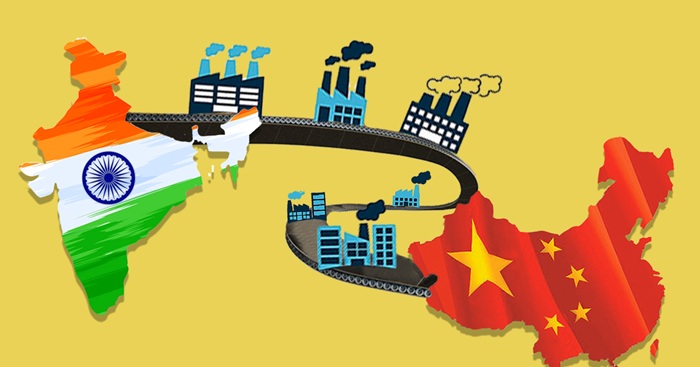
TRENDSPOTTING 2016: "While China continues to dominate the global market as the sourcing hub, a few international treaties and initiatives like TPP, AGOA, EU -Vietnam FTA etc, is expected to change the global sourcing landscape and new power centres are bound to emerge. Industry forecast suggests the market growth rate of developed countries will slowdown and big emerging economies like China, India will be the key driver of growth."
Trade treaties change the game
While China continues to dominate the global market as the sourcing hub, a few international treaties and initiatives like TPP, AGOA, EU -Vietnam FTA etc, is expected to change the global sourcing landscape and new power centres are bound to emerge. Industry forecast suggests the market growth rate of developed countries will slowdown and big emerging economies like China, India will be the key driver of growth. Even though dramatic sourcing shifts are unlikely in near future and China is likely to dominate, optimism hinges on potential opportunities from various international trade deals in the long term. “Although apparel imports from China into the US have remained largely flat, we are seeing a slow but steady shift away from China as businesses look to position their supply chains to take advantage of the forthcoming trade deals. Many vendors are looking at Vietnam due to the potential benefits from TPP (the Trans-Pacific Partnership),” explains Colin Browne, VP and MD of Asia Product Supply at VF Corp.
Explaining the long term impact of AGOA , Browne he says, “From a geographical perspective, sub-Saharan Africa is finally becoming a reality, especially now that AGOA has been extended. We are seeing an increased number of vendors visiting the continent and a number of deals being done. It will be a long time before it rivals the Asian supply base, but the size and availability of resource will allow it to become a dominant player over the next 25 years. As brands venture into such new markets, doing so with known and trusted factories or partners will make the journey less arduous and reduce risk to both parties. These deep, symbiotic relationships will be key to long-term success.” His opinion is reiterated as KL Lee, vice chairman of Esquel Group as he points out that after TPP conclusion in October, there are even more questions as to whether China will lose its leadership position in textiles and apparel. For those who continue with the old ways of manufacturing and not transforming, there is no choice but to move operations to the so-called ‘low-labour-cost’ countries. Esquel is pursuing a different approach: with innovation and using technology in the form of automation and process improvements, they will increase productivity and therefore reduce unit labour cost while improving quality consistency. So while Esquel’s workforce will earn more by sharing the company’s economic success, the company can remain competitive. Of course, Esquel is not only in China as it has facilities in Vietnam and Malaysia that stand to benefit from TPP.
Also as developed countries such as US, EU and Japan are focusing solely on highest-value stages of textile and apparel value chain, that are designing, marketing and distribution while manufacturing activities are concentrated in China, India and other developing countries such as Bangladesh, Vietnam, Pakistan, Indonesia, etc. Rick Helfenbein, President of TellaS Luen Thai (USA), and chairman of the American Apparel & Footwear Association (AAFA) opines the sourcing landscape is unlikely to shift dramatically in 2016. China may dip down a few notches, and Vietnam will move up, but the two combined will still hold nearly 49 per cent market share of the US apparel business. In fact, the top five countries – China, Vietnam, India, Bangladesh, and Indonesia – will likely have a 65 per cent market share of the US in 2016. The best strategy continues to be optimisation of the supply chain with a focus on price, quality, and speed to market.
Lack of sustainable environment a bug bear
Improving productivity and collaboration across the entire demand chain are also seen as key. From a sustainable investment focus perspective on the opportunities and risks in the supply chains and challenges in the procurement activities from developing countries continues to be a crucial factor the major textile and apparel players. Issues like disparity in wages, lack of basic human rights, child labour, strikes, unhygienic work infrastructure, exploitation of women labourers, safety hazards are rampant in the developing countries which is creating a major hindrance in the consolidation of global supply- value chain.
An Accenture and the World Economic Forum report, highlighted that while a business case can be made for improving conditions, human rights frameworks lay out an obligation on corporations to make sure every worker in their supply chain is paid a living wage, trumping other considerations. Garment workers in Bangladesh make merely 0.6 per cent of a EUR29 product in total earnings, well below the living wage, a recent report has found. In Bangladesh, many garment workers have to work 14-16 hours shifts each day (most often six days per week). In Pakistan, workers have to work 10 or more hours a day. In Thailand, during peak season, excessive overtime is common as factory owners are reluctant to hire additional workers. Unsafe working conditions continue to be a problem ot only in Bangladesh, but also in many developing countries. Often, workers face unsafe, cramped and hazardous conditions at work which can lead to health problems of the workers and to dangerous situations in the factories such as fires and collapses.
Trade Unions (TUs) have the potential to play an effective role in solving disputes between workers and employers. In many countries, internationally guaranteed rights such as the right to organise are highly restricted. Hence, many TUs are often tightly controlled, yellow unions exist, and TU members may be arbitrarily dismissed, detained or sometimes threatened with their lives. (e.g. in Cambodia 115, Pakistan116). In these cases, the potentially helpful role of TUs is diminished. However, international trade laws, United Nations are increasingly reinforcing the basic rights for the workers and determining the basic wages but in various places the local Governments are reluctant to implement them strictly to keep low production cost and maintain the market dominance.
Paul Forman, Group Chief Executive, Coats Plc says “In terms of strategies the importance of knowing your supply chain cannot be underestimated, wherever in the world it is. Ethical sourcing and corporate responsibility is increasingly becoming a competitive advantage for industry players. Consumers quickly punish weak unethical behaviour and increasingly reward outstanding performance, so there must be continued improvements in standards worldwide. The sourcing landscape is increasingly as much about the 'who' and the 'how' as much as the ‘where’.”
Future claims for responsible sourcing
It seems a good cost/benefit ratio was perfectly adequate for the successful procurement of textiles and clothing in the past, but now a whole range of other factors have to be taken into consideration, both on the sales and procurement market front including speed of innovation, volatility of demand, more effective product differentiation (e.g. by region) and, last but not least, the higher social and environmental standards in production expected by customers. Further, in the socio economic dimension, the management of supply chain is increasingly focusing on the procurement of raw materials, particularly cotton and leather), product safety (including the use of hazardous substances), and the carbon footprint of products, in the garment industry, about a quarter of CO2 is produced during raw material production, and half during the garment manufacturing process. Finally, it is to be seen whether and how sustainable procurement policies and potentially controversial aspects of the supply chain can have a positive or negative impact on enterprise value. Although environmental aspects are become increasingly important, the focus still tends to be on the social dimension at present.
Pakistan’s Soorty Mills plans capacity expansion, exports growth
"Out of 30 per cent of the total fabric export, 10 to 15 per cent goes to Bangladesh. Bangladesh is its largest export destination. Other than Bangladesh, the company exports to Turkey and Latin America. Since Bangladesh is now able to manufacture premium jeans products with capacity to handle good washes, Soorty Mills has expanded into garmenting in Bangladesh"

Soorty Mills is known for its variety of denim fabrics. The Pakistan-based company Pakistan with offices and manufacturing in Bangladesh produces fabrics under three categories: basic, high fashion and premium. “Our basic is not really basic but a bit higher than standard basic,” says Dhirendra Lodha, GM, Marketing and Merchandising at the company’s Bangladesh office, adding, “Our strength is more on stretch. We manufacture bi-stretch fabrics as well, which has Lycra in weft and warp, in both directions. It is a four way stretch fabric, very comfortable and is emerging as a big category.” The company has also extended its production to garmenting in Bangladesh.
Making a mark with stretch denim
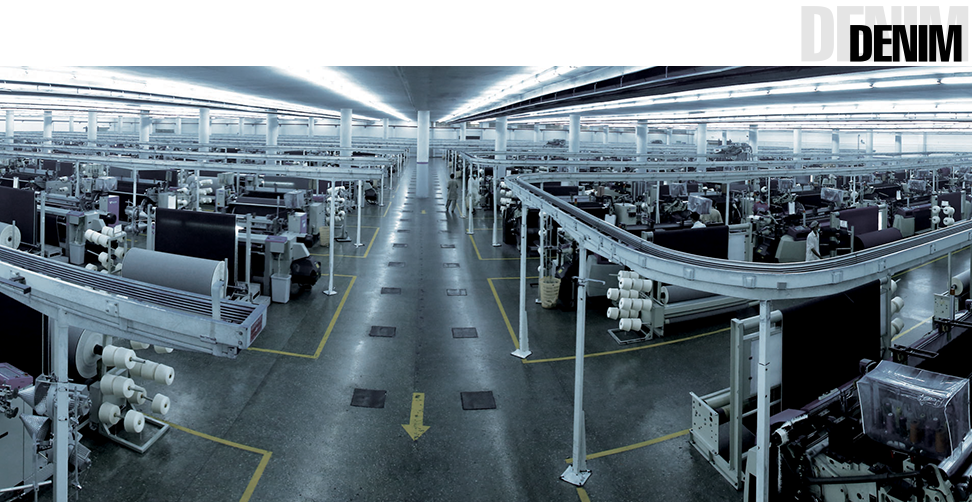
In stretches, Soorty Mills has three categories. Cotton poly spandex, which is high stretch having fabric stretchability of 35 to 75 per cent and used for products like jeggings, the second category gets higher in weight and is meant for true five pocket jeans. “In the true five pocket for women, you will have cotton stretches and blended fabrics. The poly percentage goes down and the stretchability is about 25 per cent. The third category is for premium five pocket, essentially the blends and coatings on a basic denim. These are typically 10 to 10.5 ounces. In volume terms, it is lower but in value terms it is significant,” explains Lodha.
The company has the capacity of carrying out any denim processing technique from basic denim, coated denim, overdyed, multiple fibre blends, to specialty fibres. Elaborating on the Soorty’s USP, Lodha says, “All our products are made of branded Lycra. We don’t use spandex or elastane. We do a lot of our products on dual effects, which is a new age fibre blend with better recovery properties. We do modal blends, bamboo blends. We do special coatings like colour coatings, transparent coatings, all over prints, green cast denims, domo shades, lurex blends, metallic blends, special finishes, garment dyeing and so on.”
Expansion into garmenting in Bangladesh
Out of 30 per cent of the total fabric export, 10 to 15 per cent goes to Bangladesh. Bangladesh is its largest export destination. Other than Bangladesh, the company exports to Turkey and Latin America. Since Bangladesh is now able to manufacture premium jeans products with capacity to handle good washes, Soorty Mills has expanded into garmenting in Bangladesh. “Fashion is becoming very fast now. Every brand wants to do 12 to 14 collections a year. So you can’t keep increasing your lead time. And the lead time is getting impacted by the poor infrastructure. But there is no substitute for Bangladesh in the near future,” exclaims Lodha.
Its garmenting factory in Bangladesh is spread across two floors and has state of the art facilities. It is a Leed certified sustainable design with a focus on recycling and reusing. It uses wind energy and recycled water. Six months from now, the company aims manufacture 50,000 denims a day at this factory.
“Soorty is more into value added products. We are 35 years old company. We are more into denim but non denim is a small part of what we do and is more for in-house consumption. We started as a garment manufacturer in Pakistan. Now we have multiple facilities across Pakistan. We have a capacity of producing 2.5 million garments a month. Soorty is a vertically integrated unit having all processes from spinning to garmenting. In our denim facility, we produce 3.5 million meters of fabric a month. Another mill is in the establishing stage, which will add two million meters a month,” informs Naveed Ahmed, Manager Marketing and Public Relations, Soorty Mills.
While increasing its fabric production capacity to 5.5 million meters a month by next year, the company aims to increase its exports from 30 per cent to 50 per cent in the near future. www.soorty.com
Chinese knits, hosiery flood Northern Indian markets
Chinese sweaters, caps, pullovers, sweaters, children’s dresses, mufflers, and blankets are flooding Ludhiana, the hosiery capital of India. They look stylish, attractive and have a large variety of designs and cheap pricing, which make them popular among buyers. These Chinese hosiery items are priced around 15 to 20 per cent lower than locally made products.
It’s estimated that these Chinese imports have occupied around 20 per cent of the market. If an Indian cap costs Rs 400, a China-made cap costs around Rs 300. There are several reasons for the increasing share of such goods in the market. First, they are of better quality due to high class machinery. Also the Chinese government promotes technological advancements. If industrialists in Ludhiana want to install high-tech machines, they have to pay an interest of 10 to 13 per cent. In Japan they pay three per cent. But in China, the loan is interest-free. The industry in Ludhiana wants similar schemes that will promote it and enable it to flourish.
It’s estimated that Chinese products could have a much higher share in the cities of coastal India like Chennai, due to less freight charges. About 85 to 90 per cent of the demand of the woolen market in India is met by Ludhiana. Most of these units are small- and medium-sized.
Southern textile mills face trouble with dyeing units closure
The mass closure of dyeing units in Erode and other parts of Tamil Nadu has forced weavers in the state to process fabric in upcountry centers, resulting in high transport costs and increased lead time. The predominantly cotton-based spinning and power loom sectors across the nation have been facing severe recession in the last 18 months due to glut in global market and higher duties imposed on Indian textile products than on products from other textile manufacturing countries.
One solution is for textile manufacturers in Tamil Nadu to focus on future investments only in wet processing and further value addition to sustain the viability of 47 per cent of the spinning capacity and 22 per cent of the power loom capacity in the country.
It is hoped that the reopening of dyeing units in Rajasthan and the recently announced MEIS and IES export benefits for fabrics and other finished goods might improve market conditions in the coming months. Against this background, the Southern India Mills’ Association and the Powerloom Development and Export Promotion Council have decided to join hands to study the fabric market on a continuous basis and give feedback to the spinning and power loom sectors and also to the government.
Bangladesh’s export earnings improve
Bangladesh’s export earnings from the US market touched double digit growth at over 11 per cent in the January-November period last year. Earnings from the US in this period of 2015 grew by 11.66 per cent compared to the same period of 2014. Earnings from readymade garment product exports to the US in the 11 months increased by 11.41 per cent compared to the same period of the previous year.
The country’s readymade garment sector has shown good performance in recent months. RMG export earnings from the US in July to December of financial year 2015-16 grew by 15.17 per cent compared to the same period of financial year 2014-15. Double digit export earnings growth in the US market is attributed to good competitiveness and improvement in factory compliance on the part of Asian country’s exporters.
Shaking off the negative impact of the Rana Plaza building collapse and the political turmoil Bangladesh, has started to gain space in the US market riding on the commitment and efficiency of entrepreneurs. Moreover, the ongoing factory inspection by Accord and Alliance is encouraging US buyers to come to Bangladesh.
Strong demand attract brands take to Filipino market
The apparel and footwear market in the Philippines is registering strong value growth, supported by consumer and business confidence. Increased appetite for these products is stimulated by increasing disposable income of buyers, especially among young professionals in urban areas. There are a growing number of department stores and apparel and footwear specialists in the local market. Sportswear, although among the smallest categories, continues to have strong double-digit growth.
Foreign brands are entering the local market. The presence and opening of shopping malls nationwide make it easier for multinationals to find suitable locations for their brands. The Filipinos’ stronger western fashion awareness, both in style and different brands, cultivated by their exposure to the internet, is another positive factor.
There is an assortment of brands, appealing to a wide range of consumer segments across gender and income groups. A wide network of outlets, strategically located in shopping malls and retail districts nationwide, enables brands to cater to a large base. Apparel and footwear continue to be dominated by smaller players whose brands comprise more than half of value sales.
Sportswear will continue to have the fastest growth in the medium term and will be driven by sports-inspired apparel and footwear.
Vivienne Westwood costs cutting strategy post Brexit
British top fashion's and most contradictory designers, Vivienne West wood reported a sales, for the year up December 31, 2016, increased 11 per cent, but margins were under pressure following challenges in the retail market and adding to its woes was the weak pound post Brexit. During the period, the company saw a 37 per cent increase in wholesale sales and a 5.3 per cent rise in retail sales, boosting its full-year turnover to £37.5 million, as against a turnover of £33.7 million during a year ago period.
Despite these setbacks, the brand “continues to remain attractive to its wider customer base as sales growth demonstrates,” however, the company suffered a dramatic drop in pre-tax profit which fell to £1.9 million when compared to £2.3 million in 2016. Westwood says drop in profitability was due to a 19 per cent increase in cost of sales due in part to the weak pound post the EU referendum. The brand is now focussing on alleviating these constraints by reviewing pricing and working steadfastly towards cost cutting. The brand is also working on a strategic review of the business targeted at creating a new operating structure. These measures it disclosed will allow it to optimise processes and overall efficiency of the business.
Foreign buyers eye Vietnam’s textile units
Foreign investors, especially ones Chinese, are buying Vietnam’s textile and garment companies. The enterprises on sale are mostly small ones mostly located in localities with advantageous transport conditions.
Some of the factories comprise production workshops, a security room, a canteen and pleasure room for workers, and electricity systems. The trend has gathered momentum to an extent that there is a view that foreign invested enterprises, and not Vietnam’s textile and garment industry, would benefit from the Trans Pacific Partnership agreement and that with their powerful financial capability and experience, they have taken over Vietnam’s enterprises precisely to get benefits from the TPP.
About 70 per cent of Vietnam’s textile and garment export turnover is made up from foreign owned enterprises, which shows their large operating scale and the big role they play in the industry. Foreign investors are supposed to have a hidden motive in acquiring Vietnam’s textile and garment enterprises. It’s that this way they can dodge the regulations set up by local authorities aiming to restrict investment projects in the textile and garment sector.
In time, it is feared, foreign owned enterprises would become even larger, while Vietnamese enterprises would lose their market share and shrink.
Global nonwovens textiles to grow at over 7 per cent CAGR
The nonwoven textiles market is set to grow at an estimated CAGR of 7.86 per cent by 2020. The growth in nonwovens is due to increasing technological advancements which have led to numerous product developments.
Polypropylene is set to gain the maximum grip during the forecast period. Polypropylene is a raw material used in the manufacturing of nonwoven fabrics. This has applications in manufacturing hygiene products, home furnishings, and the automobile market. In terms of value and volume, the spun melt technology accounted for the largest share of the market in 2014, and is further expected to act as a catalyst in the coming years too.
Emerging economies – India and China, the Asia-Pacific region – have held the largest share among all the regions in the recent past. The nonwoven fabrics industry is dominated by large players such as E.I. du Pont De Nemours (US), Kimberly-Clarke Corporation (US), Avintiv (US), Ahlstrom Corporation (Finland), and Freudenberg (Germany).
The market is classified on the basis of technology (spun melt, wet laid, dry Laid), material (PP, PET, PE, rayon, wood pulp), function (disposable, non-disposable) and end use (hygiene, wipes, construction, upholstery, filtration). As compared to the traditional woven and knitting technology, a larger volume of materials can be produced at a lower cost by using nonwoven technology.
Most US apparel retailers post positive Holiday sales
Most of the apparel retailers in the US reported rise in Holiday sales with a few blaming unreasonably warm weather for decline in sales and demand of winter clothing. Holiday sales are expected to constitute nearly one fifth of the retail industry's annual sales of $ 3.2 trillion. The National Retail Federation sees a sales increase of 3.7 per cent this holiday season, compared to the 4.1 per cent rise last year.
L Brands, for instance, retailer of Victoria's Secret and Bath & Body Works chains, said its December comparable store sales increased 8 per cent, reflecting strength in both its brand stores. The company recorded comparable store sales increase of 4 per cent in the same period last year. Net sales for the month were $ 2.42 billion, up 9 per cent from $ 2.21 billion last year.
Stein Mart registered a 1.8 per cent increase in comparable store sales for the month of December, compared to a 5.8 per cent increase in the year-ago period. Total monthly sales grew 4.7 per cent to $198.3 million from $189.5 million in the prior-year month. And fashion apparel retailer Cato Corporation witnessed its December same-store sales rise 6 per cent, while total sales were up 9 per cent from last year to $118.5 million.
And teen apparel retailer Buckle was one of the apparel retailers, who saw comparable store net sales for December decline 5.4 per cent from the year-ago period. Net sales decreased 4.5 per cent to $182.1 million against $ 190.6 million, last year.
Bangladesh has so far submitted its progress report twice in line with 16-point US Action Plan for Bangladesh, to the United States Trade Representative, the Chief trade negotiator for the Obama administration. However, Bangladesh is yet to receive any positive response.
“We are trying to get duty-free entry for garment items to the US,” Commerce Minister Tofail Ahmed had told reporters while talking about the country's preparations to attend the 10th WTO ministerial conference in Kenya from December 15-18, 2015.
According to Ahmed, Bangladesh is one of the highest tax paying nations in the American market and the country's garment exports to the US have maintained buoyant growth. The higher rate of duty and suspension of trade privileges could not stop the growth of garment exports to the US. Ahmed, who is also the coordinator for the least-developed countries (LDCs) in the WTO summit, will lead the 19-member Bangladesh delegation.
www.lbrands.com
More...
Bangladesh to increase efforts for duty-free access to the US
After the US Senate decided to allow duty-free access to Napali apparel products to the US, Bangladesh has decided to put in more efforts at both bilateral and multilateral forums to get duty-free market access to the US. The US House of Representatives on December 11 passed a bill allowing Nepali RMG duty-free access to the US market until 2025.
Bangladesh has so far submitted its progress report twice in line with 16-point US Action Plan for Bangladesh, to the United States Trade Representative, the Chief trade negotiator for the Obama administration. However, Bangladesh is yet to receive any positive response.
“We are trying to get duty-free entry for garment items to the US,” Commerce Minister Tofail Ahmed had told reporters earlier while talking about the country's preparations to attend the 10th WTO ministerial conference in Kenya from December 15-18, 2015.
According to Ahmed, Bangladesh is one of the highest tax paying nations in the American market and the country's garment exports to the US have maintained buoyant growth. The higher rate of duty and suspension of trade privileges could not stop the growth of garment exports to the US.
Ustr.gov Mincom.gov.bd
‘Textile industry needs technology and skills to compete globally’
The textile industry should look at reviving technology and skills to recapture higher share in the global trade, said Kavita Gupta, Textile Commissioner, while speaking at the inauguration of joint technological conference of textile research associations.
“The future of textile industry is going to be technical textiles,” she said, adding, “In the last five years, there had been 20 per cent growth year-on-year in this segment. The sector should aim to be 40 per cent of the country’s textile industry. The centres of excellence created for technical textiles should look at having joint annual conferences as done by the research associations. The Union Government had allocated Rs 200 crores under the technology mission for technical textiles and there is still some fund that is not spent. The centres should come forward with proposals”.
D. Krishnamurthy, Chairman of the council of administration of South India Textile Research Association, while speaking on the occasion informed that the association conducted 19 training programmes in the last one year. He also elaborated on the projects taken up and completed by the four textile research associations in the country.
The South India Textile Research Association has also launched a website where the companies can register to get a consolidated report on the quality of fibres and yarn. Initially, it will be for 40s, 60s, 80s and 100 count yarn. The industry experts are of the opinion that this effort by SITRA will help in establishing standards for quality of yarn.
www.sitra.org.in
BGMEA to assess inspection status of RMG factories
After Accord on Fire and Building Safety in Bangladesh, a platform of European retailers, and Alliance for Bangladesh Worker Safety, a consortium of North American buyers, accused Bangladeshi factories of no progress on remediation work, the Bangladesh Garment Manufacturers and Exporters Association (BGMEA) has decided to personally look into the matter.
Accord has stopped work with almost eight garment factories for their failure to meet the conditions of remediation in time and it has also warned over 120 factories of cutting business ties over slow progress in corrective action plan. Even Alliance has cut relations with 23 factories from its supplier list and warned 12 more for the same reasons. Now the BGMEA started collecting information from its member factories regarding factory inspection and remediation progress.
It has created a format for updating inspection status. Around 46 factories have already provided their inspection status. Once BGMEA receives status from all the factories in question, it would compare them with that of the Accord and Alliance to appear at a conclusion and find a way out.
www.bgmea.com.bd
WAGES: A crucial detriment in consolidation of supply-value chain
TRENDSPOTTING 2016: "The industry has a ‘buyer-driven chain.’ This means that the big retailers and marketers, and traders drive the market (i.e. they determine where to produce, what to produce and at what prices). Hence, retailers and brands, typically situated in developed countries in Europe, Japan and the US. These brands do tasks such as branding, design, marketing and they outsource the production of the garments".

Today the textile and garment industry is a global one and supply -value chains are spread across many countries and continents. Currently the garment industry plays such a role in many least developed and developing countries.Textile and garment industry is one of the key sectors contributing to a country’s overall economy and human resource development. After agriculture, garment industry is the second highest manpower intensive industry. World Garment Market is pegged at almost1.7 trillion USD by 2012. About 60 million to 75 million people are employed in the textile, clothing and footwear sector worldwide (2014 ) whereas to compare in 2000 only 20 million people were employed in the industry and about three quarters of garment workers worldwide are female.
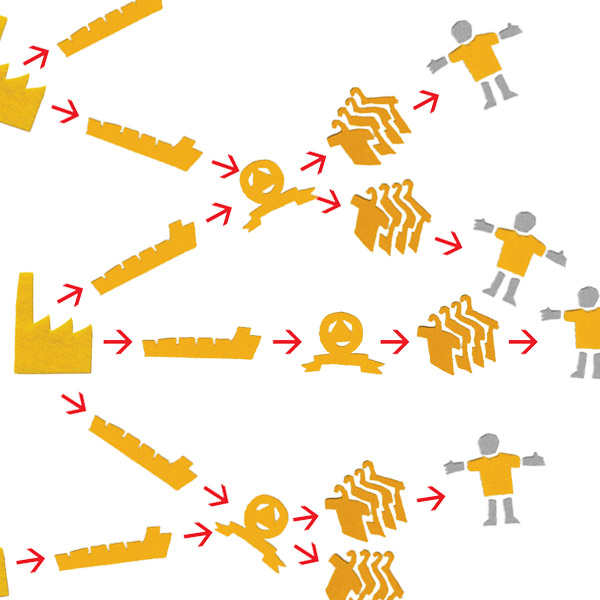
The late 20th century saw a period of significant change in the concentration of the garment market: since that time, the main producing and exporting countries have almost completely changed.In 1970, among the biggest exporters to US were: Japan, United Kingdom, Canada, Italy, France, etc. By 2011, the USA was receiving most imports from countries like China, Cambodia, Pakistan, Mexico, Bangladesh, etc. While even in 1970 countries Production has, in general, shifted to least developed or developing countries. The bulk of production remains in Asia, although the production market in some non-Asian developing countries is growing: e.g. Panama, Chile Egypt. Countries like Turkey, Morocco and Tunisia have emerged as key players when it comes to exports to the European countries.
Developing countries in the buyer driven chain
The industry has a ‘buyer-driven chain.’ This means that the big retailers and marketers, and traders drive the market (i.e. they determine where to produce, what to produce and at what prices). Hence, retailers and brands, typically situated in developed countries in Europe, Japan and the US. These brands do tasks such as branding, design, marketing and they outsource the production of the garments. While production: covered by the laws of the state where it is executed (e.g. Bangladesh) and by international human rights, labour law and commercial law standards (e.g. human rights treaties, ILO Conventions, codes of conduct). The most labour intensive parts of the chain are in developing countries, whilst most knowledge intensive parts remain in developed countries.
In recent years there has been a change in how garments are sourced: there has been a move towards consolidation of supply chains to be able to keep up with ‘fast fashion’ concept. However the disparity in the wages in different countries is a major impediment for this. Many garment workers (particularly women and migrant workers)50 in developing countries work in what is known as the informal economy. In 2004, it was estimated that the informal economy generated 35% of global GDP; the figure is likely higher now. Whilst there is no universal definition of the informal economy, the ILO has identified some key factors: informal workers ‘are not protected under the legal and regulatory frameworks’ and are, ‘characterised by a high degree of vulnerability. Informal workers are not typically recognised by the law and hence do not have access to social security, and most forms of labour protection. The ILO has acknowledged that there is ‘no clear dichotomy or split between the ‘informal economy and the ‘formal economy. States (represented by their respective governments) can play an influential role in impacting change in the garment industry. The creation of the International Labour Organisation (ILO) has been instrumental in the international recognition of fundamental minimum labour standards. The creation and development of many international human rights treaties have enshrined certain internationally guaranteed rights which can positively affect labour conditions in the garment.
In equality in wages & infrastructure
However international treaties are binding on the states that have ratified them. These states are obliged to comply with them; however, there is no mechanism for enforcement unless the state has also ratified the optional protocol to the respective treaty. Major garment producing countries that are party to the optional protocols against which individuals can invoke their human rights: Philippines (ICCPR), Cambodia (CEDAW), Thailand (CEDAW). However in the remaining countries like Laos, Pakistan, India, Bangladesh, China) there are no enforcement mechanisms for any of the abovementioned treaties available. The United Nations has guiding principles for companies to conduct business in a human rights respecting way. In these guiding principles, states and corporations are urged to take measures to uphold and enforce human rights. Moreover, these principles state how to access remedies as individuals in case of a human rights violation. Regional Efforts have also been there to Focus- Supply Chain.
However the countries like Cambodia, Bangladesh, India are riddled with informal economy .Many factories lack adequate nursing facilities or child care which effectively discriminates against women, making it very difficult for them to continue working once they have children. Unfortunately, women get paid less for the same work as men do. Child Labour Child Labour is an issue of much concern in the garment industry and can be found in many parts of the industry, e.g. child labourers have been found working as cotton pickers in Uzbekistan , India. In India where young girls are hired into Sumangali schemes who are exploited . In Bangladesh, Pakistan, Thailand and India during peak season, excessive overtime is common because factory owners are reluctant to hire additional.
Changing trend in labour laws in lease developed nations
The complex global supply and value chains mean that the demands of consumers in Europe or America have an effect on the conditions and wages of workers thousands of miles away. But it has been seen that Governments are not interested in improving conditions for employees, as it increases costs for employers as well and might encourage outsourcing companies to take their business elsewhere. Here it should be noted, for example, that the textile industry in Bangladesh makes a substantial contribution of 10 to 15 % to national GDP Gross National Product and employs around four million people, mainly females In turn the companies themselves are rather keen to make sure there are no accidents, as it could seriously harm their reputation, image or brand, but the persistent competitive pressure in the garment industry ensures that production chains are continuously adapted, which not drives down costs, but also exacerbates the problems. After months of unrest and unsettled pay rates, Cambodia’s Labor Committee said in November it would increase the monthly minimum wage for garment workers by 28 percent to $128.Strikes in the sector were rampant—and at times violent this year as at least three were killed when military police fired on protestors demanding higher wages in January. But the Cambodian government had been hesitant to raise the rate despite the ongoing unrest in fear that factory owners would be unable to pay and that factories might have been forced to relocate.Unions were originally fighting to see the wages go from the previous $100 per month to $177, but settled on $140 as their lowest acceptable offer. The rate was below what the unions wanted and members from eight labor unions were reportedly planning to meet in November to discuss their next course of action. The renewal of the AGOA expected to give a strong impetus to textile and garment shipments from Africa to the U.S., as some Turkish textile manufacturers eye Kenya and Ethiopia for manufacturing operations, butAfrican countries urgently need to upgrade infrastructure and simplify customs procedures
Africa's textile and garment industry is optimistic that its shipments to the United States, the world's biggest market for such products, will surge following the 10-year renewal of the African Growth and Opportunity Act (AGOA) - under the United States' General System of Preferences that allows duty-free imports of a wide range of African products, which was signed by President Barack Obama on June 11, 2015.
This is also driving many Turkish, Indian and Chinese textile companies to African countries, particularly Ethiopia and Kenya, to not only flee the rising production and labor costs at home but also to avail of the duty-free exports under the AGOA to the United States.