India’s textile sector requires significant reforms to maintain global competitiveness: NITI Aayog
A Niti Aayog report highlights, India’s textile sector needs significant reforms to maintain global competitiveness. Titled, ‘Trade Watch July-September (Q2) FY25,’ the report emphasizes the sector's importance to India's industrial output, employment, and exports, which reached $34.2 billion in 2023.
Despite accounting for 5 per cent of India's total exports, the textile industry's global trade share remains a modest 4 per cent, ranking India sixth worldwide. While India excels in natural fiber-based textiles like cotton and carpets, it lags in apparel and technical textiles, where countries like Bangladesh and Vietnam are more dominant, the report points out.
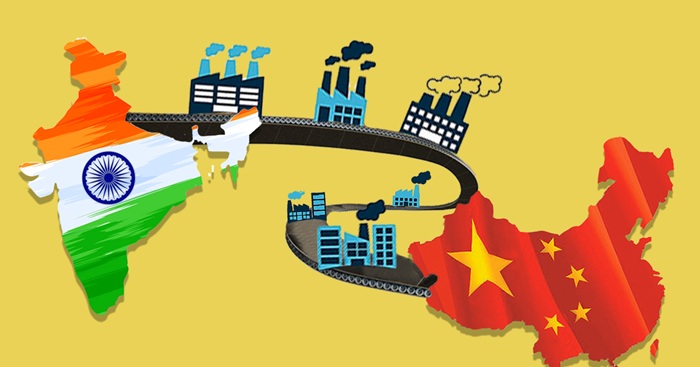
India's presence in man-made textiles is moderate, and it trails in high-value technical textiles, a sector led by China, Germany, and South Korea, the report further shows. The Indian textile market needs to improve its supply chain integration, cost-efficiency, and adherence to sustainability standards to remain competitive in the global textile market, the report.
Furthermore, India's textile exports registered a slight decline in FY24 to t $35.94 billion, while competitors like Bangladesh and Vietnam achieved approximately $44 billion. Over the past six years, India's T&A exports have grown by only 0.8 per cent annually, well below the global rate of 3.5 per cent.
The report notes, India’s textile industry lacks product diversification, with over half of the textile exports relying on just 134 items. It also stresses India's dependence on China for synthetic fiber and technical textile raw materials.
Additionally, the report acknowledges the impact of changing geopolitical dynamics, particularly the US-China trade shifts, which create both challenges and opportunities for India. To capitalize on these shifts, India must enhance its ‘ease of doing business,’ improve trade infrastructure, and align with international regulatory standards.
Scoop S/S '26 moves to Olympia National Kensington, London for landmark July 2025 edition
Scoop, the UK’s leading contemporary fashion and lifestyle show, has announced its relocation to the iconic Olympia National Kensington, London, for the Spring/Summer 2026 edition scheduled from 13 to 15 July 2025. The move marks a significant new chapter for the event, known for its curated selection of emerging designers and lifestyle brands.
The newly renovated Olympia National, a heritage venue with over 100 years of fashion history, offers a larger and more elevated setting to showcase Scoop’s signature blend of fashion, art and culture. Founder and Managing Director Karen Radley expressed excitement about the transition, calling the space Scoop’s ‘most beautiful incarnation yet.’
Themed ‘For Fashionable People’, Scoop S/S ’26 promises a vibrant showcase full of joy and creativity, embracing a sunny, optimistic spirit. While full details remain under wraps, organisers hint at a fresh and energetic atmosphere that mirrors the show’s distinctive style. Radley noted that the new venue will offer buyers an inspiring, sunshine-filled environment to explore the latest in premium women’s fashion, as well as curated luxury lifestyle, beauty, home and men’s collections.
Known internationally as a must-visit on the trade show circuit, Scoop continues to play a key role in spotlighting global emerging designers and aligning with the pulse of modern retail. The 2025 edition aims to be a celebration of forward-thinking fashion in one of London’s most iconic spaces, reinforcing Scoop’s position at the heart of the UK’s creative fashion industry.
Next plans physical expansion after a five-year gap
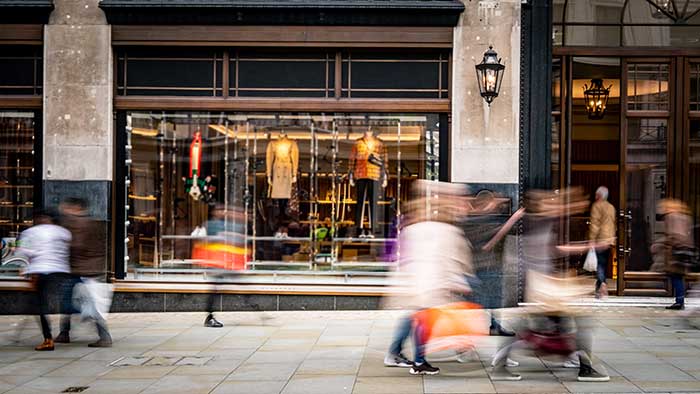
Signaling the end of the worst phase of UK’s retail shift from physical to online retail, Simon Wolfson, CEO, Next, announced plans to expand into brick and mortar stores after a gap of almost five years.
According to Wolfson, by January 2026, Next will expand its retail footprint by 0.4 per cent. This would include opening ten new stores, relocating six existing ones, and converting two homeware stores into fashion outlets.
However, despite this expansion, Next expects store sales in 2025-26 to decline by 0.3 per cent. The company’s online sales though are projected to increase by 4.3 per cent during the year, leading to an overall growth of 2.3 per cent in UK sales.
The broader UK retail landscape continues to evolve, with online shopping maintaining a strong presence. The proportion of non-food purchases made online by nation’s consumers rose to 36.4 per cent in February 2025, from 35.8 per cent the previous year, notes British Retail Consortium,
The shopping habits of UK consumers have stabilized, with physical stores continuing to hold relevance alongside e-commerce, states Wolfson. With this strategic expansion, Next positions itself to balance both retail channels while capitalizing on a recovering high street presence.
Government extends deadline for submitting data for RoSCTL rates revision for garment exports
The Indian Department of Revenue's RoSCTL Committee has extended the deadline for submitting data for the Rebate of States and Central Taxes and Levies (RoSCTL) rate revision for garment and made-up exports to April 15, 2025. Chaired by GK Pillai, the committee will now accept data submissions from Trade & Industry Associations and Export Promotion Councils (EPCs) until this new date.
Originally set for March 31, 2025, the deadline extension responds to requests from exporters and EPCs.
The committee aims to gather comprehensive information to accurately calculate duties, taxes, and levies applied to RoSCTL Scheme-covered exports at federal, state, and local levels. This data will inform the revision of ceiling rate schedules. In communication with administrative Ministries, Commodity Boards, and other stakeholders, the committee is expected to submit its report in May 2025.
This extension provides exporters and industry participants additional time to submit necessary data for the scheme's rate review.
Over 100 global fashion brands pledge to oppose mulesing in Australia’s wool industry
Over 100 fashion brands worldwide have pledged to oppose mulesing, a controversial practice in the Australian wool industry. Mulesing involves surgically removing skin from lambs' hindquarters to prevent flystrike, a painful and potentially fatal maggot infestation.
Leading brands like Zara, Patagonia, and Adidas, alongside Australian labels such as Aje and Kathmandu, have signed a letter of intent organized by Four Paws. These brands commit to either eliminating mulesed wool from their products or doing so by 2030.
Four Paws argues, viable alternatives exist, and brands refuse to support ‘live lamb cutting.’ Echoeing this, the RSPCA advocates brands to breed flystrike-resistant sheep as a humane solution. They allege, the wool industry has failed to phase out mulesing as promised in 2004 and millions of lambs have been enduring the procedure since.
RSPCA emphasizes, Merino sheep's wrinkly skin, bred for increased wool yield, makes them susceptible to flystrike. Breeding plain-bodied sheep is a feasible and long-known solution, they assert. They also recommend a CSIRO-developed vaccine as a potential alternative.
The industry's peak body, WoolProducers Australia disputes the term ‘live lamb cutting,’ calling it a sensationalized label. The term misrepresents mulesing and suggests using ‘lifetime lamb protection procedure’ instead, they argue. They highlight, nearly 90 per cent of the wool producers use pain relief during mulesing, demonstrating a commitment to animal welfare. They urge all states to mandate pain relief.
The Sheep Sustainability Framework's 2024 report indicates, while a majority of producers still mules, a large percentage uses pain relief. However, the report does not reflect on the topic of breeding flystrike-resistant sheep. Animal welfare groups continue to push for the breeding of flystrike resistant sheep, rather than focusing on pain management during mulesing.
Indian Textile Needs Urgent Reforms for Global Competitiveness: Warns Niti Aayog report
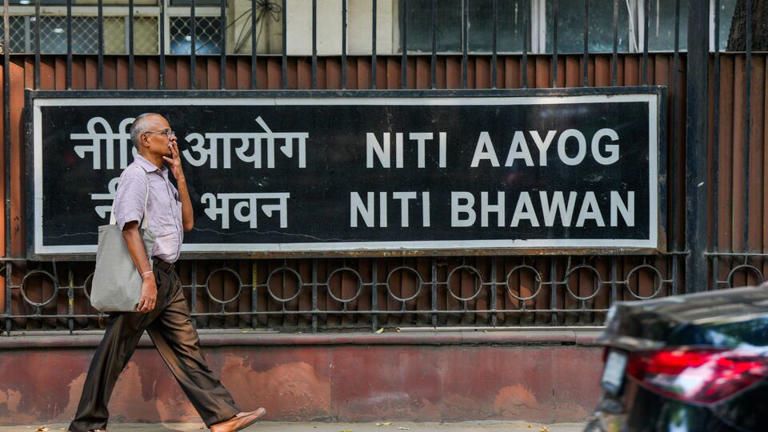
Niti Aayog’s latest "Trend Watch Quarterly" report has issued a stark warning: India's textile sector must undergo swift and comprehensive reforms to sustain its competitive advantage in the global market. Released on March 28, the report, titled "Trade Watch July-September (Q2) FY25," highlights the sector’s critical role in India's economy while underscoring the urgent need for strategic policy interventions.
A sector of national importance, facing global challenges
The textile industry remains a crucial pillar of India’s industrial output, employment, and exports. In 2023, textiles accounted for 5% of India’s total exports, valued at $34.2 billion. However, despite its historical significance, India's global textile trade share stands at just 4%, ranking it as the sixth-largest exporter. In contrast, countries like Bangladesh and Vietnam have surged ahead, capitalizing on cost efficiencies and favorable trade policies.
“The domestic textile sector needs immediate reforms in supply chain integration, cost efficiency, and sustainability compliance to sustain its competitive advantage,” the report states.
India’s Strengths and Weaknesses: A detailed analysis
The report provides an in-depth analysis of India’s textile exports, identifying both strengths and areas for improvement:
1. Natural fibre dominance
India is a global leader in natural fibre-based textiles, particularly in cotton and carpets. However, this reliance limits diversification, making the industry vulnerable to shifts in global demand for synthetic and technical textiles.
2. Apparel and technical textiles gap
India struggles in apparel exports, with competitors like Bangladesh and Vietnam overtaking its market share due to lower labor costs and preferential trade agreements. The country also lags in high-value technical textiles, a segment dominated by China, Germany, and South Korea, which is critical for industrial and medical applications.
3. Export concentration
While India exports 840 textile products, over 52% of its exports come from just 134 items, reflecting a lack of diversification. This over-concentration poses a significant risk—if these 134 items lose competitiveness, the industry could face a substantial downturn.
4. Dependency on imports
India remains dependent on China for synthetic fibres and technical textile raw materials, posing a challenge for self-reliance and expansion in high-margin textile segments.
Key Textile Export Figures (FY24)
|
Country |
Textile/Garment Export Value (USD Billion) |
|
India |
35.94 |
|
Bangladesh |
44.47 |
|
Vietnam |
~44 |
India’s Global Textile Trade Share
|
Metric |
Value/Percentage |
||||||
|
India's Global Trade Share |
4% |
||||||
|
India's Textile Export Value (2023) |
$34.2 Billion |
||||||
|
India’s Export Concentration
|
|
The imperative for reform
The report highlights a concerning trend: India’s textile and apparel exports have stagnated at approximately $40 billion for the past six years, growing at a mere 0.8% annually—well below the global growth rate of 3.5%. To regain its competitive edge, India must implement crucial reforms in:
- Supply chain integration: Streamlining logistics and reducing inefficiencies to lower costs.
- Cost efficiency: Enhancing productivity and leveraging economies of scale to maintain competitive pricing.
- Sustainability compliance: Meeting stringent global labor and environmental regulations to retain market access in developed countries.
- Diversification: Expanding into man-made fibres and technical textiles to reduce over-reliance on traditional cotton-based exports.
Global trade dynamics and geopolitical shifts
The report also examines how global geopolitical shifts—particularly the ongoing US-China trade tensions—are reshaping trade patterns. While this situation presents opportunities for India in sectors like pharmaceuticals, IT services, and manufacturing, it also necessitates improvements in ‘Ease of doing business’ reducing bureaucratic hurdles to attract foreign investment, ‘Trade infrastructure’ upgrading ports, logistics, warehousing to boost efficiency and ‘Regulatory alignment, ensuring compliance with global trade policies to strengthen international partnerships.
“Growing geopolitical fragmentation, particularly between the US and China, is reshaping global trade dynamics,” the report notes.
Looking Ahead: Strategic policy reforms
B.V.R. Subrahmanyam, Chief Executive Officer at Niti Aayog, emphasized, “India’s trade landscape continues to evolve, driven by strategic policy reforms, resilient industrial growth, and expanding global partnerships.”
The report concludes that India must prioritize innovation, modernization, and policy-driven competitiveness to capitalize on emerging global opportunities. It also hints at upcoming insights into the Reciprocal Tariff Plan’s impact on India, which will be detailed in the next edition of Trade Watch.
As global trade dynamics continue to shift, India’s textile industry stands at a crossroads. The need for urgent reforms is undeniable—without decisive action, India risks losing its foothold in the global textile market. With strategic investments in modernization, policy support, and diversification, India can reclaim its position as a global textile powerhouse.
Ermenegildo Zegna reports 16.4 % decline in adjusted operating profit during 2024
Italian luxury group Ermenegildo Zegna’s adjusted operating profit contracted by 16.4 per cent to €184 million ($198 million) in 2024, as the group stepped up investments despite a challenging environment.
However, the group’s adjusted earnings before interest and tax (EBIT) exceeded analysts' expectations to around €175 million.
Having witnessed a 9 per cent decline in sales last year to €1.95 billion due to weakness in China, the group expects revenues to range between €2.2 billion to €2.4 billion in 2027. The group’s adjusted EBIT is expected to reach €250-300 million by the same year.
The company continues to adopt a cautious approach while also remaining committed to delivering on our projects, says Gildo Zegna, Chairman and CEO. Protecting its brands’ identity remains the first priority for the company, adds Zegna. Besides Zegna, the group also owns other fashion brands like Thom Browne and Tom Ford Fashion.
Lenzing Conclave in Panipat, India showcases sustainable fiber innovations for home textiles
The Lenzing Group, a global leader in wood-based specialty fibers, recently hosted the Lenzing Conclave at The Orlov Hotel in Panipat, India, drawing key manufacturers and exporters from the home textile industry.
The exclusive event served as a collaborative platform to explore Lenzing’s latest sustainable fiber innovations and their versatile applications in home textiles such as carpets, rugs, bed linens, terry towels, and filled products like comforters and pillows.
Lenzing presented its advanced fiber portfolio, including Tencel Lyocell A100, LF, x Micro, Fill, and Lenzing Ecovero Black, highlighting their role in enhancing product performance while minimizing environmental impact. A special focus was placed on the use of Lenzing fibers in structural bed linens, demonstrating how they enable unique textures and aesthetics across both basic and intricate weaving designs.
Avinash Mane, Senior Commercial Director for AMEA & NEA in Commercial Textiles at Lenzing Group, underscored the company’s commitment to innovation and sustainability. “With sustainability at the core of everything we do, Lenzing is committed to offering high-performance fiber solutions that support the transition to a greener home textile industry,” he stated.
The conclave facilitated engaging discussions, live product showcases, and meaningful networking, reinforcing Lenzing’s leadership in sustainable fiber solutions. The company expressed gratitude to all attendees for their active participation and reiterated its commitment to driving eco-conscious innovation through strong industry partnerships in India and beyond.
Bio-Aryavedic Naturals launches Albedon, an eco-friendly alternative to traditional starching
A startup from Kerala, Bio-Aryavedic Naturals, has introduced an eco-friendly alternative to traditional starching methods. The company has launched a fabric stiffening spray made from tapioca.
Named, ‘Albedon fabric ironing stiffener spray,’ this product is easy to use during ironing. It not only makes clothes stiff but also adds shine, making them last longer, and keeping them cleaner.
Vineetha AK and Arun Bhaskar, Founders, emphasize, the spray can absorb greenhouse gases and turn them into oxygen, which helps clean the surrounding air
Albedon has been tested at the Central Government’s Textile Testing Laboratory besides undergoing clinical evaluations at the Sree Chitra Tirunal Institute for Medical Sciences and Technology in Thiruvananthapuram. The company also received support and funding from the Kerala Startup Mission.
Bio-Aryavedic Naturals was among the top five startups at the Naaripreneur for Her program by IIM Visakhapatnam, beating out 155 other startups from 24 states. They've also been recognized by NBCC India and were chosen by IIT Madras to showcase their innovation at the Bharat Tex 2025 Global Textile Event in New Delhi.
Karl Mayer unveils RMF 8 EL and HDR 9 EL NET for cost-effective stone bag production
Karl Mayer has introduced two innovative machines - the RMF 8 EL and HDR 9 EL NET - designed for the efficient and economical production of high-performance stone bags used in demanding construction environments. These warp knitting machines cater to different manufacturing approaches: the HDR 9 EL NET produces ready-to-use tubular sacks in one piece, while the RMF 8 EL delivers flat textile sheets for later assembly.
Built for extreme durability, the stone bags are made from coarse net structures using recycled polyester or polyethylene fibres. They can hold stones weighing from one to 12 tonnes, making them ideal for coastal erosion control, bridge pier foundation reinforcement, disaster recovery structures, and temporary road bases. Their resistance to rust and corrosion ensures long service life even under seawater exposure.
The RMF 8 EL offers exceptional flexibility, supporting widths up to 190 inches and multiple gauges (E3, E4, E8, E9) to tailor robustness to specific needs. The HDR 9 EL NET, available in gauges E4 and E7, streamlines production with ready-made net bags that require no sewing or finishing, significantly reducing manufacturing time and labour.
Lightweight yet highly stable, these stone bags are easy to transport, handle, fill, and install, even with crane assistance minimising the need for skilled labour on-site. Their net structures adapt easily to uneven surfaces and effectively fill gaps, ensuring secure placement in varied terrains.
With wide-ranging applications in infrastructure, marine, and emergency construction, Karl Mayer’s new machines deliver versatile, eco-friendly solutions that meet modern industrial demands with speed, precision, and reliability.
More...
Government steps up cotton procurement at MSP to support farmers in Telangana
Led by Prime Minister Narendra Modi, the Indian federal government is stepping up to help cotton farmers in Telangana, a major cotton-producing state, by buying large quantities of their crops at the Minimum Support Price (MSP). This move comes as market prices for cotton have been dropping, putting farmers at risk.
G Kishan Reddy, Federal Minister and President – Telangana, BJP says, the government’s actions are benefiting over 900,000 cotton farmers in the state.
He highlights, a government agency, Cotton Corporation of India (CCI) has set up 110 buying centers across Telangana. So far in the 2024-25 growing season, they've purchased over 21 million quintals of cotton, which adds up to roughly 155.56 billion rupees.
Telangana is the third-largest cotton-producing state in India, and the government has significantly increased its support to farmers there in recent years. Since 2014-15, the Modi government has bought cotton worth over more than Rs 580 billion, providing much-needed financial assistance to farmers. Additionally, the MSP for cotton has more than doubled, going from Rs 3,750 per quintal in 2014-15 to Rs 7,121 in 2024-25.
The government's support goes beyond simply buying cotton. They're also providing farmers with resources like soil testing, high-quality seeds, fertilizers, farm loans, insurance, irrigation, and warehouses. And they're making sure farmers get a fair price for their crops. The CCI steps in to buy cotton whenever market prices fall below the MSP, providing a safety net for farmers.
The Modi government has set MSPs for 22 different crops, including cotton, ensuring that farmers receive at least 50 per cent more than their production costs. The current cotton procurement drive in Telangana reinforces the government’s dedication to protecting farmers' incomes and providing them with financial stability.
Cellulose Fibres Conference 2025 spotlights innovation and sustainability in Germany
The Cellulose Fibres Conference 2025, held on 12–13 March in Cologne, Germany, drew leading industry experts, researchers, and innovators to explore sustainable fibre solutions across textiles, hygiene, and packaging. The event reinforced its position as the premier global platform for the cellulose fibre sector, offering two days of high-quality presentations and robust discussions on advancing eco-friendly technologies.
Cellulose fibres such as viscose, lyocell, and modal, traditionally made from wood-based pulp, are now being complemented by innovations using agricultural waste, recycled textiles, and paper-grade pulp. This shift toward alternative raw materials reflects the industry's growing focus on sustainability and circular economy practices.
This year, biosynthetics were introduced for the first time, gaining significant attention. Experts explored challenges in scale-up, biodegradability, and performance compared to fossil-based synthetics. Sessions covered fibre-to-fibre recycling, marine biodegradability, microplastic reduction, and cutting-edge technologies for pulp and fibre development.
Rahul Bansal of Birla Cellulose highlighted the event’s importance for global collaboration, noting rising investments in cellulose-based product development. Andreas Engelhardt of The Fiber Year reported an annual global capacity expansion of 200,000 tonnes, while Marina Crnoja-Cosic of Textile ETP projected 17 per cent annual growth from 2024 to 2029, driven mainly by Lyocell. Simone Seisl added that Lyocell is replacing declining cotton production due to climate change.
To support future development, CIRFS proposed a unified cellulose fibre standard, including types like viscose, modal, lyocell, and emerging fibres. The proposal received strong backing, including from Ikea, which expressed interest in scaling up cellulose fibre usage.
A key highlight was the ‘Cellulose Fibre Innovation of the Year 2025’ award. SA-Dynamics (Germany) won for biodegradable cellulose aerogel insulation textiles. Releaf Paper France earned recognition for converting urban leaf waste into fibres, and Uluu (Australia) impressed with seaweed-derived PHA polymers as plastic alternatives in textiles.
Sponsors like GIG Karasek, Birla Purocel, List Technology AG, Valmet, and Dienes played vital roles in the conference’s success. Social media engagement extended the event’s reach, while on-site networking tools fostered collaboration. A traditional German bowling night added a social touch to the proceedings.
With growing momentum, CFC 2025 reaffirmed the industry's commitment to advancing sustainable, bio-based textile solutions.
US textiles under pressure, tariffs, trade issues, and the fight for survival

The US textile industry, a significant contributor to the national economy, faces a complex mix of challenges. The industry employs 471,000 workers and generates $64 billion in annual output. It is a key supplier to the US military, providing over 8,000 products, and is a source of high-tech innovation for sectors ranging from healthcare to aerospace.
However, the industry has been facing numerous challenges, including economic downturns, unfair trade practices like forced labor, ill-conceived trade policies, inadequate customs enforcement, post-pandemic inventory issues, and freight and logistics challenges. These factors have hindered growth and investment, leading to a downturn in business over the past three years.Despite these challenges, the textile industry has shown resilience. In 2024, the value of US man-made fiber, textile, and apparel shipments was estimated at $63.9 billion.
Table: Value of US textile shipments
|
Category |
Value of shipments (2024) |
|
Textile Mills |
$25.0 bn |
|
Textile Products |
$23.6 bn |
|
Apparel |
$9.8 bn |
|
Man-made Fibers |
$5.5 bn |
Source: U.S. Census Bureau
The US has a strong position in the global textile market. Export of fibers, textiles, and apparel were $28 billion in 2024. It is the second-largest individual country exporter of textile-related products in the world
Table: Export by category and region (value in billion)
|
Export Category |
Value (bn) |
|
Cotton, Wool, Hair |
$5.0 |
|
Yarns |
$4.0 |
|
Fabrics |
$8.0 |
|
Home Furnishings etc. |
$3.9 |
|
Apparel |
$7.1 |
|
Exports by region |
|
|
Region |
Value (bn) |
|
USMCA |
$12.2 |
|
CAFTA DR |
$3.0 |
|
Asia |
$2.8 |
|
Europe |
$2.1 |
|
Other Regions |
$2.8 |
Source: U.S. Department of Commerce
The top export markets for US fibers including cotton fibers are Mexico at $36 billion followed by China at 1.9 billion. Canada, Honduras and Pakistan are the other three in the top five list.
Challenges and the way out
To address the various challenges the sector is facing, the National Council of Textile Organizations (NCTO) and industry leaders have launched an aggressive lobbying campaign, advocating for policies to support the industry.
On major policy they are looking for is customs enforcement. The industry is pushing for robust enforcement of free trade agreement rules, closing the de minimis loophole, and fully enforcing the Uyghur Forced Labor Prevention Act (UFLPA) to combat import fraud and circumvention of trade laws. In fact, NCTO is leading a coalition to close the de minimis loophole, which allows low-value shipments to enter the country duty-free, creating an unfair advantage for foreign competitors.
NCTO is also actively involved in advocating the Miscellaneous Tariff Bill, expansion of the Berry Amendment (which requires the Department of Defense to purchase 100 per cent US-made textiles and clothing), full enforcement of the Make PPE in America Act, and increased tariffs on finished textile and apparel imports from China.
Looking ahead, the US textile industry anticipates the challenges to continue but remains optimistic about its future. The industry is focused on working with policymakers to enact supportive measures, strengthening partnerships with Western Hemisphere trading partners, and combating illegal trade practices.
The global garment import kaleidoscope, a rise from Bangladesh
From the point of view of global apparel import trends, the recent rise in Bangladesh's Ready-Made Garment (RMG) exports reveals a compelling picture. The first half of fiscal year 2024-25 shows a significant rise across major markets, highlighting shifts in sourcing strategies and evolving consumer demands.
The EU, a cornerstone of Bangladeshi RMG exports
The European Union's continued dominance as Bangladesh's primary market is undeniable. Accounting for roughly 50 per cent of the total RMG exports, the EU's imports reached $9.87 billion, a 15.22 per cent increase year-over-year.
Table: Bangladesh RMG exports to EU markets (July-Dec 2024-25)
|
Country |
Import value ($ bn) |
Growth rate (%) |
|
Germany |
2.47 |
14 |
|
Spain |
1.7 |
3 |
|
Netherlands |
1.06 |
>10 |
|
France |
1.09 |
>10 |
|
Poland |
0.79 |
28 |
|
Italy |
0.77 |
<10 |
|
Denmark |
0.56 |
>10 |
Diversification and growth: While Germany remains the top importer, the substantial growth in countries like Poland (28 per cent) indicates a diversification of import destinations within the EU. This could reflect changing consumer preferences or strategic sourcing decisions by retailers.
Varying growth rates: The disparity in growth rates, from Poland's high to Spain's modest increase, suggests that market-specific factors are at play. These could include economic conditions, retail trends, and competitive pressures.
The US a strategic shift
The US which accounts for 19-20 per cent of Bangladesh's total RMG exports, has emerged as a crucial growth market. The 17.55 per cent increase in imports ($3.84 billion) is significant, particularly in light of geopolitical trade tensions.
The imposition of tariffs on Chinese goods by the US has created a window of opportunity for alternative sourcing destinations like Bangladesh. Therefore, US buyers are actively seeking to diversify their supply chains to mitigate risks associated with reliance on a single source. This shift is not merely about cost; it also reflects concerns about supply chain resilience and ethical sourcing.
Expanding horizons
Bangladesh's success is not limited to traditional markets. The 6.70 per cent growth in exports to the UK ($2.16 billion) and the 14 per cent increase in exports to Canada ($640 million) are noteworthy. Furthermore, the strong performance in emerging markets, with a total of $3.37 billion, demonstrates Bangladesh's growing competitiveness.
Table: Bangladesh RMG exports to emerging markets (July-Dec 2024-25)
|
Country |
Import value ($ mn) |
Growth rate (%) |
|
Japan |
600 |
5.7 |
|
Australia |
430 |
7.5 |
|
India |
370 |
18 |
|
Korea |
230 |
2.84 |
|
Turkey |
220 |
43 |
India's rise: The 18 per cent growth in exports to India is particularly significant, reflecting the growing demand for affordable apparel in the expanding Indian market.
Turkey's remarkable growth: The 43 per cent growth in exports to Turkey highlights the potential of this market.
Diversification: The expanding footprint in markets like Australia, Japan, and Korea showcases Bangladesh's ability to cater to diverse consumer preferences.
Despite the positive trends, challenges remain. As noted by the BKMEA president, buyers are demanding lower prices despite rising production costs. This could squeeze profit margins for Bangladeshi manufacturers. Infrastructure and supply chain bottlenecks are another bane. Gas and electricity shortages, as well as reliance on imported yarn, pose significant challenges to the industry. Banking activities and law and order situations also need to be addressed to sustain export growth.