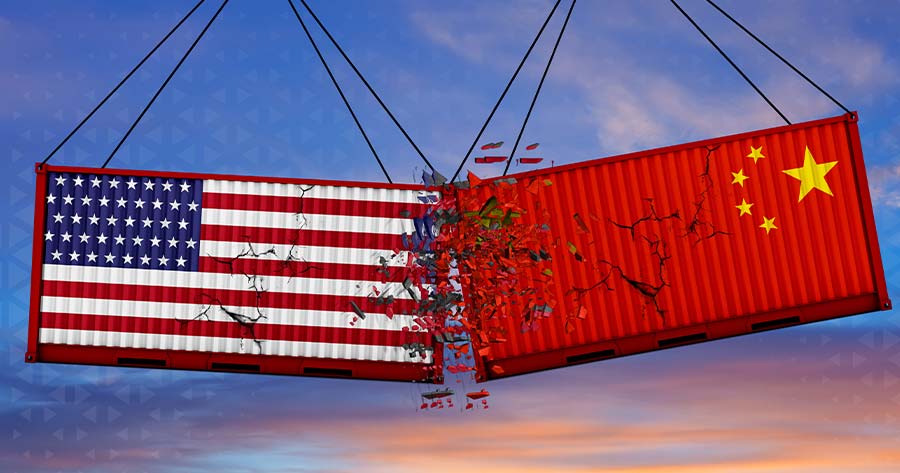
US businesses want their country to drop the idea of slapping tariffs on Chinese imports. They say the tariffs would trigger a chain reaction of negative consequences for the US economy, provoking retaliation, stifling US agriculture, goods, and services exports and raising costs for businesses and consumers.
They say the way to respond to unfair Chinese practices and policies is not by imposing tariffs or other measures that will harm US companies, workers, farmers, ranchers, consumers, and investors.
The trade groups represent everything from the high-tech industry to apparel vendors, agribusiness and auto parts importers, companies such as Apple, Alphabet - the parent company of Google - Walmart and Nike. US officials have been urged to work with like-minded partners to address common concerns with China's trade and investment policies. Unilateral US tariffs would only serve to split the United States from its allies, hinder joint action to effectively address shared challenges, and ensure that foreign companies take the place of markets that American companies, farmers and ranchers must vacate when China retaliates.
The United States has long accused China of forcing US companies to turn over proprietary commercial information and intellectual property as a condition of operating in China.
- 1
- 2
- 3
- 4
- 5
- 6
- 7
- 8
- 9
- 10
Global cotton enters a deficit year in 2026 as supply drop meets logistics risk
The global cotton economy has entered a fragile and sensitive phase. Early projections for the 2026-27 season suggest that world... Read more
India’s textile trade gets a Pacific push as New Zealand FTA removes tariff barr…
India and New Zealand have inked a ‘once-in-a-generation’ Free Trade Agreement (FTA), one that will have a profound impact on... Read more
Lululemon’s world-first nylon circularity push signals a new apparel arms race
The global apparel industry’s circularity narrative is entering a more technically demanding phase. Polyester recycling once the flagship of sustainable... Read more
Beyond the DTC Rush: Levi’s hybrid channel strategy sets a new retail benchmark
The global apparel sector is entering a phase where channel strategy is no longer a tactical lever but a core... Read more
The New Rules of Resale: EPR turning secondhand into fashion’s strategic growth …
The global fashion industry is facing a decisive regulatory and commercial reset. What began as a sustainability narrative around reuse... Read more
The 2027 Mandate: Why denim’s future hinges on verifiable data
For decades, the global denim industry has relied on a narrative of durability, heritage, and authenticity. That narrative is now... Read more
Europe’s textile core unravels as costs, imports and policy pressure bite
Europe’s textile and apparel sector, long seen as a benchmark for craftsmanship and industrial depth, is slipping into a prolonged... Read more
Automation, innovation, regulation are the forces shaping textiles in 2026
The global textile sector has entered a new era. Early 2026 saw the industry breach a $1.06 trillion valuation, reflecting... Read more
The new Brussels rulebook, every EU apparel order is now a balance-sheet risk
The humble export order sheet is undergoing a transformation. What was once a straightforward commercial instrument: SKU, volume, FOB price,... Read more
Why 2026-27 could be a defining cotton year for India’s farm-to-fashion economy
The global cotton economy is entering a more constrained phase, and for India, the implications run far beyond the farm... Read more