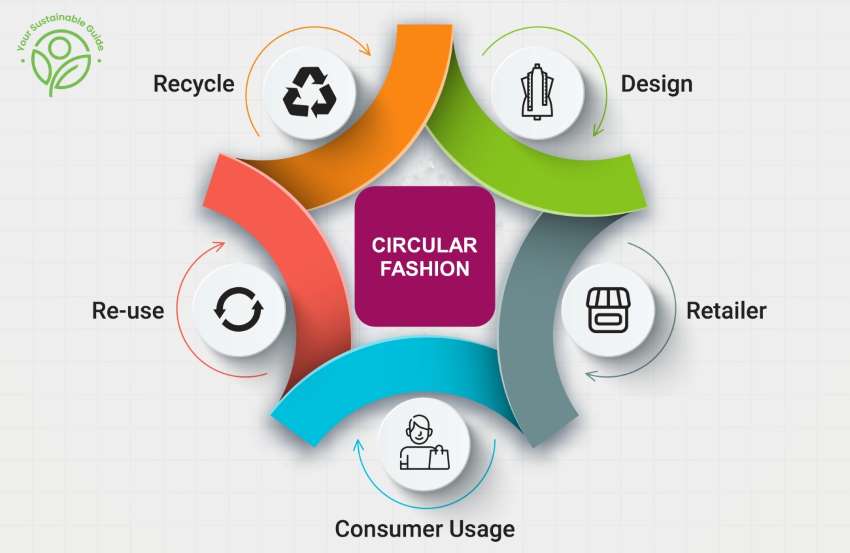
Millennials in the US insist on sustainable products. So, retailers, manufacturers and brands alike in the US are being forced to become environmentally aware. There’s a focus on less-disposable products across all consumer categories, including apparel. Brands are taking a closer look at their supply chains, manufacturing processes, overall and business practices in the context of environmental concerns. As the circular economy grows in importance, companies are researching and developing less environmentally damaging production methods and materials and communicating their commitment to sustainability to consumers.
When it comes to apparel manufacturing, sustainability initiatives can be particularly beneficial for the environment, too. Businesses are pushing their suppliers and partners to improve sustainability because sustainability helps buyers achieve cost efficiencies, improve revenues and boost profitability. Companies that make sustainability a priority stand to benefit immensely, as sustainability initiatives also force them to identify efficiencies in their operations, maximize their supply chains and minimize waste. The result is often an increase in yearly revenue and a renewed sense of loyalty among consumers who see the company as a champion for sustainability. Outdoor clothing retailer Patagonia produces new clothes in a smart, sustainable way. Fashion brand Reformation uses sustainable fabrics and upcycled materials in its clothing and ensures that it partners only with socially responsible suppliers.
- 1
- 2
- 3
- 4
- 5
- 6
- 7
- 8
- 9
- 10
Beyond the DTC Rush: Levi’s hybrid channel strategy sets a new retail benchmark
The global apparel sector is entering a phase where channel strategy is no longer a tactical lever but a core... Read more
The New Rules of Resale: EPR turning secondhand into fashion’s strategic growth …
The global fashion industry is facing a decisive regulatory and commercial reset. What began as a sustainability narrative around reuse... Read more
The 2027 Mandate: Why denim’s future hinges on verifiable data
For decades, the global denim industry has relied on a narrative of durability, heritage, and authenticity. That narrative is now... Read more
Europe’s textile core unravels as costs, imports and policy pressure bite
Europe’s textile and apparel sector, long seen as a benchmark for craftsmanship and industrial depth, is slipping into a prolonged... Read more
Automation, innovation, regulation are the forces shaping textiles in 2026
The global textile sector has entered a new era. Early 2026 saw the industry breach a $1.06 trillion valuation, reflecting... Read more
The new Brussels rulebook, every EU apparel order is now a balance-sheet risk
The humble export order sheet is undergoing a transformation. What was once a straightforward commercial instrument: SKU, volume, FOB price,... Read more
Why 2026-27 could be a defining cotton year for India’s farm-to-fashion economy
The global cotton economy is entering a more constrained phase, and for India, the implications run far beyond the farm... Read more
Luxury resale’s next big battle is no longer digital, it is about who controls s…
For nearly a decade, the luxury resale story was written in the language of platforms. Market leadership was measured by... Read more
Digital Arms Race: Indian apparel giants deploy AI to neutralize tariff crisis
The Indian textile and apparel sector is in a digital survival phase in 2026, shifting from traditional labor-intensive models to... Read more
Europe’s Textile Endgame: Why Project FAE is becoming fashion’s most critical in…
Europe’s apparel majors are no longer treating circularity as a branding layer. With Project FAE or Feedstock Activation Europe, the... Read more