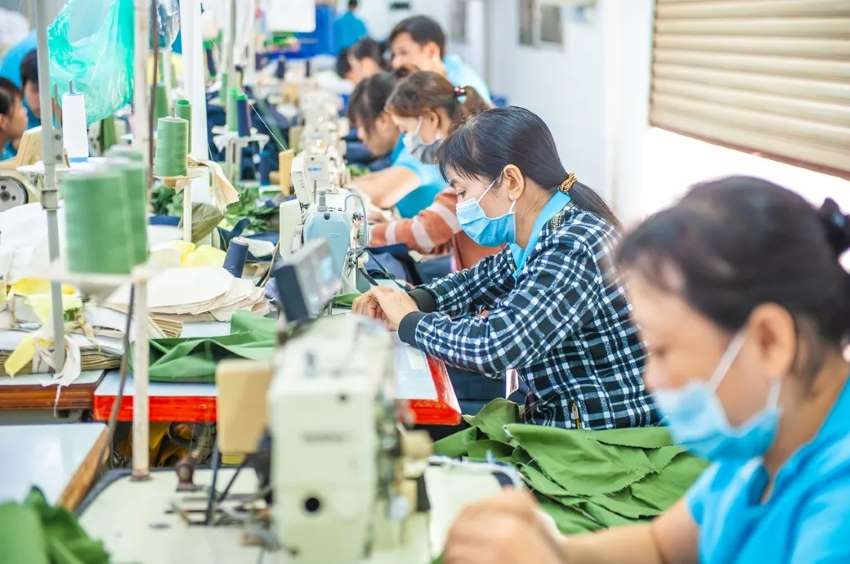
The garment industry in Los Angeles is currently going through a transition period. The tag “Made in China” is becoming more prevalent as minimum wage rises and domestic sewing and textile companies struggle to survive dwindling profit margins.
In comparison to rising expenses and costs to manufacture garments in Los Angeles, countries such as China apply lax legal policies in favor of businesses to produce more garments using fewer financial resources. As a result, many garment manufacturers that focus their business on quantity rather than quality in the wholesale market are now relying heavily toward foreign-based sewing and textile companies to keep their businesses afloat.
Unfortunately it is not all rosy for these garment manufacturers importing textiles from foreign companies. For one, most foreign textile companies do not guarantee copyright ownership of textiles and their designs. As a result, a number of garment manufacturers are being sued for copyright infringements and end up defending not just their claims, but also their retail customers’ claims pursuant to their indemnity agreements.
In an effort to circumvent any copyright issues, some domestic garment manufacturers have taken questionable measures to protect their business interests. The most common way has been to modify or change certain portions of the original textile design purchased from foreign textile companies to try to make it more original. In most instances, such revision efforts have not been successful where there has been substantially similar textile design that already had been registered with the copyright office.
- 1
- 2
- 3
- 4
- 5
- 6
- 7
- 8
- 9
- 10
Cotton markets hold firm as tariffs, higher supply reshape global fiber economic…
In a year marked by tariff escalations, geopolitical brinkmanship and a recalibration of global trade flows, the international cotton market... Read more
Beyond Cotton How Kapok could redefine sustainable insulation in textiles
In the lush, humid heart of Southeast Asian rainforests stands a giant, a silent sentinel of the forest canopy. Growing... Read more
Bharat Tex 2026: Redefining the global textile value chain
Union Minister of Textiles, Giriraj Singh, has officially unveiled Bharat Tex 2026, signaling a significant leap in India’s influence over... Read more
Intertextile Shanghai Spring 2026: A hub for global textile innovation
The textile industry’s pulse is quickening as Intertextile Shanghai Apparel Fabrics – Spring Edition prepares to open its doors from... Read more
Moscow Fashion Week 2026: Blending sustainable innovation with timeless glamour
Scheduled to run from March 14-19, 2026 in Moscow, Russia, the Moscow Fashion Week (MFW) is cementing its status as... Read more
The Store as Stage: How fashion is crafting immersive consumer worlds
The North American fashion retail sector in 2026 is shedding its product-first identity and shifting towards a model that values... Read more
Turning the supply chain upside down, on-demand production reshapes apparel
The global fashion industry, long celebrated for its creativity and scale, is facing a structural reckoning. For decades, retailers and... Read more
Intertex Milano 2026 - A global nexus for textile innovation
Intertex Milano is set to return this summer, confirming its status as a premier international destination for the textile and... Read more
Primark at crossroads as AB Foods weighs spin-off amid digital and Lefties press…
The long-standing supremacy of Europe’s budget fashion champion, Primark, is facing a test. As of February 2026, Associated British Foods... Read more
Vietnam, Bangladesh, Cambodia drive US apparel imports in 2025
The 2025 year-end data for the US apparel sector reveals an industry in structural flux. Despite aggressive tariff measures and... Read more