FW
Mali to increase cotton ouput
Major African cotton producer Mali expects to increase its output to 1 million tonne annually within next two to three years as it plans to introduce new cotton varieties to boost yields. The country is targeting a record 2019/20 cotton crop of 800,000 tonne this year which is expected to make it the top producer in Africa, edging out rival Burkina Faso.
The so-called “Cotton 4” African producers - Mali, Chad, Benin and Burkina Faso - are meeting with other member states at the World Trade Organization in Geneva this week to discuss measures to promote trade. One of the key topics they hope to address is the reduction or removal of billions of dollars of state subsidies which they say create an uneven playing field for exporters.
The United States and Brazil are the world’s top exporters of cotton, with C4 countries together ranking in fifth position with about 1 million tonne in annual export. But proportionally cotton is a bigger contributor to African producers’ budgets and they are also taking steps to encourage more investment in creating African textiles, rather than just exporting raw cotton.
Fynd launches retail app
Fynd has launched Uniket. This is a direct-to-retail solution which will enable shopkeepers in Tier II and Tier III cities to grow their business by getting direct access to the brand’s inventory and the flexibility to buy anytime, anywhere and in any configuration they like. Uniket also enables a shopkeeper to buy in single pieces rather than buying complete sets from a typical wholesale market. Through Uniket, Fynd provides shopkeepers with their own free website and app with a selling capability of over 50,000 styles from 50 brands. Shopkeepers no longer need to worry about customers leaving their shop dissatisfied due to a lack of choice in their favorite brands. By downloading the Uniket store app, shopkeepers can now keep a minimal inventory in their shop, of brands that are in high demand, and also offer delivery of these branded and quality stocks to their customers’ doorstep. The Uniket store app offers up to 45 per cent margin on bulk orders and 15 per cent commission on customer orders.
Uniket’s aim is to tap the unorganised retail market, support shopkeepers and offer a seamless shopping experience to customers across the country. Uniket has on boarded 6,500 stores and has established its presence in 350 cities across 24 states across India.
Fortum, Spinnova unveil wheat straw-based clothing at Vancouver Conference
Fortum, a major European energy company building new business options in the circular economy, along with the sustainable fiber technology company Spinnova are showcasing the world’s first clothing made from agricultural waste, namely wheat straw, at the Textile Exchange Sustainability Conference in Vancouver, this week.
The showpieces include a knitted t-shirt, as well as a jacket and skirt made of a woven fabric on organic cotton warp. The prototype material is unique also due to its extremely low environmental impact from raw material extraction, processing and manufacture, verified by life-cycle analysis (LCA).
Spinnova’s technology, presently in a piloting phase, turns micro-fibrillated cellulose (MFC) directly into fiber mechanically without any dissolving or harmful chemical processes. Fibers of the now showcased clothing were produced at Spinnova’s pilot facility in Finland, which also means that Spinnova’s technology can be applied to various biomasses without further technology development. Now Fortum and Spinnova plan to establish sustainable fiber production at Fortum’s future biorefineries that will use residual biomasses such as agro waste.
The biomass will be processed into materials for bioproducts of lignocellulosic origin, as well as cellulosic products. The refineries will be based on fractionation technology, enabling highly resource-efficient utilisation of wheat straw and resulting in significantly lower environmental impact compared to other processing technologies.
China hosts belt and road forum
A belt and road forum was held in China, September 29, 2019.
More than 200 people from over 20 countries along the belt and road attended the conference and discussed the new opportunities for international textile cooperation and the new trend of global textile economy development under the belt and road initiative.
The forum reviewed the trade and investment cooperation between China’s textile industry and countries along the belt and road, and summarised the overall situation, and key areas of China’s textile industry in terms of international cooperation. A representative from Iran’s textile industry introduced the development history and current situation of the Iranian textile industry, highlighting the rapid development of Iran’s textile and apparel trade after the proposal of the initiative. The forum was aimed at bringing more thoughts and enlightenment to the future development of the world textile economy, and creating opportunities for multi-field integration, multi-party economic and trade activities and high-quality resource sharing in the industrial chain and effectively promoting international cooperation and development to achieve a win-win situation in Asian textile cooperation.
Under belt and road, China is attempting a deep integration of international and domestic markets as well as a more suitable overseas investment environment.
Bangladesh Denim Expo in November
Bangladesh Denim Expo will be held from November 5 to 6, 2019.
The world’s leading denim trade shows will host around 100 exhibitors from 11 countries, including Bangladesh. Other participating countries include China, Japan, Italy, India, Singapore, Brazil, Spain, Pakistan, Turkey, and Germany. Through a series of product displays, presentations, seminar sessions, and panel discussions, the expo will encourage healthy debate and interaction among exhibitors and visitors to champion a more responsible denim industry. The focus is on sustainability and within this the issue of responsibility – an overriding theme of this year’s event.
Bangladesh is now the world’s largest producer of denim and leads the way in terms of addressing some of the sustainability challenges related to denim production, including excessive use of water and chemicals. Each expo marks continued and gradual progress being made by the more progressive players in the industry.
The Sustainable Apparel Forum will be held alongside the expo. The forum will see more than 50 speakers from Bangladesh and overseas, sharing expert opinions across five panel discussions covering current issues about the country’s apparel industry. These include human resources, transparency in business, water conservation, purchasing practices, sustainable chemical management, waste management, circular economy in textiles, and climate change, to name a few.
Lenzing upgrades Refibra technology
Lenzing Group recently upgraded its Refibra technology with 30 per cent more usage of recycled raw material to further drive circular economy in the textile segment. This new offering adds it up in the family of Tencel™ Lyocell fibres with low fibrillation properties.
The new fibers are 100 per cent biobased and manufactured using eco-responsible closed loop production process. They are made using a new technique that shows low fibrillation and moisture management properties with improved breathability, smoothness and strength. The fiber has its applications in denim, athleisurewear, apparel and home textile and with this it has expanded its offering as a sustainable alternative for knitwear, lingerie and towels.
The low fibrillation property of the fibers maintains the smoothness of the fabric even after multiple washes. Also, similar to the other Tencel™ Lyocell fibers the Refibra technology is capable of saving tonne of cotton scraps from being dumped into the landfill, by blending 30 per cent of pulp made from recycled cotton scraps collected from the garment manufacturing units. These sustainable fibers leave least impact on the environment, reusing water and solvent at a recovery rate of more than 99.5 per cent.
Moreover, an additional feature includes a special identification technology that increases the transparency confirming the fibre origin. Tencel™ Lyocell fibres with REFIBRA™ technology are identifiable in yarn, fabrics and final garment stage, which not only improves the supply chain transparency, but also gives brands an upper hand in confirming the sustainability of their fibres to the customers thereby increasing the brand trust.
Exhibitors pleased with International buyer presence at 48th edition of IHGF-Delhi fair
Indian exhibitors are pleased with the turnout of overseas buyers at the 48th edition of IHGF-Delhi fair. The fair is being held from October 16-20, 2019 at India Expo Centre & Mart in New Delhi.
First time visitors to the show Omaya Sisemore of Earths’s Treasures from USA and Antoinette Stander from South Africa were surprised to see a large variety of Indian products on display by over 3,200 Indian exhibitors.

Similarly, Jesica Wilson from USA who has been visiting this show for the last five years noted that this edition focused more on the Reuse and Recycle theme to increase environment consciousness in India. She also said confirmed her visit to the next edition of the fair that will be held from April 15-19, 2020.
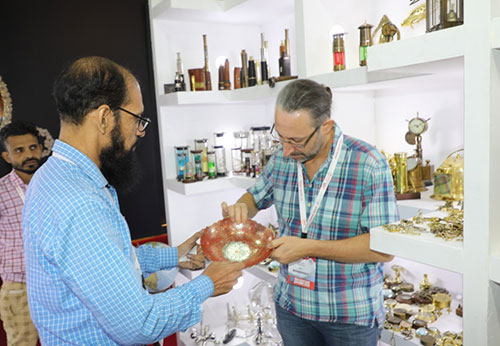
Another buyer from UK, Susan Redford was visiting the show for the 26th time in the last 20 years. She purchases accessories, home décor, gifts, furniture and incense for her company Namaste Ltd from the fair. According to her, the fair has got better with time as it keeps introducing new initiatives every year.
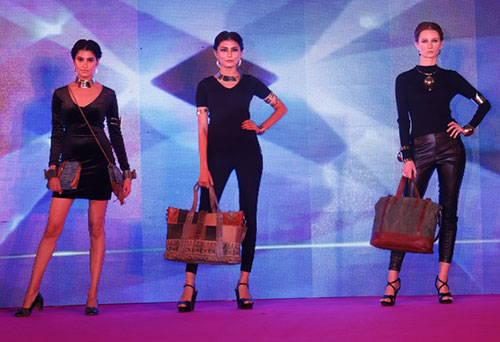
One of the main attractions of the fair included a fashion show on second day. This show had models walking on the on ramps displaying attires, fashion jewellery and accessories contributed by the exhibitors such as Krocks Jewellery, Oriental Exports, Sia Crafts, Vinayak Exports, Kenway Sartaj.
Image Magic installs two Kornit Avalanche Poly Pro Systems
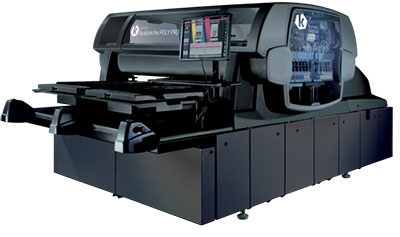 Tokyo-based Image Magic has expanded its longstanding digital direct-to-garment capabilities by installing two Kornit Avalanche Poly Pro systems. The move supplements Image Magic’s continuous development of internal efficiencies, and increases its capacity for an operation that has observed 40 per cent year-over-year growth.
Using the eco-friendly NeoPigment™ Olympia ink set, Kornit Avalanche Poly Pro was developed to extend digital design complexity, color gamut, and durability to polyesters, which have grown in popularity as a result of sportswear and ‘athleisure’ trends. It is the first digital direct-to-garment print system developed specifically for such materials.
Kornit Digital develops, manufactures and markets such industrial digital printing technologies for the garment, apparel and textile industries. The company delivers complete solutions, including digital printing systems, inks, consumables, software and after-sales support. It caters directly to the changing needs of the textile printing value chain. Kornit’s technology enables innovative business models based on web-to-print, on-demand and mass customisation concepts. With its immense experience in the direct-to-garment market, Kornit also offers a revolutionary approach to the roll-to-roll textile printing industry: The brand serves a mix of corporate clients, including some of Japan’s leading apparel brands, and general consumers via a predominantly internet-based sales model.
Digital supply chains to transform fashion industry in future
"Digitisation is taking the fashion industry by storm with many fashion e-commerce companies achieving the unicorn status in the industry. A prominent example of this is the Singapore-based privately held e-commerce start-up Zilingo which is digitising the entire fashion supply chain by unifying the HR systems, logistics APIs and operating systems of over of its 4,000 sourcing partners across the world. This has helped the company to reach $1 billion revenues in a short period of time."
 Digitisation is taking the fashion industry by storm with many fashion e-commerce companies achieving the unicorn status in the industry. A prominent example of this is the Singapore-based privately held e-commerce start-up Zilingo which is digitising the entire fashion supply chain by unifying the HR systems, logistics APIs and operating systems of over of its 4,000 sourcing partners across the world. This has helped the company to reach $1 billion revenues in a short period of time.
In future, the company also plans to incorporate transparency programs that will give it a direct oversight of quality-control issues at the factory level through the provision of real-time data. By using proprietary quality-control modules, the company’s line managers will use connected tablets and a heat map to detect problem areas in their products.
Technology drives growth in apparel companies
Zilingo is thus symptomatic of the rapid advances reshaping the sourcing and apparel industries with tech companies driving the change. Signs of this shift was evident at this year's ‘Sourcing at One Magic’ event, hosted in Las Vegas recently. Many companies attending the event were looking for new ways to navigate the volatility caused by the recent tariff hikes, improve their delivery times and be more sustainable by harnessing the value of big data.
Like Zilingo, the growth of New York-based The Ohzone, has also been driven by the rise of e-commerce platforms and the race to deliver ever more effective online visual search technology in the clothing sector. The fashion technology company specialises in the creation of precise 3-D, zoomable models of real garments. These can be used to market the garment on the Shopify e-commerce platform, as well as to test outfits and change out elements without the need for any inevitably wasteful sampling. The company plans to push the digital apparel envelope further by creating digital-only clothing.
Digital closets gain popularity
The idea of creating a digital closet is rapidly gaining ground with many designers producing photo-realistic, digital-only collections. A prime example of this is the Scandinavian retailer Carlings, with its digital tailors manipulating its client's photos so it appeared that they were wearing the company's limited-run finery – and all at a very real world $30 per piece. Similarly, Moscow-based fashion influencer Daria Simonova modeled her Carlings'3-D collection to her 56,000 followers on Instagram, with her photo of a puffer jacket paired with lightning bolt-embellished jeans notching up more than 4,700 likes.
The power of mobile games
One way brands can leverage the potential of digital closets is through mobile gaming. For instance, Glu Mobile's Covet Fashiongame enables players to style their models in digitally rendered clothing and accessories – brought in $53.4 million in sales last year. Similarly, San Francisco-based company's Kim Kardashian: Hollywood game, allows users to dress an avatar – presumably an amply derriered one – in designer garments, has generated more than $240 million in sales since it was launched in 2014. Meanwhile, the first digital couture dress – created by The Fabricant, an Amsterdam-based fashion label – fetched $9,500 at auction in May.
Digital designerwear is thus on its way to become the next fast fashion with the apparel industry dramatically upping its uptake of IT engineers.
FashionatingWorld receives Media Award at Intertextile
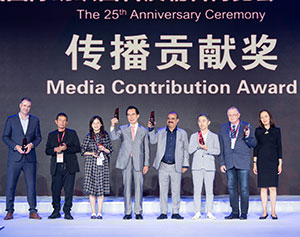 FashionatingWorld, the leading global network of webplatforms, steered by DFU Publications, was graced with Media Contribution Award at the Intertextile Shanghai Apparel Fabrics show in Shanghai. The global media company that has been associated with Intertextile Shanghai events for a long time.
Sanjay Chawla, Global Convener, Publisher & Editor in Chief received the awards among few other media dignitaries. This comes as a high recognition being conferred by the biggest apparel fabrics exhibition in the world.
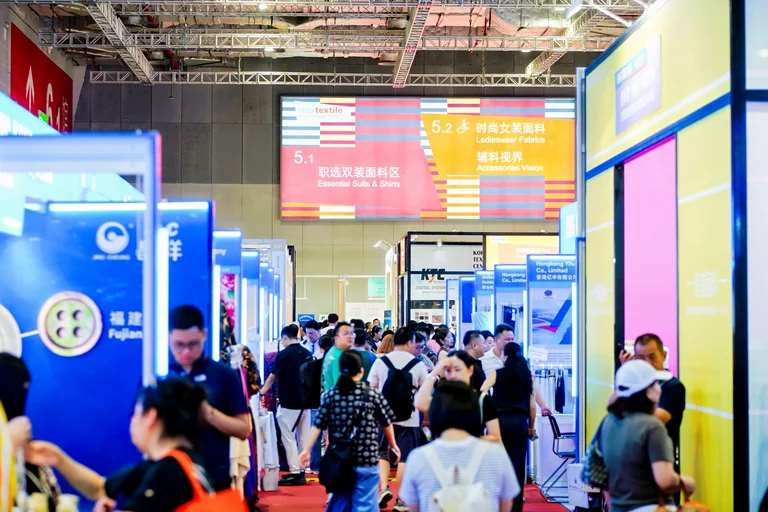
Intertextile Shanghai Apparel Fabrics celebrated its 25th anniversary on September 25, 2019, The trade show awarded leading industry players, experts, trade bodies , exhibitors as well as buyers , who have had a prominent association with Intertextile Shanghai exhibition, all these years.