FW
Dystar unveils first testing lab for the export industry in Bangladesh
Singapore dye manufacturer DyStar Group has opened the first of its kind testing laboratory for the export industry in Bangladesh, providing end-to-end solutions in the supply chain, from raw materials to final products along with the testing services. The new facility, Texanlab Bangladesh, in Dhaka can test not only textile products but also dyes and auxiliaries. The company has Texanlabs in India and Bangladesh, and plans to set up similar labs in cities like Turkey, Vietnam and may be Pakistan.
The new lab would help to support the industry assisting them reduce the harmful chemicals, creating a greener and cleaner environment. Texanlab being a service company of DyStar Group closely works with more than 50 global brands and retailers and has tested more than 3,50,000 RSL parameters since its inception.
Germany-based CHT phases out formaldehyde
Specialty textile chemicals supplier CHT has seen a spike in demand for formaldehyde-free binders used in textile finishing and pigment dyeing – despite some initial doubts about the effectiveness of these types of formulations.
Formaldehyde-based finishes, as is the case with many chemicals used in the textile supply chain, have come under greater regulatory scrutiny. Many customers expected that the formaldehyde-free technology would lead to higher costs and adjustments in production processes. Nevertheless, in 2018 the team of CHT Germany was able to sell more than 500 tons of formaldehyde-free binders in Germany alone.
CHT, based in Germany, has set the goal to become the preferred partner for sustainable specialty chemicals all over the world. In all of its business fields its product ranges are now being increasingly substituted by future-oriented, more sustainable products. In order to future-proof its operations, CHT has also been developing alternatives to a variety of traditional textile chemicals which not only meet but exceed new and existing legal regulations. The ultimate goal of this ongoing work is to completely substitute critical substances and to develop future-oriented alternatives even if the industry has not yet the demand for such solutions. Chemical firms are now moving towards a greener approach to textile finishing.
Bangladesh to ink deal with Russia to boost apparel exports
Bangladesh is likely to sign a MoU with Russia to boost exports, especially in apparels. The country has also been looking at Russia for quite some time as a potential export destination for readymade garments. There is big demand for Bangladesh-made apparel items, seafood, potato, medicine and other products. Russia is interested in importing these items from Bangladesh.”
Bangladesh’s apparel exports to Russia amounted to $427.8 million during the fiscal 2017-18, according to Bangladesh Export Promotion Bureau. Knitwear contributed to $260.6 million of export while woven segment contributed $167.2 million. From July to January 2019, apparel exports amounted to $276.3 million, of $169 million was knitwear items and $107.3 million woven items.
American companies in China delay plans
US companies in China forecast a gloomy year ahead. They are worrying about a deterioration in bilateral trade ties and nearly a quarter are delaying investments. China and the US have exchanged tit-for-tat tariffs on more than 300 billion dollars of goods in two-way trade. The tariffs have directly hit US businesses, increasing costs and lowering demand from Chinese consumers with some companies even forced to lay off workers. About one-fifth of firms have moved or are considering moving production outside of China, with the tariffs and rising costs top reasons. A majority of firms think tariffs should be kept in place in some fashion during negotiations.
Market access -- a long-time concern for US, European and other foreign businesses and at the top of the American administration’s list of gripes -- remains a problem for most companies. Another issue under debate between the world's top two economic powers is protection of American intellectual property, with the US accusing China of encouraging theft of US creations. For one-third of firms this has caused them to limit investment in China, rising to about one-half in technology and resource and industrial sectors.
Nevertheless, China is still a critically important market for many American companies.
Mimaki Europe Launches Make the Difference Campaign to Celebrate, Inspire and Drive Customer Growth and Profitability
Monday 18. February 2019 - Mimaki, a leading manufacturer of wide-format inkjet printers and cutting systems, today launched its, Make the Difference campaign, designed to celebrate Mimaki-powered print innovation and customer success. Produced by some of the most inspirational print service providers and brands across Europe, the project explores digital print diversity with stories focussing on applications from POSPOP to textiles, direct-to-object and 3D applications.
Encapsulated by the campaign’s full title, ‘Your Inspiration, Our Innovation, Make the Difference’, the initiative showcases innovative, high quality and creative commercial projects produced by Mimaki customers. In addition to the creation of a Mimaki community designed to share success, the campaign that will initially run for 6 months, will also form an inspirational catalogue of best-in-class printed applications to drive increased ideas, knowledge sharing, business growth and profitability.
“We are delighted to launch this campaign today and further support and celebrate our amazing customers. At Mimaki, we see success as a team effort,” says Danna Drion, Mimaki Europe’s Senior Marketing Manager. “By working together, we can fuse creativity, technology and energy to deliver incredible results.
“This campaign will highlight the fantastic work that our customers deliver in partnership with other suppliers including graphic designers, artists, architects and engineers – producing jobs that are not only commercially successful, but inspirational and educational too. Over the coming weeks and months, we will be telling their stories, representing industry segments including sign graphics and industrial print to fashion, interior design and architecture. We will celebrate and reward featured customers at FESPA in Munich in May 2019,” continued Drion.
The first series in the campaign, launched today, tells three different stories featuring Mimaki customers and a technical Mimaki blog. These include Gate7 and its client KUHN, a leading UK-based manufacturer of farm machinery, as well as the award-winning University of Huddersfield in West Yorkshire, UK. The technical blog, on the other hand, will explain about a set of Mimaki’s proprietary core technologies used to ensure stable production and continuous operation to deliver superior results. All stories will be available on the dedicated ‘Make the Difference’ campaign page. This page also features a Mimaki customer contact form, for those interested in participating.
“While the campaign has only just begun and we continue to invite customers to participate, we are already excited by many of the applications we’ve experienced so far,” Drion stated, “We hope that the unique blend of art and science, creativity and technology, design and delivery, will provide the inspiration for the development of new and profitable solutions for Mimaki customers across Europe.”
2019: A Year of Growth For Digital Printing
InPrint USA, to be held April 9-11, 2019, in Louisville, Ky., will once again be collocated with the International Converting Exhibition USA (ICE). InPrint will highlight exhibits from industry suppliers that service the functional, decorative, and package printing market. InPrint/ICE attendance will be highly beneficial to companies wishing to keep abreast of the newest technologies and to learn best practices in the complex operations of inkjet printing for plastics, metals, woods, glass, ceramics, and textiles, in market sectors such as apparel, automotive, furnishing and interior décor, labels, signs and banners, and packaging.
InPrint USA 2019 will partner with two major trade organizations; The Wallcoverings Association (WA) and the Flexible Packaging Association (FPA). For both the packaging and wall décor market, inkjet printing has the capability of meeting consumers’ demand for higher print quality, increased number of colors and faster response to market trends. In addition, digital printing enables customized prints and has the unique advantage of enabling color and design cohesiveness across multiple substrates. So for example, businesses such as boutique hotels, wishing to offer residents a lifestyle experience, can coordinate the print décor of ceramic, wood, and carpet flooring, with wall and window coverings, bedding and even packaging of personal care items. Round table participants at the 2018 InPrint conference felt that décor — including textiles, flooring, and wallcoverings — and packaging are the two segments that provide immediate growth opportunities. According to Boston-based I.T. Strategies, research consultants for the digital print community, wallcoverings saw more than $100 million in revenue in 2017, and is one of the many fast-growing sectors within industrial printing. To support the décor print market, a number of new colorant and machinery developments will be showcased that are worth investigation.
Colorant Systems
Switzerland-based Sensient Imaging Technologies, a subsidiary of Milwaukee-based Sensient Technologies Corp., recently introduced ElvaJet® Opal SB inks formulated for low-viscosity Epson® printheads. ElvaJet Opal SC inks for mid-viscosity print heads, such as Kyocera, were launched in 2018 and were awarded the ECO PASSPORT by OEKO-TEX® certification, a certification now also achieved by the ElvaJet Opal SB inks. Both the ElvaJet Opal SB and SC inks offer exceptional digital dye sublimation performance in terms of color, sharpness, and superior release from coated and uncoated transfer papers as low as 18 grams per square meter in weight, according to the company.
 However, the greatest benefit to users may be the ability to standardize colors across different types of printers. Dr. Simon Daplyn, marketing manager of Sensient’s inks division stated: “Users of wide format and industrial printers in the same print shop can now reproduce the same output on all machines because ElvaJet Opal SB and SC inks use the same color reference. This standardization offers unique options for production flexibility and a reduction of consumable costs.”
Austria-based Zimmer Austria Inc. is a producer of machines for textile and carpet finishing. For special applications that require colorant penetration through the substrate such as carpeting, terry towels, flags, and plush, or heavy automotive and home décor fabrics, Zimmer offers the Colaris3 high-performance pre-treatment, digital printing, and colorant systems. The Colaris series of printers can be used with a variety of colorants such as reactive, disperse, acid, pigment, and vat. Inline pre- and post-treatment systems can be added to improve print quality and increase ink penetration.
MAGNOROLL GMA is used as an inline pre-treatment applicator for lighter to medium-weight fabrics.
CHROMOJET (CHR-DPT) is an inline pre-treatment system for medium to heavy substrates such as terry towels, flocked fabrics, velour and carpet.
SUPRAPRESS press station is used as a penetration and equalization device to ensure maximum penetration on qualities like carpets or polyester blankets. Products like velour, or even flags and banners, may also benefit from the additional pressing.
SUPRAFIX SHS is a combined, horizontal color fixation system using optionally saturated steam, superheated steam or hot air condition according to the amount of ink being used. The fixation activity is controlled by a flow through steam/hot air stream and ensures highest penetration, ink fixation and drying in a single pass at shortest possible time.
Printhead Development
The Colaris3 printers can be configured with up to 96 StarFire™ SG1024 compact industrial printheads. Developed by Tokyo-based Fujifilm, the StarFire SG1024 printhead is available in three models for Colaris3 printers, each with varying drop size capability — the SA model is intended for printing light- and medium-weight home decor, apparel, and flag substrates that can achieve ink penetration with drop sizes ranging from 12 to 35 picoliters; the MA model has capability of 30 to 75 picoliter drops and is best suited for medium-weight carpets velours, terry cloth and low to medium plush piles; and the LA model printhead is capable of 75 to 180 picoliter drop sizes for ink penetration of voluminous substrates such as heavier weight carpet, furs, and plush blankets.
The StarFire SG1024 printhead is a compact, self-contained unit built to withstand demanding industrial textile and other applications. The life of the printhead is extended because of the replaceable coated metal nozzle plate and continuous ink recirculation with RediJet™. The printhead is compatible with solvent, ultraviolet-curable and aqueous ink formulations.
Digital Dye Sublimation System Development
The Epson Group, led by Japan-based Seiko Epson Corp., has taken a whole system approach with the Epson SureColor F9370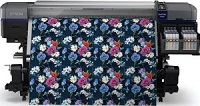 Dye-sublimation Inkjet Printer. The machine offers industrial-level production speeds up to 1,169 square feet per hour and is equipped with dual PrecisionCore® TFP® printheads. The PrecisionCore print chips are based on micro-electro-mechanical systems (MEMS) technology, which uses a 1-micron-thin piezo actuator that acts like a pump to deposit ink.
The ability to pump larger amounts of fluid through densely packed nozzles yields a multitude of small, round, precise dots ensuring a high print quality when reaching high print speeds. The UltraChrome® DS with High-Density Black dye sublimation inks, combined with the included Wasatch® SoftRIP® TX SureColor F9370 Edition softwear from Salt Lake City-based Wasatch Computer Technology, ensures a large color gamut and high color quality.
Features of the software include:
Color Atlas Generator — to create a custom swatch book and match colors accurately by specifying and printing a range of color swatches on a target fabric. RGB values for chosen swatches then may be entered into SoftRIP or saved to a Wasatch Color Database.
Color Neighborhood Analyzer — to specify a spot color and create a targeted 100-patch test pattern centered on that color.
Color Database — enables the user to maintain a list of saved and frequently used colors. The color chosen from the Color Database can be routed through ICC management or directly to print heads, depending on workflow needs.
Single Pass Printers
Single pass printers, capable of printing up to 70 meters per minute (m/min) when set with a CMYK colorant system, now surpass speeds of rotary screen printing. Unlike scan-type printers, single pass printhead systems print on the substrate as the fabric is fed under a fixed print unit. IT-Strategies reported that in 2017, the Lario printer manufactured by Italy-based MS Printing Solutions S.r.l., was installed in more locations that any other single pass printers.
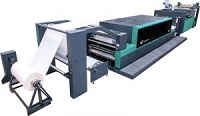 New to this market, and introduced in late 2018, the EFI™ Reggiani BOLT, can reach speeds of 90 m/min. Unique to this system is a proprietary technology for combining digital and rotary techniques for hybrid solutions. One or more analog printing stations, which may be easily connected as an optional feature, can be integrated into the digital printer for special effects or spot colors. The robust recirculating printhead has been developed in partnership with a leading printhead manufacturer and will be available exclusively to EFI Reggiani. With drop sizes ranging from 5 to 30 picoliters, the Bolt is capable of high-quality grayscale images. The year 2019 may prove to be a game changer for digital printing as companies continue to specialize and provide innovative solutions for increased flexibility and speed to market.
Picanol presents rapier and airjet innovations
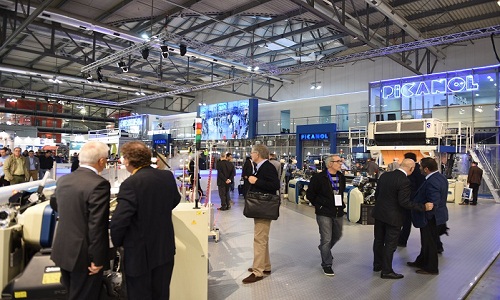
The company will promote its expertise at Igatex Pakistan and Techtextil North America this month. © Picanol
Picanol, a leading textile machinery manufacturer, will participate in this month’s Igatex Pakistan 2019, the largest event for textile machinery manufacturers in Pakistan, which takes place from 26-28 February 2019, in Karachi. Picanol will be present at the booth of Madhani Associates, which has represented Picanol in the Karachi region for the last five years.
“Picanol machines enable production in the four main Pakistani weaving segments: denim, sheeting, bottom weight and terry towel. Both the OMNIplus Summum airjet and OptiMax-i rapier have proven to be the most productive weaving machines,” the company reports. “This is an impressive feat as weavers in Pakistan run the machines at maximum speeds – not a pick per minute less.”
Picanol’s high levels of productivity, speed and efficiency are complemented with the lowest running costs, which come thanks to a unique approach to energy saving, the company explains. “Ultimately, this makes a real difference and is the reason why the number of Picanol machines installed in Pakistan is continuously increasing.”
Picanol also offers an extensive range of services and support including training, electronic repairs, parts, weave-up upgrades, harness frames, machine installation and start-up, and textile set up and optimisation assistance.
The company will also promote its expertise at Techtextil North America 2019, which also runs from 26-28 February, in Raleigh, NC. Picanol will be present at a leading trade show for technical textiles and nonwovens with an information booth.
“The history of Picanol is clearly intertwined with that of the American textiles industry. Picanol set up its own organisation – Picanol of America – on 1 February 1966. Since then, America has always proven to be a market of great strategic importance as Picanol has installed tens of thousands of weaving machines at American weaving mills. Over the years, the technical fabrics segment has become a very dominant area, which makes Techtextil an important fair for Picanol,” the manufacturer reports.
The company will not only promote its rapier and airjet weaving machines at Techtextil, but also the extensive range of services and support that it provides to its many customers from its 18,000 sq. ft facility: training, electronic repairs, new machines installation and start-up, textile technical support, spare parts, and weave-up upgrades.
Hong Kong International Home Textiles and Furnishings Fair: A one stop platform for fine home textiles
"The 10th HKTDC Hong Kong International Home Textiles and Furnishings Fair will be held from April 20-23, 2019 at the Hong Kong Convention and Exhibition Centre. The fair is an ideal sourcing platform and an information exchange hub for fine home textiles. The fair will be held concurrently with the HKTDC Hong Kong Houseware Fair. The twin fairs will form a one-stop sourcing platform to meet buyers’ needs for all kinds of household items and home textiles."
 The 10th HKTDC Hong Kong International Home Textiles and Furnishings Fair will be held from April 20-23, 2019 at the Hong Kong Convention and Exhibition Centre. The fair is an ideal sourcing platform and an information exchange hub for fine home textiles. The fair will be held concurrently with the HKTDC Hong Kong Houseware Fair. The twin fairs will form a one-stop sourcing platform to meet buyers’ needs for all kinds of household items and home textiles.
High-end design-led textiles and furnishings in Hall of Glamour
The Hall of Glamour, the premium zone of the fair will feature high-end, design-led textiles and furnishings. Leading companies including Ava International, Craftex India, I&S, J-Tex (HK) and Kerala Balers, will be present at the fair. Alongside with first-time participating brand Casablanca in the Baby & Bedroom Textiles zone, these exhibitors will showcase their quality textiles covering bedding, curtains, carpets and towels.
Focus on sustainable products
The fair will highlight environment-friendly and sustainable products by labeling exhibitors with green products or hotel supplies for effective sourcing. Other zones include bathroom & kitchen textiles, carpet & floor coverings, window fashion & accessories, upholstery & furnishing products and design solutions and trade services.
Eminent brands to showcase
The fair will display a spectrum of quality textile products from eminent brands. Korean exhibitor I&S Co will showcase high-quality rugs and mats, one of which is the Dwinguler Yoga Mat. The mat adopts a three-layer structure, with the top and bottom foam to provide cushion and support and a fabric layer to prevent bending. Also, its non-slip embossing surface prevents the mat from moving around while exercising, making it suitable for intensive training such as yoga, pilates and gym.
Casablanca Home, a well-known local brand and a first-time participant will present a variety of bedding products, including the patented Anti-Mosquito Summer Quilt which is highly suitable for area under tropical climate.
Group Pavilions for distinctive products
Three textile industry associations from India, namely the Handloom Export Promotion Council (HEPC), Export Promotion Council for Handicrafts (EPCH) and Carpet Export Promotion Council (CEPC) will form group pavilions to showcase the best of textiles products from the South Asian country. Adding to it will be two new group pavilion will be formed by ongxiang Zhouquan and Pujiang, which are both well-known manufacturing bases of premium bedding products especially quilts in Zhejiang Province of mainland China.
Events to facilitate information exchange
To facilitate business matching and networking, product demos and launch pad sessions will introduce latest products to buyers in an interactive and relaxing atmosphere. Participants can also keep abreast of the latest market trends and updates at the forums and seminars held by experienced professionals and experts in the industry.
Luxury fashion loses its shine as profits score above quality for most
"Luxury equaled to quality for many and for many others, fashion labels also equated to safety. They felt safe in buying certain brands like Volvo and Rolex as they ensured quality and a complete value for money to their consumers. However, over decades many luxury brands exploited this sentiment to unreasonably increase the price of their products. For instance, the Saint Laurent leather jacket, which consumers believe to be made from the best materials, plays on their psyche of having invested in a high work of art."
 Luxury equaled to quality for many and for many others, fashion labels also equated to safety. They felt safe in buying certain brands like Volvo and Rolex as they ensured quality and a complete value for money to their consumers. However, over decades many luxury brands exploited this sentiment to unreasonably increase the price of their products. For instance, the Saint Laurent leather jacket, which consumers believe to be made from the best materials, plays on their psyche of having invested in a high work of art.
Fashion brands choose profit over quality
Today, the 20 biggest fashion companies of the world gobble up 97 per cent profit share. To achieve their set targets, these companies either slash the quality of their garments or increase prices. In fact, to sell their low quality clothes at higher prices, they double down on their runway shows, ad campaigns and influencer relationships, which ups the visibility – and lustability – of what they make, rather than the quality.
The result: clothes have become status symbol. Gucci, a brand which originally made goods from high-end leather goods, now makes clothes for the millennials that includes T-shirts, sweats, trainers and phone cases in coffer-swelling numbers. Like brand tees, they’re a way rep your love of the brand in a (comparatively) accessible way. But all this is quite different from what ‘luxury’ originally denoted.
Creating a hype to increase sales
Experts point out if something’s hyped, it doesn’t matter what material it’s made out of, if you want it. For example, Supreme’s box logo tees, which despite retailing for less insane prices, resell for up to £500. To create this hype, brands limit their accessibility. Supreme does it by creating lesser products. Others do it with price: Enfants Riches Déprimes, sells £1,400 hoodies, specifically to lock out a mass consumer. For Vetement, it’s about irony. Its DHL T-shirt appeals to only handful of fashion insiders.
Luxury brands would rather make a loss on their product than have their exclusivity diluted by selling it at markdown. These days consumers can buy mid-to-accessible luxury goods from smaller upstart brands, or even the high street, that are as good as or better than the pieces you would get from LVMH. The price reflects the prestige and branding of the product, so you get a £700 branded sweatshirt that was manufactured for less than £50.
Environmental consequences
The big loser is the planet which has to bear the environmental catastrophes caused by clothing industry. As per Fashion Transparency Index, which ranks brands according to how opaque their supply chains are, no luxury label appears in the top half. Though some have started revealing how their clothes are made, the prevailing trend is that the more expensive the clothes, the less clarity they offer about how they’re made. This is the opposite of how the luxury industry’s long positioned itself, as the home of craft and quality. A huge proportion of couture pieces today are sold at a loss to bestow an aura of quality on goods that are made cheaply but sold at massive markup.
The accelerated fashion cycle, where trends disappear in a matter of months, does not encourage craftsmanship. Instead, consumers prefer to buy clothes with a shelf life, both in terms of how they look and how they’re made. Instead of buying from established designers, they prefer products of the same quality from an upcoming independent designer.
EAC publishes report on UK’s fashion industry waste
The Environmental Audit Committee (EAC) published its report on the fashion industry and the waste that it creates. The report outlines how British people buy more clothes per person than any other country in Europe. What’s more, this amounts to more than 300,000 tonne of textile waste flooding landfills or being incinerated. The report makes a number of recommendations, including creating mandatory targets on sustainability for all fashion retailers that have an annual turnover of £36 million (approximately $47 million) or more.
It also advances a scheme called Extended Producer Responsibility (EPR) scheme. EPR would allow for monitoring compliance with sustainability criteria—for example identifying water usage and how to reduce it—and give benefits to companies who lower their environmental impacts. In practice this might mean a one-penny-per-garment charge which could be waived when retailers demonstrate they have attempted to reduce their impact in meaningful ways.
The report urges the government to support these efforts by shifting taxation systems to more directly encourage reuse, repair and recycling. It also advocates using models like those in Sweden that reduce VAT on clothing repair. This report offers a refreshing insight into an industry that has cultivated rock-bottom prices at a high, hidden cost. It highlights the people caught in its exploitative manufacturing chains and the wider public, who are getting poor-quality merchandise that is harming the environment. The report zeroes in on how fast fashion has failed and how a return to a culture of paying more for quality that will last is one of the key answers.