FW
PolyU showcases 12 collections at PolyU Intimate Fashion Show
The Hong Kong Polytechnic University (PolyU) showcased the creativity and talents of 12 graduating students at the PolyU Intimate Fashion Show held on March 20, 2019 at the Kai Tak Cruise Terminal, Kowloon Bay. The 12 collections were designed and produced by the students majoring in Intimate Apparel and Activewear under the University’s Institute of Textiles and Clothing (ITC), with raw materials sponsored by intimate apparel manufacturers and suppliers.
Four well known personalities from the fashion industry were part of the panel of judges to shortlist the six finalists who were awarded the opportunity to showcase the full set of their design collections at the PolyU Fashion Show scheduled in June this year.
Indian apparel exports up seven per cent in 2019
Indian apparel exports increased seven per cent in February 2019 compared to February 2018. Textile and apparel exports in February 2019 grew three per cent.
Indian exports of manmade yarn/fab/made-ups fell two per cent in February 2019 compared to February 2019. Jute exports (including floor coverings) fell ten per cent. Carpet and handicraft exports too fell three per cent each. India’s share in world trade in textile and clothing is estimated to be 4.95 per cent. With these exports, India is ranked second among suppliers in the world. The stressed advance ratio of textile sub-sector has been improving continuously. From 23.70 per cent in September 2017, the stressed advance ratio of the textile sector has come down to 18.70 per cent in September 2018. The old duty drawback rate which was very attractive came to an end in September 2017. Because of this attractive scheme, Indian exporters advanced their delivery schedules to avail of the duty drawback scheme. Consequently, textile and apparel exports skyrocketed in September 2017. Exports, in September 2018, declined sharply. From that level, however, exports are normalizing which is believed to continue in future as well to end the current financial year flat.
India and the US engage in tit for tat tariff war
The US decision to withdraw GSP preferences to India has come about as a result of the change in foreign direct investment rules in India. The tightened norms that came into effect on February 1 place several restrictions on e-commerce companies, including Walmart and Amazon. Walmart has a reputation of killing small retail businesses with ultra-low prices, a concern that probably influenced India’s decision to tighten FDI rules. While the FDI policy might be irreversible, economic diplomacy can still defuse the situation and prevent the removal of the GSP benefits.
Tensions escalated when India, in response to America’s 25 per cent tariff hikes on steel and 10 per cent levies on aluminium, immediately accused it of unfair trade practices, and, seeking to signal a muscular approach, threatened retaliatory tariffs on US imports.
India’s GSP status came under review after the US medical and dairy industries complained that India was not providing them equitable and reasonable access to its market. India’s use of price control measures against imported drugs and medical devices has grown noticeably. Cardiac stents were put under price controls in February 2016 and knee implants attracted similar action in August 2017, after which trade margins for many medical devices are sought to be capped. US manufacturers complain that in doing so, India has meted out differential treatment to them vis-à-vis domestic players.
India’s cotton output falls to eight year low
India’s cotton output for the year is expected to be the lowest in eight years. Prices are expected to rise if El Nino weakens, exports increase and due to off-season demand. Higher prices will add cost pressure on the value chain, making yarn, fabric and apparel exports less competitive. The situation has been further aggravated by the appreciating rupee. Both higher cotton prices and the rupee movement are reducing international competitiveness of Indian value-added textile products. A stronger rupee will shrink revenues of exporters by lowering price realisation.
Prices in cotton futures market moved up seven per cent on reports of improving demand from China and domestic mills. India has already shipped around 6,00,000 bales to China since October. Indian traders have signed contracts to ship 8,00,000 bales of cotton to China as prices have rallied in that country. Moreover, cotton procurement by Cotton Corporation of India at minimum support price has also helped prices to cross Rs 21,000 levels.
China’s decision to impose 25 per cent import tax on cotton, in retaliation to tariffs enacted by the US, has allowed India to grab a bigger share of the Chinese market. The United States, the world’s biggest exporter of the fiber, has cornered the bulk of Chinese imports for at least a decade.
Egypt upgrades textile machinery to boost cotton sector
Egypt is overhauling its cotton industry. Machines in cotton weaving, ginning and spinning factories don’t handle production of extra-long staple cotton. They operate only with imported short-staple cotton. These obsolete machines will be replaced. Some of the machines in the ginning factories date back to 1878. Modernisation process will include merging some cotton plants, with the aim of increasing production fourfold in coming years. Funds to finance the project will come from the sale of unneeded textile industry assets. Factory upgrade will be the real beginning for modernising the whole industry and is expected to have strong effects on competitive edge of textile products in local and international markets. The first modernised ginning plant is to begin operations in April. It is among 11 ginning plants being overhauled, along with several weaving and spinning factories.
Egypt has comparatively rich advantages in cotton raw materials, extremely preferential trade policies and low production factor costs, which provide a good basis for further development of the textile and garment industry. The Egyptian textile industry contributes almost three per cent of GDP, employs one-third of the industrial labor and generates exports that are 15 per cent of Egypt’s non-oil exports. The industry has been, however, beaten out in the past two decades by the invasion of cheaper products from other countries.
CHIC Shanghai showcases over 1,400 brands, exhibitors wrap up many orders
 CHIC China International Fashion Fair, Asia's largest and most important fashion and lifestyle fair, held from March 12 to 14 2019, concluded successfully with 103,722 visitors. The fair was attended by over 1,365 national and international exhibitors with 1,453 brands from 16 countries. Held over 117,200 sq. mt at the National Exhibition & Convention Center, Shanghai; CHIC attracted visitors from all trade channels including leading department stores, shopping centers, e-Commerce platforms, agents, distributors, multi-brand stores to wholesalers etc.
Discussions held at the fair focused on the latest trends, cooperation between brands and order inquiries. Exhibitors of the international area Fashion Journey from Belgium, Germany, France, Hong Kong, Italy, Korea, Poland, Switzerland, Taiwan, USA were very positive about their participation in the fair.
A lavishly designed stage
Italian manufacturers, under Italian Trade Agency ITA, presented a lavishly staged stand design, with an own catwalk area featuring Italian fashion two times per day to special VIP visitors invited by the ITA Shanghai Office and attracting crowds of people outside the pavilion watching the shows.
Exhibitors were also able to place orders. Giorgio et Mario and Urbahia from France, Leguano from Germany, or Zhongqiao Resources from Hong Kong, caused a stir with their color changing T-shirts and wrapped up many orders. Epoque Hats from Poland, a newcomer at CHIC, had customers visiting from, all over China, Korea, Japan and France.
New format attracts visitors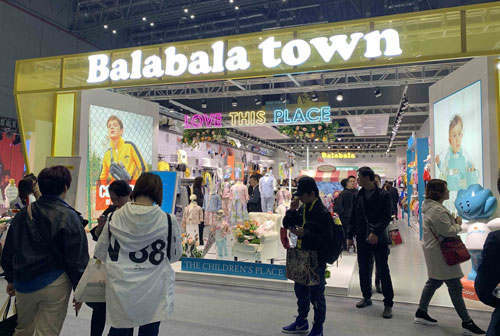
Exhibitors also presented new formats such as Diction in the area of Impulses, an online platform and a showroom for international designer brands, or Hangzhou E-Fashion Town in the womenswear section New Look.
Chic Tailoring, the new Bespoke area at CHIC, attracted thousands of visitors with KuteSmart (formerly Red Collar) presenting its latest tailor-made technology. The customer chooses the design, the fabrics, the style and receives the finished product within 7 days. The complete process takes place via special apps.
At Urban View, market leaders such as GSON, Semir or the HODO Group reported on a large number of inquiries for nationwide representations. TCH (Techno Chillout House), a UK label founded in 1989 in Bristol, drew visitors to the stand with a giant tiger head.
With Topnine, Tilman, Covet Blan from Korea and 4cm, wookong , YZKK and Time Pop, Chic Young Blood presented the trendy street wear labels , which caused a great sensation at the fair.
New entries at the show
The online platforms JD.com and Koalo.com, one of the most dynamic websites launched in 2014 introduced themselves at the event as did DFO Showroom with five product categories and over 60 international apparel and accessories brands in its portfolio and all major retail formats including Galleries Lafayette, Harvey Nichols, Shangpin, Secco, etc. as customers.
Event emphasises need for information exchange
Events such as the Kids Fashion Brand Business Development Meeting, the Jewelry, Bags Procurement Demand Meeting for key buyers, or the Analysis of Consumption Motivation and Marketing Strategies presentation in the Context of Consumption Grading were packed with visitors queuing in the lobby indicating a great need for information exchange.
Discussions were held on topics such as ‘Returning to the Top of Fashion banquet.’ Here market leaders such as Bosideng Group, Toread, Mukzin, Eifini, etc. held intensive discussions with major retail chains including Dashang Group, Tmall etc. The CHIC APP enabled the brnads to arrange appointments in advance of the fair with potential customers.
Zimmer Austria to display Magnoroil coating machine at IDEA19 expo
Zimmer Austria recently shipped its 500th Magnoroll coating machine to be displayed at IDEA19 expo in Miami Beach, Fla. This coating machine has made a name for itself on account of its highest quality and outstanding precision for reliable first class results.
The machine is equipped with state-of-the-art operating software and comes in a unique modular design that combines various coating techniques (knife, screen, slot or magnet roll coating) within just one machine. This minimises machine downtimes and ensures quick adaptation to specific requirements.
Vietnam welcomes CPTPP as a growth driver
The Comprehensive and Progressive Agreement for Trans-Pacific Partnership (CPTPP) is expected to help Vietnam’s GDP and export expand by 1.32 per cent and 4.04 per cent by 2035.
In addition, it is seen as helping increase total job opportunities in Vietnam and cutting down non-tariff barriers to trade and investment in all CPTPP members, which will help ease business costs and risks in Vietnam and increase opportunities for enterprises to expand markets and diversify investment resources. CPTPP members have committed to remove 78 per cent to 95 per cent of import taxes as soon as the agreement takes effect. Many key exports such as agricultural products, seafood, shoes, garment and textiles, wooden products, electronics and rubber would enjoy zero tax immediately or a few years later.
Participating in the CPTPP helps Vietnam multilateralise economic and trade relations, avoiding risks due to dependence on some big markets. CPTPP would create opportunities for enterprises to export timber and wood-based products to boost exports when products such as plywood, picture frames, door frames and especially furniture which are subject to import duties of between six per cent and 9.5 per cent will be freed of these duties. Vietnamese garment and textile products which meet with common technical standards would enjoy a zero tax rate.
US apparel trade deficit up six per cent
In 2018, US trade deficit in apparel rose nearly six per cent from a year ago. The share of US textile and apparel manufacturing in GDP dropped to 0.15 per cent in 2017 from 0.57 per cent in 1998. However, US textile manufacturing is gradually coming back. The value added of US textile manufacturing reached its highest level in 2017 since 2009.
The size of the US textile and apparel industry has significantly shrunk over the past decades. Textiles accounted for over 80 per cent of the total output of the US textile and apparel industry as of 2017, up from around 50 per cent in the late 1990s. Clothing accounted for only 12 per cent of the total US fiber consumption in 2012, whereas the manufacturing of non-apparel textile products in the United States, such as industrial and technical textiles, has been growing particularly fast over the past decade. In 2018, US textile manufacturing and apparel manufacturing lost jobs. However, improved productivity is one critical factor behind the job losses.
The United States remains a leading textile exporter and apparel importer overall. For the first time since 2001, the US textile sector has experienced a trade deficit rather than a trade surplus.
Tirupur investors look at setting up units in Ethiopia
Tirupur-based knitwear industrialists are visiting Ethiopia to analyze the prospects of making investments in the African country. The Tirupur cluster is witnessing an increase in production and operation costs. Many established players are looking for expansion opportunities and Ethiopia offers investment opportunities. With that, they can improve their market shares. Ethiopia offers advantages including cheap labor, ready-to-use sheds, income tax breaks and training subsidies and offers tax-free gateways into the US, Europe and China. From Ethiopia exporters can ship garments without duty to these two major markets.
In Ethiopia, Tirupur units hope to concentrate on producing bulk quantities of basic styles of garments rather than tough styles. Besides the labor cost, which is 50 per cent lower compared to India, another big advantage in Ethiopia is that land and building are readily available. So it is just a plug and play model with cheap power.
Indian textile mills are also setting base in Ethiopia. KPR Mills from Tirupur has started a unit in Ethiopia. Other prominent textile players to have followed suit are Raymond, Arvind, Best Corporation and JJ Mills. KPR has invested in a capacity of ten million units, providing employment for nearly 1000 people. Raymond’s plant in Ethiopia has a capacity of two million jackets.