FW
Orta works toward transparency
Orta Anadolu is on a mission toward greater sustainable denim manufacturing. With the help of Better Cotton Initiative, Orta is contributing towards a sustainable shift. The Turkish textile manufacturer is contributing to a more ecologically sound denim supply chain. One of the ways is by using a washing-machine filter that captures micro-plastics, eventually allowing enzymes to consume the collected waste. Stepping outside the larger format of trade shows and forums, the company is connecting with brands on a more personal level. Believing in the power of collaboration, it wants everyone in the entire value chain to work together. The mill is educating its brand partners regarding greener denim throughout the product lifecycle.
As a part of its push to promote an eco-friendly industry, Orta is using technology to facilitate connections along the supply chain and implementing changes to remain transparent. Using a Lifecycle Assessment QR code printed on its labels, Orta leads its brand partners through its denim sourcing, affording greater insight into how its textiles are produced.
Utilizing more sustainable raw materials at the beginning of the supply chain and less harmful processes during production is a major concern for many denim textile manufacturers and jeans brands.
Germany to host cellulose fiber event next February
A conference on cellulose fibers will be held in Germany, February 11 to 12, 2020. The conference will cover the entire value chain of cellulose fibers from lignocellulosic feedstock, dissolving pulp, cellulose fibers – such as rayon, viscose, modal or lyocell and new developments – to a wide range of applications, woven textiles (clothing) and nonwovens (wipes and technical applications), as well as micro- and nanocellulose for food, cosmetics and pharmaceuticals. The aim of the event is to gather together technology providers and developers, academia and industry, pulp, fiber and equipment suppliers, retailers and textile brands, policy makers and investors to debate recent market dynamics, in other words, all developers, producers and players in the value chain of modern cellulose fibers.
Cellulose fibers are a success story within the textile market with a cumulated annual growth rate of at least ten per cent over the last ten years. This makes them the fastest growing fiber group in the textile industry and also the largest investment sector in the bio-based economy worldwide. The high growth rates are driven by the demand for natural fibers (and bottlenecks in cotton), the microplastic problem and possible bans for plastic fibers. All three drivers will continue to play a significant role in the future development of the sector
Forever 21 downsizes stores in the US
Forever 21 is downsizing some of its biggest stores at malls across the US. Its store count swelled from 480 stores in 2010 to 600 stores in 2014 to 800 stores in 2018. The once-hot retailer is grappling with a sales slump as mall traffic declines and teens gravitate toward other fast-fashion outlets and online-only retailers. Sales dropped by 20 per cent or 25 per cent last year. The average size of a Forever 21 is now 21,000 sq ft, which is nearly half the average of 38,000 sq ft still listed on its website.
As Forever 21 supersized its stores, it filled them with a growing array of merchandise, expanding into children's, men's, plus sizes, intimates and athleisure. However, the company struggled to gain traction among a wider group of customers. In an effort to be everything to everyone, it ended up being nothing to anybody. It also cannibalized sales from some of its existing stores while adding to its fixed overhead costs.
Customers complain there aren’t enough employees on the floor available to help and that they often find entire sections of dressing rooms closed off and cash registers that have been shut down. The company pulled the plug on its China operations earlier this year. It has also been closing stores in the United Kingdom.
Flag clothing gains popularity in USA
Even though Nike has recalled its “Betsy Ross” American flag sneakers, shoppers looking for flag-adorned clothing in stores have plenty of other options as the trend of flag clothing is quite popular in the USA. Nike had intended to release a pair of Air Max 1 Quick Strike sneakers for the fourth of July that featured a 13-star flag, commonly linked to Philadelphia seamstress Betsy Ross, but later halted distribution based on concerns that it could unintentionally offend and detract from the nation’s patriotic holiday.” But when shopping for their Independence Day outfits, consumers should also remember a little known fact: Under the U.S. Flag Code, any clothes with the flag on it are technically illegal.
However, Nike’s idea for a flag-adorned shoe is very much on trend with fashion as there has been a growing interest in classic apparel that can be worn for a long time. Consumers are buying apparels with the flag or its colors for a timeless look. Last week, Gap-owned Old Navy unveiled a collection of purple T-shirts with a flag across the front. The color of the shirts is a blend of blue and red, meant to symbolise unity between the country’s political parties. The brand has also relaunched its flag tees that were originally launched in 1994.
Tommy Hilfiger also plans to relaunch seven pieces from its 90s collection, with items featuring its iconic flag logo and red, white and blue color panels.
Fast Retailing teams up with UN Women to launch empowerment program
Fast Retailing in partnership with UN Women will champion women’s rights and empowerment in the apparel industry. This is the first formal alliance between UN Women and a clothing company based in Asia. Under the new partnership, Fast Retailing and UN Women will together promote safe and secure work environments, and advance empowerment for all women and girls. The scope of the partnership is to jointly implement a program for female workers in garment factories in Asia, Fast Retailing’s main production hub. The partnership also comprises a management training program to further diversity at the company. The project will target partner factories in Bangladesh, China and Vietnam, to identify specific local gender-based challenges that female factory workers face. A support program will be developed to provide specialised training for female workers selected from 200 partner factories in the three countries.
Women comprise the majority of workers in the garment sector, but too often they are segregated into lower paying jobs that offer little chance for advancement. Men occupy the majority of leadership roles, such as line supervisors and managerial positions. Moreover, female workers are often hampered by gender occupational segregation, pay wage gaps, and gender-based recruitment bias, making it more difficult for them to develop sustainable and fulfilling careers.
Companies quit Vietnam over costs
Vietnam’s labor costs are rising. Hence, international apparel makers are slowing down and in some cases, completely halting expansion in the country. Some are now focusing on Indonesia, which is expected to become a significant production base in three to five years.
Manufacturers are worried the US-China trade war will further push up labor costs since tech giants are shifting production out of China to avoid US tariffs. Vietnam has traditionally attracted foreign manufacturers due to its low-cost labor and availability of natural resources but its low cost appeal is waning. Its minimum wage grew at an average of 8.8 per cent a year between 2015 and 2019, making it one of three countries with the highest minimum wage growth in southeast Asia. This, together with robust economic growth and the rising costs of living risks exacerbating regional wealth inequality, has emboldened workers to demand for higher minimum wages. Vietnam raised its minimum wages by an average of 5.3 per cent last January. Along with rising costs, one of Vietnam’s weaknesses is the lack of skilled workers. It is far behind China, Singapore, Malaysia, and Thailand in this aspect at a time when developing a highly skilled workforce is critical for attracting FDI into value-added industries.
The Japan observatory AW to showcase innovative fabrics at Milano Unica 2020
"The Japan Observatory - a convergence of specially selected Japanese companies in business booths; totaling 30 companies and groups, alongside PR and Trend booths will showcase new trends and an index presenting highlighted fabrics at Milano Unica 2020 AW."
 The Japan Observatory - a convergence of specially selected Japanese companies in business booths; totaling 30 companies and groups, alongside PR and Trend booths will showcase new trends and an index presenting highlighted fabrics at Milano Unica 2020 AW.
The new exhibitors at the exhibition include
Fubisya Co: A weaving studio in Fukui Prefecture; Fubisya Co produces woven silk clothes used for clerical garments worn by monks (known as ‘KESA’ in Japanese). The company sells original leno fabrics woven by six rapier looms. Its fabrics normally centre on leno weave using polyester, but it has now developed a weave with silk-cashmere to showcase this time and further present a weave of 70 per cent tri-acetate/30% polyester alongside.
Showa Co: Showa Co will showcase fabrics retaining sustainability/eco-conscious elements such as selvage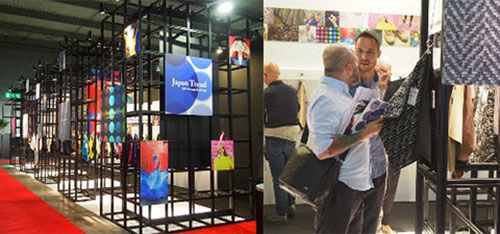 denim that is vegetable dyed on organic cotton and organic wool denim honoured with the PV Award, alongside union denim made of wool and cotton for the autumn/winter season.
The company will present products including: selvage denim (using 60/4 yarn) and stretch denim (using 60/4 yarn), alongside 100 per cent silk denim. Other line-ups will comprise a wide-ranging variation: double-faced denim using double gauze (80 single yarn), nylon denim, as well as sample items featuring lamé prints and/or laser processing.
Toban Textile Co: Toban Textile Co will showcase a fabric with an expressive surface feel; creating an uneven touch derived from the yarn characteristics, belying its seemingly plain appearance, alongside a 100% cotton fabric processed to give a pigskin touch. In their own words: ‘We produced a fabric using natural fibres with a leather-like appearance.
Their sustainable fabrics comprise; organic cotton, recycled cotton and WASHI fabric. They have also developed and successfully produced yarn-dyed 100% cupro (spun) in volume, although fine-count methods normally weaken yarns, hindering mass production. They will further present developed items; covering thickness from a thin shirt-like material to thick fabric alongside double-weave gauze and union cupro/wool cloth.
Toyoshima & Co: With the high demand for sustainable fabrics in European markets in mind, Toyoshima & Co will showcase filament type textile/knits using ‘Tencel’ lyocell alongside spun type for menswear/ladieswear, all of which are produced in the textile regions of Hokuriku, Bishu and Tohoku.
The company will equally introduce ‘Orgabits’ related fabrics at Milano Unica, as part of its contribution to global environmental protection. Its other project to recycle and reutilise food waste, namely ‘food textile, has been already acclaimed via sales in Europe and it will further showcase knits leveraging food waste and using tomatoes, cabbages, coffee and cherries.
Chugai Kunishima Corporation: Chugai Kunishima Corporation decided to participate in Milano Unica to further expand its sales channels. The company will showcase two different types of line-ups comprising 50 itemsd. One involves fabric for menswear, using fine-yarn-count wool. The other type is casual fabric for high-end brands; a blend of linen and wool and piece-dyed, so that only wool is dyed while the linen part remains white and appears as a design. They refer to it as a fabric likely to exist but as yet unseen. When they make a striped pattern, for example, unique stripes in gradation emerge, as if drawn by chalk. They will equally propose other fabrics for unisex use; one with an uneven feel by washer finishing and an original design textile tactfully produced by weaving and finishing techniques.
8th edition of HGH India inaugurated in Mumbai
"The 8th edition of HGH India 2019, the annual trade show for Home Textiles, Home Décor, Gifts & Houseware in India, was inaugurated by Shantamanu Development Commissioner, Handicrafts along with Arun Roongta, Managing Director of HGH India and other dignitaries from the industry."
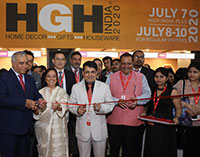 The 8th edition of HGH India 2019, the annual trade show for Home Textiles, Home Décor, Gifts & Houseware in India, was inaugurated by Shantamanu Development Commissioner, Handicrafts along with Arun Roongta, Managing Director of HGH India and other dignitaries from the industry.
HGH India 2019, being held from July 02-04, 2019 at the Bombay Exhibition Centre in Mumbai, connects 700 brands and manufacturers from 32 countries with over 35,000 retailers, brand representatives, distributors, importers, as well as institutional and trade buyers.
One of the highlights of the exhibition includes the presence of international brands from Turkey, Europe, USA,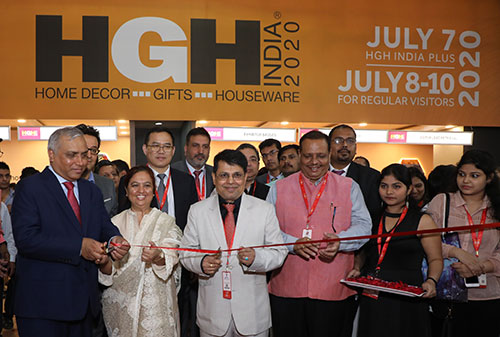 UAE, UK and over 75 exhibitors from China brought through the Zhejiang Broad International Convention & Exhibition Co. Well-known Indian brands are also showcasing a wide range of innovative products in the home textiles, home décor, houseware, and gift space.
Shantamanu, Development Commissioner, Handicrafts, says, “HGH India focuses on the artisans, craftsmen, carpet weavers and handicraft workers. Trade shows like this help in providing exposure to them and watching the biggest names of the industry together on one unified platform, helps them understand the kind of opportunities available. While HGH stands for Home Décor, Gifts and Houseware, for me it stands for Higher, Go Higher.”
Arun Roongta, Managing Director, HGH India, says, “the exhibition is a testimony to the entire home product industry’s trust in the trade show and we are confident that it will be another successful year for all our patrons, accelerating the growth of the home textile, home décor, houseware and gift industries.”
Novelty, innovations, styles to boost future denim sales
"A study by the NPD Group in 2018 titled, ‘The Denim Evolution’ reveals, despite stiff competition denim remains a highly popular category with activewear having 24 per cent of total apparel sales while sales of men’s and women’s jeans making up 25 per cent sales. As per the study in 2018, American women spent $8.8 billion on jeans, a growth of 6 per cent over previous year."
 A study by the NPD Group in 2018 titled, ‘The Denim Evolution’ reveals, despite stiff competition denim remains a highly popular category with activewear having 24 per cent of total apparel sales while sales of men’s and women’s jeans making up 25 per cent sales. As per the study in 2018, American women spent $8.8 billion on jeans, a growth of 6 per cent over previous year.
The report also notes that despite the introduction of new apparel styles, denim holds a major share in bricks-and-mortar sales. Driven by its fits, price and comfort, around 70 per cent consumers prefer buying jeans at physical stores rather than online.
Adequate representation of the denim category
According to Marshal Cohen, an NPD retail analyst, despite their robust growth, denim brands needs to introduce new styles and designs. He cites the examples of retailer Debbie Rudoy, whose shop in New York has 30 per cent of its space dedicated to denim with brands including Mother, Frame, CQY and L’Agence. According to Rudoy, denim will remain the top choice of consumers if retailers represent the category well. These retailers should direct their shoppers to brands that will give them a superior fit in order to create long-term customers.
Offering novelty to their customers
Los Angeles–based designer Rik Guido seconds her opinion. According to her, denim brands need to offer more novelty to their consumers. She validates her statement with the introduction of a new denim brand named La Forme. The brand has created a new denim that though looks like an indigo jean but fits and feels like yoga pants. It is made from an Italian fabric that is 86 percent performance cotton and 16 percent polyester/spandex, retailing for $68 to $88.
Cohen says, the denim sector holds a lot of potential if entrepreneurs are able to satisfy the needs of their customers. According to him, instead of manipulating their consumers, brands should try to evolve with them.
ROICA™ to display five unique yarn groups at Interfiliere 2019
"ROICA™ - the pioneer of innovative stretch fibers, will display five unique yarns groups under the themes of Heritage, innovation and lifestyle at Interfiliere 2019. The Heritage theme will focus on the ROICA Eco-Smart™ family which offers two new sustainable solutions. The first includes ROICA™ EF, a premium stretch fiber consisting of recycled content with GRS certification."
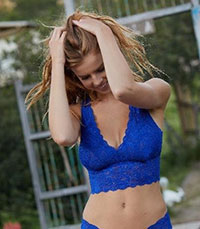 ROICA™ - the pioneer of innovative stretch fibers, will display five unique yarns groups under the themes of Heritage, innovation and lifestyle at Interfiliere 2019. The Heritage theme will focus on the ROICA Eco-Smart™ family which offers two new sustainable solutions. The first includes ROICA™ EF, a premium stretch fiber consisting of recycled content with GRS certification. The second is ROICA™ V550, a sustainable premium stretch fiber certified by the Cradle to Cradle Certified™ Gold Level for Material Health product and ingredients for biological cycle.
Also featured in this area are innovations from ROICA Feel Good™ family of yarns including the unique odour neutralising ROICA™ CF yarn and the ROICA Color Perfect™ range which offers world-first sustainable color solutions.
As part of the “ROICA™ ‘Innovation’ gallery, ROICA™ will explore topics around well-being, tactility,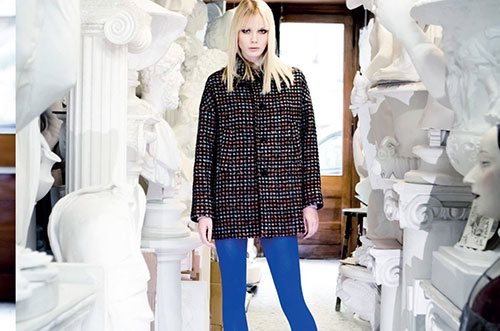 comfortable wearability, advanced colour technology, lustre and performance. A full suite of innovations will be on show including examples from ROICA Colour Perfect™, ROICA Resistance™, and a special focus on ROICA Eco-Smart™ and ROICA Feel Good™ family.
The ‘Lifestyle’ area displays revolutionary and technologically advanced yarns and fabrics with a fresh approach to its style of ‘doing business’. The area features the following brands:
COSABELLA produced by Collezioni SRL: The brand sells in over 100 countries, with a premium collection of 2000 styles for every sector of lingerie and leisurewear. Latest styles use a delicate floral lace by Tessitura Colombo Antonio made with ROICA™ V550 belonging to the ROICA Eco-Smart™ family for their more luxurious upscaled lines.
Livy selects Iluna Group’s contemporary graphic stretch lace with ROICA™ EF for the precious “BELLAGIO” line that includes a soft triangle bralette, a padded bra, a brief and a body for optimal comfort. The must-have range has a stunning aesthetic which represents the unique appeal of this lifestyle brand”.
Sarah Borghi: The worldwide luxury Italian fashion brand offers hosiery, tights, and socks. It scrutinises the finest yarns and evolving technologies to breath flawless life into its unique range of luxurious fashion. The brand has developed the first line made out of sustainable ingredients that will be launched at the ROICA™ booth during Interfilière.
Vitamin A: The Californian brand offers a swimwear made with sustainable high-performance fabrics including a unique jacquard development by Maglificio Ripa with a 3D texture made with the GRS certified premium responsible stretch ROICA™ EF and Q-NOVA® by Fulgar.
Wolford: This is one of the first brands to explore the real value of ROICA™. Known for its exceptional European Skinwear including legwear, lingerie and bodywear, the company has been striving to develop fully degradable items at the end of the product lifecycle.