


FW
Companies monetize e-textiles
Over the past 20 years, e-textiles have progressed from an academic curiosity to an important technology platform generating revenue for companies globally. Companies in e-textiles get the majority of their revenue on a project-by-project basis. Many companies continue to investigate this sector, fuelled by a clear long-term vision for the potential around e-textiles. Electronic products and their surrounding digital ecosystem which they fuel are key products for the four largest companies in the world. The idea is to combine the features of each, providing a comfortable, fashionable, customisable interface between humans and digital products, creating huge value in the process. These early steps are critical to establishing real short-term revenue, before developing towards the bigger picture ideas.
Challenges for e-textiles companies range from optimising supply chain and manufacturing, validating product value in the minds of consumers to end of life management of the products once they are sold. Steps are being taken across these challenges, in investing to consolidate advanced manufacturing in house, pursuing medical approval routes for biometric monitoring after consumer routes have proven unfavorable, and by optimising materials with recycling or disposal in mind.
Most prominent e-textile brands remain relatively young, driven either by recent start-ups, spin-outs from larger companies lower in the value chain, or generally companies outside of the mass-market consumer sector in either textiles or electronics.
Budget lowers textile grants
In the budget, the grant for textile and apparel is about 30.41 per cent lower than the previous year’s revised grant. This is mainly because of the discontinuation of ROSL scheme from March 7, 2019. The new scheme called Rebate of State and Central Taxes and Levies which was announced simultaneously will be issued through free transferable scrips. In terms of percentage change, the maximum change in grant is for the Integrated Wool Development Program, which has increased by about 447 per cent.
In terms of value, the maximum grant is for procurement of cotton by the Cotton Corporation of India, which is 118 per cent higher than the last year. There has been a slight increase of about 12.4 per cent in the Amended Technology Upgradation Fund Scheme. For the handicraft development program, the grant has been increased by about 18.9 per cent. For silk and jute, the grant has been increased by 23.2 per cent. The power loom sector has got an increase of 49.8 per cent in the total grant. The grant for the Integrated Scheme for Skill Development has been increased by about 139.3 per cent.
The textile sector in India is the biggest employer after agriculture.
Apparel Sourcing Paris to be held from September 16
Apparel Sourcing Paris will be held September from 16 to 19, 2019. The event will foster exchange of ideas and allow both visitors and exhibitors to compare information about current trends. This is the biggest trade fair in Europe for sourcing clothes and will host over 700 exhibitors from all over the world. The offer encompasses all the markets for women’s, men’s and children’s ready-to-wear. This covers knitwear, dresses and blouses, tailoring, sportswear, evening wear, outerwear, made-to-measure, lingerie and swimwear, work wear and textile accessories.
The September edition will mark Turkey’s return. The exhibition is also expecting participation by countries which traditionally attend Apparel Sourcing, such as China, which accounts for the main contingent coming to the show from overseas, and Hong Kong, a hub for business with China. However, it will also welcome India, Bangladesh and Pakistan, in addition to Ethiopia. Cambodia will have artisan and classic products on display, such as dresses, tunics and traditional scarves.
There will be a series of lectures on changing markets and topical issues such as clothes sourcing in Vietnam, a supply region which is expanding, and financing for fashion labels. In addition, the agenda includes live catwalk shows and presentations of collections by Bangladeshi, Pakistani, Chinese, Cambodian and Ethiopian delegations.
IFJAS 2019 generates business enquiries worth Rs.145 crore
"The 12th edition of three-day-long Indian Fashion Jewellery & Accessories Show (IFJAS 2019), organised by the Export Promotion Council for Handicrafts (EPCH) generated business inquiries worth Rs. 145 crore on its conclusion in Noida."
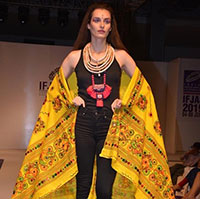 The 12th edition of three-day-long Indian Fashion Jewellery & Accessories Show (IFJAS 2019), organised by the Export Promotion Council for Handicrafts (EPCH) generated business inquiries worth Rs. 145 crore on its conclusion in Noida.
Rakesh Kumar, Director General – EPCH informed that over 504 overseas buyers and their representatives sourced from a diverse range of products showcased by over 250 Indian exporters, manufacturers and entrepreneurs from various parts of India alongwith special regional flavour with participation of artisans from Eastern, Western and Southern regions of India.
The products displayed at the event included fashion jewellery, semi precious fashion jewellery, fashion 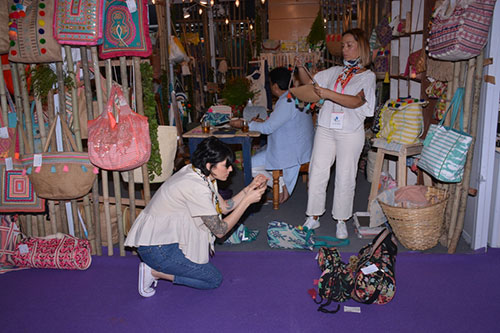 accessories, hand bags, purses, fancy shoes and embroidered fashion accessories etc. The second day of the show included the distribution of Ajay Shankar Memorial awards to best design and display stands. These awards were presented by Manoj Tiwari, Hon’ble Member of Parliament and President of BJP, Delhi.
Buyers from Argentina, Barbados, Brazil, Belgium, Colombia, Finland, France, Greece, Italy, Israel, Japan, Kuwait, Lebanon, Mexico, Nigeria, Norway, Russia, Senegal, Singapore, South Africa, Spain, Sri Lanka, UAE, UK and USA visited during three days extravaganza and sourced the requirement of exquisite range of products of fashion jewellery and accessories.
Apart from above, buyers from CIS countries namely Kyrgyzstan, Azerbaijan, Turkmenistan, Ukraine and Tajikistanand buyers from African countries like Congo, Ghana, Gambia, Senegal, Nigeria and South Africa also visited the show.
The show, which ended with positive note, was organised by EPCH- a nodal agency for promotion of handicrafts exports from the Country and projects India’s image abroad as a reliable supplier of high quality handicrafts.
Indian Fashion Jewellery & Accessories Show presents Ajay Shankar Memorial Awards
"The 12th edition of the Indian Fashion Jewellery Accessories Show, presented the Ajay Shankar Memorial Awards for the best design and display stands. The show is currently being held at India Expo Centre & Mart in Greater Noida. Manoj Kumar Tiwari, Member of Parliament & President BJP Delhi, presented the awards to the selected participants in a colorful ceremony held followed by cultural performances."
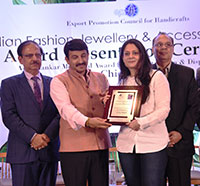 The 12th edition of the Indian Fashion Jewellery Accessories Show, presented the Ajay Shankar Memorial Awards for the best design and display stands. The show is currently being held at India Expo Centre & Mart in Greater Noida.
Manoj Kumar Tiwari, Member of Parliament & President BJP Delhi, presented the awards to the selected participants in a colorful ceremony held followed by cultural performances.
The awards were given in two categories i.e. Fashion Jewellery and Fashion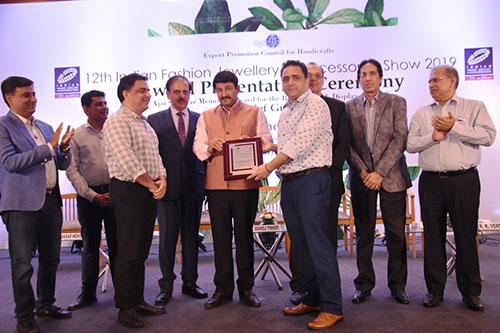 Accessories. One gold, two silver and two bronze awards were given in both the categories.
The Ajay Shankar Memorial Awards were instituted in the memory of late Ajay Shankar, former Development Commissioner (Handicrafts) who was one of the major motivators for establishing this fair.
Tiwari expressed his delight at the range of jewelry and accessories displayed at the show. According to him, the handicrafts sector is not only increasing exports from the country but also creating employment for a large number of artisans and craftsperson.
He further said that the arts and crafts of India are known from the ancient time for intricate workmanship, exquisite nature and exclusive designs. Each state of India have distinct nature of arts and crafts produced at the village level for many centuries. More than 70 lakhs artisans engaged in producing various types of items are the backbone of the handicrafts sector.
AEPC Welcomes easing of credit flows
AEPC has applauded the Indian government on reduction of the corporate tax to 25 per cent for companies with an annual turnover upto Rs 400 crore and proposed reduction in customs duty on wool fibres.
AEPC also welcomed the procedural simplifications proposed - like Interchangeability of PAN and Aadhaar, simplified single monthly return, fully automated GST refund module and the electronic invoice system. The industry hopes to witness a reduction in the compliance burden following these measures.
The industry today is faced with sever working capital shortage, due to long pending ROSL dues, difficulties in getting bank credits and GST refund blockages. AEPC hopes that the Rs. 70,000 crore proposed to be provided to PSBs will ease up the working capital credit flows. The industry is also waiting for the Rebate of State and Central Taxes and Levies (ROSCTL) scheme to be operationalised. We are hoping that the scheme gets enough funding for a smooth roll out and faster clearance of all past dues.
Serena Williams to endorse new accessory by Nike
Nike has chosen tennis player Serena Williams to endorse its new accessory nicknamed as the ‘Broosh.’ This Swarovski crystal sewn-on Swoosh brooch will be worn by Williams on her knit-textured Nike dress.
This accessory is inspired from the decorative jewelry of the past generations but has been given a modern spin. Williams will also endorse Nike’s Flare Knit Low, made with Swarovski Ultrafine Crystal Rocks. The shoe is comprised of thousands of crystal chatons to create a refined surface structure and flexible texture that is incredibly thin and lightweight.
Cifra adds new eco-sustainable yarns to its collection
Cifra, the leader in the production of knitwear with WKS technology which is internationally patented, is investing in research and design thanks to the expansion of its design department and the addition of new eco-sustainable yarns including:
Econyl®: This yarn by Aquafil is a Nylon 6 fiber made completely regenerated waste materials. It has to do with a nylon thread to be exact, coming from recovered plastic materials: fishing nets, and more generally, scraps of fabrics used by the textile industry which are salvaged and regenerated through a complex process of decomposition.
QNova®: This yarn by Fulgar is a pre-consumer Nylon 6.6 recycled and eco-sustainable fiber derived exclusively from regenerated raw materials, and produced according to the criteria and requirements of modern traceability. Q-Nova® consists of waste materials coming from the company's main production cycle. Materials as such cannot be reused in any other way and should be disposed of externally as waste.
The Starlight® by Radici yarn, derived from the post-consumption of PET bottles, offers a valid post consumer alternative.
The Amni Soul Eco® by Fulgar enables garments to rapidly decompose once disposed of and placed in landfills. In favor of a circular model of sustainability, all these yarns will be combined with Eco Smart® by Roica elastomer which lends a very high level of biodegradability to the fabrics.
ISKO I-SKOOL Grand Finale celebrates young talent in the denim industry
The ISKO I-SKOOL™ Grand Finale, held on July 3, 2019 in Berlin celebrated young denim talent. Promoted by ISKO™, leading denim ingredient brand, and carried out with the help of its research division Creative Room™, ISKO I-SKOOL™ - the design denim competition announced its winners with a unique tribute to the Creative Theme.
Launched in January 2019 at the international trade show Premium Exhibition in Berlin, the project’s Creative Theme “New Denim Codes” challenged the designers’ creativity to explore a novel perception of the body, developing the right fit for any shape or form.
A first in the history of the program, this edition was attended by Denim Design Professionals in the early stages of their careers, in addition to students in their final year of a Fashion Design BA or MA. Designers were asked to focus on the body as inspiration, along with a market and target consumer analysis. They then worked on their own vision of the future of fit. They had to go beyond the creation of a single outfit, designing a complete Capsule Collection by selecting some of the most advanced ISKO™ denim fabrics and patented technologies.
The diversity of these emerging New Denim Codes, the variety of body types and the different facets of our society were echoed in many aspects of the evening’s concept and performances, through a mix of elements and materials.
The decision was based on several criteria, such as the impact of the finalists’ vision and storytelling and the actual marketability of the garments, created with the help of Creative Room™. Responsible Innovation™ was an integral part of the designers’ projects as they tapped into ISKO™ premium fabrics, all of which are created implementing responsibility throughout every step of the production process. Part of these innovative fabrics is a special denim selection which led ISKO to be the first mill in the world to have achieved Nordic Swan and EU Ecolabel certifications.
Vietnam supply chain gets stronger
Vietnam’s supply chain diversification has been happening for a few years already, mainly driven by rising labor costs in China. Even before the trade war, Vietnam was getting attention because of the proximity to China and because of the existing infrastructure in the country. The full supply chain has been set up in the country for the past decade already.
In 2018, Vietnam’s exports of textiles and apparel to the US increased 6.19 per cent over 2017. Vietnam is currently the third largest supplier of textiles and apparel to the US after China and India. The country has invested significant effort into building up the apparel sector, in particular. By the end of this year, Vietnam expects to become the second largest exporter in the world.
With the Comprehensive and Progressive Agreement for Trans-Pacific Partnership (CPTPP) now in place, even more eyes are on Vietnam for sourcing. As part of the deal, Vietnamese garments bound for Canada, Mexico, Japan, Australia, New Zealand, Peru, Singapore, Malaysia and Brunei either are already enjoying duty-free access or will within ten years as some tariffs get phased out in waves. Because of CPTPP, a lot more investment into fully vertical supply chains is happening in Vietnam.











