


FW
New and shorter recycling methods to combat fashion pollution
"The problem of waste in the fashion industry is getting bigger. Ariel Muller, Asia Pacific Managing Director of non-profit Forum for the Future, recently noted at the Ecosperity conference in Singapore, the fashion industry, which produces around 10 per cent of global carbon emissions is likely to produce over 26 per cent emissions by 2050. The industry loses around $500 billion every year due to clothes that are hardly worn and rarely recycled. Textiles equivalent to one truck of garbage are either landfilled for burned every second."
 The problem of waste in the fashion industry is getting bigger. Ariel Muller, Asia Pacific Managing Director of non-profit Forum for the Future, recently noted at the Ecosperity conference in Singapore, the fashion industry, which produces around 10 per cent of global carbon emissions is likely to produce over 26 per cent emissions by 2050. The industry loses around $500 billion every year due to clothes that are hardly worn and rarely recycled. Textiles equivalent to one truck of garbage are either landfilled for burned every second.
Harsha Vardhan, H&M’s Global Environment Manager, Production, terms this waste as a missed opportunity that can be exploited for further benefit of the industry. For this, he advises brands to adopt the circular economy model which relies heavily on recycling. However, this could prove as an uphill task as trash is not traditionally seen as treasure and consumers too have an unending thirst for novelty; particularly Asian consumers.
Preferences for new, shiny clothes increases fashion garbage
Edwin Keh, Chief Executive Officer of The Hong Kong Research Institute of Textiles and Apparel (HKRITA) says,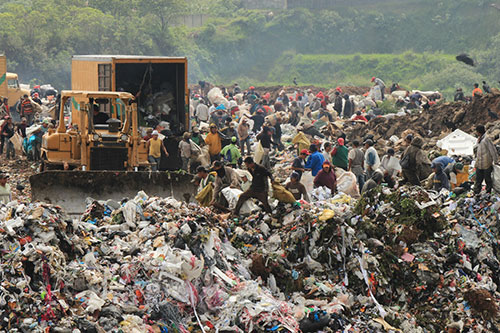 Asian consumers have a deep-rooted preference for the new, bright and shiny clothes which needs to be changed. They associate new materials with quality and value. Also, the traditional recycling methods compel them to compromise on looks and feel of the garments which further increasing their aversion to recycling.
For this Arthur Huang, Chief Executive and Founder of upcycling firm Miniwiz, emphasizes that brands need to revamp their recycling methods. Recycling materials and products and even the recycler needs to be seen as sexy. He advises designers to work with the world’s top lifestyle tastemakers who dictate the current trends in the market. Citing the example of his own firm’s collaboration with sportswear firm Nike, Huang informs that Miniwiz not only incorporated recycled materials into the EVA foam midsole and used Nike’s proprietary Flyknit technology—which is more environmentally sustainable than traditional sports footwear manufacturing methods—but also considered the wider ecosystem.
For packaging, Miniwiz introduced an “Air Bag”, made from 100 per cent recycled polypropylene, each the result of recycling 180 disposable coffee cup lids. The structured bags could be stacked, replacing traditional palettes used in the transportation process, and could be arranged into an in-store installation.
Scaling up business models
Huang opines that even if Asian consumers embrace the idea of alternative materials, the industry must make recyclability as its selling point. It should instead scale up its business models as quickly as possible. A case in point is HKRITA which focuses on shorter and less energy intensive recycling methods. The institute aims to recycle fibre to fibre and garment to garment. It uses heat and pressure to separate and reprocess material which ensures less damage to the material, less energy in the reprocessing, and no generation of chemical waste.
One of Miniwiz’s innovations, the Trashpresso mobile recycling machine also encourages more people to recycle their garments. Consisting of a 12-metre container housing a solid-waste processing line, the Trashpresso machine compacts the recycling process into three steps: reducing the size of the plastic waste, purification and reshaping. The result is usable consumer products such as coasters, bowls and cups, in just four minutes.
Miniwiz pairs the latest technology with artificial intelligence (AI) and data to give the scalability. Latest camera technology and a robust materials data bank is used to identify the materials presented for recycling. The machine processes the trash using AI which allows it apply the correct level of heat and pressure. Collaborations like these between brands, designers, manufacturers and scientists helps the industry move towards circular fashion. It now needs to work together to find solutions to this issue of circularity.
Nisti confers Life Time Achievement Award on Rikhab Jain
 Rikhab C. Jain, Chairman, TT Group was awarded with the prestigious Life Time Achievement Award by the Executive Council of NISTI at the NISTI-ITTA joint conference held on July 12, 2019 in New Delhi.
Jain was awarded for his entrepreneurial excellence, visionary leadership, ethical management, effective organisational abilities and outstanding success in building a diversified business.
An MBA from IIM, Kolkata, Jain also holds a honorary doctorate degree in Business Management. He has many firsts to his credit including pioneering exports in 1964. He has spearheaded many textiles associations including NITRA FOHMA, DHUM, AEPC, (Knitwear Cell).
Winner of lifetime achievement awards from FOHMA, DHUM, SIHMA, TAI and WBHA, Jain is recognised as the pioneer of the hosiery industry. He was recently awarded with prestigious “Transforming India Award” by Ministry of Textiles.
Sale of knitted fabrics to reach 52,000 tonne in 2019
According to the Fact. MR study, sale of knitted fabrics are likely to increase from approximately 49,000 tonne to reach nearly 52,000 tonne in 2019. This growth will be influenced by a variety of factors, such as positive growth prospects of the textile industry and increasing popularity of knitwear among the millennial population. According to the study, sales of knitted fabrics in the APEJ region are likely to reach nearly 35,000 tonne by the end of 2019, which will continue to support growth of the market in the region.
China leads growth of knitted fabrics market in the APEJ region with a whopping 61 per cent share in the global sales of knitted fabrics. China is one of the top clothing exporters in the world, as it accounts for over one-third of the EU’s apparel and textile imports. Domestic manufacturers in China are rapidly transforming their manufacturing strategies with digitalization and automation to bolster their sales of high-quality knitting fabrics worldwide.
The Fact.MR study predicts demand for weft-knitted fabrics will remain higher vis-à-vis wrap-knitted fabrics, owing to the low cost and versatility of weft-knitted fabrics. Weft-knitted fabrics need only single yarn feed, which ultimately helps end-user in the textile industry to cut down the raw material input requirements and the processing steps involved in the production of knitwear apparels. As most end-users are seeking ways to curtail economic, social, and environmental costs of their manufacturing processes, the demand for weft-knitted fabrics has remained consistently high over the period of past few years.
Canadian sourcing show ATSC in August to have leading speakers
Apparel Textile Sourcing Canada (ATSC) will be held August 19 to 21, 2019. ATSC will feature 500 exhibits of the latest in apparel and textile products and services from more than 20 countries. In addition, ATSC will deliver a world-class fashion show, representing local and international designers, up-and-coming student talent and global fashions presented by show exhibitors.
Thousands of representatives from the apparel and textile industry will convene to hear Canadian trade policy updates and future market outlook as well as the latest industry developments. The show will present a leading roster of speakers covering key topics such as customs, imports and exports, investment opportunities for apparel brands and retailers, shifts in the North American apparel retail trade, compliance, sustainability, industry trends and forecasts, latest digital and lean manufacturing technologies, and the future of fashion. Global apparel industry experts will discuss China’s changing role in the international sourcing landscape.
With Canada in the midst of a shifting trade environment, ATSC has put together the most comprehensive sourcing seminars, expert panels and Q&A segments to arm representatives across all segments of the industry — brands, retailers, e-commerce sellers, designers, importers and buying offices — with the knowledge, tools and practical solutions they need to address current industry issues and navigate through the rapidly-transforming sourcing ecosystem.
BGMEA accuses Accord of harming the apparel industry
BGMEA President Rubana Huq has accused the new fire safety related conditions imposed by Accord of harming the apparel industry. She believes that the new conditions are slowing down the pace of the association’s growth. She also accused Accord of violating the conditions of the memorandum of understanding. Bangladesh attracts renowned clothing brands with is its cheap labor. But the sector, which employs over four million workers, had faced some fires and accidents due to lax safety measures. The government sprang into action after the 2012 fire at Tazreen Fashions followed by the Rana Plaza collapse, which highlighted the poor working condition at the factories.
The Accord was formed as an independent and legally binding agreement between brands and trade unions to work towards a safe and healthy garment and textile industry in Bangladesh.
Bangladesh, Vietnam become the second largest apparel exporters in the world
World Trade Statistical Review 2019 released by the World Trade Organisation reveals that Vietnam and Bangladesh have jointly become the second largest apparel exporters in the world in terms of export value. Bangladesh exported apparels worth $32 billion in 2018, increasing from $29 in 2017. On the other hand, Vietnam exported $32 billion apparels in 2018, increasing from $27 billion in the previous year where total global apparel export market is $421 billion.
Bangladesh’s market share in the global clothing market eroded 0.1 percentage points to 6.4 per cent in 2018 from 6.5 per cent in 2017. Bangladesh’s closest competitor in the global market, Vietnam, narrowed the gap with its competitor with its exports increasing by 0.3 per cent to 6.2 per cent in 2018.
China still remains as the top exporter of apparel products with $158 billion, its market share slid to 31.3 per cent in 2018 from 34.9 per cent in the previous year. India’s market share declined to 3.3 per cent from 4.1 per cent, while Turkey’s share declined to 3.1 per cent from 3.3 per cent a year ago.
Punjab warp knitters oppose duty
Warp knitters in Punjab apprehend that the anti-dumping duty would hike prices of domestic yarn, giving an advantage to Chinese products. The anti-dumping duty was imposed at the behest of domestic yarn manufacturers. Knitters wonder why domestic yarn manufacturers need protection at the cost of lakhs of people engaged in fabric production, garment and apparel making. However, manufacturers say the domestic industry is already protected by an anti-dumping on nylon filament yarn, which was lifted only last year.
Warp knitting manufacturers in Punjab roll out a range of products, including shoes, school bags, curtains, briefcases, sports gear and helmets. Warp knitting fabrics are used in a range of items, including upholstery of cars, home textiles, travelling accessories and men’s and women’s wear. This is a highly labor intensive industry. Punjab has some 350 units. Ludhiana has less than 12 units, especially in circular knitting. Due to cheap imports from China and Bangladesh and their predatory pricing, demand from the Kolkata market has drastically plummeted in the past five years. Earlier, Kolkata used to be the major buyer from the Punjab market. The industry wants a hike in import duties to discourage the dumping of warp knitting fabrics from China and Bangladesh.
Uniqlo plans stores in China
Uniqlo aims at having more than 1000 stores in China in three years. The move comes on the back of Chinese consumers’ soaring demand for upscale clothing. Uniqlo will continue to ride the country's booming consumption upgrade to open more stores in lower tier cities.
As of now, the Japanese clothing brand has some 700 outlets in China. Uniqlo will use both physical and online channels to reach its goals. It will also adopt technologies to improve its digital operations, such as developing mobile phone apps and websites so its products can connect digitally with consumers, especially at places where there are no brick-and-mortar stores. Uniqlo, in the meantime, is catering to the new consumption pattern of China's young consumers, who are willing to pay for quality rather than quantity. From 2014 to 2018, its market share climbed from 0.7 per cent to 1.2 per cent in the Chinese market.
Fast fashion produced rapidly to meet the latest trends mainly uses western designs and does not reflect Chinese preferences. Established global and domestic brands face difficulties in maintaining customer loyalty in China. Integration of fashion and traditional Chinese cultural factors is necessary. Retailers need to adopt innovative upgrades and be more responsive to the needs of consumers.
NIPR organises lecture on revival of the moribund Nigerian textile industry
The Kaduna state chapter of the Nigerian Institute of Public Relations (NIPR) recently organised a public lecture on the ‘Revival of Industry in The North, The Textile Example’. Speaking at the event, two notable textile leaders, Dattijo Adhama and Comrade Issa Aremu identified the revival of the moribund textile industry as the fastest way of President Muhammadu Buhari’s mission of lifting 100 million Nigerians out of poverty.
While Aremu called for creation of a ministry for the textile industry, Dattijio Adhama, Executive Chairman, Adhama Textiles and Garments Industry, noted that even if the textile industry produces only pants, it will have a huge capacity to employ millions of Nigeria. He stated that even if Nigeria produces three pairs of pants for each Nigerian annually, it will produce 600 million pants annually.
Adhama also commended President Muhannadu Buhari and Central Bank Governor, Godwin Emefiele for the policy to compel the military and paramilitary agencies to patronise Made in Nigeria textile.
General-Secretary of National Union of Textile Garments and Tailoring Workers Union, Comrade Aremu recommended the establishment of a Ministry for Textile Industry to fast track the full revival of the industry to generate the desired jobs.
Nilit develops new sustainability strategy
Nilit, one of the largest manufacturers of premium nylon 6.6 fiber, has developed a sustainability business strategy that encompasses all aspects of its operations. Nilit’s sustainability business strategy focuses on reducing its carbon footprint, greenhouse gas emissions, consumption of water and other natural resources, and use of harmful chemicals and nonrenewable materials. It also aims to accelerate the creation and commercialisation of new products that are bio-based, biodegradable and recycled.
The strategy calls for adhering to the highest standard with regard to ethical business practices while treating employees, customers, suppliers, and partners with courtesy and respect and choosing to partner with those who do the same. At the same time, it aims to support sustainability education and charitable programs in the communities in which it operates.
The company, headquartered in Middal Haemek, Israel, has also taken significant measures to strengthen its Corporate Social Responsibility (CSR) position over the past three years. It has examined its products and manufacturing facilities, conducting complete Life Cycle Assessments (LCA).
It has also ensured that its policies and procedures fully safeguard its employees and the communities in which it operates, while protecting the planet and the people who inhabit it.











