


FW
11th Bangladesh Denim Expo to give insights on Bangladesh apparel industry
The 11th edition of the Bangladesh Denim Expo will provide an insight into the capabilities of the Bangladesh apparel industry and a forum for the local and international visitors to congregate and learn about the latest denim developments from a host of leading industry exhibitors and experts in their field.
To be held from November 5 and 6, 2019 at the International Convention City Bashundhara, Dhaka Bangladesh, the expo will feature over 100 exhibitors and over 9,000 visitors. It will be held in a new enlarged show space area.
The theme of the expo will be Responsibility. It will highlight the fact that all those involved within the apparel industry have a degree of responsibility in terms of social responsibility, environmental responsibility and economic responsibility to ensure that apparel product is being produced in the most ethical, environmentally friendly, sustainable manner possible, with the highest regard for worker’s safety and well-being.
The aim of the expo is to address burning issues of the day with regard to the long term sustainability of the Bangladesh denim industry and the larger global apparel sector.
Americans keep European retail thriving
American shoppers are helping boost the European retail market says Planet Shopper Index. Looming fears of a US manufacturing recession and the growing threat of a trade war with China aren’t affecting American spending abroad, especially as the dollar remains strong against the euro and the pound. Fashion and beauty are among the main beneficiaries of tourist spending in the UK and Europe. Tax-free retail sales to US shoppers have risen in double-digits for 14 months in succession, with a 15 per cent year-on-year rise in July and a growth of 30 per cent earlier this year.
Emerging APAC economies are also driving European retail growth. Europe has seen rising spend on the part of consumers from India, the Philippines, Thailand and Indonesia. They have helped counter slowdowns from other major luxury spenders like Chinese and Russian tourists.
The ICC Cricket World Cup, hosted in the UK this year, saw an additional 80,000 Indian nationals visit the country, with tax-free sales booming 18 per cent in June. And Indians love luxury brands, the category accounting for 42 per cent of spending by Indian shoppers in the UK. Chinese and Gulf Co-Operation Council shoppers have been traditionally seen as Europe’s biggest luxury spenders.
USA imposes 25% tariffs on all UK fashion and textile exports
 Exports of fashion and textile products from the UK to the USA will be hit with a 25 per cent tariff as a part of the ongoing dispute between the USA and the EU over subsidies granted to both Boeing and Airbus.
The list of products that will be face 25 per cent tariff includes cashmere jumpers, swimwear, bed linen and handbags. This is in addition to the normal duties which will apply. The US has threatened to introduce the tariffs as early as October 17 2019. It has been confirmed that these tariffs will apply even if the UK leaves the European Union with or without a deal.
Simon Cotton, Chief Executive of UKFT, said that these tariffs will have a significant impact on the UK knitwear industry. He urged all parties involved to come to an agreement quickly for the sake of British manufacturers and consumers.
Sustainability initiatives to help global textile dyestuff market earn more revenues
Researchers from the Texas Tech University have developed a method to separate toxic dyes from wastewater. Hence, the global textile dyestuff market is expected to earn sustainable revenues at the back of improvements in waste management technologies. Moreover, the need for dye testing has also created a large playfield of opportunities for the market vendors.
According to a recent study, the global textile dyestuff market will expand at a moderate CAGR of 5 per cent over the period between 2018 and 2026. Furthermore, the total value of the global textile dyestuff market, which stood at US$ 5 billion in 2017, is expected to increase. The growth of the global textile dyestuff market largely relies on advancements in the clothing and apparel industry.
The need for dying garments and apparels is amongst the leading drivers of market demand. Furthermore, textile dying holds tremendous significance for the chemical industry as it helps in analysis of dye properties. Textile manufacturers are required to cater to the needs of a heterogeneous mix of consumers. This factor, coupled with availability of improved dying technologies, has played a vital role in market growth.
Textile manufacturers are making earnest efforts to improve their waste management procedures. Some of the leading vendors in the global textile dyestuff market are BASF SE, Archroma International, Huntsman International LLC., Bozzetto Group, Lanxess AG, and Dystar Group.
Colorjet showcases new collection at NYFW 2019
"ColorJet India, India’s biggest manufacturer of digital inkjet textile printers in association with Niti Singhal, a renowned fashion designer from the house of ‘Twee in One’, showcased their collection at Flying Solo at New York Fashion Week (NYFW) 2019. NYFW was held from September 6-11, 2019. It was attended by over 70 designers and 700 celebrity guests including Gigi Hadid, Priyanka Chopra and Kriti Sanon."
 ColorJet India, India’s biggest manufacturer of digital inkjet textile printers in association with Niti Singhal, a renowned fashion designer from the house of ‘Twee in One’, showcased their collection at Flying Solo at New York Fashion Week (NYFW) 2019. NYFW was held from September 6-11, 2019. It was attended by over 70 designers and 700 celebrity guests including Gigi Hadid, Priyanka Chopra and Kriti Sanon.
The designs showcased consisted of a mix of cotton wrap satin fabric printed with reactive ink, polyester crepe fabric printed with disperse ink and cotton satin fabric printed with pigment ink.
Flying Solo is an innovative fashion brand, an organisation of designers and a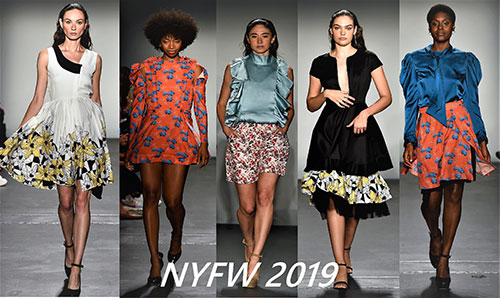 platform,which is revolutionising fashion by making up-coming designers the main beneficiaries. The result is a hotbed of creativity, inspiration, and the most vibrant experience in New York City.
ColorJet with its various Digital Printing Solutions provides a better and a sustainable way of printing. ColorJet printers has advanced capabilities to match the pace of ever evolving trends and has opened new avenues for many who are looking out for superb quality and innovative design.
Founded in 2004, ColorJet India, the largest manufacturer of digital inkjet printers in India, maintains its operations via two manufacturing facilities and sales offices spread across seven countries, which include India, China, Bangladesh, UAE and Sri Lanka. ColorJet India markets its products in 25 countries worldwide and has installed and implemented over 4,000 of its printing solutions and products across 450 cities around the world backed.
C.L.A.S.S. partners with ROICA and Varvaressos at Filo
"C.L.A.S.S. partnered ROICA and Varvaressos at Filo-the international fair dedicated to yarn held in Milan from September 25- 26, 2019. The ROICA EF– GRS (Global Recycled Standard ) yarn is made with 58 per cent f pre-consumer recycled content. GRS guarantees its sustainable mission with a certification by the influential Textile Exchange, one of the most known and recognised global players in the market."
 C.L.A.S.S. partnered ROICA and Varvaressos at Filo-the international fair dedicated to yarn held in Milan from September 25- 26, 2019. The ROICA™ EF– GRS (Global Recycled Standard ) yarn is made with 58 per cent f pre-consumer recycled content. GRS guarantees its sustainable mission with a certification by the influential Textile Exchange, one of the most known and recognised global players in the market.
The ROICA V550 breaks down without releasing harmful substances under the testing environment according to Hohenstein Environmental Compatibility certification. Made and engineered by Asahi Kasei R&D team, and produced in ROICA German plant only, the yarn offers additional and relevant circular economy advantages linked to material health as proved by a Gold Level Material Health Certificate by the Cradle to Cradle Product Innovation Institute for a safe and biological end of life cycle.
FILO's visitors were invited to attend "Smart Yarn: Spinning Sustainable Solutions For The Fashion Of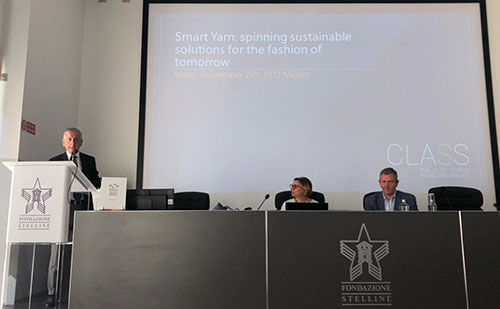 Tomorrow", the talk held by C.L.A.S.S. founder Giusy Bettoni and Andreas Röhrich, Director of Product Development & Innovation at Wolford AG. The company has chosen ROICA™ V550 in its ultimate Aurora collection. Since years Wolford strives to develop fully degradable items at their end of life. On top of last year achievement of the Cradle to Cradle Certified at GOLD Level certification for the biological cycle, recently Wolford got it also for the technical cycle by using the Econyl yarn made by Aquafil always in blend with ROICA V550. .
Greek yarn manufacturer Varvaressos unveiled the new generation smart cotton, Supreme Green Cotton born from an innovative and socially-responsible system granting sustainability from the cotton seed to the garment while supporting farmers and businesses at the foot of Mount Olympus. The Supreme Green Cotton Collection matches the highest European and international standards, without compromising on quality. The collection perfectly meets the requirements for high-end garments, thanks to excellent uniformity, superior strength, contamination-free and long-staple eco-fibers.
Cotton yarn exports by india decline by 26.41%
According to a report by DGCIS/MOS, the export value of cotton yarn declined by 26.41 per cent to US$ 1,999.21 million during the January-August 2019 from US$ 2,716.77 million in the corresponding period last year. In terms of quantity, the exports declined by 21.99 per cent to 668.44 million kilograms to 856.44 kilograms.
The export value of cotton yarn from April-August 2019 declined by 38.6 per cent to US$1,081 million from US$ 1,762 million in the corresponding period last year. Quantity wise, the country exported 35.7 per cent less cotton yarn during April-August 2019 than 552 milion kilograms exported during April-August 2018.
Fashion for All gains popularity as brands transcend size, gender boundaries
"For decades, most retailers and brands focused on traditional sizing with a few plus size offerings (beyond size 0-12) often hidden at the back of the store. However, it is no longer acceptable for brands to cater only to a specific size or body type. They are now reaching beyond the norm into new categories and products in terms of size, culture, gender and sustainability. This is offering them new opportunities of revenue generation as Millennials and Generation Z are increasingly investing in these categories."
 For decades, most retailers and brands focused on traditional sizing with a few plus size offerings (beyond size 0-12) often hidden at the back of the store. However, it is no longer acceptable for brands to cater only to a specific size or body type. They are now reaching beyond the norm into new categories and products in terms of size, culture, gender and sustainability. This is offering them new opportunities of revenue generation as Millennials and Generation Z are increasingly investing in these categories.
A prime example is H&M criticized for stocking smaller sizes than even most American brands. The brand has now adjusted its sizes to be more in line with American shapes, and launched a plus size line. Similarly, J.Crew, which received widespread backlash for the launch of its infamous size 000 in 2014, has expanded to size 24 across all merchandise. This extension in sizes is not limited to women’s clothing alone. Even menswear brands are tapping into this growing trend. Bonobos, which earlier offered diverse sizes for only women, has now created more inclusive men sizes.
Brands open up to modest fashion
Modest fashion is becoming a huge rage these days. A 2018 study estimates 40 per cent of current women’s luxury ready-to-wear can be categorised as modest or modest-accepted fashion. This is evident from the fact that the designs of Safiya Abdallah, Founder of fashion label Dulce, featured in this summer’s edition of the Cosmopolitan. The magazine described the designer as a ‘proud hijabi-wearing woman opening up a whole world of chic options for Muslim women.’ It also describes the designs of hijab as fresh, fierce and super stylish while still maintaining a modest look.
Inclusive fashion also dominates the marketing campaigns and designs of many fashion brands. H&M has developed an entire collection designed on modest clothing. Just like H&M, six other designers engaged in modest fashion were recently profiled by Good Morning America.
Emergence of gender fluid fashion
Just like inclusive fashion, another concept becoming increasingly popular is gender-fluid fashion. Recent data shows, around 38 per cent Gen Z-ers ‘strongly agree’ that gender no longer defines a person as much as it used to, and 27 per cent millennials felt the same. To cater to the growing demand for off gender fashion, brands like H&M, Gucci, Aeropostale, Zara and Prada are launching gender fluid lines. independent designers too are launching own unisex lines. Besides brands and designers, the concept of genderless fashion is also extending to new store formats. Department stores are experimenting with gender-blending styles. Galeries Lafayette, as an example, opened its flagship on the Avenue des Champs-Élysées last spring, and mixed men’s, women’s and unisex sections throughout the floors.
Sustainability and transparency
Just being size inclusive is not enough for brands these days. They also need to be sustainable. Many large brands and retailers like TomboyX, Girlfried Collective, Sotela and Reformation are working to adapt their practices to becoming more sustainable.
Along with sustainability, brands also need to advocate transparency. Their initiatives towards inclusivity need to be legitimate and authentic. They should also embrace different views, races, gender identifications, styles [and] social connections along with sizes.
Duty free Bangladesh garments flood India
The Indian apparel industry is worried about duty-free imports of readymade garments from Bangladesh. Bangladesh can export more than 60 products including garments to India, without any duty, under the South Asian Free Trade Area (SAFTA) agreement. These exports have grown 480 per cent in the last five fiscal years. Textile goods produced and sold in India are subject to GST. However, the same products from Bangladesh reach India without any duty and so there is a ten per cent to 15 per cent cost difference between the products.
Many big Indian apparel industry players have set up manufacturing units in Bangladesh and they are also involved in exports to countries that include India. China, though, poses the biggest threat. China uses Bangladesh’s trade advantages to sell its fiber as well as machines. Chinese textile companies provide the fiber and fabrics to units in Bangladesh and get them exported as finished goods to India.
Bangladesh’s share in the international readymade garment market is second only to China’s. Bangladesh enjoys various trade advantages as it is one of the least developed countries. Also, it has the advantage of cheap labor and all these factors have put Bangladesh in second place in readymade garment exports.
Yarn manufactures in india demand increase in import duties
The Indian Manmade Yarn Manufacturers Association has demand an increase in import duties as an increase in viscose staple fiber yarn imports to India and low import duties have caused a slowdown for domestic manufacturers.
VSF yarn imports to India have increased by 200 per cent year-on-year in the first five months of the current 2020 financial year. The increase in cheap yarn imports has forced domestic manufacturers to lower their prices, which has led to financial difficulties, especially for the smaller businesses.
There is at least one month of unsold inventory across both large and small spinners who are now contemplating production offs of one-two days a week. An increase in import duty on VSF yarn from 5 per cent to at least 10 per cent will give these spinners a level-playing field to the industry.











