


FW
The USMCA deal to rewrite North American trade
 For domestic textile manufacturers and importers in the US, the United States-Mexico-Canada Agreement (USMCA) is a like the medicine that though doesn’t cure but does not hurt either. These manufacturers view the agreement as an extension of the North American Free Trade Agreement (NAFTA) that ruled trade between the three countries for a quarter century. Though experts viewed NAFTA as a threat to local jobs, US textile companies viewed it as a getaway to an export market in the south.
Victory for domestic manufacturers
On the other hand, the newly christened trade pact is being seen as a victory for domestic soft-goods and shoe stakeholders. According to Steve Lamar, CEO & President, AAFA the deal provides domestic textile, apparel and footwear industries an assurance of support to supply chain operations that employ hundreds of thousands of Americans.
The deal encourages American businesses to continue to work with supply chains in the North American region, says Lamar. It does not impose unnecessary trade barriers, such as punitive tariffs which are important for businesses as they recover from the effects of COVID-19 on their businesses, he adds.
US Trade Representative Robert Lighthizer worked closely with the US Congress to get the deal approved. According to the USTR, the deal contains significant improvements and modernized approaches that will deliver more jobs, ensure labor protection, expand market access and offer greater trade opportunities for large and small companies.
Concerns about USMCA the deal
However, supply-chain risk intelligence analyst Tim Yu of Resilience360 raises concerns about the new rules and changes that USMCA introduces. According to him, the deal could affect North American supply chains, including major amendments to rules of origin, higher de minimize thresholds, labor rights obligations, customs facilitation, intellectual property, environmental protections, and digital trade and e-commerce. The rule will compel the defendant to prove that an alleged labor rights violation will not affect trade or investment between parties, he says.
According to Yu, the deal will benefit digital trade and e-commerce firms, retail manufacturers and agriculture producers by offering them greater market access and trade liberalization measures. However, it would also affect North American production by incentivizing foreign companies to move production elsewhere to avoid additional trade restrictions.
Kim Glas, CEO, National Council of Textile Organizations (NCTO) stresses that the deal will greatly benefit the US textile industry at a time when domestic producers, have converted their production lines to manufacturing personal protective equipment (PPE) for frontline workers during this crisis. According to him, it is absolutely critical to sustain the $20 billion in apparel and textile trilateral trade between the US Mexico and Canada and USMCA can go a long way to ensure this.
The pandemic, an opportunity to make or break US textiles, apparel industry
 The Coronavirus outbreak across the US has exposed the country’s ineptness in manufacturing critical textile-related personal protective equipment (PPE) on an emergency scale. With great difficulty, factories across the country were able to manufacture the required products like face masks and gowns for frontline workers and the public.
One reason for this is the slow pace of textile and apparel industry revival since the Great Recession. It made retailers and brands realize the importance of sourcing at least a portion of their merchandize closer home. Coronavirus might accelerate this trend further, fuelling the growth of domestic textile industry.
Strengthening supply chains
The pandemic offers domestic textile players an opportunity to regain their position as producers. And as Kim Glas, CEO, National Council of Textile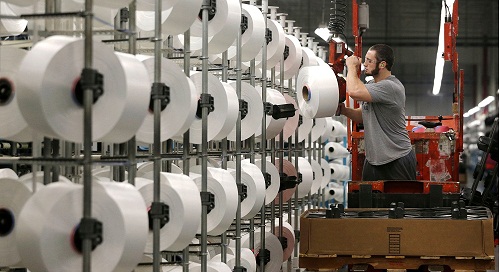 Organizations (NCTO) points out, lawmakers and key decision makers need to introduce new policies and fund to strengthen existing textile supply chains besides attracting new ones.
Glas advises textile leaders to build on the woven fabric and yarns industry in the country. As the US does not have a lot of cut-and-sew operations, it is currently automating some of its finished products to better compete with imports in speed and in lowering labor costs. Manufacturers in the country have also opened new facilities to convert textile and other waste to new textile uses and resins
Policies for domestic producers
The government should draft new policies to support the growth of these industries, Glas feels. It should prioritize domestic production chains and make adequate investments into it. The industry should also appeal to its customers to buy products made in the US only, especially products like masks and other supplies, views Sherry Wood, Director-Merchandising, Texollini.
Experts opine though some production is coming back online and orders are picking up, customers are reluctant to spend due to the looming financial uncertainty. Hence, there is a need for brands and retailer to strengthen domestic industry and production chains that exist with its free trade agreement countries in the Western Hemisphere.
Foundation for ‘Made in America’ supplies
Ed Gribbin, President, Americas Apparel Production Network (AAPN), views the pandemic as an opportunity for the textile and apparel industry to build a foundation for a ‘Made in America’ supply chain for critical medical supplies. Wood also believes it offers ‘Made in America’ to be a key sourcing destination. Consumers, including those in the fashion industry were moving away from products made in China even before the pandemic. The pandemic has accelerated their move.
Preeti Arya, Assistant Professor, Fashion Institute of Technology, advises the industry to revise supply chains for sampling, R&D and small manufacturing, especially of nonwovens and more sustainable yarns and fabrics.
Challenges in the way
Julia Hughes, President, United States Fashion Industry Association argues even though the move to bring apparel production back to the US is welcome, it is not feasible as it is difficult to find companies that make on a cost competitive scale in the country. Hughes acknowledges production of yarn and fabrics in the country is very competitive as the industry has begun to embrace automation and robotics into production.
Once, the pandemic is over, the apparel industry might again revert to producing cheap products as many retailers have gone bankrupt due to COVID-19 losses. This could arrest the revival of ‘Made in America’ apparels in a big way, opines Hughes.
CFDA cuts days for New York Fashion Week
The Council of Fashion Designers of America hasl cut back the number of days designated for its spring shows in September to three.
In a notice sent to members and obtained by WWD, the spring shows will now run Sept. 14 to 16. If there is enough demand. Sept. 17 will be added as a supplemental day.
The group stressed that the shortened calendar will be for the September shows only and no decision has been made for pre-fall 2021 or beyond.
The group is working on an updated version of the official NYFW application for returning or new brands that will be shared in the coming weeks. It is also planning to provide all participating brands with digital resources to showcase their collections that will allow them to share their latest work, maximize exposure and operate directly with the industry.
EPB increases export target for FY2020-21
The Export Promotion Bureau (EPB) of Bangladesh has increased its export target for FY 2020-21 by 13 per cent. The bureau has set a $37.44-billion export target for the year for expects exports to reach $33 billion by the end of current fiscal year, 2019-20. The initial target for the outgoing fiscal was $45.50 billion.
As per the target, the ready-made garment (RMG) sector will contribute more than 82 percent. Additionally service export will contribute $7.6 billion. The apparel industry has witnessed 82 percent and 62 percent negative growth in April and May respectively this year compared to last year’s April and May. Total export earnings during July-May fell b by 17.99 percent to $30.99 billion, from $33 billion in the same period of last fiscal year.
Bangladesh fetched $34.13 billion from RMG export in FY ’19 marking 11.49-per cent growth over that in FY ’18. The compound annual growth rate of apparel export in the past five years has been 6.86 percent.
The export sectors need government policy support to overcome the pandemic’s impact and sustain, she opined. According to the business leader, such a decline has not yet been detected in the history of the industry. Exports fell $6.6 billion in the current fiscal year, close to a fifth of last year. The RMG sector experienced a 4.6 billion export decline in the just three months from April to June 2020, exacerbating the impact of COVID-19 on the industry.
Google, WWF Sweden partner for a data-driven platform on sustainability
Google and WWF Sweden are partnering to create a data-driven platform to enable the fashion industry to make more environmentally-responsible sourcing decisions and move towards more sustainable manufacturing processes.
Research by environmental consultancy Quantis found that the footwear and apparel industries combined were responsible for 8.1 per cent of global emissions. Most of these impacts occur at the raw materials stage in the production process.
Google and WWF will create an updated platform that leverages all these data types, with the aim of further increasing accuracy and relevance of raw material assessments. It will include numerous raw materials based on WWF data and knowledge. This knowledge will be combined using Google Cloud’s technical capacity – including big-data analysis and machine learning.
The platform aims to address these challenges by offering an open-source resource that can be used on a standalone basis, or to complement existing efforts.
ICON enters into agreement to sell Starter China equity
Intellectual property specialist and US brand management company Iconix Brand Group (ICON) recently entered into a share purchase agreement to sell its equity of Starter China for $16 million, according to a filing with the Securities and Exchange Commission. The buyer was not identified in the filing, but the deal is expected to close by September 15.
The Starter China business has been part of the Iconix China subsidiary. Iconix plans to use the proceeds to repay debt and for general corporate purposes.
According to Iconix chief executive officer Robert Galvin the company was up to close to 20 stores already for Starter in China, but the scene has been reset with the coronavirus shutdown and companies have raced to make sure they have some extra cash on hands.
As of March 31, Iconix had a total debt of $645 million with annual revenues of $141 million and earnings before interest, taxes, depreciation and amortization of $64 million, according to S&P Capital IQ.
IDH makes progress on sustainability goals: report
IDH, the sustainable trade initiative which brings governments, companies, CSOs and financiers together in action driven coalitions, has released its 2019 annual report 'Delivering sustainable solutions for business impact'. According to this report IDH has made progress on its sustainability developing goals and is providing sustainable solutions to businesses and governments.
In the apparel sector, IDH operates in Vietnam, Pakistan, India, and China to address the challenges by developing sustainable business models, public-private partnerships that inform policy, and collaborative improvement program. In 2019, IDH also explored replicating some of the program’s successes in Ethiopia. As a result, a forum was formally established, convened by IDH, bringing together key public, private and CSO actors to facilitate the sustainable growth of the textile sector in Ethiopia, thereby achieving our goal to get five platforms up and running.
Sateri joins Fashion Industry Charter
Chinese viscose producer Sateri has joined the Fashion Industry Charter for Climate Action, an initiative led by the United Nations Framework Convention on Climate Change (UNFCCC). This commitment from Sateri is the latest in a series of moves made by the viscose producer to best address sustainability improvements in its supply chain operations. As the latest signatory to the Charter, Sateri will participate in relevant Working Groups which bring together stakeholders and experts in the fashion and textile sectors. It will formulate Sateri Vision 2030 focusing on carbon reduction for a sustainable business.
Signatories to the charter share the common goal of reducing greenhouse gas emissions in the fashion industry by 30 per cent by 2030 and achieving net-zero emissions by 2050, actions which align with the Paris Agreement’s aim of limiting global warming below 2oC. Sateri recently also joined the Sustainable Apparel Coalition (SAC), China Association of Circular Economy (CACE), and the European Disposables and Nonwovens Association (EDANA).
Macy's registers $4 billion loss in Q1 FY20
Macy’s Inc reported a staggering $3.58 billion loss with Coronavirus-hit first quarter of the current financial year as store shutdowns resulted in the department store chain recording a $3 billion impairment charge. Net sales for the first quarter nearly halved to $3.02 billion.
On a per-share basis, it reported a net loss of $11.53 in the first quarter ended May 2 compared with a profit of 44 cents a year earlier. Excluding one-time items, the company lost $2.03 per share, meeting expectations, according to IBES data from Refinitiv.
The company had raised $4.5 billion last month including a $3.15 billion asset-based loan to keep its business running as stores reopened. As of May 2, it had $1.52 billion in cash and cash equivalents, and $18.58 billion in total liabilities and shareholders' equity.
Stoll acquisition makes Karl Mayer a global player in trans-technology
The acquisition of Stoll by Karl Mayer has set course for the formation of a trans-technology global player, who changes the world of its customers and of the textile sector. With this acquisition, Karl Mayer has become the leading provider of solutions for the two most important stitch- forming processes, flat knitting, and warp knitting. The company’s entire expertise in the fields of warp knitting, flat knitting as well as technical textiles, warp preparation for weaving and digital solutions is now housed under one roof.
Stoll will continue its activities within Karl Mayer as autonomous business unit. The brand will be carried on independently, and represents Karl Mayer’s expertise in the field of flat knitting technology. Karl Mayer also relies on Stoll’s proven management. The previous CEO, Andreas Schellhammer, will become president of the Stoll business unit within Karl Mayer, according to a press release by Karl Mayer.











