


FW
Liberty Fairs to launch virtual marketplace
Men’s contemporary fashion and lifestyle trade show Liberty Fairs plans to launch a virtual market place with wholesale platform Joor. The marketplace will go live from August 3-5. Liberty Fairs also plans to cancel the shows originally slate for August and September, citing safety concerns and restrictions as a result of the continuing COVID-19 pandemic. The organizer recently welcomed its former Project sales manager Edwina Kulego to the team, who will be joining as the vice president of Liberty Fairs.
Earlier this month, Informa Markets had announced its plans to cancel its September apparel and footwear trade shows, including Coterie, Fame, Moda, Sole Commerce, Project and Children’s Club. The trade shows were to be held in New York City.
Other trade show organizers such as Pitti Immagine and Kingpins have opted for digital events, though each has indicated that virtual gatherings will not replace in-person events in the future.
UK retailer John Lewis to close 8 stores
Putting around 1,300 jobs at risk, British department store chain John Lewis plans to close eight stores. The closures will include two major outlets in Birmingham and Watford as it would continue to invest heavily in e-commerce, with online sales looking set to represent around 60 to 70 per cent of total sales this year and next, compared with 40 per cent prior to the COVID-19 crisis. The closures will help the retailer secure the sustainability of partnership and continue to meet the needs of its customers however and wherever they want to shopp.
Considered as middle England’s favorite department store, John Lewis, follows menswear shop TM Lewin, department store Harrods, sandwich chains Upper Crust and Pret A Manger and fast-food outlet Burger King among other UK brands to have warned of job cuts in the last two weeks.
UK retailers have been hammered by the lockdown and data shows that shoppers remain wary of entering stores even as the restrictions ease, with footfall down 50 per cent year on year during the third week of reopening in England and Northern Ireland, according to the British Retail Consortium. The pandemic has heaped additional problems onto many retailers who were already struggling due to tight margins, competition from online-only stores and the cost of business rate taxes.
Philippines’ Fobap receives $80 million garment orders
The Foreign Buyers Association of Philippines (Fobap) has received $80 million worth garments orders from American fashion brands. These are the first purchase orders that the association has received since March. The association is a group of buyer representatives that monitor for their foreign principals how orders are being done in economic zones in the Philippines, from sampling and sewing to shipment and even after-sales.
Fobap members had been appealing to their principals abroad to give them at least some of the orders, especially since many workers are having a difficult time to cope with the health crisis. Around $300 million worth of planned orders were canceled at the start of the year due to the pandemic.
However, the situation improved last week as popular brands Ann Taylor, Vineyard Vines and Ralph Lauren confirmed orders worth $28 million. Another $50 million was made by Lucky Brand Jeans, Talbots, Kohl’s and Champion.
Upcoming Intertextile Shenzhen to showcase trends for S/S 2021 & A/W 2021-22
 To be held concurrently with the first Shenzhen edition of Yarn Expo, as well as CHIC and PH Value, Intertextile Shenzhen Apparel Fabrics will offer China a comprehensive, convenient platform for sourcing between seasons. The rebranded expo will be held from July 15-17, 2020 at the Shenzhen World Exhibition and Convention Center. Over 2,000 exhibitors will attend the exhibition spanning 60,000 sq mt.
Broad product display for myriad visitors
Exhibitors at Intertextile Shenzhen Apparel Fabrics will showcase a wide variety of products including cotton, wool, silk, linen, ramie, man-made, knitted, coated fabrics, lingerie and swimwear fabrics, functional fabrics, printed fabrics, fibers and yarns, embroidery and lace, accessories, textile-related CAD/CAM/CIM technology, design and styling agencies, and fashion & textile trade publication.
Visitors will include garment manufacturers, trading companies. import and export corporations, wholesalers and distributors, agents, department stores, retailers and store chains, buying offices, fiber producers, spinners and weavers, trade association, interior designers, textile institutes, etc. Intertextile Shenzhen Apparel Fabrics will also host a series of fringe programs with numerous highlights such as special forum and knowledgeable seminars to add extra value for the presence of its visitors.
International trends for Spring/Summer 2021
The fringe program at Intertextile Shenzen Apparel Fabrics will host a presentation of the international trends for spring/summer 2021 by the Intertextile Directions Trend Committee. These trends will focus on the themes: Sobriety, Preservations, Diversity and Spontaneity.
Sobriety: Embracing the notion of inclusivity, the Sobriety theme will reveal raw and poetic humanity through its sheer and natural tone. Introducing an era of natural elegance, refined imperfections and smart preciousness, the theme will focus on luminescent colors with delicate skin tones to create a sensual and charming effect. Fabrics displayed in this theme will be lightweight fabrics with clean surfaces and refined textures. They will have a lustrous and iridescent finishing of tulles, laces and mesh. The softly sketched flowers and foliage on these fabrics will evoke a sense of modern romance while irregular strips printed on evanescent textures, delicate pastel travel engravings and ephemeral optical draws will add a touch of reality to the collection.
Preservations: Emphasizing on the return to natural fibers, Preservations theme will focus on simple work wear and durable innovative essentials. Colors in this theme will be vegetal khakis and greens in different tones as the base and natural neutrals and warm browns as complements. The focus will be on simple work wear fabrics like cottons, linens and denims. These fabrics will have a lightly stone washed and raised finishing with stretch. They will be rainproof, windproof and breathable with exotic stripes, lightweight madras checks and modern ikat stripes.
Spontaneity: This theme will reveal a cheerful and joyful way of rediscovering adolescence by mixing strong primary light shades with reassuring essential nostalgic neutrals. Fabrics will include a confluence of artificial and natural preppy cottons, triacelate, linens, poplins, piques, compacts and serges. These fabrics will have chambrays and pencil strips on them and will give a fresh look to circular knitting.
Diversity: Here the focus is on an expressionist lifestyle through its synthetic inspired colors that will be mixed with deep pigments and earthy shades. Reds and Browns will be combined with indigo blues with metallic yarns and neon accents being used on rustic fabrics such as cotton, linen, cupro, paper. The theme will highlight summer blends of worsted wool with silk and recycled nylon with wide bicolored stripes, push giant expressive motives and multi-colored jungle leaves.
Sneak peek into Autumn/Winter 2021-22 trends
 The Intertextile Shanghai Apparel Fabrics will also give visitors a comprehensive preview of the seasons ahead with a sneak peak at the Autumn/Winter 2021-22 trends. These trends will focus on four themes: of Feel Good, Impact, Preservation and Lyric.
Feel Good: Aiming to create a retrospective feeling for tenderness, the Feel Good theme will focus on soft neutral and gentle tones. The fabrics in focus will be recycled, protective, inflated and padded fabrics that give the wearer a warmer and cozier look. The fabrics will mostly comprise tweeds, lightweight blends of wool, cashemere and silk. Highlight jersey and sparkling materials with goblins and layered prints.
Impact: Blending beauty with dynamism, Impact will showcase ultra bright colors mixed with masculine neutrals. Fabrics will mainly comprise recycled polyester and cotton, quilted polyamide, liquid polyamide and Lycra. These fabrics will have laser, enamel embossed finishing and technical processes with extravagant prints.
Preservation: Emphasizing on the values of honesty, integrity and individuality, Preservation will focus on a sensitive color palette nurtured by the natural elements of earth and forests. The fabrics displayed under this theme will include natural blends with alpaca and camel hair. They will also include bulky wovens with fancy checks and bold stripes in coarse wool.
Lyrics: The final theme for A/W 2021-22 will blend luxurious, historical and dramatic colors with classic dark shades. Fabrics will include dense rich satins alongwith cloque, moiré, taffeta, crushed velvet and fine chenille. The fabrics will also blend wool with silk and cashemere. The fabrics will have exquisite finishings of rare laces, extra fine tulle, metallic embroideries, sequins and rhinestone appliqués.
Seminars on design and sustainability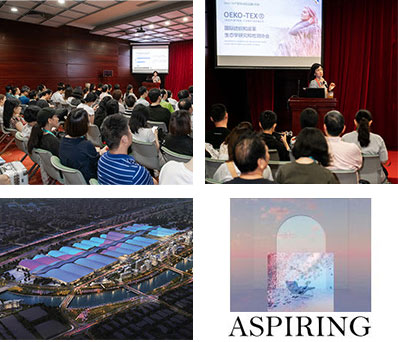
Intertextile Shenzhen 2020 will also host seminars on two themes: Design & Trend and Sustainability. ‘Design & Trend’ seminar will focus on topics such as Key Fashion Trend Forcasting in China, Fabric China Trends 2021/22 AW, Interpretation of Color Trend in 2021/22 AW, Trends of New Fiber Based Yarn 2021/22 AW, Trends of Center Artificial Fur, Trends of Differential and Functional Knitted Fabrics and Trends of Shirt Fabrics.
Sustainability will cover will topics such as sustainable fashion, Green Innovation Practices, Fabric Development Scenario, Interpretation For Sustainable Fashion, Building the Ecosystem of Quick Response Apparel Chain, Material Projection and Quick Response to Overcome the Hard Times, and New Regulations of Eco Passport and Standard 100 by OEKO-TEX in 2020.
Duty free exports to China could boost Bangladesh’s clothing sector
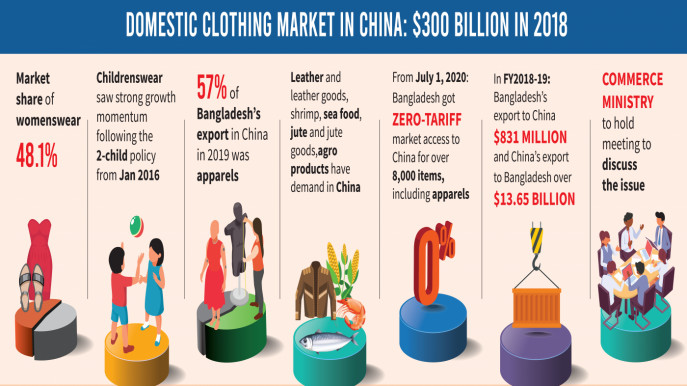 Proving to be a silver lining in dark clouds, China granted duty-free access to all exports from Bangladesh including apparels from July 1. This could help Bangladesh offset losses caused by around 20 per cent decline in its clothing exports this year. Knitwear exporters could benefit more from this due to the condition of 40 per cent local value addition to these exports. To explore this opportunity, Bangladesh needs to develop its manufacturing industries, break away from the limitations of industrial structure, improve the quality of export and shift to higher value-added exports, says Li Jiming, Chinese Ambassador to Bangladesh.
Bangladesh exported over $ 590 million worth of textiles, clothing and accessories to China in 2019. The country has the potential to export more clothing items as its production costs are much lower than those in China.
Product diversification and quality improvement needed
Bangladesh also benefits from abundant jute production. The country is the second-largest producer of jute after India and can sell this raw jute to China and India. This can help it to boost its entrepreneurs and export. According to ATM Azizul Akil, Senior Vice-President, Bangladesh-China Chamber of Commerce and Industry, the duty-free export facility provided by China would help Bangladesh minimize its massive trade deficit. However, to benefit from this, the country first needs to emphasize on product diversification and improving the quality of products. The facility does not benefit 97 per cent of Bangladesh’s products currently.
An alternative market to India
Along with duty export facilities, China has also offered ‘Change of Tariff Heading’ (CTH) facility as an alternative to the condition of 40 per cent value addition. According to this facility, if a shirt is made with imported fabric and with less than 40 per cent value addition by Bangladesh, the duty-free facility will be available under the CTH because the HS code of imported fabric is different from that of shirts, explained Mustofa Abid Khan, Member, Bangladesh Trade and Tariff Commission
As India has imposed various non-tariff barriers including anti-dumping duties on jute imports from Bangladesh, the county has been forced to temporarily suspend its jute exports. In such a scenario, the duty-free access provided by China provides an alternative market for Bangladesh jute exports
Value addition rules cause concern
Given all its benefits, the latest duty-free market access China offers to Bangladesh comes with a condition of 40 per cent value addition by Bangladesh to the product’s price. According to experts, this is a very stringent condition as Bangladesh can add 40 per cent value to only a few items locally. Hence, experts are unsure whether the facility would actually benefit Bangladesh or prove to be a mare’s nest.
Yarn Expo Autumn to feature exhibitors of sustainable products
Yarn Expo Autumn will feature a wide range of exhibitors at its upcoming show who have developed numerous options that cater for a new wave of demand for sustainable products.
To be held from September 23–25, 2020 at the National Exhibition and Convention Center (Shanghai), the expo will give visitors a chance to view a diverse range of raw and recycled products to satisfy consumer demand for a more sustainable industry.
International exhibitors will showcase a wide variety of yarns and fibers made from raw, sustainable materials along with recycled and regenerated products. For example, the Cotton Council International (CCI) will share its sustainability efforts by exhibiting at Yarn Expo, offering buyers quality and traceable fibers from the very beginning of the supply chain.
Yarn Expo Autumn 2020 will be held concurrently with Intertextile Shanghai Apparel Fabrics – Autumn Edition, PH Value and CHIC, providing a concentrated overview of the latest trends and developments in the textile sector, all in one place. Yarn Expo is organized by Messe Frankfurt (HK) and the Sub-Council of Textile Industry, CCPIT.
Uniqlo to report strong sales in June
Japanese casual clothing chain Uniqlo is likely to report strong same-store sales for June, taking the edge off a profit plunge for owner Fast Retailing Co due to store closures and weak demand amid the coronavirus pandemic.
For June, JP Morgan analyst Dairo Murata forecast a 20 per cent–30 per cent jump in the brand’s domestic same-store sales, helped by demand for the company's Airism face masks, which sold out quickly after going on sale that month. Japan began lifting pandemic lockdown measures in late May.
Such a rise, following declines of 57 per cent in April and 18 per cent in May, would be the strongest sign yet of the business recovering, at least in its home market. Stores in China, a key growth market, have also reopened and people are shopping again.
While strong June sales may also highlight the company's relative strength among global fast-fashion peers, helped by its focus on practical clothes and strength in Asian markets, it may be too early to say the worst is past.
US imports of men & boys denim jeans decline in May
The import of men & boys (MB) denim jeans by the US fell drastically in May ’20 both in quantity and value on yearly basis. Shipment was worth 444,155 dozen in quantity and $37.95 million in value during May this year, falling 75 per cent and 77.80 per cent, respectively. As far as monthly decline is concerned in May ’20 over April ’20, total MB jeans import plunged 25.57 per cent in value and 22.60 per cent in quantities. The US’ import of MB denim jeans in April ’20 was valued at $51 million.
The cumulative decline in January-May ’20 period was 38.78 per cent and the import valued at $437.74 million, a $278 million less than what the country had imported in Jan.-May ’19 period. Of all countries, Mexico noted staggering growth of 104.7 per cent in quantity of MB jeans exports to the US in May ’20 over April ’20, while it escalated by 86.17 per cent in value-terms.
Bangladesh was the second largest exporter of MB jeans to the USA with 80,210 dozen shipment worth $5.82, which is a sharp decline of 80.30 per cent and 81.30 per cent, respectively, on yearly basis. Nicaragua registered a Y-o-Y fall of 61.70 per cent in value and 57.40 per cent in quantity, while China tumbled by 80.40 per cent in values and 80.60 per cent in quantity in May ’20 over May ’19. China’s decline was worse than Nicaragua. The CAFTA-DR benefitted country surpassed China to ship $4.10 million worth of MB jeans to the US in May ’20. The shipment value of China stood at just $2.09 million.
Japan’s apparel imports decline by 13.56 per cent
Apparel imports by Japan declined by 13.56 per cent on Y-o-Y basis during the January-May ’20 period. The country imported 1,040.90 billion yen of garments in the period, revealed the Ministry of Finance. Import by weight also declined 11.79 per cent to 2,458 million kg as imports from all major apparel export destinations took a severe hit due to ongoing pandemic situation.
Japan’s apparel imports from Vietnam declined by 0.16 per cent on Y-o-Y basis to 173.13 billion yen while its imports from China declined by 16.45 per cent. Weight-wise Vietnam’s imports declined by 2 per cent to 297.05 million kg while those of China tumbled by 13.86 per cent on yearly basis to 1,635.83 million kg. India’s apparel shipment to Japan in the mentioned period declined by 31.91 per cent and valued at 12.61 billion yen (US $ 117.36 million). Also, the weight of shipment shrunk 29.41 per cent to 22.58 million kg. Shipments from Bangladesh fell by 13.89 per cent to at 48.98 billion yen. The weight of apparel shipments also decreased 15.41 per cent to 109.31 million kg.
Indonesia: Diversification of global supply chain to benefit Indonesia: DBS Group
At a virtual media briefing, John Laurens, Head-Global Transaction Services, DBS Group stated that Indonesia will benefit from the diversification of global supply chains as multinational companies are looking into ways to reduce reliance on China to manufacture their supplies following the outbreak of COVID-19. Lauren said companies will continue to diversify to low-cost markets like Vietnam, Bangladesh, India, Indonesia, as the pandemic has severely disrupted the global supply chains. It has also made some companies question their heavy reliance on China, while China’s ongoing trade war with the US has also burdened the industries with additional tariffs.
Taking advantage of this situation, Indonesian government has established a special task force to attract businesses leaving China and facilitate their relocation to Indonesia. On June 30, President Jokowi Widodo announced seven foreign companies had confirmed plans to relocate production facilities, mostly from China, to Indonesia. He added that 17 more were looking into opening facilities in the country. The relocation of seven companies is projected to bring $850 million to Indonesia while potentially employing around 30,000 workers, based on the Investment Coordinating Board’s (BKPM) estimates.











